Banking
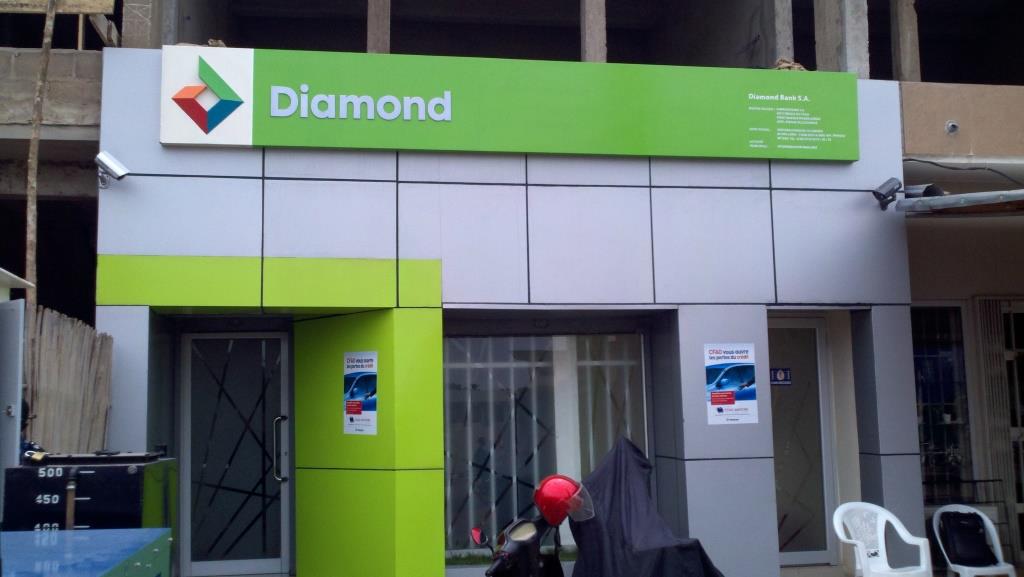
Diamond Bank Shareholder Loses N21b
By Dipo Olowookere
There are strong indications that one of the major shareholders in Diamond Bank Plc, a financial institution on the Nigerian Stock Exchange (NSE), may eventually lose up to N20.6 billion or $67.2 million of its investment in the local lender.
Diamond Bank has been struggling lately and there are fears that it could go the way of defunct Skye Bank Plc, which had its operating licence revoked by the Central Bank of Nigeria (CBN) in September 2018 for low capital base.
Four years ago, an American firm believed to be the world’s largest private equity group, Carlyle Group, invested heavily in Diamond Bank.
At the time, Diamond Bank organized an operation to raise N50 billion (about $303 million at the exchange rate of N165 for $1 at that time), with Carlyle then acquiring about 4.16 billion shares at N5.80k each (at about N24.1 billion or $146.2 million), becoming the leading individual shareholder in the bank with 17.7 percent of the shares.
But today, with exchange rate at about N306 at the interbank segment of the foreign exchange market, Diamond Bank is only worth 86 kobo per share.
Business Post reports that Carlyle Group has already lost N4.94k per share of its investment in Diamond Bank, resulting in a total of N20.6 billion or $67.2 million.
At the present market value, Carlyle’s participation in Diamond Bank is worth about $11.7 million because the share’s prices never exceeded purchase price and yield per share has been negative.
Instead of the awaited expansion, Diamond Bank sold some of its operations in the West African region, Nigeria excluded, and, its profit kept falling. From N1.43 net profit per share in 2014, it fell to N0.36 due notably to a significant drop in trading revenues and there are fears already that the 2018 financial year could follow the same trend.
Indeed, even though trading revenues are important once again, they are negatively affected by a fall in the net interest margin at the end of the first nine months of 2018.
“Carlyle is very pleased to join the Diamond Bank Group as an investor. Diamond Bank is one of the most recognised retail banks in Nigeria, with a strong corporate culture, best-in-class management team, advanced technology, large retail franchise, and innovative product and service offerings,” Managing Director and Head of West Africa for the Carlyle Sub-Saharan Africa Fund which was the investment vehicle at the time, Geneviève Sangudi, had said four years ago when the firm keyed into the Diamond Bank dream.
But according to Ecofin Agency, things never went as planned for Carlyle Group because of the fall in oil prices and Diamond Bank was already suffering from an important volume of bad debts, which continued to lose value.
A solution: quickly find foreign investors to support the group
In such conditions, Diamond Bank cannot rely on its shareholders and is thus obliged to quickly find a solution to settle an important part of its international bonds that will mature in May 2019 and this is a great challenge since its liquid assets in foreign currency represents 25 percent of the $200 million Eurobond to be settled.
Recently, Moody’s downgraded Diamond Bank’s issuer rating from caa1 to caa3 due to two main reasons; first, there is a great volume of bad debts that the bank is not really able to solve yet; from 42 percent in December 2017, it lost two percent points at the end of the third quarter of 2018 to reach 40 percent.
Secondly, important members of its board resigned, signalling internal management problems. Moody’s thinks that this could impact the effort required to solve the bank’s bad debt problems (of which only 20 percent are sufficiently covered).
On November 23, 2018, Diamond Bank’s share gained 7.6 percent points after a week of value loss. It started the week of November 26, 2018, with a loss of 1.26 percent in value.
At the moment, Diamond Bank has a total of 23.1 million shares outstanding and an EPS of -70 kobo.
Banking
Ecobank, DHL Organise Programme to Unlock Fresh Possibilities for SMEs
By Modupe Gbadeyanka
Some entrepreneurs across diverse sectors recently completed a three‑week intensive capacity‑building programme organised by Ecobank Nigeria, in partnership with DHL.
The event was put together to equip Small and Medium Enterprises (SMEs) with the skills, tools, and insights required to scale beyond local markets and compete globally.
The focus was on critical growth enablers such as cross‑border trade, e‑commerce opportunities, logistics, customs procedures, and international shipping—key pillars for sustainable expansion in today’s increasingly connected global marketplace.
In one of the sessions, titled Trade and Grow Beyond Borders: Welcome to E‑commerce, the Relationship Channel Manager for DHL Customers/Global Express, Mr Charles Eke, underscored logistics as a critical success factor for SMEs, identifying key challenges such as access to finance, markets, and efficient logistics.
He also provided practical guidance on customs processes, international shipping, documentation, and shipment tracking, while emphasising the immense opportunities e‑commerce presents for cross‑border expansion.
According to him, international markets often offer greater growth potential than domestic markets for well‑positioned SMEs.
The Head of SMEs, Partnerships and Collaborations at Ecobank Nigeria, Mrs Omoboye Odu, described the programme as a catalyst for meaningful growth and mindset change.
“Over the past three weeks, something truly powerful has taken place. This programme has gone far beyond knowledge sharing—it has inspired new thinking and unlocked fresh possibilities for our SMEs. The message is clear: no business should be limited by geography,” she said.
Mrs Odu reiterated Ecobank’s deliberate focus on SMEs as key drivers of Africa’s economic development, saying, “Beyond building capacity, we are intentionally opening doors by connecting businesses to new markets and opportunities. With our presence in over 30 African countries, coupled with integrated payment, trade finance, and e‑commerce solutions, Ecobank is uniquely positioned as the Pan‑African bank enabling seamless cross‑border trade.”
One of the participants, Ms Dolapo Fatoki of Debsfray, a Lagos-based fashion brand, described the initiative as impactful, practical, and transformative.
“The sessions were highly informative. I gained a deeper understanding of documentation and pricing, two areas that previously posed major challenges for me. The collaboration between DHL and Ecobank has been exceptional and truly beneficial,” she noted.
Similarly, the Creative Director of FC Accessories, Mr Tosin Olukuade, described the programme as “an eye‑opener,” adding that it reshaped his approach to business growth.
“The insights I gained will help me scale my business exponentially. I am grateful to Ecobank and DHL for creating this opportunity,” he said.
Reflecting on the programme’s digital focus, the chief executive of Needle Point, Mrs Theresa Onwuka, highlighted how the sessions broadened her outlook on growth and innovation.
“The class was so good—it got my mind thinking of possibilities. My main takeaway is clear: digitalisation is the way forward,” she remarked.
Banking
Banks to Submit Monthly Reports on Failed Digital Transactions
By Adedapo Adesanya
The Central Bank of Nigeria (CBN) has directed banks and other financial institutions to submit monthly reports on failed electronic transactions across digital channels, as part of new compliance measures introduced in its revised Guide to Charges.
The directive was contained in a circular titled Exposure Draft of the Guide to Charges by Banks and Other Financial Institutions in Nigeria, 2026 (The Guide) and signed by the Director of the Financial Policy and Regulation Department, Mrs Rita Sike.
According to the apex bank, Chief Compliance Officers and Heads of Information Technology in financial institutions are required to jointly render electronic reports of all failed transactions conducted via Automated Teller Machines, Point of Sale terminals, mobile channels, web platforms, and other electronic systems.
The circular read, “The Chief Compliance Officer and Head Information Technology shall jointly render monthly reports electronically, of all failed electronic transactions via various e-channels (ATM, PoS, mobile, web/internet and related channels) that originate or terminate in the institution.”
The reports are to be submitted to designated CBN email addresses, reinforcing the regulator’s push for stricter monitoring of service failures across the banking system.
Beyond the reporting requirement, the CBN also introduced broader accountability measures, placing responsibility on top management of financial institutions to ensure strict adherence to the new guide.
Executive Compliance Officers or Managing Directors are mandated to cascade compliance expectations across all business units and ensure that banking systems are configured to apply only approved charges.
Specifically, the regulator directed that Heads of Information Technology must ensure that “all systems configurations only capture and allow posting of charges as permitted and described in this Guide,” while Chief Compliance Officers are to monitor strict compliance with the framework.
The revised guide, effective May 1, 2026, replaces the 2020 version and provides a comprehensive framework for charges across banking and other financial services.
The CBN explained that the review was aimed at promoting a safe and sound financial system, encouraging innovation, and expanding financial inclusion through lower tariffs on micropayments and transactions.
It added that the revised framework would strengthen oversight and accountability, encourage the adoption of electronic payment channels, and accommodate new industry participants.
Business Post also reported that the regulator has raised ATM card fees by 50 per cent to N1,500 and scrapped the monthly maintenance charge.
Banking
CBN Proposes N1,500 ATM Card Fee, N150 e-Dividend Mandate Processing Fee
By Aduragbemi Omiyale
The Central Bank of Nigeria (CBN) has proposed that financial institutions operating in the country should charge N150 for the e-dividend mandate processing fee from May 1, 2026.
This was contained in the latest Guide to Charges by Banks and Other Financial Institutions in Nigeria, signed by the Director of the Financial Policy and Regulation Department of the CBN, Ms Rita Sikе.
The move is to promote a safe and sound financial system in Nigeria, accelerate the adoption of innovative financial services, financial inclusion and micropayments/transactions.
The reviewed guide, according to the central bank, provides for an increased range of financial services, encourages development of innovative products, strengthens responsibility for oversight and accountability and promotes financial inclusion through lower tariffs for micropayments/transactions.
It also reviewed some charges for banking services to encourage increased adoption of electronic channels and accommodate new industry participants since the issuance of the 2020 guide.
“In view of the above, the draft guide is hereby exposed to members of the public for their comments/input on the proposed fees contained therein. Comments are to be sent to [email protected] on or before May 08, 2026,” a part of the note stated.
In the draft, the banking sector regulator is suggesting the payment of N1,500 for local debit card issuance and replacement by customers and a $10 annual fee for foreign currency-denominated debit/credit cards.
For on-site ATM transactions, a charge of N100 per N20,000 withdrawal was proposed and N100 plus a surcharge of not more than N500 per N20,000 withdrawal. It emphasised that the surcharge, which is an income of the ATM deployer/acquirer, shall be disclosed at the point of withdrawal to the consumer.
The bank also said that for electronic fund transfers below N5,000, no fee would be collected, but from N5,000 to N50,000, customers would part with N10, and for transfers above N50,000, the fee of N50 would be paid, while for microfinance banks, there would be the settlement bank’s charge plus 10 per cent of the charge.
The CBN noted that this guide applies to commercial banks, merchant banks, Payment Service Banks (PSBs), non-interest banks, microfinance banks, finance companies, Primary Mortgage Banks (PMBs), Development Finance Institutions (DFIs), credit guarantee companies, Mobile Money Operators (MMOs), and any other institution as may be designated by it.
-
Feature/OPED6 years agoDavos was Different this year
-
Travel/Tourism10 years ago
Lagos Seals Western Lodge Hotel In Ikorodu
-
Showbiz3 years agoEstranged Lover Releases Videos of Empress Njamah Bathing
-
Banking8 years agoSort Codes of GTBank Branches in Nigeria
-
Economy3 years agoSubsidy Removal: CNG at N130 Per Litre Cheaper Than Petrol—IPMAN
-
Banking3 years agoSort Codes of UBA Branches in Nigeria
-
Banking3 years agoFirst Bank Announces Planned Downtime
-
Sports3 years agoHighest Paid Nigerian Footballer – How Much Do Nigerian Footballers Earn