
Economy
Chinese Firm Builds $50m Manufacturing Hub in Lagos

By Dipo Olowookere
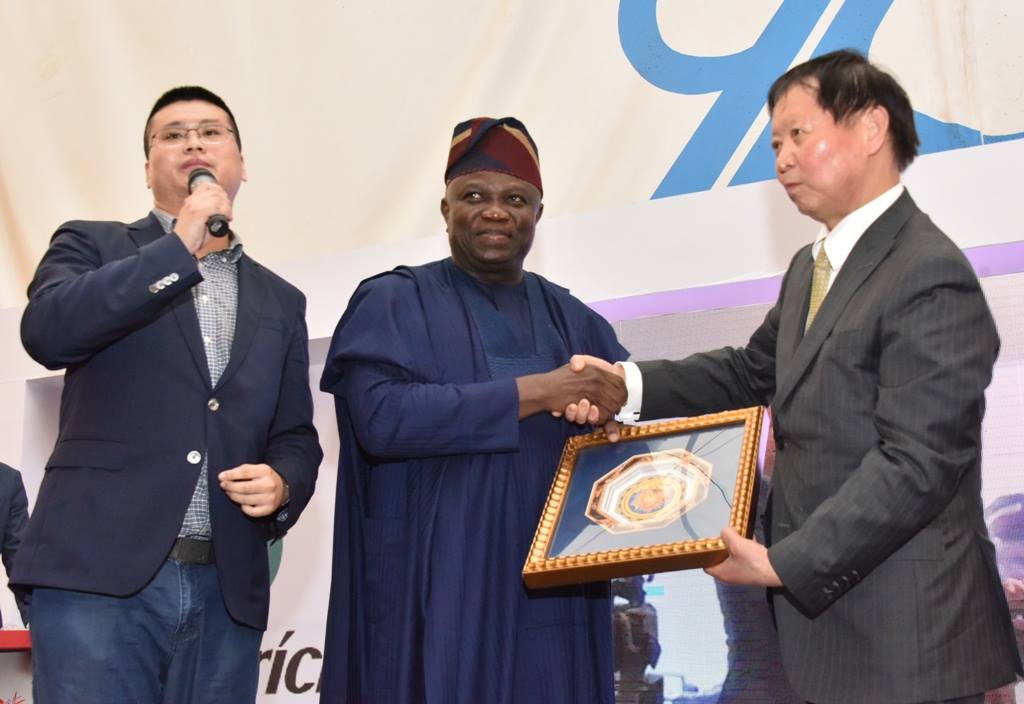
A manufacturing hub believed to gulp about $50 million has been constructed by a Chinese company known as Longrich in the Lekki Free Zone of Lagos State
On Sunday, Lagos State Governor, Mr Akinwunmi Ambode, performed the pre-launch of the facility, expressing optimism that the facility would go a long way to create jobs and boost the nation’s foreign exchange earnings.
Mr Ambode said the facility was another success story of the efforts of his administration to attract investment as well as an eloquent confirmation of the strategic importance of the free trade zone to the state’s economy.
He said a total of 25 companies were presently setting up manufacturing plants within the zone, saying it was indeed gratifying that the efforts to drive investments were yielding positive results.
The Governor disclosed that the most important thing to him was that whether in government or outside of government, factories were springing up in the zone, thereby creating job opportunities for the people and improving the economy of the State.
According to the Governor, “One of the most fulfilling feelings in life is to see one’s efforts yield positive results. It gives me immense satisfaction to be here today to witness this Pre-Launching Ceremony of Longrich Nigeria Manufacturing Plant to be located in the Lekki Free Zone in Lagos State, Nigeria.
“At the inception of this administration, one of our core focus areas was attracting investments to our State; to create employment for our people and wealth for our investors. Today’s event is one of those crowning moments that confirm that our efforts have been rewarded.”
Governor Ambode particularly commended Longrich Group of Companies for the decision to site the $50 million factory in Lagos of all the cities and countries in Africa, saying the State and the country stand to benefit immensely from the investment.
“I have been informed that this Lekki Longrich facility, upon completion, would not only be the hub for the distribution of the products to the African sub-region but would provide employment for at least 1,000 new workers in our State and boost the nation’s foreign exchange earnings from exportation of manufactured products to other African Countries.
“If we go by the success story of Longrich in China and the company’s track record, there is no doubt that Longrich Nigeria would be modelled after the world-class LONGLIQI Bio-Industrial Park in China which covers an area of more than 133 hectares and serves as location of LONGLIQI Bio-Science Co., Ltd,” Governor Ambode said.
While describing the firm as a global brand with range of top class quality products and unique business model, the Governor also lauded the fact that Longrich had created wealth for over 500,000 people who are trading in more than thirty brands of the company, with the majority of the traders residing in the state.
Besides, Governor Ambode assured that the state government would continue to play its role as business enablers, especially by providing the necessary infrastructure and services required to support all investors and businesses who decide to make Lagos their home.
“Our administration has embarked on massive and ambitious projects. We have introduced public sector reforms and policies aimed at making it easier to do business in our State.
“Our governmental institutions like the Ministry of Commerce, Industry and Cooperatives, Office of Public Private Partnership and Office of Overseas Affairs and Investment (Lagos Global) are, more than ever before, in the fore front of providing an enabling business environment for local and foreign investments to thrive.
“These are just a few indicators to assure you of our commitment to securing not just Longrich’s investment in the South-West quadrant of Lekki Free Zone but to secure and attract more investments to our State,” he said.
The Governor, who described the Lekki Free Zone as the flagship of the state government’s industrial development drive, said aside the physical amenities, the facility also comes with a bundle of incentives that propel business prosperity.
He added that with the ongoing gas pipeline laying to the zone nearing completion, power generation costs, which accounts for significant production cost, would soon be significantly reduced, just as he reiterated the commitment of the State Government to sustain the business environment and protect all investments in the State.
Earlier, Chairman of Longrich, Mr Xu Zhiwei commended Governor Ambode for creating the enabling environment for businesses to thrive in the State, saying it was on record that the Governor’s efforts made the setting up of the factory which would fully take off in October, 2019 possible.
“I want to thank Governor Ambode. He gave us the enabling environment; he gave us the full support; he embraced our dreams and believe in us. We can also feel the safety and security in Lagos State,” Zhiwei said.



By Adedapo Adesanya
The NASD Over-the-Counter (OTC) Securities Exchange declined by 2.14 per cent on Monday, March 30, weakening the Unlisted Security Index (NSI) by 89.95 points to 4,109.74 points from 4,199.69 points.
During the session, investors lost N53.82 billion, leaving the market capitalisation of the trading platform at N2.458 trillion versus the previous session’s N2.512 trillion.
The bourse recorded four price gainers and four price losers led by 11 Plc, which shed N35.12 to close at N316.50 per share compared with last Friday’s value of N351.17 per share. MRS Oil Plc declined by N20.00 to quote at N190.00 per unit versus the previous price of N21o.00 per unit, FrieslandCampina Wamco Nigeria Plc dropped N11.00 to trade at N99.00 per share versus N110.00 per share, and Central Securities Clearing System (CSCS) Plc dipped N2.93 to N77.17 per unit from N80.10 per unit.
Conversely, IPWA Plc appreciated by 55 Kobo to N6.06 per share from N5.51 per share, Industrial and General Insurance (IGI) Plc expanded by 5 Kobo to 57 Kobo per unit from 52 Kobo per unit, Geo-Fluids Plc gained 4 Kobo to close at N3.22 per share versus N3.18 per share, and Acorn Petroleum Plc improved by 1 Kobo to N1.34 per unit from N1.33 per unit.
Trading data revealed a decline of 63.7 per cent in the volume of securities to 21.3 million units from 58.6 million units, a 59.6 per cent drop in the value of securities to N651.1 million from N1.6 billion, and a 24 per cent contraction in the number of deals to 38 deals from 50 deals.
The most active stock by value on a year-to-date basis was CSCS Plc with 56.3 million units exchanged for N3.8 billion, trailed by Okitipupa Plc with 27.5 million units traded for N1.8 billion, and Infrastructure Guarantee Credit Plc with 400 million units valued at N1.2 billion.
Resourcery Plc was the most traded stock by volume on a year-to-date basis with 1.1 billion units worth N415.7 million, followed by Infrastructure Guarantee Credit Plc with 400 million units sold for N1.2 billion, and Geo-Fluids Plc with 133.1 million units transacted for N511.2 million.
By Dipo Olowookere
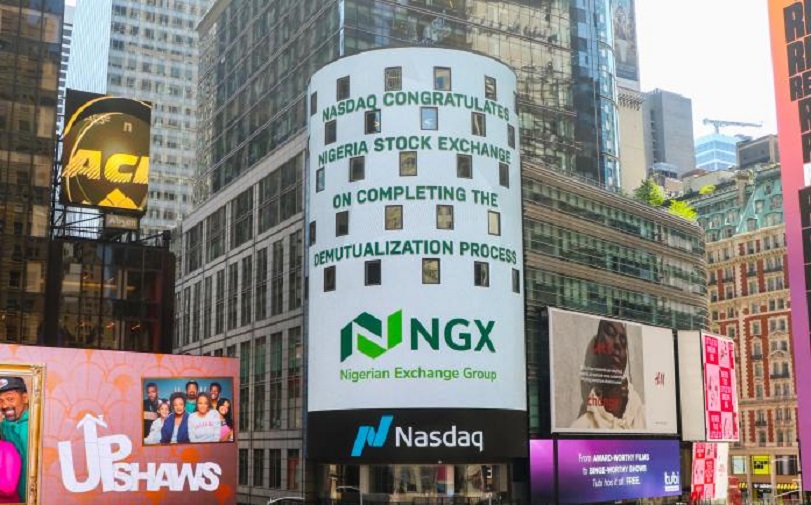
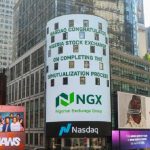
The Nigerian Exchange (NGX) Limited began the new week bearish after it shed 0.21 per cent on Monday due to profit-taking.
Business Post reports that four of the five key sectors of Customs Street tracked pointed southwards yesterday, as only the energy index gained 0.10 per cent.
The insurance counter lost 1.38 per cent, the banking space depreciated by 0.81 per cent, the industrial goods sector weakened by 0.45 per cent, and the consumer goods segment declined by 0.02 per cent.
As a result, the All-Share Index (ASI) retreated by 428.63 points to 200,484.43 points from 200,913.06 points, and the market capitalisation moderated by N275 billion to N128.694 trillion from N128.969 trillion.
The market breadth index was negative during the session, as there were 27 price gainers and 34 price losers, representing weak investor sentiment.
Secure Electronic Technology depreciated by 10.00 per cent to N1.17, May and Baker slumped by 9.42 per cent to N38.00, Legend Internet tumbled by 8.67 per cent to N6.85, Cutix shrank by 8.29 per cent to N3.21, and Fortis Global Insurance lost 7.97 per cent to trade at N1.27.
On the flip side, Austin Laz appreciated by 9.98 per cent to N4.41, Zichis gained 9.93 per cent to quote at N15.16, Trans Nationwide Express soared by 9.65 per cent to N2.84, The Initiates advanced by 9.60 per cent to N21.70, and Learn Africa improved by 9.41 per cent to N9.30.
The bourse closed with a turnover of 593.3 million shares valued at N25.7 billion executed in 60,311 deals compared with the 595.2 million shares worth N24.5 billion traded in 43,440 deals in the previous trading day.
This showed that the value of transactions went up by 4.90 per cent, the number of deals increased by 38.84 per cent, and the volume of trades decreased by 0.32 per cent.
Access Holdings finished the session as the most active with 86.6 million units sold for N2.3 billion, First Holdco exchanged 84.6 million units worth N4.3 billion, Secure Electronic Technology traded 31.1 million units valued at N37.4 million, Fidelity Bank transacted 26.7 million units worth N512.4 million, and Zenith Bank traded 26.1 million units valued at N2.6 billion.
By Adedapo Adesanya
The first trading session for the Naira in the Nigerian Autonomous Foreign Exchange Market (NAFEX) ended on a negative note, as it lost N3.00 or 0.22 per cent against the Dollar on Monday, March 30, to trade at N1,383.58/$1 compared with last Friday’s closing price of N1,380.58/$1.
The local currency remains under pressure as increased demand for forex for international settlements and import-related obligations continue t0 strain available FX supply.
Last week, the Central Bank of Nigeria (CBN) shed the policy requiring International Oil Companies (IOCs) to keep half of their export proceeds in Nigeria and allowed them to fully access their funds. Market analysts noted that this could reduce the dollar supply, putting pressure on the nation’s legal tender whenever outflows exceed inflows.
The country’s external reserves recorded a marginal decline, falling by 0.7 per cent to $49.48 billion, reflecting a depletion of about $350 million and signalling continued pressure on Nigeria’s FX buffer.
However, the Nigerian currency further appreciated against the Pound Sterling in the official market during the session by N12.05 to N1,824.94/£1 from N1,836.99/£1, and gained N5.80 against the Euro to sell at N1,586.28/€1 versus N1,592.08/€1.
Equally, at the GTBank forex desk, the Naira improved its value against the greenback yesterday by N7 to N1,394/$1 from N1,401/$1, and remained unchanged at the parallel market at N1,410/$1.
As for the cryptocurrency market, it was mixed even as Federal Reserve Chairman Jerome Powell eased any concerns about imminent rate hikes.
The central banker said the lender is inclined to look past the Iran-related energy shock for now and hold rates steady, adding that the US central bank — for the moment — is looking past short-term oil price shocks and focusing on inflation expectations that remain “well anchored.” As a result, bond yields fell, but oil continued its rise, ultimately pressuring the stock market and crypto.
Solana (SOL) gained 1.1 per cent to sell at $82.68, Ethereum (ETH) appreciated by 1.0 per cent to $2,021.66, Cardano (ADA) grew by 1.0 per cent to $0.2431, Ripple (XRP) jumped 0.2 per cent to $1.32, and Bitcoin (BTC) added 0.1 per cent to settle at $66,568.25.
However, TRON (TRX) dipped 1.0 per cent to $0.3199, Dogecoin (DOGE) went down by 0.2 per cent to $0.0909, and Binance Coin (BNB) dropped 0.1 per cent to $609.25, while the US Dollar Tether (USDT) and the US Dollar Coin (USDC) closed flat at $1.00 each.







-
 Feature/OPED6 years ago
Davos was Different this year
-
Travel/Tourism10 years ago
Lagos Seals Western Lodge Hotel In Ikorodu
-

 Showbiz3 years ago
Estranged Lover Releases Videos of Empress Njamah Bathing
-
 Banking8 years ago
Sort Codes of GTBank Branches in Nigeria
-

 Economy3 years ago
Subsidy Removal: CNG at N130 Per Litre Cheaper Than Petrol—IPMAN
-

 Banking3 years ago
Sort Codes of UBA Branches in Nigeria
-

 Banking3 years ago
First Bank Announces Planned Downtime
-

 Sports3 years ago
Highest Paid Nigerian Footballer – How Much Do Nigerian Footballers Earn