

Economy
Investment Opportunities for Retail Investors


By FSDH Research
There are now investment products in the Nigerian financial market for all Nigerians, irrespective of their income level. Opening an investment account is now easier than ever, after meeting the basic regulatory Know Your Customer (KYC) requirements.
In fact, in some cases, it could be as simple as A, B, C. Technology has made the process of transferring money into an investment account easy, simple and convenient. Since direct cash payments into investment accounts are not allowed in all cases, investors can now transfer money into their investment accounts through their phones and other convenient online platforms.
A mutual fund is an instrument that creates investment opportunities for retail investors in Nigeria. So instead of stacking your hard-earned money in a place where it does not increase in value, why not commit to a mutual fund and let your money start working for you, even when you are sleeping.
Mutual funds provide retail investors with an opportunity not only to preserve their wealth, but to grow their money. They are similar to the ‘esusu’, ‘ajo’ or ‘adashe’ systems prevalent in Nigeria where a group of people contribute monies on a regular basis to a common purse, usually managed by the leader.
After a specified period, say a week or a month, each person gets back his or her money after paying some sort of commission to the manager. Mutual funds are also similar to piggy banks, which are used to encourage savings amongst both children and adults.
However, mutual funds are better than these forms of savings because the managers of these funds invest the money paid into mutual funds accounts to generate additional income. The fund managers pool funds from various individuals and invest them in financial securities such as Nigerian Treasury Bills, Government Bonds, Commercial Papers, Real Estate and Stocks and Commodities.
In addition, mutual funds offer other benefits to the retail investor. Investors benefit from lower transaction costs. Since knowledgeable and experienced fund managers manage the fund, retail investors can sleep with both eyes closed. The fund managers make the ‘what’, ‘when’ and ‘why’ investment decisions on behalf of the investors in a bid to protect investment and earn the maximum return possible. Fund managers decide what security to invest in, when to do so and why.
From a national perspective, the monies from mutual funds could help to increase savings level in Nigeria, which is currently low compared to other countries. Investment in mutual funds is also a way to provide both short-term and long-term capital for companies and government to expand operations and improve infrastructure. This would help increase production, employment and consumption, and stimulate the economy.
Government would also be able to generate greater revenue through taxes on businesses.
In Nigeria, the Securities and Exchange Commission (SEC) regulates mutual funds operations and the professionals that are involved in them.
Most mutual funds are open-ended investment schemes: new investors can buy additional units at any time. The fund managers are also able to provide active liquidity by buying units from existing investors who want to sell units for cash.
Mutual funds offer investors an opportunity to diversify their investment portfolio. The existence of a Trustee and Custodian to a mutual fund ensures the safety of investments, as the Trustee ensures that the fund is managed in line with approved investment guidelines, while the Custodian holds the fund assets in safe custody.
The mutual fund assets in Nigeria have grown significantly in the last five years, an indication of the growing interest in this class of investment.
Data from the SEC on the Net Asset Value (NAV) of all registered mutual funds in Nigeria shows that the collective NAV grew by 328% between 18 April 2014 and 18 April 2019. This translates to a Compound Annual Growth Rate (CAGR) of 34% between this period.
Despite the impressive growth rate, FSDH Research notes that there is significant room for growth in mutual fund assets as we estimate the ratio of mutual funds to the country’s Gross Domestic Product (GDP) to be 0.57%.
FSDH Research notes, however, that mutual funds need more support than is currently available to enable potential investors to fulfil their wealth creation and developmental goals. Government, regulators and the operators in investment management need to provide mutual funds additional support. Government should intensify its efforts at improving the business environment. This will lead to job creation in the country, consequently reducing unemployment, increase savings and investable funds. Regulators could promote innovative legislation to increase investment in mutual funds and expand investment channels to increase returns on the funds invested.
The Fund Managers Association of Nigeria (FMAN) should continue to create public awareness on the benefits of mutual funds in order to generate interest from the investing public.










By Aduragbemi Omiyale
Leading manufacturer of personal healthcare products and consumer goods, PZ Cussons Plc, recorded a 22 per cent growth in its revenue in the 2026 fiscal year.
In its unaudited results recently submitted to the Nigerian Exchange (NGX) Limited, the company posted revenue of N260.46 billion in the period under review compared with the N212.63 billion achieved in the corresponding period in 2025.
This revenue growth was buoyed by market share gains for its major brands, increased household penetration and robust volume uplift, according to the chief executive of PZ Cussons, Mr Oghale Elueni.
It was observed that the cost of sales as a percentage of revenue was 72 per cent, 100bps lower than the prior year, driven by better mix and supply efficiencies.
Marketing and distribution expenses increased by 48.2 per cent to N26.51 billion from N17.89 billion, and administrative expenses also spiked by 43 per cent to N21.07 billion from N14.70 billion.
Also, the organisation recorded significant profitability for the year ended May 31, 2026, rising by 388 per cent to N49.10 billion from N10.07 billion.
Mr Elueni attributed this strong performance to the strength of the business, the equity of the brands, and the discipline of execution, noting that despite the complex and consistently challenging operating environment, the company pulled through to deliver growth in both revenue and profit.
He disclosed that the 22 per cent revenue growth recorded for the 2026 financial year was influenced by a healthy mix of volume and price initiatives.
“The balance sheet was further de-leveraged and strengthened through a cash-accretive P&L and efficient working capital management. The impact has been an improvement in the net asset position from N17.3 billion negative at the beginning of the year to N70.6 billion at year-end.
“The business grew volumes in both the electrical and consumer business, leveraging investment in our brands and sharpening our go-to-market capabilities. The result has been market share gains for our major brands, increased household penetration and robust volume uplift, contributing to overall revenue growth,” he stated.
Mr Elueni expressed profound appreciation to the shareholders for their unwavering support in navigating through the challenges in the last 12 months, noting that the board remains confident that, despite geopolitical uncertainties and their attendant economic shocks, the business is sufficiently resourced to deliver value to stakeholders.
“We have a business that has strong brands, an adaptive operating framework and a culture of disciplined execution that supports the consistent delivery of value to stakeholders,” he stated.


By Adedapo Adesanya
Nigeria’s crude oil production increased in May and June, according to data published by the Organisation of the Petroleum Exporting Countries (OPEC).
The country’s output increased by 42,000 barrels per day to 1,530 million barrels in May, from 1,489 million barrels in April.
According to Reuters, Nigeria, whose shipments were not affected by the Iran war, also pumped more in June, based on flow data from financial group LSEG, information from other companies that track flows, such as Kpler, and data provided by sources at oil companies, OPEC, and consultants.
Output from the OPEC rose by 2.34 million barrels a day to 18.75 million a day, with the gains driven by Kuwait, Saudi Arabia and Iran, the survey showed. The rebound still leaves production considerably below prewar levels.
Kuwait posted the biggest increase among OPEC’s 11 members last month, boosting output by 870,000 barrels a day to 1.36 million a day followed by Saudi Arabia, which raised output by 550,000 barrels a day to an average of 7.2 million a day. That was followed by Iran, which hiked by 510,000 a day to pump 2.85 million a day, and has accumulated a hoard of supply on tankers at sea as it struggles to find buyers.
In the wider alliance, Russia has bolstered crude exports to record levels following Ukrainian strikes on its refineries, potentially diverting volumes that can’t be processed at home.
Even before the peace deal, Persian Gulf producers had found ways to sneak cargoes out through the strait, which was largely shuttered in the early stages of the conflict.
The uptick in supply is creating a surplus in parts of the market, erasing crude’s wartime rally and raising the question of whether OPEC nations will need to compete for customers.
The group’s June production was still 7.3 million barrels a day, or 28 per cent, below February levels, when adjusted for exit by the United Arab Emirates (UAE).
The UAE quit OPEC in May, giving it the freedom to pump at will once the strait fully stabilises. Iraq also briefly threatened it could exit unless eventually given a higher output quota by the organisation.
On Sunday, a subgroup of seven OPEC+ nations announced a 188,000 barrels a day boost in August continuing the series of small and symbolic production hikes during the war to continue a process of restoring output halted a few years ago.
By Adedapo Adesanya
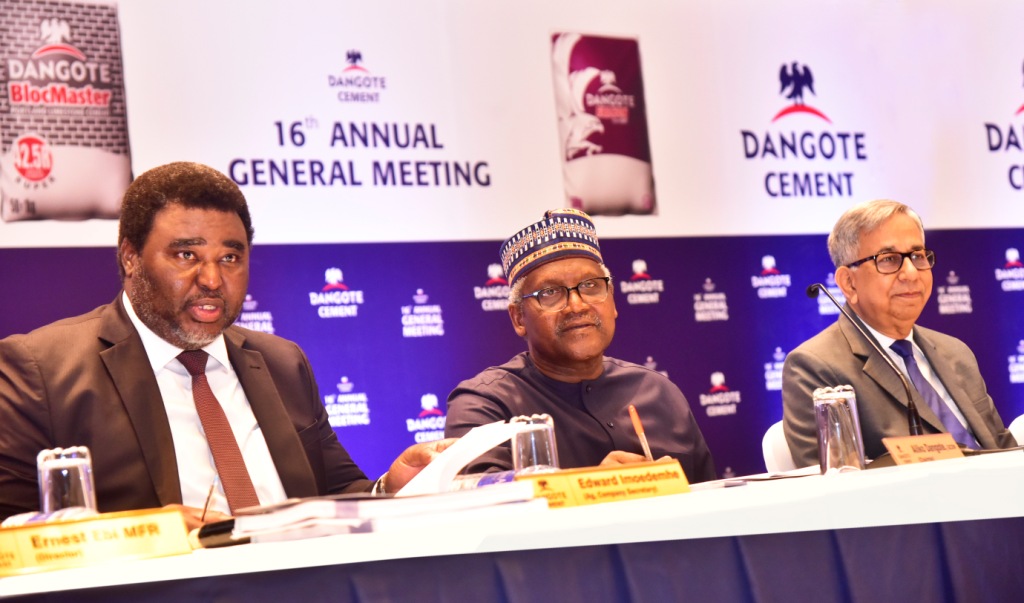
Shareholders of Dangote Cement Plc have approved plans that could pave the way for the company’s secondary listing on the London Stock Exchange (LSE) while also endorsing a final dividend of N45.00 per ordinary share for the 2025 financial year.
The resolutions were passed at the company’s 17th Annual General Meeting (AGM) held on Thursday at Eko Hotels & Suites in Lagos, where shareholders also approved the audited financial statements for the year ended December 31, 2025.
The approval for an international secondary listing marks a significant step in Dangote Cement’s plans to broaden its access to global capital markets and enhance its international investor base.
In May, the company’s founder Mr Aliko Dangote said the cement subsidiary was planning a London listing to sell 10 per cent stake, sixteen years after debuting on the Nigerian Exchange (NGX) Limited. This would provide the company with the much-needed boost to compete in the United Kingdom market.
Shareholders also ratified the payment of a final dividend of N45.00 per ordinary share from the company’s retained earnings as of December 31, 2025. The dividend was paid on Thursday, July 2, 2026.
At the meeting, shareholders approved the appointment of Ms Mariya Aliko-Dangote to the company’s board of directors. In recent months, the eldest daughter of the billionaire as well as her sisters Halima and Fatima, have been strategically positioned across their father’s empire in what has been touted as succession plans.
They also re-elected four directors retiring by rotation: Mr Emmanuel Ikazoboh, an Independent Non-Executive Director; Mr Olakunle Alake, a Non-Executive Director; Ms Berlina Moroole, a Non-Executive Director; and Mr Alvaro Poncioni Merian, an Independent Non-Executive Director.
In addition, shareholders authorised the board to determine the remuneration of the company’s external auditors for the 2026 financial year.
The AGM also noted the disclosure of managers’ remuneration in compliance with the provisions of the Companies and Allied Matters Act (CAMA) 2020.
Shareholders further approved the election of Mr Robert Ade-Odiachi, Mr Sheriff Yussuf Mojirola and Mr Nicholas Nyamali as shareholders’ representatives on the Statutory Audit Committee. They will serve alongside the company’s representatives, Mr Ernest Ebi and Mr Olakunle Alake, until the next AGM.
They also approved annual remuneration of N20 million for the chairman and N15 million each for the non-executive directors for the financial year ending December 31, 2026.

-
 Feature/OPED6 years ago
Davos was Different this year
-
Travel/Tourism10 years ago
Lagos Seals Western Lodge Hotel In Ikorodu
-

 Showbiz4 years ago
Estranged Lover Releases Videos of Empress Njamah Bathing
-
 Banking8 years ago
Sort Codes of GTBank Branches in Nigeria
-

 Economy3 years ago
Subsidy Removal: CNG at N130 Per Litre Cheaper Than Petrol—IPMAN
-

 Banking3 years ago
Sort Codes of UBA Branches in Nigeria
-

 Banking3 years ago
First Bank Announces Planned Downtime
-

 Sports3 years ago
Highest Paid Nigerian Footballer – How Much Do Nigerian Footballers Earn