

Economy
Japaul Operations Under Serious Threat

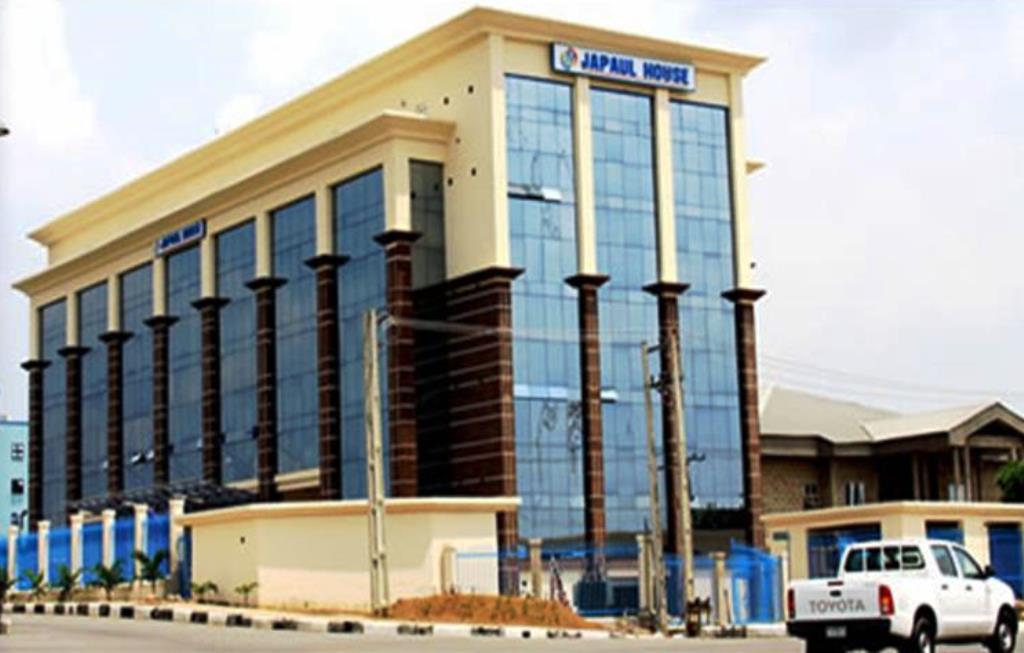
**As Access Bank Gets Court Order to Seize Properties
By Dipo Olowookere
If urgent steps are not taken, Japaul Oil & Maritime Services Plc, one of the companies listed on the Nigerian Stock Exchange (NSE), may not be able to conduct its normal business interests.
This is because Access Bank Plc, another publicly quoted firm, has obtained a Mareva judgment to virtually take control of the company.
In suit No: FHC/L/CS/29/19, Justice C. J. Aneke of the Federal High Court sitting in the Lagos granted the lender “An Order for the immediate Arrest and detention of the Vessels MV JAPAUL A TUGBOAT AND MV DOMINON (MV PINA) TUGBOAT, THE VESSELS JD-1 DREDGER and JD 11 DREDGER the 1st, 2nd, 3rd and 4th Defendants (the mortgaged properties) anywhere they may be found within the Nigerian territorial waters within the jurisdiction of this Honourable Court pending the hearing and determination of the substantive suit.
The judge also granted the bank, “An ORDER OF MANDATORY PRESERVATIVE INJUNCTION is made restraining the 3rd Defendant, JAPAUL MINES & PRODUCTS LIMITED, JAPAUL OIL & MARITIME SERVICES PLC AND PAUL ABIODUN JEGEDE, OWNERS OF JAPAUL A TUGBOAT AND MV DOMINION (MV PINA) TUGBOAT, THE VESSELS JD-1 DREDGER AND JD-11 DREDGER the 1st,2nd, 3rd, and 4th Defendants (the mortgaged properties) from registering any change or charges or mortgages to the ownership of the 1st and 2nd Defendants pending the hearing and determination of the substantive suit.”
In addition, the financial institution got, “An ORDER OF MAREVA INJUNCTION restraining the 3rd Defendant; JAPAUL MINES & PRODUCTS LIMITED, JAPAUL OIL & SERVICES PLC and PAUL ABIODUN JEGEDE, OWNERS OF JAPAUL A TUGBOAT AND MV DOMINION (MV PINA) TUGBOAT, THE VESSELS JD-1 DREDGER AND JD-11 DREDGER the 1st, 2nd 3rd and 4the Defendants herein, their agents, officers, assigns from operating the account maintained with the banks listed in schedule hereto including issuance of cheques, bank drafts, cash withdrawals or anything howsoever that would cause any sum of money to be removed from the said account pending the hearing and determination of the substantive suit.”
In a report, Proshare said, “The Mareva order made it impossible for the company to operate its accounts and sustain its activities as a going concern; the consequence of which threatened the jobs of hundreds of workers employed by the company.
“While this was at play, the listed company represented that it met its minimal requirements as a listed entity; yet the market was not availed of this information; especially as it relates to market being properly apprised of the situation and the potential contingent liabilities appropriately priced into market valuations. This is a matter we intend to interrogate in subsequent reviews on the development as it relates to the issue of market disclosure and corporate transparency.
“Far more pertinent must be the discovery that the company followed through on the complaint procedure put in place by financial regulators on matters of this type, as a means of market friendly resolution of banking excess charges with material consequence on profitability (including shareholder value). The firm represents that when such a formal complaint was made; the regulators advised them to “stay on the queue” as several cases of this nature was pending.
“This alleged response from a market regulator requires some deep reflections as it undermines the integrity of timely problem resolution mechanisms put in place to build confidence in the market and promote a veritable ‘ease of doing business’ climate.”
Japaul claimed in the court papers that it had approached Access Bank to complain about the exorbitant charges it noticed in its corporate account with the bank after an internal financial audit. The company requested that the excess charges be reversed and duly credited back into its account.
The bank declined and insisted that Japaul was in debt to the bank, and therefore, should pay up on its debt first.
While Japaul accepted indebtedness, it, however insisted that to keep the books clean and its records with the bank tidy; Access Bank should show good faith by conducting a reconciliation of the forensic report dated July 23, 2018 and reverse undisputed excess bank charges thereon; and use the amount credited to its account to (partly) offset amounts outstanding in respective of its loan.
The court papers showed no indication of this being done and indeed infers that Access Bank refused to oblige Japual’s request and went ahead to freeze the company’s account in December 2018.
This was further exacerbated when the bank, in response to the suit instituted by Japaul, approached another court in the same judicial division to seek for, and obtain an order to seize (arrest and detain) the assets (equipments) of the firm, freeze the account of the company and that of its Chairman and founder, Mr. Paul Abiodun Jegede on January 15, 2019.
The company subsequently sought redress in the same courts over what it saw as a breach of good faith between itself and its banker.
As a result of the legal confrontation, for four months (approx.) in 2019, Japaul and its Chairman were denied access to either the corporate account of the listed entity or/and that of the Chairman personally (having been a guarantor of the loan); thereby placing the company in dire operating conditions even while the substantive suit was yet undetermined.




By Aduragbemi Omiyale
The Debt Management Office (DMO) on Monday allotted bonds worth N929.3 billion to investors from the N1.7 trillion bids it received from subscribers.
The exercise, which took place on Monday, July 20, 2026, was oversubscribed by market participants, reflecting the confidence investors have in the government’s ability to redeem the debt instrument on maturity.
On offer for sale for the July auction was N1.2 trillion worth of the FGN bonds, but the DMO allotted below this, despite receiving bids above the offer.
The papers were offered in 10-year, 15-year, and 20-year tenors, at N400 billion each.
For the decade-old note, investors staked N444.47 billion, but the debt office sold N245.73 billion at an 18.34 per cent coupon rate. For the one and a half-decade-old paper, bids valued at N518.00 billion were received by the DMO, with a non-competitive bid of N50.00 billion, with N302.13 billion allotted to investors at 18.40 per cent, and for the two-decade paper, the DMO got competitive bids of N665.19 billion and N381.46 billion was sold to bondholders at 18.35 per cent.


By Adedapo Adesanya
The Governor of the Central Bank of Nigeria (CBN), Mr Yemi Cardoso, disclosed that Nigeria’s external reserves had risen to $52.5 billion, enough to finance about nine months of imports.
He disclosed this on Tuesday at the end of the 306th meeting of the Monetary Policy Committee (MPC) held in Abuja, where the Monetary Policy Committee (MPC) retained the benchmark interest rate at 26.50 per cent as well as the standing facilities corridor at +50/-450 basis points around the MPR.
Similarly, the Cash Reserve Requirement (CRR) was maintained at 45 per cent for Deposit Money Banks, 16 per cent for Merchant Banks, and 75 per cent for non-Treasury Single Account (TSA) public sector deposits.
Speaking on FX developments, the central banker said at the $52 billion level, the country’s external reserves were significantly above the internationally recommended threshold of three months of import cover.
On the Naira exchange rate, Mr Cardoso said the foreign exchange market had deepened and was now operating on a transparent willing-buyer, willing-seller basis.
He said the apex bank remained committed to maintaining a liquid and functional foreign exchange market, adding that daily market turnover sometimes exceeded $1 billion.
According to him, the long-term stability of the naira would depend on key economic fundamentals, including increased oil exports, foreign direct investment, and improved domestic productivity to reduce dependence on imports.
He also added that the MPC welcomed the federal government’s renewed commitment to stronger policy coordination, particularly collaboration between fiscal and monetary authorities, which he said had helped reduce the impact of the Middle East crisis on the Nigerian economy.
Mr Cardoso said members of the committee also commended efforts to improve crude oil production and urged relevant agencies to intensify reforms in other sectors, including solid minerals, to boost government revenue.
On the regulatory forbearance granted to banks during the COVID-19 period, he reiterated that this had been discontinued because it had served its purpose.
According to him, the policy had “outlived its time” and was no longer necessary in assessing the health of the banking sector.
“Forbearance, we felt, had outlived its time. Many of you will recall this is something that came as a result of COVID. And now we are in 2026; we did not see the reason why that should continue to form part of the analysis of the banking system,” he said.
Mr Cardoso explained that banks had begun recalibrating their portfolios following the end of the policy, leading to a temporary reduction in outstanding risk assets.
He, however, assured that the development was part of a transition towards a stronger and more sustainable credit environment.
“It reflects a transition to a more sustainable and better quality credit environment, which is what we all want. We don’t want unanticipated shocks that come in a boom-and-bust fashion,” he said.

By Adedapo Adesanya
The NASD Over-the-Counter (OTC) Securities Exchange extended its recent positive run by 1.17 per cent on Tuesday, July 21, triggered by appreciation seen in four bellwethers.
Leading the pack was FrieslandCampina Wamco Nigeria Plc, which added N12.00 to its value to close at N153.15 per share compared with the previous day’s N141.15 per share. NASD Plc appreciated by N1.90 to N36.00 per unit from N34.10 per unit, Food Concepts Plc improved by 23 Kobo to N2.48 per share from N2.25 per share, and Afriland Properties Plc grew by a marginal 1 Kobo to N15.01 per unit from N15.00 per unit.
As a result, the market capitalisation of the bourse increased by N30.40 billion to N2.637 trillion from Monday’s N2.606 trillion, and the NASD Security Index (NSI) gained 50.70 points to finish at 4,393.97 points, in contrast to the 4,343.27 points it ended a day earlier.
The unlisted securities exchange recorded a price loser yesterday, and it was Geo-Fluids Plc, which shed 1 Kobo to settle at N2.30 per share versus N2.31 per share.
During the trading day, the volume of securities traded by market participants on Tuesday dropped 99.4 per cent to 322,147 units from the previous day’s 52.6 million units, the value of securities dipped by 89.8 per cent to N19.4 million from the preceding session’s N191.2 million, and the number of deals contracted by 3.6 per cent to 27 deals from 28 deals.
Great Nigeria Insurance (GNI) Plc ended the day as the most traded stock by value on a year-to-date basis, with 3.4 billion units traded for N8.4 billion, followed by Infrastructure Credit Guarantee (Infracredit) Plc with 2.3 billion units transacted for N6.5 billion, and Central Securities Clearing System (CSCS) Plc with 75.4 million units exchanged for N5.3 billion.
GNI Plc also closed the day as the most traded stock by volume on a year-to-date basis, with 3.4 billion units worth N8.4 billion, followed by Infracredit Plc with 2.3 billion units valued at N6.5 billion, and Resourcery Plc with 1.1 billion units sold for N415.7 million.
