

Economy
Leaked Audio: CBN Says No N500bn Missing, Stolen

By Dipo Olowookere
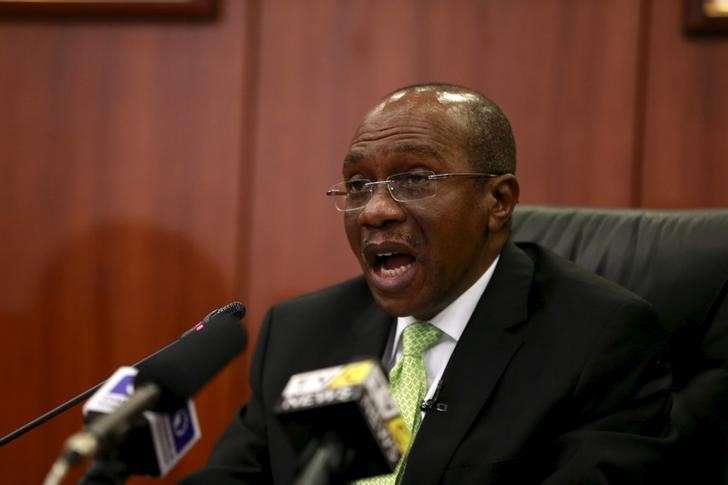
Few hours ago, an online news platform published an audio of a purported conversation among Governor of the Central Bank of Nigeria (CBN), Mr Godwin Emefiele; a CBN Deputy Governor, Mr Edward Adamu; a Director of Finance at the CBN, Mr Dayo Arowosegbe; and one of his Special Adviser, Mr Emmanuel Ukeji concerning an alleged business worth N500 billion gone bad.
Reacting to the issue, spokesman of the CBN, Mr Isaac Okorafor, said in a statement that there was no issue of cover-up or stolen money as reported by the platform.
“Contrary to the headline-grabbing narrative that the discussion was about a fraudulent transaction, this conversation, the beginnings of which was omitted to create a different impression, was simply to proffer solutions to a misunderstanding that affected the bank’s balance sheet.
“As publicly known, the CBN was approached in 2015 by the National Economic Management Team and the National Economic Council (NEC), chaired by the Vice President, to assist State Governments with Conditional Budget Support, in the aftermath of the significant nose-dive in global oil prices and associated FAAC allocations.
“In order to ensure that ordinary Nigerians workers got their salaries, pensions and gratuities, and that the economy continued to recover from recession, the bank provided about N650 billion in loans at 9% with a two-year grace period to 35 States of the Federation.
“These monies were distributed to the States monthly with documented approval of the Federal Ministry of Finance and the Presidency.
“In closing the bank’s 2018 accounts, external auditors in their Draft Account, erroneously classified about N150 billion of these loans as bad, which negatively affected the bank’s Balance Sheet and shareholders fund.
“The selective conversation being circulated was simply a discussion to ascertain why the auditors took that position and next steps to resolving it.
“Obviously, it soon became clear that a State Government loan cannot be classified as “bad” or “irrecoverable” when the State still exists and getting FAAC allocations. The bank then reached out to the Federal Ministry of Finance and they jointly gave comfort to the auditors who accepted in writing that these monies would be repaid.
“On this basis, the auditors reversed the negative entry and the certified that the CBN’s 2018 accounts were a true reflection of the State of Affairs.
“Reconciliation of Balance Sheet items are regular conversations amongst Senior Management of many agencies and should not be misconstrued as anything but that.
“Had the online media which released the selective recordings sought the comments of CBN as required of journalism practice, we would have provided it.
“Clearly those who listened to the audio can easily ascertain that the conversation had nothing to do with anything fraudulent as purported.
“The bank therefore urges all well-meaning Nigerians to disregard this audio and continue to trust that the bank is doing everything it can to represent their interests in the best possible way.
“Under the leadership of Governor Emefiele, the CBN has always stood for, and vigorously pursued transparency in its stewardship of public resources and policies.
“NO MONIES ARE MISSING OR STOLEN.
“The integrity of the CBN Governor remains unassailable. He has no account in Dubai or anywhere in the world and would never convert the funds of CBN for personal use. Not in the past, not now and not ever.
“The use of selective wiretapped conversations of the bank’s management, to malign his character and integrity will never stand. The bank will pursue every legal means to bring the perpetrators to justice,” the statement issued on Sunday night read.



By Aduragbemi Omiyale
The Debt Management Office (DMO) on Monday allotted bonds worth N929.3 billion to investors from the N1.7 trillion bids it received from subscribers.
The exercise, which took place on Monday, July 20, 2026, was oversubscribed by market participants, reflecting the confidence investors have in the government’s ability to redeem the debt instrument on maturity.
On offer for sale for the July auction was N1.2 trillion worth of the FGN bonds, but the DMO allotted below this, despite receiving bids above the offer.
The papers were offered in 10-year, 15-year, and 20-year tenors, at N400 billion each.
For the decade-old note, investors staked N444.47 billion, but the debt office sold N245.73 billion at an 18.34 per cent coupon rate. For the one and a half-decade-old paper, bids valued at N518.00 billion were received by the DMO, with a non-competitive bid of N50.00 billion, with N302.13 billion allotted to investors at 18.40 per cent, and for the two-decade paper, the DMO got competitive bids of N665.19 billion and N381.46 billion was sold to bondholders at 18.35 per cent.

By Adedapo Adesanya
The Governor of the Central Bank of Nigeria (CBN), Mr Yemi Cardoso, disclosed that Nigeria’s external reserves had risen to $52.5 billion, enough to finance about nine months of imports.
He disclosed this on Tuesday at the end of the 306th meeting of the Monetary Policy Committee (MPC) held in Abuja, where the Monetary Policy Committee (MPC) retained the benchmark interest rate at 26.50 per cent as well as the standing facilities corridor at +50/-450 basis points around the MPR.
Similarly, the Cash Reserve Requirement (CRR) was maintained at 45 per cent for Deposit Money Banks, 16 per cent for Merchant Banks, and 75 per cent for non-Treasury Single Account (TSA) public sector deposits.
Speaking on FX developments, the central banker said at the $52 billion level, the country’s external reserves were significantly above the internationally recommended threshold of three months of import cover.
On the Naira exchange rate, Mr Cardoso said the foreign exchange market had deepened and was now operating on a transparent willing-buyer, willing-seller basis.
He said the apex bank remained committed to maintaining a liquid and functional foreign exchange market, adding that daily market turnover sometimes exceeded $1 billion.
According to him, the long-term stability of the naira would depend on key economic fundamentals, including increased oil exports, foreign direct investment, and improved domestic productivity to reduce dependence on imports.
He also added that the MPC welcomed the federal government’s renewed commitment to stronger policy coordination, particularly collaboration between fiscal and monetary authorities, which he said had helped reduce the impact of the Middle East crisis on the Nigerian economy.
Mr Cardoso said members of the committee also commended efforts to improve crude oil production and urged relevant agencies to intensify reforms in other sectors, including solid minerals, to boost government revenue.
On the regulatory forbearance granted to banks during the COVID-19 period, he reiterated that this had been discontinued because it had served its purpose.
According to him, the policy had “outlived its time” and was no longer necessary in assessing the health of the banking sector.
“Forbearance, we felt, had outlived its time. Many of you will recall this is something that came as a result of COVID. And now we are in 2026; we did not see the reason why that should continue to form part of the analysis of the banking system,” he said.
Mr Cardoso explained that banks had begun recalibrating their portfolios following the end of the policy, leading to a temporary reduction in outstanding risk assets.
He, however, assured that the development was part of a transition towards a stronger and more sustainable credit environment.
“It reflects a transition to a more sustainable and better quality credit environment, which is what we all want. We don’t want unanticipated shocks that come in a boom-and-bust fashion,” he said.

By Adedapo Adesanya
The NASD Over-the-Counter (OTC) Securities Exchange extended its recent positive run by 1.17 per cent on Tuesday, July 21, triggered by appreciation seen in four bellwethers.
Leading the pack was FrieslandCampina Wamco Nigeria Plc, which added N12.00 to its value to close at N153.15 per share compared with the previous day’s N141.15 per share. NASD Plc appreciated by N1.90 to N36.00 per unit from N34.10 per unit, Food Concepts Plc improved by 23 Kobo to N2.48 per share from N2.25 per share, and Afriland Properties Plc grew by a marginal 1 Kobo to N15.01 per unit from N15.00 per unit.
As a result, the market capitalisation of the bourse increased by N30.40 billion to N2.637 trillion from Monday’s N2.606 trillion, and the NASD Security Index (NSI) gained 50.70 points to finish at 4,393.97 points, in contrast to the 4,343.27 points it ended a day earlier.
The unlisted securities exchange recorded a price loser yesterday, and it was Geo-Fluids Plc, which shed 1 Kobo to settle at N2.30 per share versus N2.31 per share.
During the trading day, the volume of securities traded by market participants on Tuesday dropped 99.4 per cent to 322,147 units from the previous day’s 52.6 million units, the value of securities dipped by 89.8 per cent to N19.4 million from the preceding session’s N191.2 million, and the number of deals contracted by 3.6 per cent to 27 deals from 28 deals.
Great Nigeria Insurance (GNI) Plc ended the day as the most traded stock by value on a year-to-date basis, with 3.4 billion units traded for N8.4 billion, followed by Infrastructure Credit Guarantee (Infracredit) Plc with 2.3 billion units transacted for N6.5 billion, and Central Securities Clearing System (CSCS) Plc with 75.4 million units exchanged for N5.3 billion.
GNI Plc also closed the day as the most traded stock by volume on a year-to-date basis, with 3.4 billion units worth N8.4 billion, followed by Infracredit Plc with 2.3 billion units valued at N6.5 billion, and Resourcery Plc with 1.1 billion units sold for N415.7 million.
