

General
Full Transcript of President Buhari June 12 Speech

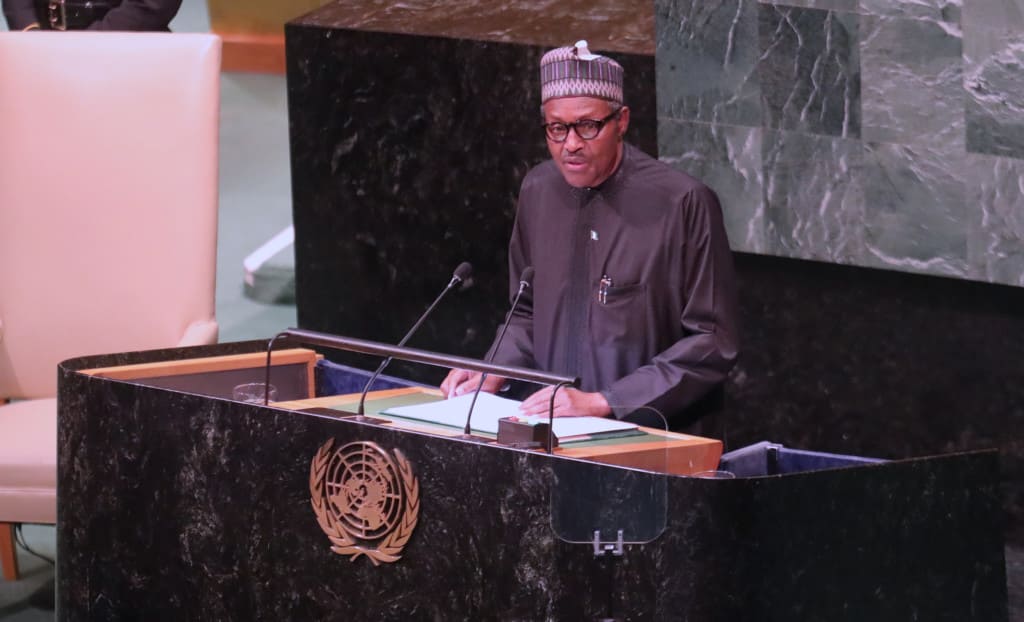
All Praise is due to GOD Almighty Who spared our lives to be present at this great occasion. We give thanks also that the democratic process has been further entrenched and strengthened.
2.Twenty years ago, a democratically elected government took over from the military in a historic transfer of political power for our country.
3.Today, we are privileged to mark the longest period of unbroken democratic leadership and 5th peaceful transfer of power from one democratically elected government to another in Nigeria.
4.Throughout the last four years, I respected the independence of INEC. I ensured that INEC got all the resources it needed for independent and impartial management of elections in the country.
5. All interested parties are agreed that the recent elections, which except for pockets of unrest, were free, fair and peaceful.
6.I thank all the people who worked for our party, who campaigned and who voted for us.I thank my fellow Nigerians, who, since 2003 have consistently voted for me.
7.Victory is your greatest reward; peace, unity and greater prosperity will be our collective legacy.Your Excellencies, Fellow Nigerians,
8.I and Nigerians collectively must give adequate thanks to our Armed Forces, Police and other law enforcing agencies for working round the clock to protect us by putting themselves in harm’s way and defending our values and protecting our future.
9.Terrorism and insecurity are worldwide phenomena and even the best policed countries are experiencing increasing incidents of unrest and are finding things hard to cope.
10. The principal thrust of this new Administration is to consolidate on the achievements of the last four years, correct the lapses inevitable in all human endeavors and tackle the new challenges the country is faced with and chart a bold plan for transforming Nigeria.
11. Fellow Nigerians, I have had the privilege of free education from Primary school to Staff College to War College.
12. I received my formative education in Katsina and Kaduna and my higher education in England, India and the United States.
13. I have worked and served in Kaduna, Lagos, Abeokuta, Makurdi, Port Harcourt, Maiduguri, Ibadan, Jos and finally here in Abuja. Throughout my adult life, I have been a public servant. I have no other career but public service. I know no service but public service.
14.I was involved at close quarters in the struggle to keep Nigeria one. I can therefore do no more than dedicate the rest of my life to work for the unity of Nigeria and upliftment of Nigerians.
15. In 2002-2003 campaigns and elections, I travelled by road to 34 of the 36 states of the Federation. This year I travelled by air to all 36 states of the Federation.
16. Before and during my time in the Armed Forces and in government, I have interacted with Nigerians of all ages and persuasions and different shades of opinion over a period of more than fifty years.
17. And my firm belief is that our people above all want to live in peace and harmony with their fellow Nigerians. They desire opportunity to better themselves in a safe environment.
18. Most of the instances of inter-communal and inter-religious strife and violence were and are still as a result of sponsorship or incitements by ethnic, political or religious leaders hoping to benefit by exploiting our divisions and fault lines, thereby weakening our country.
19. And our country Nigeria is a great country. According to United Nations estimates, our population will rise to 411 million by 2050, making us the third most populous nation on earth behind only China and India.
20. We have water, arable land, forests, oil and gas and vast quantities of solid minerals. We are blessed with an equable climate. However, the bulk of our real wealth lies in Agriculture, Livestock, Forestry and Mining. We possess all the ingredients of a major economic power on the world stage.
21. What we require is the will to get our acts together. And our strength is in our people – our youth, our culture, our resilience, our ability to succeed despite the odds.
22. A huge responsibility therefore rests on this and succeeding Administrations to develop, harness and fulfil our enormous potential into a force to be reckoned with globally.
23. Thus far, we Nigerians can be proud of our history since Independence in 1960. We have contributed to UN peace-keeping responsibilities all over the world; we have stabilized Liberia, Sierra Leone, Ivory Coast and two years ago we prevented the Gambia from degenerating into anarchy.
24. Without Nigerian influence and resources, the liberation of Angola, Mozambique, Namibia, Zimbabwe and ultimately South Africa would have come at greater cost. This fact had been attested by none other than the late Nelson Mandela himself.
25. Elsewhere, Nigeria is the Big Brother to our neighbours. We are the shock-absorber of the West African sub-region, the bulwark of ECOWAS and Lake Chad Basin Commission. We can therefore be proud to be Nigerians. We must continue to be Good Neighbours and Good Global Citizens.
26. At home, we have been successful in forging a nation from different ethnicities and language groups: our evolution and integration into one nation continues apace.
27. When, therefore we came to office in 2015 after a decade of struggle we identified three cardinal and existential challenges our country faced and made them our campaign focus, namely security, economy and fighting corruption.
28. None but the most partisan will dispute that in the last four years we have made solid progress in addressing these challenges.
29. When I took the oath of office on 29 May 2015, insecurity reigned. Apart from occupying 18 local governments in the North East, Boko Haram could at will attack any city including the Federal Capital, could threaten any institution including bombing the United Nations building and Police Headquarters in Abuja.
30. Admittedly, some of the challenges still remain in kidnappings and banditry in some rural areas. The great difference between 2015 and today is that we are meeting these challenges with much greater support to the security forces in terms of money, equipment and improved local intelligence. We are meeting these challenges with superior strategy, firepower and resolve.
31. In face of these challenges, our Government elected by the people in 2015 and re-elected in March has been mapping out policies, measures and laws to maintain our unity and at the same time lift the bulk of our people out of poverty and onto the road to prosperity.
32. This task is by no means unattainable. China has done it. India has done it. Indonesia has done it. Nigeria can do it. These are all countries characterized by huge burdens of population.
33. China and Indonesia succeeded under authoritarian regimes. India succeeded in a democratic setting. We can do it.
34. With leadership and a sense of purpose, we can lift 100 million Nigerians out of poverty in 10 years.
35. Following the 60 percent drop in oil prices between 2015 and 2016, through monetary and fiscal measures, we stimulated economic growth, curbed inflation and shored up our external reserves.
36.We now have witnessed 8 quarters of positive growth in the economy and our GDP is expected to grow by 2.7 percent this year.
37. Furthermore, our external reserves have risen to $45 billion enough to finance over 9 months of current import commitments.
38.This Administration is laying the foundation and taking bold steps in transforming our country and liberating our people from the shackles of poverty.
39.First, we will take steps to integrate rural economies to the national economic “grid” by extending access to small-scale credits and inputs to rural farmers, credit to rural micro-businesses and opening up many critical feeder roads.
40.Secondly, for small-scale enterprises in towns and cities, we shall expand facilities currently available so that we continue to encourage and support domestic production of basic goods and reduce our reliance of imported goods as I will outline later.
41.For the next four years, we will remain committed to improving the lives of people by consolidating efforts to address these key issues as well as emerging challenges of climate change, resettling displaced communities and dealing decisively with the new flashes of insecurity across the country, and the impacts on food scarcity and regional stability.
42.We are not daunted by the enormity of the tasks ahead. Instead, we are revived by this new mandate to work collaboratively with State and Local Governments, Legislators, the Diplomatic Corps and all Nigerians to rebuild and reposition our country as the heartbeat and reference point for our continent.
43. Fellow Nigerians, Your Excellencies, Ladies & Gentlemen:
a.Despite the enormous resources pledged to infrastructure development these past four years, there remains the urgent need to modernize our roads and bridges, electricity grid, ports and rail systems.
b.Whilst agriculture and industrial output have recovered since the recession, we are more committed than ever to work with the private sector to improve productivity and accelerate economic growth.
c.The Manufacturing Purchasing Managers Index which is the gauge of manufacturing activity in the country has also risen for 26 consecutive months since March 2017 indicating continuous growth and expansion in our manufacturing sector.
d.It still takes too long for goods to clear at our seaports and the roads leading to them are congested. It still takes too long for routine and regulatory approvals to be secured. These issues affect our productivity and we are committed to addressing them permanently.
e.Our Government will continue work to reduce social and economic inequality through targeted social investment programs, education, technology and improved information.
f.Our social intervention programs are a model for other nations. Together with state governments, we provide millions of school children with meals in primary schools, micro loans to traders and entrepreneurs, skills and knowledge acquisition support to graduates and of course, conditional cash transfers to the poorest and most vulnerable in our society.
g. A database of poor and vulnerable households is being carefully built based on age, gender, disability, educational levels for proper planning in this Administration’s war against poverty.
h. A database of unemployed but qualified youth has also been developed under the National Social Investment Programme which can be used by the public and private sectors for recruitment purposes. Cumulatively, nearly 2 million beneficiaries have received aid under this Programme apart from Anchors Borrowers Programme and School Feeding initiative each reaching 2 million recipients. And we will do more. Much more.
44. Fellow Nigerians, Your Excellencies, Ladies & Gentlemen, we know that there exists a strong correlation between economic inequality and insecurity.
45. When economic inequality rises, insecurity rises. But when we actively reduce inequality through investments in social and hard infrastructure, insecurity reduces.
46. The disturbing increase in rates of kidnapping, banditry and other criminal activities can be attributed to the decades of neglect and corruption in social investment, infrastructure development, education and healthcare.
47. This issue is further compounded by the impact of our changing climate and ecology.
48. The ECOWAS and Sahel regions, starting from Chad all the way to Mali, are also experiencing adverse impacts of drought and desertification, which have triggered waves of human displacement; conflicts between farmers and herdsmen; terrorism; and a fundamental socio-economic change to our way of life.
49. These issues are regional and not unique to Nigeria alone. The problems call for increased regional and international cooperation in developing a sustainable solution.
50. As Chairman of ECOWAS, I will be hosting a regional security summit of heads of states in the Sahel to develop a Joint Strategy to continue our efforts in addressing these issues.
51. Fellow Nigerians, Your Excellencies, Ladies & Gentlemen, at the heart of inequality and insecurity, is pervasive corruption. When we took office we realised that if you fight corruption, corruption will fight back – and we have seen this at all levels.
52. For Nigeria to progress, a collective resolution to address corruption and foster broad-based prosperity is required to create a country that is not only for a few privileged, but for all Nigerians.
53. This charge is not only to Civil Servants, Ministers, Legislators and State Government functionaries, but also to Corporate leaders.
54. We shall make greater investments in our rural economies. We shall aggressively source locally our raw materials.
55. We have incentives for investments specifically made in rural communities.
56. However, nationwide development cannot occur from Abuja alone; it must occur at States. And Government cannot do it alone.
57. I therefore implore all State Governments, especially those with large rural economies, to aggressively solicit investments in your states. Invest in developing human capital, reducing bureaucracy and corruption, hosting and attending investment summits and improving the ease of doing business.
58. At this point, I would like to express my sincere gratitude to the entrepreneurs, investors and venture capitalists who have built or are building agro-processing projects; petrochemical plants; crude oil and solid mineral refineries; energy exploration; software development projects; telecom infrastructure; health, education and manufacturing projects; and the like, across our country.
59. I would like to make special mention to promoters of our small businesses that are proudly making goods and services for export and for local consumption. The Nigerian economy rises and falls on the strength of your investments and productivity.
60. We will continue to listen to your ideas and plans not just about how we can secure more investment, but how your plans can help create a more equitable economy.
61. I also thank the labour unions, farmer groups and associations, organized private sector and the civil society organisations for their support and cooperation with our government these last four years.
62. We will continue to count on your support, guidance and understanding during the next four years.
63. I especially thank our traditional leaders and congratulate re-elected and newly elected State Governors and members of the National Assembly. Our Government will continue to count on your support so that we can together move our country forward.
64. Fellow Nigerians, Your Highnesses, Your Excellencies, Ladies & Gentlemen, despite the challenges over the last four years, my optimism about Nigeria’s future is unshaken and Nigeria’s role in the world as an emerging economic force is without a doubt.
65. Over the next four years, we are committed to assembling a strong team of Nigerians, and allies, to implement our transformative plans and proposals.
a. We will see significant focus, resource and, where necessary reform, in tertiary and technical education to reposition Nigeria’s workforce for the modern technological age.
b. We will accelerate investments in primary, secondary and tertiary healthcare programs, interventions and infrastructure as well as in upgrading of our medical personnel to stem the flight of our best trained people.
c. On food security, our farmers have made great strides in local production of rice, maize, cassava, poultry, fertilizer, fisheries and sesame. We remain resolute in supporting private sector in emphasizing backward integration and export expansion plans.
d. Felling of trees to provide energy for domestic use is taking its toll on our rain forests, our ecology and our climate. Accordingly, we are taking steps to harness cleaner and more sustainable sources of electricity. We export over 2 million tons of cooking gas, yet we consume less than half a million tons.
e. We will work to address this issue and support rural communities with challenges of safely switching from firewood to cooking gas.
f. Dedicated agro-industrial processing zones will be developed on a PPP basis to increase farming yields, agricultural productivity and industrial output.
g. Over 2,000 kilometers of ongoing Federal road and bridge projects across the country will be completed to reduce journey times and the cost of doing business. As I mentioned earlier, critical feeder roads will be built to facilitate easier transportation for people and goods from rural areas to major roads.
h. We are at advanced stages of securing investments to modernize and expand our transmission and distribution infrastructure, ensuring that electricity is available and affordable for all Nigerians.
i. Several rail, seaport and airport projects are at various stages of completion. We will open the arteries of transportation nationwide.
j. It is a fact that Nigeria has more gas reserves than it has oil. Over the last four years, we have become a net exporter of urea, which is made from natural gas. We invite investors to develop more natural gas-based petrochemical projects.
k. Fellow Nigerians, This Government will not tolerate actions by any individual or groups of individuals who seek to attack our way of life or those who seek to corruptly enrich themselves at the expense of the rest of us. We will crack down on those who incite ordinary innocent people to violence and unrest.
l. We will ensure that such actions are met with the strong arm of the law.
66. Nation building takes time. But we must take solace in the knowledge that this country, our country, has everything we require to make Nigeria prosper.
67. Fellow Nigerians, Your Highnesses, Your Excellencies, Ladies and Gentlemen, I invite you to join me in this journey of rebuilding our nation.
68. Our focus will not be to help the privileged few but to ensure that Nigeria works for Nigerians of all persuasions. That is a more just arrangement.
69. As we all know, correcting injustice is a pre-requisite for peace and unity. As part of the process of healing and reconciliation, I approved the recognition of June 12 as Democracy Day and invested the late Chief M.K.O. Abiola and Babagana Kingibe with National Honours, as I did with the late Chief Gani Fawehinmi. The purpose was to partially atone for the previous damage done in annulling the Presidential elections of that year.
70. Today, I propose the re-naming of the Abuja National Stadium. Henceforth it will be called MOSHOOD ABIOLA NATIONAL STADIUM.
71.In my first term, we put Nigeria back on its feet. We are working again despite a difficult environment in oil on which we depend too much for our exports. We encountered huge resistance from vested interests who do not want CHANGE, But CHANGE has come, we now must move to the NEXT LEVEL.
72.By the Grace of God, I intend to keep the oath I have made today and to serve as President for all Nigerians
73.I thank you for attending this august occasion from far and near, and for all your best wishes to me, to our party and to Nigeria.
74.God bless us all, and God bless the Federal Republic of Nigeria.



By Adedapo Adesanya
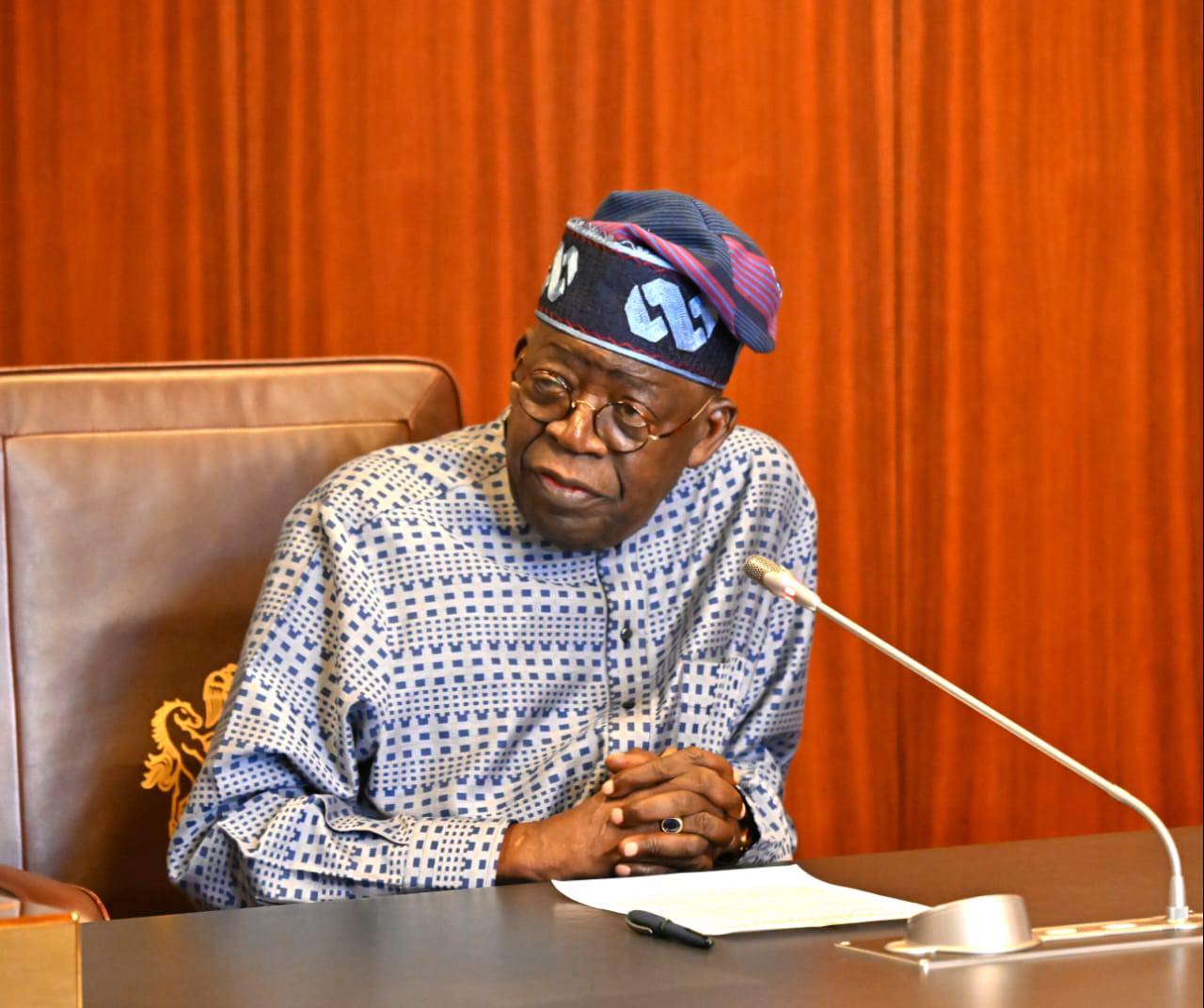
President Bola Tinubu has said state governments are now receiving substantially higher allocations to drive development, while renewed investor confidence is attracting fresh investments into Nigeria.
Speaking at the maiden State House Media Dinner in Abuja on Thursday, the president described the development as evidence that his administration’s economic reforms are beginning to deliver positive results.
He defended the reforms introduced by his administration, acknowledging that they were difficult but necessary to reposition the economy for sustainable growth.
According to Mr Tinubu, stronger public revenues have enabled increased allocations to states, while improvements in the investment climate have boosted confidence among domestic and foreign investors.
“The difficult but necessary reforms undertaken by this administration are yielding results. Our economy is stabilising. Public revenues have strengthened significantly,” he said.
“State governments are receiving substantially higher allocations to support development. Investor confidence is returning.
“Our foreign reserves have improved considerably. The oil and gas sector is attracting renewed investment. The stock market has witnessed remarkable growth. Key economic indicators are moving in the right direction,” Mr Tinubu stated.
The president also said the administration was laying the groundwork for long-term prosperity through a combination of tax and fiscal reforms, infrastructure development and improvements to the business environment.
“Through tax reforms, fiscal reforms, infrastructure investments, and improvements in the business environment, we are laying the foundations for a more competitive, productive, and prosperous economy,” he said.
Although acknowledging that more work remains, Mr Tinubu maintained that the country was firmly on the path to sustainable economic growth.
“The journey is not yet complete, but the direction is clear, and the foundations for long-term growth are being firmly established,” he added.
On security, the president said his administration had sustained a multi-dimensional strategy that has produced measurable gains across different parts of the country.
He noted that intensified military operations, improved intelligence gathering, stronger inter-agency coordination, and expanded regional and international cooperation had led to the neutralisation of thousands of terrorists and criminal elements, the rescue of numerous hostages, and the recovery of communities previously under siege.
President Tinubu reiterated his administration’s commitment to ensuring peace and security across the country, saying every Nigerian should be able to live, work and prosper without fear.
The president also commended the media for its contribution to Nigeria’s democratic development while urging journalists to uphold professionalism by reporting accurately and responsibly.
“We are adversaries only in the democratic sense, as the media constantly distrust those in power. In nation-building, we are partners,” he said.
He described government and the media as institutions with complementary responsibilities, noting that while government serves through leadership and public policy, the media serves by holding those in power accountable on behalf of the people.
By Adedapo Adesanya
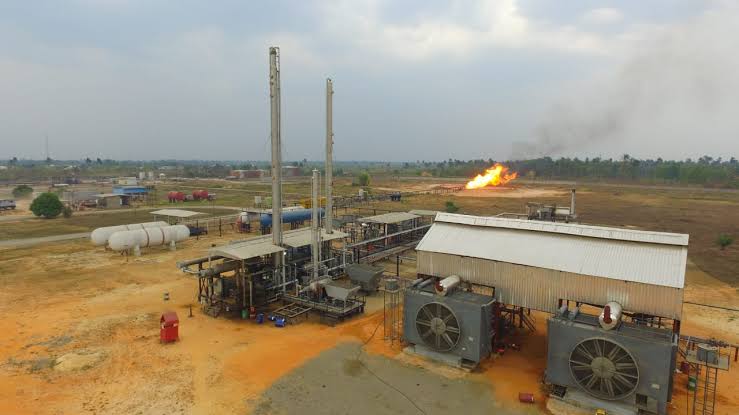
Shell Nigeria Exploration and Production Company Ltd (SNEPCo) has launched a $3 billion Contract Finance Facility in partnership with nine Nigerian banks to improve contractors’ access to funding and strengthen local participation in the oil and gas industry.
The facility is designed to provide credit support for local contractors executing projects for SNEPCo operations and will be available in both Naira and US Dollars.
The participating banks are First Bank, Guaranty Trust Bank, Zenith Bank, Access Bank, United Bank for Africa, Stanbic IBTC, Standard Chartered Bank, First City Monument Bank and Fidelity Bank.
Speaking at the signing of the Memorandum of Understanding in Lagos, the SNEPCo Managing Director, Mr Ronald Adams, said, “The initiative reflects the spirit of the Nigerian Oil and Gas Industry Content Development Act, which is aimed at in-country value retention.”
“Our partner banks offer capital and discipline. SNEPCo brings contracts and domiciliation of payments that de-risk lending. On their part, the contractors provide performance. Each is accountable to others, and the mutual accountability gives the arrangement its strength,” he added.
Also speaking, the Vice President for Finance at Shell Nigeria, Mr C. J. Akwaeze, said the scheme reflects Shell’s commitment to the growth of oil and gas operations in Nigeria.
The chairman of the indigenous oil and gas contractor group, the Petroleum Technology Association of Nigeria (PETAN), Mr Wole Ogunsanya, represented by Mrs Joan Faluyi, lauded the scheme as a “gateway to unlocking contractor financing issues which will also drive efficiency in contract execution.”
Representatives of the banks commended SNEPCo for the opportunity to partner on an initiative aimed at empowering contractors and assured the company of their continued support and cooperation.
Nigerian companies have continued to play key roles in supporting SNEPCo’s operation and project execution. Earlier this year, 43 wholly Nigerian companies took part in the turnaround maintenance exercise at the Bonga Floating Production and Offloading (FPSO) vessel out of the total of 53 companies involved.
By Adedapo Adesanya
Nigeria has joined the International Energy Agency (IEA) as an associate member, making Africa’s largest crude producer the first member of the Organisation of the Petroleum Exporting Countries (OPEC) to do so.
The governing board of the Paris-based agency unanimously agreed for Nigeria to join the IEA family, deepening its cooperation with Africa’s most populous nation in a major advance for global energy governance.
“I am thrilled that Nigeria is joining the IEA – it is Africa’s most populous country and a major international energy player. Nigeria becoming part of the world’s energy authority marks a milestone for global energy governance. I am very thankful to President Tinubu and Minister Ekpo for their trust in the IEA,” said IEA Executive Director, Mr Fatih Birol.
“As Nigeria works to strengthen energy security, support economic growth and expand energy access, deeper cooperation with the IEA will bring important benefits for both sides. We look forward to building on our already strong partnership and welcoming Nigeria to the IEA,” he added.
On his part, Nigeria’s Minister of State for Petroleum Resources (Gas), Mr Ekperikpe Ekpo, lauded the decision, saying it will contribute to helping the country utilise its energy resources.
“I am elated with the decision of the IEA Members to officially welcome Nigeria to the IEA Family as an Association country,” he said. “It is an honour for Nigeria to join this leading energy agency, and I will take this opportunity to encourage the African continent to embrace the IEA, as we all work together to achieve key development goals including universal energy access and industrialisation.”
Nigeria’s growing role in international energy markets has been highlighted by recent developments in its refining sector. During recent periods of market disruption, increased fuel exports from Nigeria helped strengthen resilience in African and international fuel markets.
The IEA, in a statement, noted that Nigeria has emerged as one of the world’s fastest-growing markets for decentralised solar solutions and is stepping up efforts to expand access to electricity and clean cooking.
The IEA governing board’s decision builds on a strong history of engagement and collaboration between Nigeria and the IEA since 2014.
In September 2025, the IEA, Mr Ekpo as Minister of Petroleum Resources and the African Energy Commission (AFREC) jointly convened a Regional Roundtable on Turning Methane Pledges into Action in Abuja, bringing together energy stakeholders from across the region to advance efforts to reduce methane emissions from the energy sector.
As an associated country, Nigeria and the IEA will work more closely across a wide range of energy issues, including on the Agency’s engagement in sub-Saharan Africa.
Created in 2015, the IEA Association programme allows the agency to deepen ties with its partner countries, bringing together major energy-producing and consuming countries from around the world.
Nigeria joins a network of 13 other Association countries that work with the IEA to advance secure, affordable and sustainable energy systems worldwide. As a result of this expansion, the IEA’s share of global energy demand has increased from 40 per cent in 2015 to over 80 per cent today.

-
 Feature/OPED6 years ago
Davos was Different this year
-
Travel/Tourism10 years ago
Lagos Seals Western Lodge Hotel In Ikorodu
-

 Showbiz4 years ago
Estranged Lover Releases Videos of Empress Njamah Bathing
-
 Banking8 years ago
Sort Codes of GTBank Branches in Nigeria
-

 Economy3 years ago
Subsidy Removal: CNG at N130 Per Litre Cheaper Than Petrol—IPMAN
-

 Banking3 years ago
Sort Codes of UBA Branches in Nigeria
-

 Banking3 years ago
First Bank Announces Planned Downtime
-

 Sports3 years ago
Highest Paid Nigerian Footballer – How Much Do Nigerian Footballers Earn