

Economy
Onyema Lauds Fayemi’s Strategies to Revive Ekiti Economy

By Modupe Gbadeyanka
Governor Kayode Fayemi of Ekiti State has been commended for his efforts at revitalising economy of the small civil servant state, which has huge tourism potentials.
Chief Executive Officer of the Nigerian Stock Exchange (NSE), Mr Oscar Onyema, who made this commendation, said he was impressed with the improvement in the Gross Domestic Product (GDP) of the state; with a 63 percent economic growth which were necessitated by the projects executed by Mr Fayemi between 2011 and 2014.
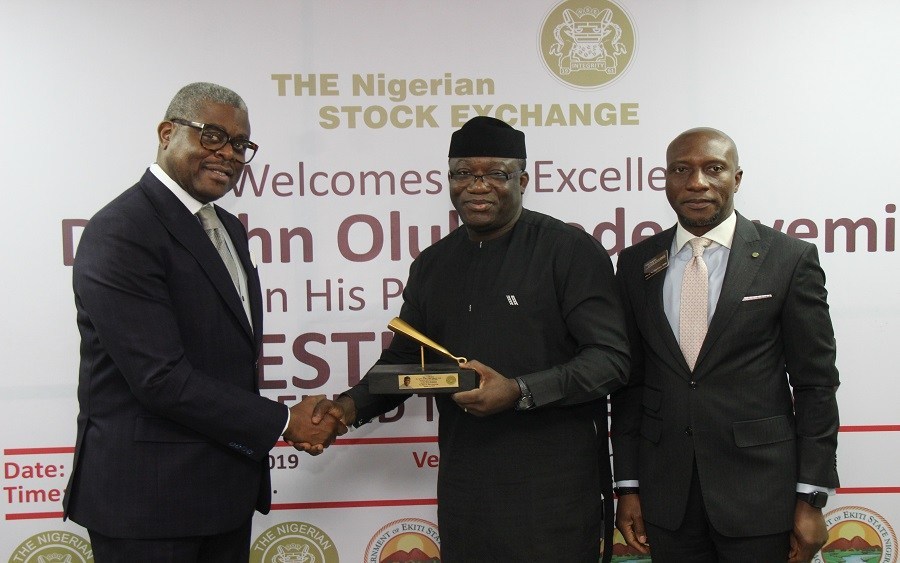
Last week, the Governor was at the NSE in Lagos to present his Investing in Ekiti: Facts Behind the State Economy and was given the honour to beat the closing gong to signal end of the trading session on the exchange.
Mr Onyema, during his speech, described Mr Fayemi as a reform-minded leader, hailing him for his commitment to providing durable infrastructure and employment opportunities for the state.
He said the governor had created a roadmap for other political leaders to follow in their quest to deliver the goods to the people.
“We acknowledge your Excellency’s progressive leadership and reform-minded approach in managing the economy of Ekiti.
“Your strategies towards revitalising the agricultural, manufacturing, mining, trade and tourism sectors, which together account for 75 percent of the state’s GDP, are also commendable.
“For instance, you have increased the proportion of capital spending in the 2019 budget to 44 percent from 31 per cent in 2018; and channelled budgetary resources toward pro-growth projects.
“We recognise that to build a sustainable economy for the estimated 3.5 million citizens of Ekiti, supported by vibrant sectors, both state-owned and private sector enterprises will require access to right-sized capital,” Mr Onyema added.
In his address, the Ekiti Governor called on investors to take advantage of the improved infrastructure, business-friendly policies and adequate security provided by his government to exploit the state’s economic prospects.
The Governor said his administration has put in place policies and legislations that will ensure that the state becomes one of the top three states in ease of doing business, adding that Ekiti State was rated number four in ease of doing business in 2014 when he left office, before sliding to the 32nd position thereafter, assuring the business community that the state would soon return to the number three spot.
Mr Fayemi said the efforts of his government had started yielding positive results with the return of development partners as well as the resuscitation of some moribund businesses like the Gossy Water, noting that three banks that left the state owing to unfriendly business policies of the immediate past administration have return.
“We are starting to regain the confidence of investors by reactivating those laws which we put in place in my first administration to create an enabling environment for investment to thrive.
“We have also passed the law establishing the Ekiti State Development and Investment Promotion Agency (EKDIPA) that will drive our Ease of Doing Business reforms and provide investors with a one-stop shop to deal with investment related matters,” he said.
On the state’s partnership with the NSE, the Governor expressed optimism that the continued partnership would help the state in unlocking investment in its focus sectors and also optimising state-owned enterprises.
Mr Fayemi explained that his efforts as governor is aimed at making Ekiti an attractive destination for investors, delivering sustainable economic growth, putting people to work and lifting the citizens out of poverty.
He highlighted the core areas where the state seeks partnership as including agriculture, tourism and the knowledge zone, a project which is designed to ensure infrastructure, power, transport, housing, recreation, medical and other services are available round the clock.
“We have renewed our focus on peace and security, which is the foundation of any economic development; and started investing in developing the infrastructure required to make Ekiti a competitive destination for business.
“We are quite concerned about the increasing spate of violence against ordinary citizens and it is the duty of the government to provide security and welfare of the citizens.
“The steps we have taken since we assumed office is to work in collaboration with neighbouring states because those things just cut across, particularly as it affects kidnapping and banditry to make the highways safe,” he said.



By Aduragbemi Omiyale
Leading manufacturer of personal healthcare products and consumer goods, PZ Cussons Plc, recorded a 22 per cent growth in its revenue in the 2026 fiscal year.
In its unaudited results recently submitted to the Nigerian Exchange (NGX) Limited, the company posted revenue of N260.46 billion in the period under review compared with the N212.63 billion achieved in the corresponding period in 2025.
This revenue growth was buoyed by market share gains for its major brands, increased household penetration and robust volume uplift, according to the chief executive of PZ Cussons, Mr Oghale Elueni.
It was observed that the cost of sales as a percentage of revenue was 72 per cent, 100bps lower than the prior year, driven by better mix and supply efficiencies.
Marketing and distribution expenses increased by 48.2 per cent to N26.51 billion from N17.89 billion, and administrative expenses also spiked by 43 per cent to N21.07 billion from N14.70 billion.
Also, the organisation recorded significant profitability for the year ended May 31, 2026, rising by 388 per cent to N49.10 billion from N10.07 billion.
Mr Elueni attributed this strong performance to the strength of the business, the equity of the brands, and the discipline of execution, noting that despite the complex and consistently challenging operating environment, the company pulled through to deliver growth in both revenue and profit.
He disclosed that the 22 per cent revenue growth recorded for the 2026 financial year was influenced by a healthy mix of volume and price initiatives.
“The balance sheet was further de-leveraged and strengthened through a cash-accretive P&L and efficient working capital management. The impact has been an improvement in the net asset position from N17.3 billion negative at the beginning of the year to N70.6 billion at year-end.
“The business grew volumes in both the electrical and consumer business, leveraging investment in our brands and sharpening our go-to-market capabilities. The result has been market share gains for our major brands, increased household penetration and robust volume uplift, contributing to overall revenue growth,” he stated.
Mr Elueni expressed profound appreciation to the shareholders for their unwavering support in navigating through the challenges in the last 12 months, noting that the board remains confident that, despite geopolitical uncertainties and their attendant economic shocks, the business is sufficiently resourced to deliver value to stakeholders.
“We have a business that has strong brands, an adaptive operating framework and a culture of disciplined execution that supports the consistent delivery of value to stakeholders,” he stated.

By Adedapo Adesanya
Nigeria’s crude oil production increased in May and June, according to data published by the Organisation of the Petroleum Exporting Countries (OPEC).
The country’s output increased by 42,000 barrels per day to 1,530 million barrels in May, from 1,489 million barrels in April.
According to Reuters, Nigeria, whose shipments were not affected by the Iran war, also pumped more in June, based on flow data from financial group LSEG, information from other companies that track flows, such as Kpler, and data provided by sources at oil companies, OPEC, and consultants.
Output from the OPEC rose by 2.34 million barrels a day to 18.75 million a day, with the gains driven by Kuwait, Saudi Arabia and Iran, the survey showed. The rebound still leaves production considerably below prewar levels.
Kuwait posted the biggest increase among OPEC’s 11 members last month, boosting output by 870,000 barrels a day to 1.36 million a day followed by Saudi Arabia, which raised output by 550,000 barrels a day to an average of 7.2 million a day. That was followed by Iran, which hiked by 510,000 a day to pump 2.85 million a day, and has accumulated a hoard of supply on tankers at sea as it struggles to find buyers.
In the wider alliance, Russia has bolstered crude exports to record levels following Ukrainian strikes on its refineries, potentially diverting volumes that can’t be processed at home.
Even before the peace deal, Persian Gulf producers had found ways to sneak cargoes out through the strait, which was largely shuttered in the early stages of the conflict.
The uptick in supply is creating a surplus in parts of the market, erasing crude’s wartime rally and raising the question of whether OPEC nations will need to compete for customers.
The group’s June production was still 7.3 million barrels a day, or 28 per cent, below February levels, when adjusted for exit by the United Arab Emirates (UAE).
The UAE quit OPEC in May, giving it the freedom to pump at will once the strait fully stabilises. Iraq also briefly threatened it could exit unless eventually given a higher output quota by the organisation.
On Sunday, a subgroup of seven OPEC+ nations announced a 188,000 barrels a day boost in August continuing the series of small and symbolic production hikes during the war to continue a process of restoring output halted a few years ago.
By Adedapo Adesanya
Shareholders of Dangote Cement Plc have approved plans that could pave the way for the company’s secondary listing on the London Stock Exchange (LSE) while also endorsing a final dividend of N45.00 per ordinary share for the 2025 financial year.
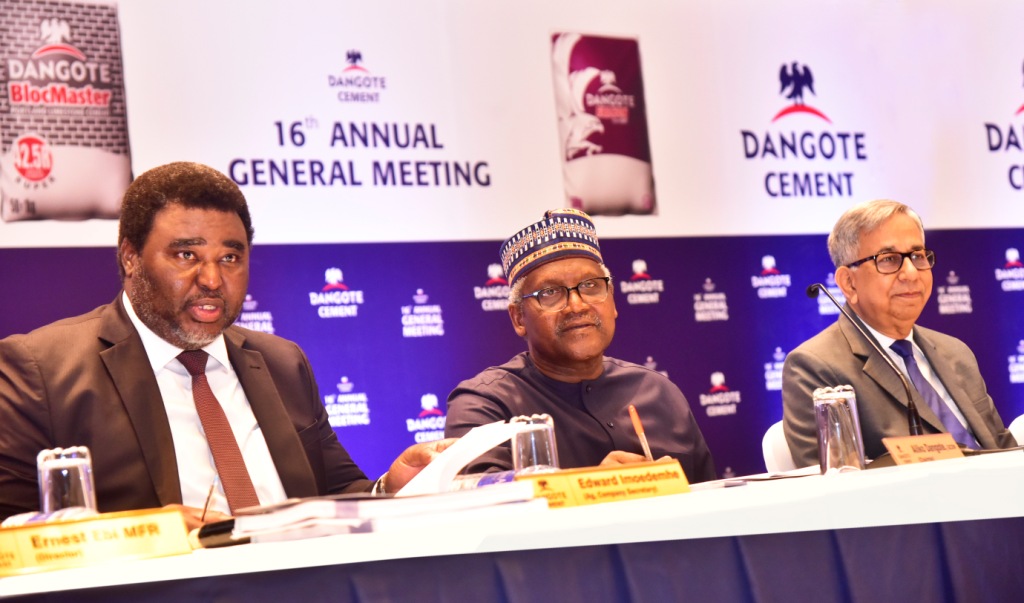
The resolutions were passed at the company’s 17th Annual General Meeting (AGM) held on Thursday at Eko Hotels & Suites in Lagos, where shareholders also approved the audited financial statements for the year ended December 31, 2025.
The approval for an international secondary listing marks a significant step in Dangote Cement’s plans to broaden its access to global capital markets and enhance its international investor base.
In May, the company’s founder Mr Aliko Dangote said the cement subsidiary was planning a London listing to sell 10 per cent stake, sixteen years after debuting on the Nigerian Exchange (NGX) Limited. This would provide the company with the much-needed boost to compete in the United Kingdom market.
Shareholders also ratified the payment of a final dividend of N45.00 per ordinary share from the company’s retained earnings as of December 31, 2025. The dividend was paid on Thursday, July 2, 2026.
At the meeting, shareholders approved the appointment of Ms Mariya Aliko-Dangote to the company’s board of directors. In recent months, the eldest daughter of the billionaire as well as her sisters Halima and Fatima, have been strategically positioned across their father’s empire in what has been touted as succession plans.
They also re-elected four directors retiring by rotation: Mr Emmanuel Ikazoboh, an Independent Non-Executive Director; Mr Olakunle Alake, a Non-Executive Director; Ms Berlina Moroole, a Non-Executive Director; and Mr Alvaro Poncioni Merian, an Independent Non-Executive Director.
In addition, shareholders authorised the board to determine the remuneration of the company’s external auditors for the 2026 financial year.
The AGM also noted the disclosure of managers’ remuneration in compliance with the provisions of the Companies and Allied Matters Act (CAMA) 2020.
Shareholders further approved the election of Mr Robert Ade-Odiachi, Mr Sheriff Yussuf Mojirola and Mr Nicholas Nyamali as shareholders’ representatives on the Statutory Audit Committee. They will serve alongside the company’s representatives, Mr Ernest Ebi and Mr Olakunle Alake, until the next AGM.
They also approved annual remuneration of N20 million for the chairman and N15 million each for the non-executive directors for the financial year ending December 31, 2026.

-
 Feature/OPED6 years ago
Davos was Different this year
-
Travel/Tourism10 years ago
Lagos Seals Western Lodge Hotel In Ikorodu
-

 Showbiz4 years ago
Estranged Lover Releases Videos of Empress Njamah Bathing
-
 Banking8 years ago
Sort Codes of GTBank Branches in Nigeria
-

 Economy3 years ago
Subsidy Removal: CNG at N130 Per Litre Cheaper Than Petrol—IPMAN
-

 Banking3 years ago
Sort Codes of UBA Branches in Nigeria
-

 Banking3 years ago
First Bank Announces Planned Downtime
-

 Sports3 years ago
Highest Paid Nigerian Footballer – How Much Do Nigerian Footballers Earn