

Economy
FMDQ to Launch First Derivatives Product in Q1 2020

By Dipo Olowookere
The Associate Executive Director in charge of Capital Markets at the FMDQ Securities Exchange Plc, Ms Tumi Sekoni, has hinted that the agency would launch the first derivatives product before the end of first quarter of 2020.
Derivatives are products, instruments, or securities which are derived from another security, cash market, index, or another derivative.
They are one of the most widely traded instruments in financial world, with value of a derivative transaction derived from the value of its underlying asset e.g. bond, interest rate, commodity or other market variables such as currency exchange rate.
Speaking on Saturday with members of the media in Lagos, Ms Sekoni said preparations were in top gear to ensure the launch of the product, noting that the exchange would continue to meet the yearnings and aspirations of its stakeholders.
She informed the media executives that the exchange would continue to educate and enlighten investors and operators on its products and services.
Also addressing journalists at the media parley at the weekend, Managing Director of FMDQ Securities Exchange Plc, Mr Bola Onadele, explained that the conversion of the agency into a full blown securities exchange was not to compete with the Nigerian Stock Exchange (NSE) in equities trading but to create new entities for the future.
According to him, FMDQ would work with Small and Medium Enterprises (SMEs) and private companies to create new entities for the future.
Mr Onadele said the company’s intention was not going into the equities market to compete with the exchange or ask companies to delist.
He noted that the exchange was looking at how to create new entities for the future, work with and nurture SMEs and private companies in Nigeria that had no access to long-term financing.
“We are not playing the game of attacking the NSE that is not our role or our job or the way we do business.
“Rather we are looking at how to create new entities for the future, to work and nurture them, to work with SMEs, private companies in Nigeria who have not had access to long term financing.
“So, we are in the business of planning 20-30 years ahead and working with Nigerian entities in getting prosperity to Nigerians,” he said.
The managing director stressed the need to position the nation’s capital market to become number one in terms of standards, governance and transparency, saying that the FMDQ would continue to work with government and regulators develop the Nigerian capital market.
He assured that the exchange would continue to trade in all securities including fixed income, derivatives, commodities and foreign exchange.
Recall that in June 2019, SEC registered its wholly owned central securities depository subsidiary, FMDQ Depository Limited, positioned to provide collateral caching, custodian and settlement services.



By Adedapo Adesanya
The International Monetary Fund (IMF) has retained Nigeria’s economic growth projections at 4.1 per cent for 2026 and 4.3 per cent for 2027, expressing confidence that ongoing macroeconomic reforms will continue to support the country’s recovery.
The projections, contained in the IMF’s July 2026 World Economic Outlook (WEO) Update titled “Global Economy in Crosscurrents of War and Technology”, remain unchanged from the forecasts released in April, despite mounting global uncertainties stemming from the conflict in the Middle East.
According to the report released yesterday, Nigeria’s growth outlook is being supported by improved macroeconomic stability and favourable terms of trade arising from its status as an oil-exporting nation.
However, the Bretton Woods institution warned that rising prices of essential goods could offset part of these gains by worsening poverty and food insecurity across the country.
The report stated that, “Nigeria is supported by improved macroeconomic stability and favourable terms of trade effects, though higher prices for essentials are expected to further aggravate poverty and food insecurity.”
Speaking during the IMF’s virtual briefing on the July 2026 World Economic Outlook Update for Sub-Saharan Africa and Nigeria, Division Chief in the IMF’s Research Department, Ms Deniz Igan, described Nigeria as one of the region’s stronger-performing large economies, noting that policy reforms have strengthened macroeconomic stability.
“Just to give you a sense, the two largest economies in the region, Nigeria is expected to grow at 4.1 per cent, quite stable, and this is supported by improved macroeconomic stability and favourable terms of trade, with Nigeria being an oil exporter,” Ms Igan said.
She, however, cautioned that inflationary pressures on essential commodities remain a major concern.
“At the same time, tighter prices, so there is some offset to that positive terms of trade effect because higher prices for essentials are expected to aggravate poverty and food insecurity,” she added.
The lender also retained Nigeria’s 2027 growth forecast at 4.3 per cent, as it noted that recent economic reforms are laying the foundation for sustained expansion despite persistent global headwinds.
For the global economy, the IMF projected growth to moderate to 3.0 per cent in 2026 from 3.5 per cent recorded in 2025, attributing the slowdown largely to the economic impact of the Middle East conflict, which is expected to offset part of the gains from the accelerating artificial intelligence-driven technology cycle.
For Sub-Saharan Africa, the IMF projected economic growth of 4.3 per cent in 2026 before improving to 4.5 per cent in 2027. The latest forecast represents a 0.1 percentage point upward revision from the Fund’s April outlook.
Ms Igan noted that the region had experienced broad-based economic recovery in 2025 before the outbreak of the Middle East conflict altered the growth trajectory.
“Let me start by noting that we actually had seen a broad-based pickup in growth in 2025 in the region. We had an acceleration of growth to 4.5 per cent.
“Now, the war obviously has clouded the outlook for 2026, and we are now projecting a softening of growth to 4.3 per cent in the region as a whole,” she said.

By Aduragbemi Omiyale
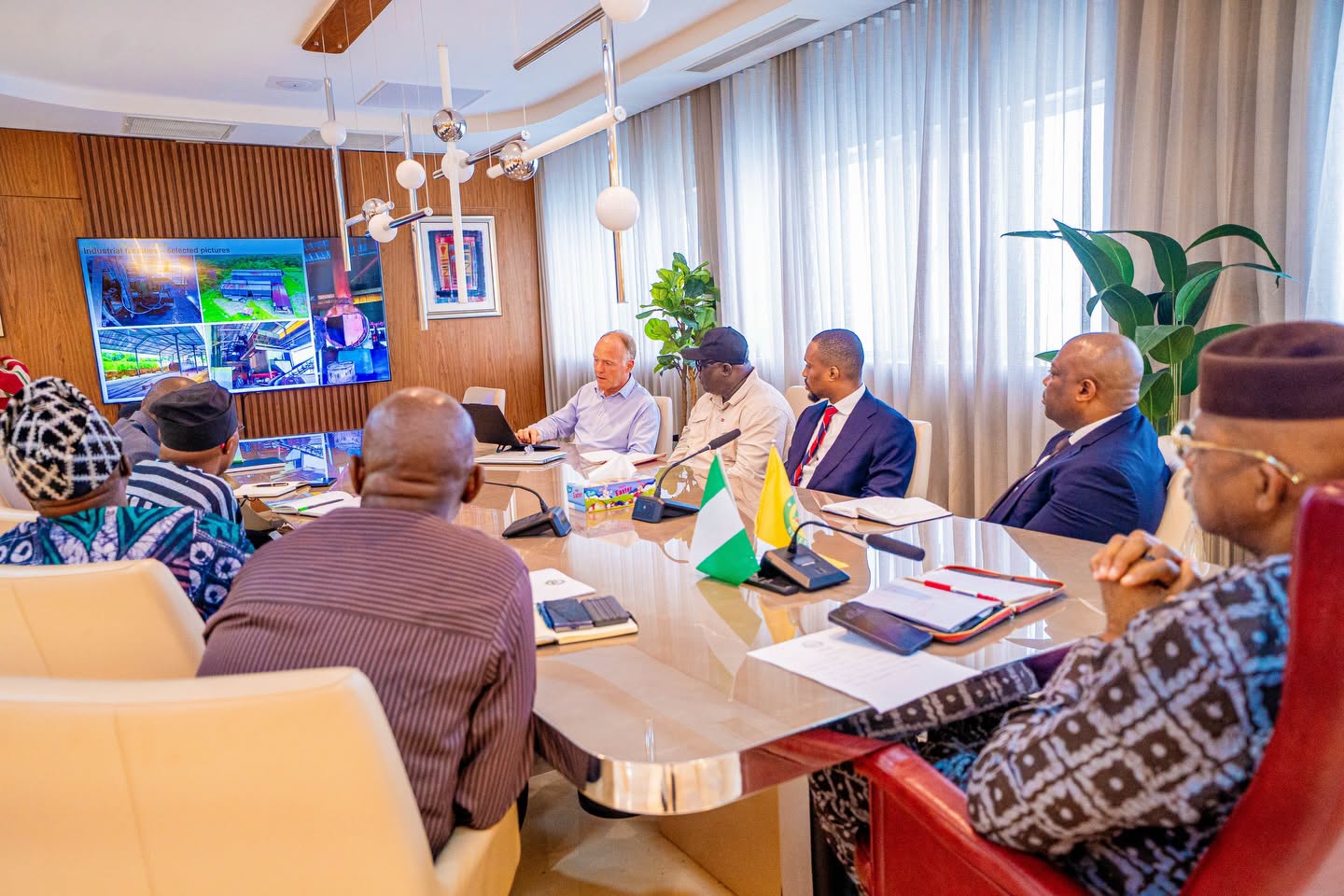
Presco Plc has concluded plans to establish operations in Ogun State as part of efforts to expand its footprint, boost earnings, and deliver more value to shareholders.
The news of the operations was announced by the Governor of Ogun State, Mr Dapo Abiodun, after he received a delegation from the company.
Presco is one of the leading integrated oil palm firms in Nigeria. It is listed on the Nigerian Exchange (NGX) Limited.
The Governor expressed his joy over the decision of Presco to situate its factory in the Gateway State.
He disclosed that the organisation has promised to have an initial investment of about $100 million in Ogun State, noting that this “validates the confidence investors continue to place in our administration’s deliberate policies aimed at creating an enabling business environment.”
According to him, beyond strengthening the state government’s agricultural transformation agenda, the project is expected to generate thousands of direct and indirect jobs, enhance food security, stimulate economic growth, and increase the state’s revenue.
“As we continue to implement our Building Our Future Together agenda, we remain committed to attracting strategic investments that will diversify our economy, create sustainable opportunities for our people, and reinforce Ogun State’s position as Nigeria’s preferred investment destination,” Mr Abiodun stated.

By Adedapo Adesanya
FrieslandCampina Wamco Nigeria Plc led two others to evict the bears from the NASD Over-the-Counter (OTC) Securities Exchange on Wednesday, July 8.
According to data, the unlisted securities exchange rebounded by 6.84 per cent during the session, thanks to the gains recorded by FrieslandCampina, Food Concepts Plc, and Geo-Fluids Plc.
During the trading day, FrieslandCampina recouped N12.57 to trade at N151.98 per unit versus Tuesday’s closing price of N139.41 per unit, Food Concepts Plc improved by 25 Kobo to N2.76 per share from N2.51 per share, and Geo-Fluids Plc expanded by 18 Kobo to N2.55 per unit from N2.37 per unit.
As a result of these accumulations, the market capitalisation added N163.34 billion to close at N2.551 trillion compared with the preceding session’s N2.387 trillion, and the NASD Security Index (NSI) increased by 272.13 points to 4,250.20 points from 3,978.07 points.
The midweek trading data showed that the volume of securities dipped by 50.9 per cent to 158,933 units from 323,780 units, and the value of securities slipped by 31.9 per cent to N10.9 million from the preceding session’s N15.9 million, while the number of deals increased by 6.9 per cent to 31 deals from the previous session’s 29 deals.
When trading activities on the platform ended for the day, Great Nigeria Insurance (GNI) Plc was the most active stock by value on a year-to-date basis, with 3.4 billion units traded for N8.4 billion, followed by Infrastructure Credit Guarantee (Infracredit) Plc with 2.3 billion units sold for N6.5 billion, and Central Securities Clearing System (CSCS) Plc with 70.7 million units transacted for N4.9 billion.
GNI Plc also closed the day as the most traded stock by volume on a year-to-date basis, with 3.4 billion units worth N8.4 billion, followed by Infracredit Plc with 2.3 billion units valued at N6.5 billion, and Resourcery Plc with 1.1 billion units exchanged for N415.7 million.
