

Economy
How Oil Firms Can Achieve Exponential Growth—Verraki

By Dipo Olowookere
Players in the nation’s oil and gas industry have been told what could be done to survive the rough operating terrain they find themselves in. In recent times, prices of crude oil have been unstable on the global market, which is giving some of them somethings to worry about.
Energy Lead and Senior Partner, Real Sector at Verraki, Mrs Abayomi Olarinmoye, while commenting on happenings in the sector, said stakeholders must begin to look at different areas to achieve exponential growth if they intend to stay long in business.
The former Managing Director for Accenture’s Resources Operating Group in Nigeria, while addressing the media at an interactive session, opined that upstream players in Nigeria’s oil and gas industry can gain competitive advantage, operational excellence and financial transparency by embracing more automation in their operations and enjoy several benefits including increased productivity, reduced operational costs and highly engaged employees.
She identified several value-adding opportunities for oil and gas companies to deploy digital technologies which would serve as catalysts to achieve exponential growth.
Mrs Olarinmoye identified the increasing reliance on real-time data by international oil and gas operators and the need for Nigerian players to adopt similar strategies given the existing infrastructure, security and operational challenges.
She further identified utilization of applications as a service business models which allow operators to deploy technology customized to suit the size of their business operations, stressing that she believes that if oil and gas companies maximize the potentials of digital supply chain technologies available today, it would help to establish a new ecosystem of markets and alliance partners.
Commenting on the energy industry in Africa, its technological advancement and the impact of these on business operations, Mrs Olarinmoye said, “The energy industry is getting smarter and more intelligent as business operations and growth decisions are being backed by leading-edge data gathering using more sophisticated tools and internet enabled equipment.
“The Internet of Things has created a paradigm shift in data-gathering – today, collected and derived data are being used to improve asset utilization and to reduce costs. This will help place the industry at the forefront of global competitiveness.”
Further speaking on the use of technology to expedite growth, Mrs Olarinmoye described how new technologies are being used in other parts of the world for data gathering in remote locations, such as drones and other intelligent equipment to inspect pipelines, enabling improved collection of data and communication within an integrated operational infrastructure.
“In order to unlock additional value from their businesses, more oil companies need to deploy digital technologies for predictive asset maintenance and to automate basic, repetitive engineering functions and operations,” she said at the gathering.
To ensure more efficient operations in the industry, she stated that oil and gas players can also unlock value from their business by deploying emerging digital technologies for remote asset monitoring, surveillance and data management.
She stressed that this becomes consequential, given the increasing demand for smarter devices and automated sensors on the field and a move to stay continuously connected with assets in remote locations.
In her words, “Investing in shared platforms for service delivery and adoption of these digital technologies by oil and gas companies will enable the ability to provide critical data in real-time without any downtime, hence improving co-operation within the ecosystems and their communities.”
Mrs Olarinmoye urged industry players to take advantage of Verraki’s best practice techniques to deliver supply chain optimization opportunities, digitize processes and guarantee production and efficiency improvements for oil and gas companies.
Verraki is focused on implementing technology and business solutions designed inherently for Africa and fit for purpose, while curating business ventures that would contribute to unlocking new sources of growth across the continent.
Led by foremost corporate professionals as well as former Accenture leadership in Nigeria, Verraki will apply its global expertise and local insights to partner with enterprises and governments to accelerate the development and transformation of Africa by providing business solutions uniquely tailored for Africa.



By Dipo Olowookere
The Nigerian Exchange (NGX) Limited rebounded by 0.46 per cent on Tuesday despite continued weak investor sentiment due to low confidence in the market.
The gains recorded yesterday were largely impacted by significant trades in First Holdco by a major shareholder of the financial institution.
In terms of price gainers and losers, the bears won the race, as 28 equities closed in the red and 24 equities ended in the green, indicating a negative market breadth index.
Learn Africa grew by 10.00 per cent to N9.90, First Holdco expanded by 9.98 per cent to N72.15, Thomas Wyatt rose by 9.80 per cent to N2.69, RT Briscoe improved by 8.68 per cent to N13.15, and Transcorp Hotels increased by 8.37 per cent to N242.00.
Conversely, International Energy Insurance lost 9.86 per cent to close at N4.66, Legend Internet slipped by 9.18 per cent to N4.45, Fortis Global Insurance decreased by 7.67 per cent to N2.77, FTN Cocoa tumbled by 7.55 per cent to N8.21, and International Breweries dropped 4.79 per cent to trade at N13.90.
Business Post reports that First Holdco led the activity chart with a turnover of 326.9 million units worth N22.3 billion. GTCO traded 22.5 million units valued at N2.8 billion, Access Holdings transacted 18.5 million units for N461.6 million, FCMB sold 16.1 million units worth N166.8 million, and Zenith Bank exchanged 15.9 million units valued at N1.7 billion.
At the close of business, a total of 634.8 million stocks valued at N53.3 billion exchanged hands in 42,494 deals versus the 523.5 million stocks sold for N22.3 billion in 59,945 deals on Monday, indicating a shortfall in the number of deals by 29.11 per cent, and a surge in the trading volume and value by 21.26 per cent and 139.01 per cent, respectively.
The All-Share Index (ASI) was up during the trading day by 1,121.33 points to 242,870.44 points from 241,749.11 points, and the market capitalisation gained N719 billion to settle at N155.849 trillion compared with the previous day’s N155.130 trillion.
Market participants will be looking forward to the release of inflation data for June 2026 by the National Bureau of Statistics (NBS) today, Wednesday, July 15.


By Adedapo Adesanya
Oil prices climbed about 2 per cent to a one-month high on Tuesday after the US reportedly reimposed a naval blockade on Iran, which will reduce oil flows from the region through the Strait of Hormuz.
Brent futures rose by $1.43 or 1.7 per cent to settle at $84.73 per barrel, while the US West Texas Intermediate (WTI) crude increased by $1.20 or 1.5 per cent to $79.34 a barrel.
Brent closed at its highest since June 12, and WTI at its highest since June 15. The closing price increase kept Brent in technically overbought territory for a second day in a row for the first time since March.
Before the Iran war, about 20 per cent of global oil supplies flowed through the strait.
US President Donald Trump stepped back from a proposal to charge a 20 per cent fee to guard the Strait of Hormuz as part of the conflict with Iran, saying he would instead seek investment deals with Gulf states.
US forces had carried out waves of attacks for the third night after Iran said it had closed the strait. President Trump on Monday reinstated a blockade of Iranian shipping and proposed the fee, but hours before the fee was to take effect, the American President said the strait was open to all shipping traffic except that of Iran.
The renewed attacks have fed doubts that a memorandum of understanding signed last month will lead to a permanent halt in the war that has disrupted global energy supplies and stoked inflation fears.
Data showed that US consumer inflation slowed more than expected in June as energy prices retreated, but financial markets still expect an interest rate hike from the Federal Reserve.
The Federal Reserve Chairman Kevin Warsh on Tuesday vowed to “do my job” if challenged by President Trump, who has said he wants the US central bank to cut interest rates and boost economic growth.
The American Petroleum Institute (API) estimated that crude oil inventories in the US fell by 564,000 barrels in the week ending July 10. In the week prior, US crude oil inventories fell by 399,000 barrels.
Although commercial crude oil inventories excluding the SPR have been falling rapidly for three months now, shedding just over 60 million barrels over the last twelve weeks, US crude inventories are only down 9.2 million barrels so far this year. The US Energy Information Administration (EIA) will release its report later on Wednesday.
By Adedapo Adesanya
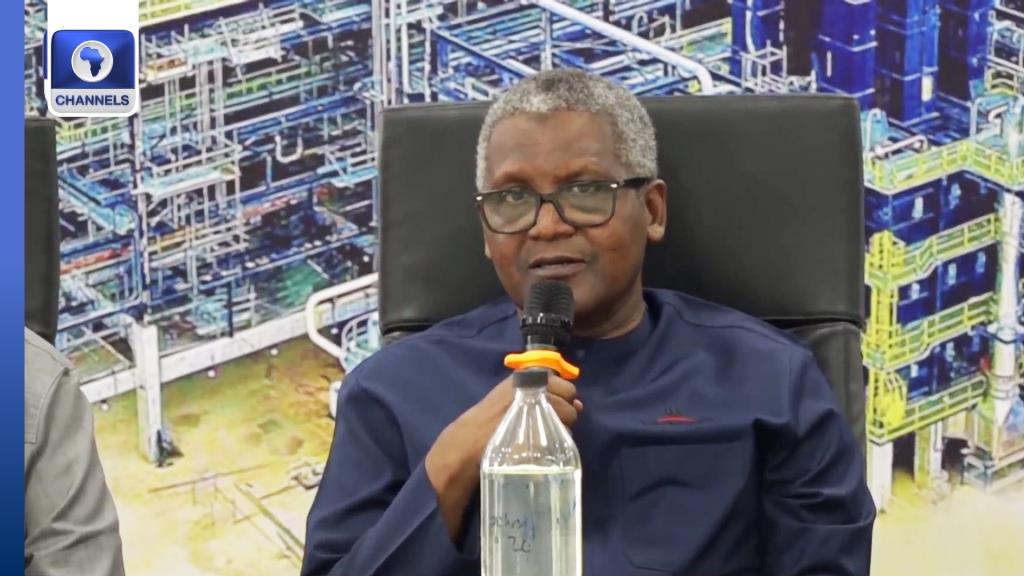
The 700,000 barrels per day Dangote Petroleum Refinery has begun pricing fuel products for the local market in US Dollars amid crude supply challenges.
The company cited difficulties securing sufficient crude under the government’s Naira-for-crude programme and rising global oil prices as reasons for the development.
The Naira-for-crude programme, launched in October 2024, allowed domestic refiners to purchase crude in the local currency and reduced pressure on the foreign exchange market.
Mr Edwin Devakumar, the vice president of the Dangote Group, said the refinery had been absorbing a currency mismatch by selling products in Naira while sourcing crude in Dollars, but limited crude supply under the Naira-for-crude programme had undermined the arrangement’s viability.
Dangote has now set the ex-depot price of petrol at $0.779 per litre, diesel at $1.087 per litre and aviation fuel at $0.942 per litre, according to a pricing template circulated to marketers.
Although the Nigerian National Petroleum Company (NNPC) Limited increased Dangote’s allocation to seven cargoes in May from about five previously, the refiner has said it requires 13 to 15 cargoes a month and has been forced to import the remainder at international prices.
The decision could boost demand for Dollars among fuel marketers and make domestic fuel prices more sensitive to exchange-rate fluctuations.
Dangote Refinery is steadily ramping up operations toward full capacity after a gradual start since late 2023. In April alone, it received 21 separate crude cargoes, with all supplies coming from West Africa, mainly Nigerian crude grades, with one cargo from Cameroon; however, it boosted international cargoes in recent months.
The refinery has been broadening the range of crude grades it processes as part of its ambition to operate as a fully merchant refinery. In 2025, about 70 per cent of the refinery’s crude imports came from Nigeria, while 24 per cent originated from the United States.
Dangote plans to double the refinery’s processing capacity to 1.4 million barrels per day by the end of 2028, a level that would enable it to process about 80 per cent of Nigeria’s recent crude oil production in a single day.
