

Economy
How Operators, Companies Plotted to Dupe Investors in 2008—SEC DG

By Dipo Olowookere
Prior to the crash of the global economy in 2008, the Nigerian capital market was the darling of many local investors, attracting many people, with good amount of money made by regulators, investors, stockbrokers and companies. It was a time money was flowing in the country like a river.
But in this, some investors had a very sad tale to tell because they lost huge amount of money during the period, which the country may never experience again.
Companies were listing their shares on the Nigerian Stock Exchange (NSE) at premium rates and some others promised to join the exchange after private placements, which never came.
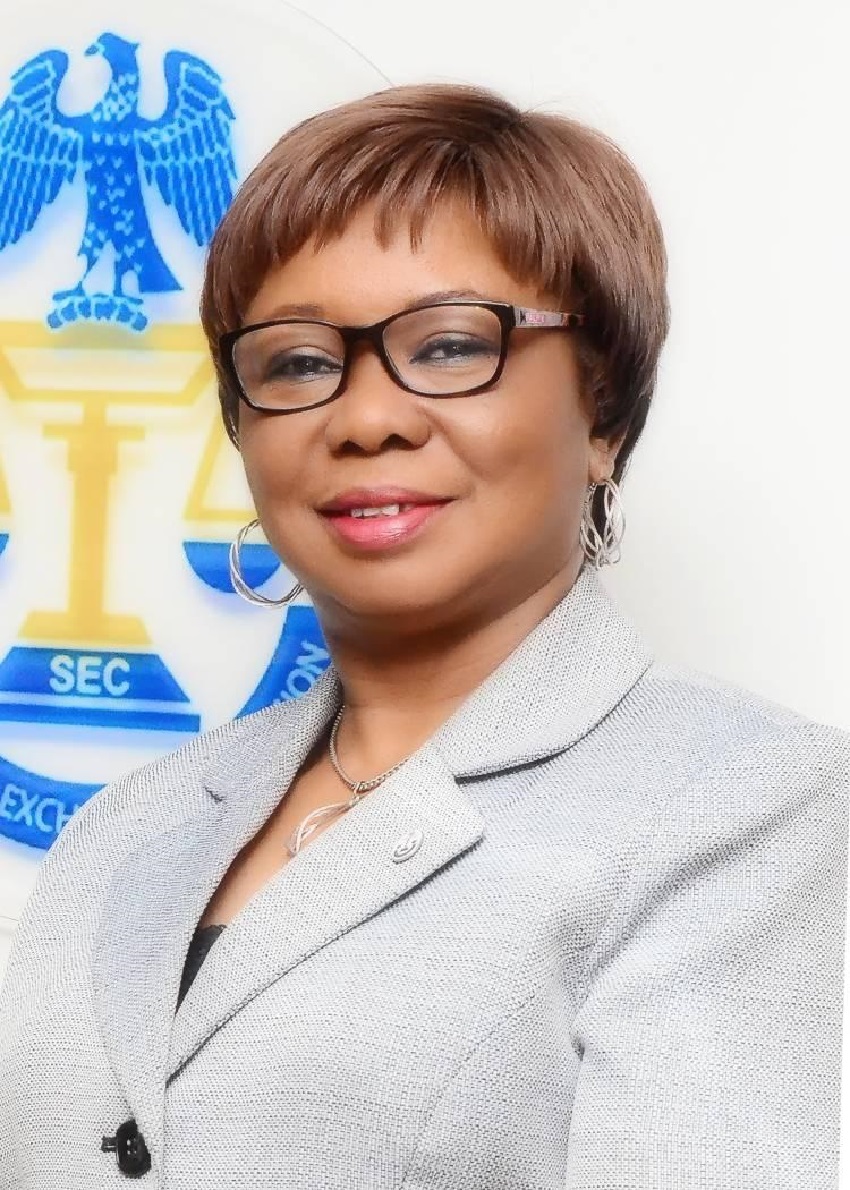
Last week, the Securities and Exchange Commission (SEC) held a joint conference with the Department of Finance of the University of Lagos (UNILAG) and the acting Director General of the agency, MS Mary Uduk, explained why some investors became victims of private placement ‘fraud’ during the period.
Commenting on the private placement bubble of 2007 and 2008, the head of the apex regulator in the nation’s capital market said this happened with the connivance of many market operators who encouraged issuers to take advantage of loopholes in the relevant investment laws at the time.
She lamented a situation where many private companies took advantage of gaps in Nigerian laws, especially between 2007 and 2008 to defraud many investors, by embarking on private placements, with promises to list the shares for trading on the Nigerian Stock Exchange, when in reality they had no such intention.
Ms Uduk recalled several efforts and appeals to such issuers, to list their shares without success, stressing that “market operators encouraged private placements knowing that the law did not allow the SEC to regulate private companies.”
“Insider trading is what we have to prove. A lot of us are in the market and we have whistle blowing mechanism. It is the operators who will be in a better position to know and report such infractions. For those that have been reported to us, we have been carrying out investigations and once we have evidence, we will invite them and also refer them to the relevant authorities
“With the whistle blowing provision, we have always asked operators in the market to come to our aid if they find any unwholesome activity going on. It is our market and so we all have to do our bit. The market should not be left to us alone; you need to provide information for us to take the necessary actions.
“Anyone that is caught engaging in any activity that is against the laid down rules, be rest assured that such an operator will be made to face the full wrath of the law,” she declared.
She urged operators to cooperate with the commission for the good of the market and the economy, realizing that “it is our market, please let us join hands and revive this market.
“Let us come together and sanitise this market,” she stressed, urging them to bring incidences of market abuse to the attention to the commission and enjoy protection under the law.
Ms Uduk said SEC has been doing its best to ensure that offenders are not left off the hook, hence the Commission is collaborating with EFCC and office of attorney general to be able to do much.
The DG has assured investors that the commission was committed to ensuring that suspicious transactions are not allowed in the capital market.
“We are committed to protecting investors in the work we do. We will keep working on our rules and the possibility of amending them when the need arises, we want more transparency in the market so that investors will feel comfortable and the market can be better,” she added.
The Acting DG said the commission also has the complaints management framework that enables investors to know where to complain to and how long it takes for such complaints to be resolved and for those of the investors that are averse to risks, they are advised to get their financial advisers to tell them where to invest.
“In doing all these, we advise retail investors to invest in Collective Investment Schemes and Mutual Funds because those are managed independently by professionals and they are diversified thereby reducing risks. We also implore investors to take ownership of their investments. They have to be able to monitor their investments, attend annual general meetings as well as read the annual reports sent out to them.



By Adedapo Adesanya
The NASD Over-the-Counter (OTC) Securities Exchange improved by 0.89 per cent on Tuesday, June 30, spurring the market capitalisation to chalk up N22.72 billion to close at N2.580 trillion, in contrast to the preceding session’s N2.557 trillion.
In the same vein, the NASD Unlisted Security Index (NSI) added 37.85 points during the session to settle at 4,2991.41 points from Monday’s 4,261.56 points.
The unlisted securities market gained weight yesterday after finishing with three price losers and gainers, led by Nipco Plc, which improved its share price by N34.24 to N384.00 per unit from N349.76 per unit. FrieslandCampina Wamco Nigeria Plc appreciated by N10.25 to close at N152.01 per share versus N141.76 per share, and Food Concepts Plc soared by 7 Kobo to settle at N2.50 per unit versus N2.43 per unit.
On the flip side, Afriland Properties Plc weakened by N1.57 to N15.17 per share from N16.74 per share, Central Securities Clearing System (CSCS) Plc lost 48 Kobo to trade at N88.00 per unit compared with Monday’s N88.48 per unit, and Geo-Fluids Plc eased by 24 Kobo to N2.37 per share from N2.61 per share.
During the session, the volume of securities traded by market participants moved up by 268.9 per cent to 846,063 units from 229,314 units, while the value of securities dropped 34.9 per cent to N15.99 million from N24.6 million, and the number of deals crashed by 26.5 per cent to 25 deals from 34 deals.
Great Nigeria Insurance (GNI) Plc remained the most active stock by value on a year-to-date basis, with 3.4 billion units worth N8.4 billion, the second spot was occupied by Infrastructure Credit Guarantee (Infracredit) Plc with 2.3 billion units valued at N6.5 billion, and the third spot was taken by CSCS Plc with 68.8 million units traded for N4.7 billion.
GNI Plc also ended the day as the most active stock by volume on a year-to-date basis, with 3.4 billion units exchanged for N8.4 billion, followed by Infracredit Plc with 2.3 billion units transacted N6.5 billion, and Resourcery Plc with 1.1 billion units sold for N415.7 million.
By Adedapo Adesanya
The Naira appreciated against the US Dollar by N3.95 0r 0.29 per cent to exchange at N1,379.68/$1 in the Nigerian Autonomous Foreign Exchange Market (NAFEX) on Tuesday, June 30, compared with the previous day’s N1,383.63/$1.
The positive movement was also seen against the Pound Sterling at the same official market window, where it gained N6.59 to trade at N1,825.05/£1 versus the preceding day’s N1,831.64/£1, and improved against the Euro by N5.05 to sell for N1,572.98/€1 compared with Monday’s price of N1,578.03/€1.
At the GTBank FX counter, the Nigerian Naira, however, lost N2 against the Dollar yesterday to quote at N1,389/$1, in contrast to the previous session’s N1,387/$1, and at the black market, it remained unchanged at N1,395/$1,
A look at the cryptocurrency market yesterday showed that Bitcoin (BTC) depleted for the fifth straight day, selling at $58,668.93. This sits below the levels that sparked rebounds in February and earlier in June, as well as the 50-day and 200-day moving averages.
Dogecoin (DOGE) crashed by 1.5 per cent to sell at $0.0713, Binance Coin (BNB) lost 1.4 per cent to close at $544.98, Ethereum (ETH) went down by 1.0 per cent to $1,574.60, TRON (TRX) depreciated by 0.8 per cent to $0.3164, and Ripple (XRP) dropped 0.8 per cent to finish at $1.03.
Conversely, Cardano (ADA) grew by 2.9 per cent to $0.1493, and Solana (SOL) increased by 0.3 per cent to $74.19, while the US Dollar Tether (USDT) and the US Dollar Coin (USDC) traded flat at $1.00 apiece.

By Adedapo Adesanya
The oil market rose on Wednesday morning amid concerns that breakdowns in discussions between Iran and the United States for a final agreement to end their war may extend supply disruptions in the key Middle East producing region.
Brent futures gained 33 cents or 0.45 per cent to trade at $73.28 a barrel, while the US West Texas Intermediate (WTI) crude climbed 34 cents or 0.49 per cent to $69.84 a barrel.
US officials arrived in Qatar for talks on the Iran war, but will meet with mediators, not Iranian negotiators. The lack of direct talks further complicates efforts to find a lasting end to the conflict and fully reopen the Strait of Hormuz.
The representatives, which include US President Donald Trump’s son-in-law Jared Kushner and envoy Steve Witkoff, arrived in Doha for what the White House described as “high-level” talks on Tuesday, but Iran and host Qatar said they would meet with mediators, rather than the Iranians themselves.
The Wall Street Journal reported that while hardline military officials are pushing for full control of Hormuz, Iranian civilian leaders like President Masoud Pezeshkian are aiming to get access to billions in frozen assets, indicating different priorities.
Brent fell by around $45 a barrel between the first and second quarters of this year, its largest quarterly loss since 2008 during the financial crisis in the US. Crude futures meanwhile fell by around $31, their largest quarterly loss since 2020, when the COVID-19 pandemic crushed global oil demand.
The declines followed progress toward ending the Middle East conflict, pulling back from the sharp gains triggered earlier by the hostilities.
Analysts have cut their 2026 oil price forecasts after five straight monthly increases, as the reopening of the Strait of Hormuz eased concerns over prolonged supply disruptions.
Tanker traffic through the critical waterway has started to recover, with US Vice President JD Vance claiming that oil flows through the strait had been restored to pre-war levels.
The American Petroleum Institute (API) estimated that crude oil inventories in the US fell by 6.072 million barrels in the week ending June 26. In the week prior, US crude oil inventories fell by 765,000 barrels.
Official oil stock data from the US Energy Information Administration (EIA)will be released later on Wednesday.

-
 Feature/OPED6 years ago
Davos was Different this year
-
Travel/Tourism10 years ago
Lagos Seals Western Lodge Hotel In Ikorodu
-

 Showbiz3 years ago
Estranged Lover Releases Videos of Empress Njamah Bathing
-
 Banking8 years ago
Sort Codes of GTBank Branches in Nigeria
-

 Economy3 years ago
Subsidy Removal: CNG at N130 Per Litre Cheaper Than Petrol—IPMAN
-

 Banking3 years ago
Sort Codes of UBA Branches in Nigeria
-

 Banking3 years ago
First Bank Announces Planned Downtime
-

 Sports3 years ago
Highest Paid Nigerian Footballer – How Much Do Nigerian Footballers Earn