

Economy
17 Insurance Firms to Resubmit Recapitalisation Plans


By Modupe Gbadeyanka
The National Insurance Commission (NAICOM) has asked 17 insurance companies in the country to review and resubmit their plans, which highlights how they intend to meet the new capital base requirement requested for by the regulator.
NAICOM had given the underwriters till Tuesday, August 20, 2019 to submit the recapitalisation templates, which should contain a resolution of the board on how the funds for the exercise would be sourced with timelines and deliverables.
“Companies intending to seek funds from the capital markets are required to submit their plan of action on a file-and-use basis.
“Companies that intend to merge or acquire another should submit their proposal after which they must comply with Section 30 and 31 of the Insurance Act 2003,” a circular issued in July and signed by Mr Pius Agboola, the Director in charge of Policy & Regulation Directorate at NAICOM, had said, adding that the agency “shall review and provide responses on the submitted Recapitalization Plans on or before 17th September 2019” stressing that, “The review may require meeting with the board and management of each of the insurance company on its recapitalisation plan.”
In the latest circular last week, which was signed by the Head of Commissioner for Insurance Directorate at NAICOM, Mr Rasaaq Salami, it was stated that a total of 49 plans were received from 47 insurers and two reinsurers.
From the figure, NAICOM said 26 firms were granted ‘No Objection’ to proceed with their plans, 17 had their plans corrected and told to resubmit the revised plans using paid-up capital and not shareholders fund.
In addition, four firms were advised to review their plans of using IPO for not having the requisite 2018 financial statements, while one, which had a pending court case, was asked to resolve it before embarking on recapitalization.
Also, plans of two firms are under review, while three companies are yet to submit their recapitalisation plans, with an operator not meeting the necessary requirements.
In the circular, Mr Salami said NAICOM has informed the affected companies about outcome of their submitted plans.
Business Post reports that this year, NAICOM gave operators a 13-month ultimatum to raise their capital base by at least 100 percent on or before June 30, 2020.
Life insurers were told to raise their minimum paid up capital from N2 billion to N8 billion; general underwriters from N3 billion to N10 billion; while composite and reinsurance companies have new minimum paid up share capital requirements of N18 billion and N20 billion, up from N5 billion and N10 billion respectively.




By Adedapo Adesanya
The NASD Over-the-Counter (OTC) Securities Exchange opened the week with a 0.52 per cent rise on Monday, July 20, driven by renewed buying interest.
The volume of securities traded during the opening session surged by 6,663.3 per cent to 52.6 million units from the previous 777,002 units, and the value of securities rose by 200.9 per cent to N191.2 million from the preceding session’s N104.2 million, while the number of deals depreciated by 15.2 per cent to 28 deals compared to the preceding session’s 33 deals.
Great Nigeria Insurance (GNI) Plc remained the most active stock by value on a year-to-date basis, with 3.4 billion units sold for N8.4 billion, followed by Infrastructure Credit Guarantee (Infracredit) Plc with 2.3 billion units valued at N6.5 billion in trades, and Central Securities Clearing System (CSCS) Plc with 75.4 million units exchanged for N5.3 billion.
GNI Plc also closed the day as the most traded stock by volume on a year-to-date basis, with 3.4 billion units worth N8.4 billion, followed by Infracredit Plc with 2.3 billion units transacted for N6.5 billion, and Resourcery Plc with 1.1 billion units traded for N415.7 million.
Yesterday, there were two price gainers and three price losers, led by FrieslandCampina Wamco Nigeria Plc, which slid by 66 Kobo to end at N141.15 per unit versus last Friday’s N141.81 per unit, Food Concepts Plc lost 24 Kobo to close at N2.31 per share versus N2.55 per share, and Geo-Fluids Plc declined by 17 Kobo to settle at N2.25 per unit compared with the previous closing price of N2.42 per unit.
Conversely, CSCS Plc chalked up N5.19 to close at N99.33 per share versus N94.14 per share, and Mass Telecoms Plc appreciated by 3 Kobo to sell at 35 Kobo per unit from 32 Kobo per unit.
As a result, the market capitalisation increased by N13.57 billion to N2.606 trillion from N2.593 trillion, and the NASD Security Index (NSI) gained 22.6 points to quote at 4,343.27 points, in contrast to the previous 4,320.67 points.
By Adedapo Adesanya
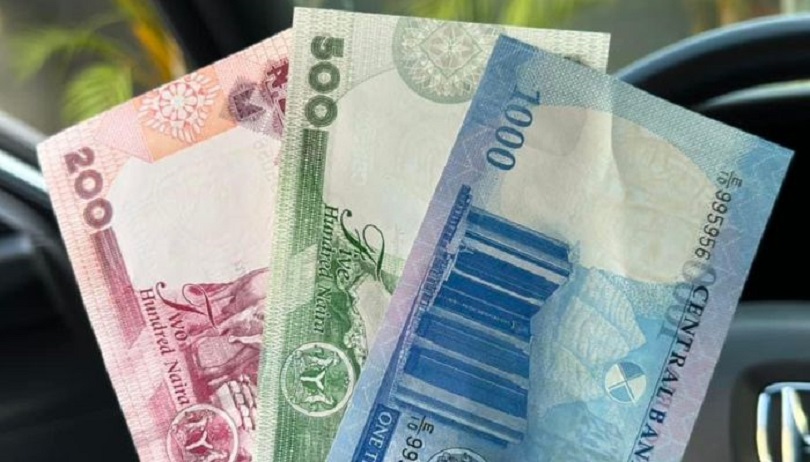
The Naira almost traded flat against the United States Dollar in the Nigerian Autonomous Foreign Exchange Market (NAFEX) on Monday, July 20. It gained 7 Kobo during the session to sell at N1,380.11/$1, in contrast to last Friday’s value of N1,380.18/$1.
It also appreciated against the Euro in the same market window during the session by N1.64 to close at N1,575.95/€1 versus the preceding session’s N1,576.99/€1, but depreciated against the Pound Sterling by N2.93 to trade at N1,857.35/£1 compared with the previous trading day’s N1,854.42/£1.
At the GTBank forex desk, the Nigerian Naira lost N1 against the US Dollar to quote at N1,389/$1 versus N1,388/$1, and at the black market, it traded flat at N1,405/$1.
Data from the Central Bank of Nigeria (CBN) showed that interbank FX turnover settled at $266.2 million, 7.5 per cent lower than the previous close of $287.8 million. Also, the number of deals at the interbank FX market declined to 68 from 106.
Despite this, there are signals that the Naira has pillars that can prop up its stability. Updated data from the apex bank showed Nigeria’s gross foreign exchange reserves increased to $51.92 billion as of July 16, 2026, reflecting continued improvements in the country’s external position.
A slew of analysts predict further increases will lift the gross balance above $52 billion this week, the highest seen since 2009.
Also, there are expectations that the country will be able to boost remittances into the country to $1 billion on a monthly basis by the end of the year; this will help ease pressure on the FX markets.
Meanwhile, in the crypto market, Bitcoin (BTC) climbed to about $65,500, reaching a two-week high, as the semiconductor selloff that dragged crypto lower last week reversed and Asian chip stocks led a broad risk rally. It rose by 2.4 per cent to $65,676.01.
There was also support from five straight days of inflows into US spot Bitcoin ETFs totalling more than $600 million, marking the strongest stretch of institutional buying since mid-July.
Cardano (ADA) jumped by 8.3 per cent to $0.1756, Ethereum (ETH) grew by 4.0 per cent to $1,930.33, Ripple (XRP) improved by 3.9 per cent to $1.13, Solana (SOL) appreciated by 3.2 per cent to $78.34, Binance Coin (BNB) added 1.9 per cent to sell for $575.34, and Dogecoin (DOGE) expanded by 1.7 per cent rise to $0.0729.
However, TRON (TRX) declined by 0.1 per cent to $0.3261, and the US Dollar Tether (USDT) and the US Dollar Coin (USDC) traded flat at $1.00 each

By Dipo Olowookere
Sustained bargain-hunting in local stocks further lifted the Nigerian Exchange (NGX) Limited by 1.12 per cent on Monday.
The buying pressure was across the major sectors of Customs Street, though the consumer goods space came under profit-taking, closing flat.
But the banking counter expanded by 3.14 per cent, the industrial goods index gained 2.82 per cent, the insurance sector increased by 0.25 per cent, and the energy segment soared by 0.08 per cent.
Consequently, the All-Share Index (ASI) surged by 2,721.83 points to 246,183.96 points from 243,462.13 points, and the market capitalisation went up by N1.755 trillion to N158.812 trillion from N157.057 trillion.
Custodian Investment and NEM Insurance chalked up 10.00 per cent each to sell for N75.90 and N30.80, respectively, BUA Cement rose by 9.98 per cent to N303.10, First Holdco improved by 9.95 per cent to N105.50, and FTN Cocoa advanced by 9.94 per cent to N9.29.
On the flip side, SUNU Assurances shrank by 10.00 per cent to N3.60, Tripple Gee slipped by 9.77 per cent to N3.51, ABC Transport tumbled by 9.62 per cent to N7.05 per cent, Abbey Bank crashed by 9.00 per cent to N9.10, and Coronation Insurance dipped by 7.69 per cent to N2.40.
The market breadth index was flat yesterday, as there were 31 price gainers and 31 price losers.
First Holdco led the activity chart during the session, with a turnover of 203.9 million shares valued at N21.5 billion. Access Holdings sold 190.7 million equities worth N4.8 billion, UBA traded 29.2 million stocks for N1.4 billion, Zenith Bank transacted 24.7 million shares valued at N2.9 billion, and Sterling Holdings exchanged 23.6 million equities worth N187.4 million.
When trading activities ended at 4 pm, investors traded 851.6 million stocks for N49.6 billion in 56,873 deals compared with the 685.9 million stocks valued at N42.7 billion transacted in 44,134 deals last Friday, representing a rise in the trading volume, value, and number of deals by 24.16 per cent, 16.16 per cent, and 28.86 per cent, respectively.
