Economy
EU Plans €820m Investment in Nigeria’s Digital Economy
By Modupe Gbadeyanka
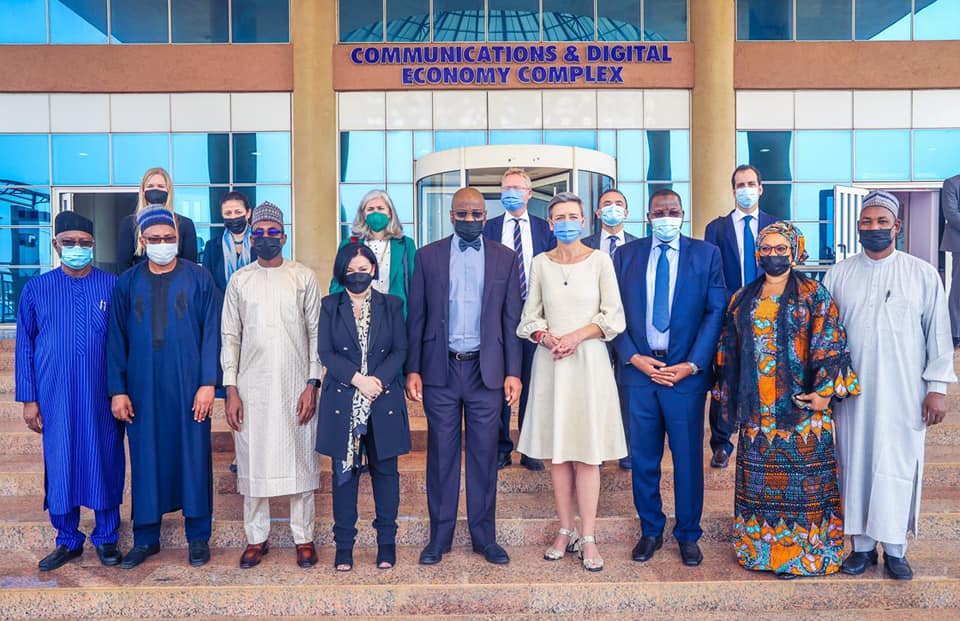
There are plans by the European Union (EU) to invest about €820 million in Nigeria’s digital economy through the Gateway Initiative.
A statement issued on Monday by Mrs Uwa Suleiman, spokesperson to the Minister of Communications and Digital Economy, Mr Isa Ali Pantami, disclosed that the investment comprises €160 million in grants and €660 million in loans.
She said the funds would be pumped into the sector by the European bloc over the next three years, according to the Executive Vice President of the EU, Ms Margrethe Vestager.
Mrs Vestager, while extolling the leadership style of the Minister, noted that this, and the need for stronger partnerships has brought global attention to the country’s digital economy sector.
She enumerated the Union’s intervention in the sector to include; Digital Infrastructure Investments, Digitalisation of Public Services, Digital Entrepreneurship, Digital Skills and Digital Governance.
“Nigeria has immense potential for digitalization and with a combination of €160 million in grants and €660 million in loans, the European Union aims to comprehensively support Nigeria’s digitalisation strategy,” she emphasized.
In his response, Mr Pantami, while expressing his delight and appreciation for the intervention, reiterated the federal government’s willingness to partner with the EU.
“Africa has always looked up to Europe in the area of technological advancements and this partnership is a welcome development that will project the digitalization aspirations of our country.”
The Minister was particular about digital entrepreneurship and the immense impact it will bring to bear on the nation’s economy.
“This partnership with regards to digital entrepreneurship will address the challenge of unemployment and unemployability alongside the Nigeria Startup Bill which also aims to address a myriad of issues within the ecosystem,” she stated.
Mr Pantami further informed the delegation that Nigeria hopes to achieve a paperless office by the year 2030 and it is on track, taking into cognizance the rate at which public institutions are embracing the digital economy drive.
The EU intervention is in alignment with the Nigeria Digital Economy Policy and Strategy (NDEPS), a digital roadmap initiated and championed by the Minister towards the economic digitalisation drive of President Muhammadu Buhari.
Economy
Naira Slides to N1,368/$1 at Official Market, N1,405/$1 at Black Market
By Adedapo Adesanya
The value of the Nigerian Naira weakened against the United States Dollar in the different segments of the foreign exchange (FX) market on Friday, amid fresh forex demand pressure.
In the black market, the domestic currency depreciated against the greenback by N5 to sell for N1,405/$1 compared with the previous day’s N1,400/$1, and at the GTBank FX desk, it lost N4 to quote at N1,374/$1, in contrast to the previous session’s N1,370/$1.
Similarly, in the Nigerian Autonomous Foreign Exchange Market (NAFEX), it slipped by N1.49 or 0.11 per cent to settle at N1,368.22/$1 compared with the preceding day’s N1,366.73/$1.
In the same vein, the local currency depleted against the Pound Sterling by N3.50 to close at N1,837.79/£1 versus Thursday’s price of N1,834.29/£1, and against the Euro, it shed 90 Kobo to finish at N1,573.87/€1 compared with the preceding session’s N1,572.97/€1.
Data from the Central Bank of Nigeria (CBN) indicated that interbank FX turnover marginally grew above the previous day by 0.97 per cent to $58.990 million from $58.423 million, with the number of deals executed by financial institutions down by 2.82 per cent to 69 deals from 71 deals, as the nation’s foreign reserves further declined to $51.922 billion from $51.938 billion.
A look at the cryptocurrency market showed that Bitcoin (BTC) fell by 1.4 per cent to $62,004.42 as renewed US–Iran tensions lifted oil prices and strengthened the US Dollar.
Iran said it attacked two oil tankers attempting to cross the waterway under US military escort. Tehran also claimed it turned back four other vessels, while ship-tracking data showed that traffic through the strait remained thin.
The development carries greater market risk than an isolated attack on commercial vessels because the presence of a US escort raises the possibility of a direct military response.
This negatively impacted the crypto space, with Ripple (XRP) down by 1.5 per cent to $1.06, and Ethereum (ETH) losing 1.2 per cent to trade at $1,867.85. Solana (SOL) depreciated by 0.9 per cent to $72.91, TRON (TRX) shrank by 0.4 per cent to $0.3271, and Dogecoin (DOGE) crashed by 0.3 per cent to $0.0698.
However, Cardano (ADA) appreciated by 0.9 per cent to $0.1711, and Binance Coin (BNB) went up by 0.1 per cent to $589.78, while the US Dollar Tether (USDT) and the US Dollar Coin (USDC) remained unchanged at $1.00 apiece.
Economy
AVA Capital Expands Investors’ Investment Opportunities With NGX Listing
By Dipo Olowookere
The range of investment opportunities available to investors in the nation’s capital market has been deepened with the listing of five billion ordinary shares of AVA Capital Plc on the Nigerian Exchange (NGX) Limited.
The local investment firm joined the country’s flagship stock exchange on Friday through listing by introduction of its equities at N7.50 per share, with a market capitalisation of N37.5 billion.
The listing marks a significant milestone in the company’s growth journey, reinforcing its commitment to sustainable growth, strong corporate governance and long-term value creation, while enhancing its visibility within Nigeria’s capital market.
The chief executive of AVA Capital, Mr Kayode Fadahunsi, described the admission of the organisation on the main board of the exchange as a defining moment in its evolution.
“Our admission to the main board of Nigerian Exchange is more than a listing; it is a public affirmation of the business we have built and the future we are committed to creating.
“We have established a resilient institution with a clear growth strategy, strong governance culture and an unwavering focus on creating sustainable value for our shareholders.
“Becoming a listed company deepens our accountability, broadens our visibility and positions us to seize new opportunities as we continue our growth journey,” he said.
On his part, the chief exchange of NGX Limited, Mr Jude Chiemeka, said the admission reflects the continued confidence of businesses in Nigeria’s capital market as a platform for sustainable growth.
“[The] listing reflects the confidence that forward-looking companies continue to place in the Nigerian capital market.
“By joining the main board of Nigerian Exchange, AVA Capital Plc is embracing the transparency, governance standards and market discipline that define public companies, while positioning itself to access a broader investor base and unlock long-term value.
“We are delighted to welcome AVA Capital Plc to the NGX family and look forward to supporting its continued growth,” he stated.
Economy
Oil Prices up on Renewed Middle East Risks
By Adedapo Adesanya
Oil prices were slightly up by 1 per cent on Friday after Iran said it had stopped two vessels seeking to exit the Strait of Hormuz, underscoring concerns over global energy supplies.
Brent futures gained $1.09 or 1.2 per cent to trade at $90.12 a barrel, while the US West Texas Intermediate (WTI) futures chalked up $1.08 or 1.3 per cent to settle at $84.67 a barrel. For July, Brent gained 24 per cent, and WTI rose 21 per cent.
Iran said four other tankers turned back after its forces intervened, although the Iranian reports could not be independently confirmed.
The war in Iran, which began on February 28, has sharply curtailed traffic through the Strait of Hormuz, a vital chokepoint that previously carried about a fifth of global crude oil and natural gas supplies, disrupting millions of barrels per day of Middle East output.
Iran has largely blocked shipping through the strait since the conflict began, while its Houthi allies in Yemen in July threatened vessels transiting the Bab el-Mandeb strait at the southern end of the Red Sea, jeopardising an alternative export route used by Saudi Arabia and other regional producers.
A drone strike that sparked fires on two gas vessels in Egypt’s Mediterranean port of Damietta also raised threats to shipping through the Suez Canal.
A body set up by Iran to manage the Strait of Hormuz said on Friday that crossings remained impossible due to “continued aggressive actions by U.S. military forces in the region.”
However, there were no reports of new US attacks on Iran overnight between Thursday and Friday after what was a sharp escalation in its war on Iran earlier in the week, with joint US-Saudi strikes on Iranian-allied forces in Iraq.
There are indications that this might go over the weekend after US President Donald Trump, in a statement to Fox News on Friday, said the war was going well.
He later said he believed a deal could still be reached with Iran, and Special Envoy Steve Witkoff, his son-in-law Jared Kushner and Secretary of State Marco Rubio are involved in talks.
Earlier in the week, the US Energy Information Administration (EIA) data showed commercial crude stocks last week fell to their lowest levels since 2018.
Oman has presented Iran with a plan backed by Gulf states to manage the Strait of Hormuz, including collecting voluntary fees for using it. This was initially rejected, but Reuters reported that talks with Oman over the waterway were continuing.