

Economy
Nigeria to Increase Gas Export to Europe


By Adedapo Adesanya
The Nigerian government is planning to increase gas export to the European Union (EU) as part of efforts to boost the nation’s revenue.
This was part of the talking points reached in collaborative digital economy plans between both parties through the Gateway Initiative.
According to the Senior Special Assistant to the Vice President on Media and Publicity, Mr Laolu Akande, in a statement titled Nigeria EU to work together on digital economy, explore raising LNG supply to European countries on Monday, the EU had requested for Nigeria to increase allocation.
Addressing the EU delegation, Vice President Yemi Osinbajo was quoted as saying, “We are relieved to hear of the EU’s support on gas as a transition fuel. It’s some bit of relief.”
He added, “The importance of the energy relationship between Nigeria and the EU also featured, while consideration of all options for increased supply of Liquified Natural Gas from Nigeria to the EU was agreed to, following a request from the EU. A technical meeting on this will be convened shortly.”
Business Post had reported that the Executive Vice President, EU, Mrs Margre Vestager, according to a statement signed by Mrs Uwa Suleiman, the spokesperson for the Minister of Communications and Digital Economy on Monday, in Abuja said the European bloc under its Gateway Initiative will invest about €820m (N385 billion) in the Nigerian digital economy sector over the next three years.
The statement read in part “The European Union under its Gateway Initiative has disclosed plans to invest about £820m in the Nigerian Digital Economy sector over the next three years.”
Mrs Vestager, who was on a working visit, said the union plans to invest in digital infrastructure investments, digitalisation of public services, digital entrepreneurship, digital skills, and digital governance.
She was quoted as saying, “Nigeria has immense potential for digitalisation and with a combination of £160m in grants and £660m in loans, the EU aims to comprehensively support Nigeria’s digitalisation strategy.”
In his response, the Minister, Isa Pantami, thanked the EU for the intervention and affirmed the federal government’s willingness to partner with the EU.
“Africa has always looked up to Europe in the area of technological advancements and this partnership is a welcome development that will project the digitalisation aspirations of our country,” he said.



By Adedapo Adesanya
The NASD Over-the-Counter (OTC) Securities Exchange opened the week with a 0.52 per cent rise on Monday, July 20, driven by renewed buying interest.
The volume of securities traded during the opening session surged by 6,663.3 per cent to 52.6 million units from the previous 777,002 units, and the value of securities rose by 200.9 per cent to N191.2 million from the preceding session’s N104.2 million, while the number of deals depreciated by 15.2 per cent to 28 deals compared to the preceding session’s 33 deals.
Great Nigeria Insurance (GNI) Plc remained the most active stock by value on a year-to-date basis, with 3.4 billion units sold for N8.4 billion, followed by Infrastructure Credit Guarantee (Infracredit) Plc with 2.3 billion units valued at N6.5 billion in trades, and Central Securities Clearing System (CSCS) Plc with 75.4 million units exchanged for N5.3 billion.
GNI Plc also closed the day as the most traded stock by volume on a year-to-date basis, with 3.4 billion units worth N8.4 billion, followed by Infracredit Plc with 2.3 billion units transacted for N6.5 billion, and Resourcery Plc with 1.1 billion units traded for N415.7 million.
Yesterday, there were two price gainers and three price losers, led by FrieslandCampina Wamco Nigeria Plc, which slid by 66 Kobo to end at N141.15 per unit versus last Friday’s N141.81 per unit, Food Concepts Plc lost 24 Kobo to close at N2.31 per share versus N2.55 per share, and Geo-Fluids Plc declined by 17 Kobo to settle at N2.25 per unit compared with the previous closing price of N2.42 per unit.
Conversely, CSCS Plc chalked up N5.19 to close at N99.33 per share versus N94.14 per share, and Mass Telecoms Plc appreciated by 3 Kobo to sell at 35 Kobo per unit from 32 Kobo per unit.
As a result, the market capitalisation increased by N13.57 billion to N2.606 trillion from N2.593 trillion, and the NASD Security Index (NSI) gained 22.6 points to quote at 4,343.27 points, in contrast to the previous 4,320.67 points.
By Adedapo Adesanya
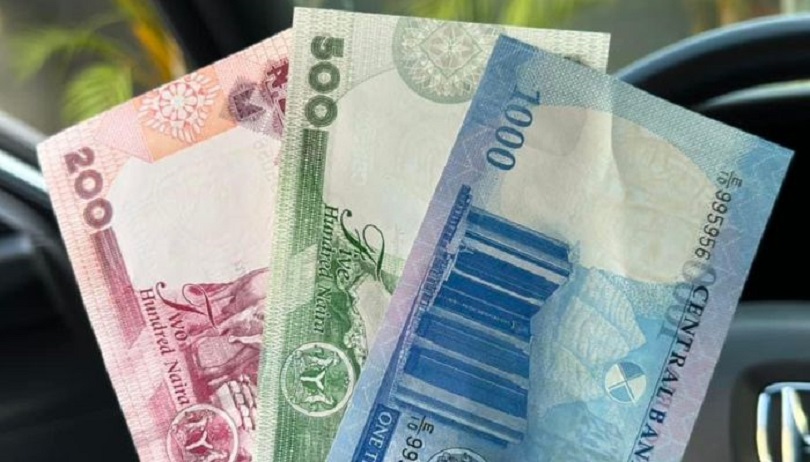
The Naira almost traded flat against the United States Dollar in the Nigerian Autonomous Foreign Exchange Market (NAFEX) on Monday, July 20. It gained 7 Kobo during the session to sell at N1,380.11/$1, in contrast to last Friday’s value of N1,380.18/$1.
It also appreciated against the Euro in the same market window during the session by N1.64 to close at N1,575.95/€1 versus the preceding session’s N1,576.99/€1, but depreciated against the Pound Sterling by N2.93 to trade at N1,857.35/£1 compared with the previous trading day’s N1,854.42/£1.
At the GTBank forex desk, the Nigerian Naira lost N1 against the US Dollar to quote at N1,389/$1 versus N1,388/$1, and at the black market, it traded flat at N1,405/$1.
Data from the Central Bank of Nigeria (CBN) showed that interbank FX turnover settled at $266.2 million, 7.5 per cent lower than the previous close of $287.8 million. Also, the number of deals at the interbank FX market declined to 68 from 106.
Despite this, there are signals that the Naira has pillars that can prop up its stability. Updated data from the apex bank showed Nigeria’s gross foreign exchange reserves increased to $51.92 billion as of July 16, 2026, reflecting continued improvements in the country’s external position.
A slew of analysts predict further increases will lift the gross balance above $52 billion this week, the highest seen since 2009.
Also, there are expectations that the country will be able to boost remittances into the country to $1 billion on a monthly basis by the end of the year; this will help ease pressure on the FX markets.
Meanwhile, in the crypto market, Bitcoin (BTC) climbed to about $65,500, reaching a two-week high, as the semiconductor selloff that dragged crypto lower last week reversed and Asian chip stocks led a broad risk rally. It rose by 2.4 per cent to $65,676.01.
There was also support from five straight days of inflows into US spot Bitcoin ETFs totalling more than $600 million, marking the strongest stretch of institutional buying since mid-July.
Cardano (ADA) jumped by 8.3 per cent to $0.1756, Ethereum (ETH) grew by 4.0 per cent to $1,930.33, Ripple (XRP) improved by 3.9 per cent to $1.13, Solana (SOL) appreciated by 3.2 per cent to $78.34, Binance Coin (BNB) added 1.9 per cent to sell for $575.34, and Dogecoin (DOGE) expanded by 1.7 per cent rise to $0.0729.
However, TRON (TRX) declined by 0.1 per cent to $0.3261, and the US Dollar Tether (USDT) and the US Dollar Coin (USDC) traded flat at $1.00 each

By Dipo Olowookere
Sustained bargain-hunting in local stocks further lifted the Nigerian Exchange (NGX) Limited by 1.12 per cent on Monday.
The buying pressure was across the major sectors of Customs Street, though the consumer goods space came under profit-taking, closing flat.
But the banking counter expanded by 3.14 per cent, the industrial goods index gained 2.82 per cent, the insurance sector increased by 0.25 per cent, and the energy segment soared by 0.08 per cent.
Consequently, the All-Share Index (ASI) surged by 2,721.83 points to 246,183.96 points from 243,462.13 points, and the market capitalisation went up by N1.755 trillion to N158.812 trillion from N157.057 trillion.
Custodian Investment and NEM Insurance chalked up 10.00 per cent each to sell for N75.90 and N30.80, respectively, BUA Cement rose by 9.98 per cent to N303.10, First Holdco improved by 9.95 per cent to N105.50, and FTN Cocoa advanced by 9.94 per cent to N9.29.
On the flip side, SUNU Assurances shrank by 10.00 per cent to N3.60, Tripple Gee slipped by 9.77 per cent to N3.51, ABC Transport tumbled by 9.62 per cent to N7.05 per cent, Abbey Bank crashed by 9.00 per cent to N9.10, and Coronation Insurance dipped by 7.69 per cent to N2.40.
The market breadth index was flat yesterday, as there were 31 price gainers and 31 price losers.
First Holdco led the activity chart during the session, with a turnover of 203.9 million shares valued at N21.5 billion. Access Holdings sold 190.7 million equities worth N4.8 billion, UBA traded 29.2 million stocks for N1.4 billion, Zenith Bank transacted 24.7 million shares valued at N2.9 billion, and Sterling Holdings exchanged 23.6 million equities worth N187.4 million.
When trading activities ended at 4 pm, investors traded 851.6 million stocks for N49.6 billion in 56,873 deals compared with the 685.9 million stocks valued at N42.7 billion transacted in 44,134 deals last Friday, representing a rise in the trading volume, value, and number of deals by 24.16 per cent, 16.16 per cent, and 28.86 per cent, respectively.
