Banking
Guinness Nigeria Begins Local Production Of Spirits

By Dipo Olowookere
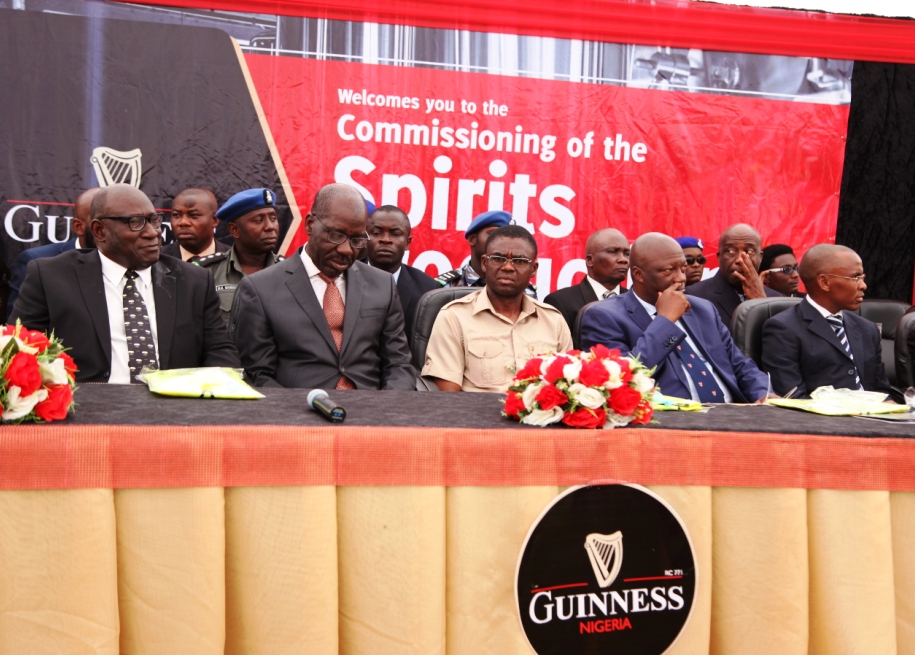
In a move aimed at reducing the import dependent profile of the Nigerian economy, creating more jobs and boosting the local sourcing of raw materials, leading manufacturer and Nigeria’s only total alcohol beverage company, Guinness Nigeria Plc, has commissioned a new production line that will support the local manufacturing of some of its spirits brands in Nigeria.
Some of the brands to be manufactured locally include Smirnoff X1 intense chocolate vodka, Smirnoff Extra Smooth Vodka, Gordon’s Dry Gin, Moringa Citrus Blend, McDowell’s No. 1 Reserved Whisky, McDowell’s VSOP and Royal Challenge Finest Premium Whisky.
The production line, with a design capacity of 1.2 million cases, is located within the Guinness Brewery, Ikpoba Hill, Benin city.
It was commissioned by the Executive Governor of Edo state, Mr Godwin Obaseki at amidst pomp, fanfare and commendation for this landmark stride by Guinness Nigeria.
Governor Obaseki, who nostalgically recalled his long personal relationship with the brand as a stockbroker, commended the board and management of Guinness Nigeria for this feat, and urged other companies to see the current economic recession as an opportunity for backward integration and expansion of their business horizons.
“This is a company I am very close to and very fond of, and so, I am quite excited that one of my first official corporate functions as Governor is to commission the new spirits line for the company.
“We are very pleased that Guinness is part of the landscape of Benin and Edo State, and has been so since 1974.
“And so, for us, you are a partner, and as a state, we will take our partnership very seriously. Even though the economic environment in Nigeria today is quite challenging and difficult, for us in Edo State, we see opportunities embedded in those challenges,” Mr Obaseki said.
Governor Obaseki also used the occasion to announce that the Edo state government would like to partner with Guinness Nigeria to create a minimum of two hundred thousand jobs over the next four years in line with his administration’s agenda.
In his remarks, Chairman, Guinness Nigeria, Mr Babatunde Savage described the commissioning as part of the company’s rich and prestigious legacy and a testament to its long term commitment to Nigeria.
“Guinness Nigeria has a strong heritage in Nigeria and in Benin since we built our brewery here in 1974 with a robust portfolio of global brands like Guinness and Johnnie Walker to boot.
“Today, we add to that strong heritage with the commissioning of our spirits production line in Nigeria – a first for Guinness Nigeria. With this line, we are now able to produce previously imported spirits locally and we are able to offer a wider variety of products to our consumers at a more affordable price point,” Savage enthused.
Mr Savage also reiterated the company’s commitment to making a marked and positive difference in the lives of Nigerians via strategic social interventions.
“As a responsible corporate citizen, Guinness Nigeria is interested in more than running a profitable business, we are also enriching our communities with investments in the areas of provision of water, health facilities and education scholarships to mention a few.
“As an example, in the water sector to date, we have impacted over 1.5million people in Nigeria through the provision of potable water to 25 communities in 14 States across Nigeria,” Mr Savage said.
President, Diageo Africa, Mr John O’Keffe, noted that the commissioning reinforces Guinness Nigeria’s position as the first and only Total Beverage Alcohol (TBA) Company in Nigeria.
“Guinness Nigeria is now able to offer a truly broad portfolio of beer, spirits and non-alcoholic drinks to consumers at every category and price point. Innovation is a competitive advantage for us in this market and we have a strong innovation pipeline with plans to introduce some exciting new products for our consumers to enjoy.
Also our commitment to local sourcing is further strengthened by the commissioning of this plant that will produce preciously imported spirits, using locally supplied raw materials. As part of our broader local raw materials (LRM) sourcing, we are looking to increase our locally sourced production inputs to 70% in the coming years,” Mr O’Keffe mentioned.
Some dignitaries present at the occasion include Managing Director, Guinness Nigeria Plc, Mr Peter Ndegwa, British High Commissioner to Nigeria, Mr Paul Arkwright, Edo State Deputy Governor, Hon. Philip Shaibu, Secretary to the State Government, Barr. Osarodion Ogie, Edo State Head of Service, Mrs Gladys Idahor, the Chief of Staff, Edo State Government, Mr Taiwo Akerele.
Banking
Zenith Bank Marks 2026 World Environment Day With Lagos Clean-up Drive
By Modupe Gbadeyanka
Zenith Bank Plc has joined other global corporations to commemorate the 2026 World Environment Day with a two-phase environmental clean-up initiative in Lagos State.
The financial institution participated in the commemoration under the global theme Inspired by Nature. For Climate. For Our Future through a two-day event.
In the first phase, which was a morning clean-up conducted by staff of the Bank on Wednesday, 3 June 2026, along Ajose Adeogun Street, Victoria Island, Lagos, employees of the lender cleared waste, sensitised residents on proper disposal practices, and reinforced the bank’s culture of community service and environmental stewardship.
The second day, participants engaged in a waterways clean-up at the Falomo Waterways, Ikoyi, Lagos. This was in collaboration with the Lagos Waste Management Authority (LAWMA) and the Lagos State Waterways Authority (LASWA). The joint effort focused on removing marine debris, promoting cleaner waterways, and supporting the state’s broader climate-resilience agenda.
“At Zenith Bank, sustainability is integral to how we operate. Clearing our streets and our waterways is a practical reminder that protecting the environment is a shared responsibility – and one we are proud to take up alongside LAWMA and LASWA.
“Through these exercises, we are taking deliberate action to preserve our communities, support climate action, and inspire others to act. Our operations will continue to align with global environmental standards as we build a more sustainable future for Nigeria and Africa,” the chief executive of Zenith Bank, Ms Adaora Umeoji, stated.
Zenith Bank says it remains committed to embedding Environmental, Social and Governance (ESG) principles across its operations, investing in green initiatives, energy efficiency, and community-focused programmes, in line with its commitment to environmental sustainability and responsible business practices.
These efforts advance the United Nations Sustainable Development Goals – particularly SDG 7 (Affordable and Clean Energy), SDG 11 (Sustainable Cities and Communities) and SDG 13 (Climate Action). Sustainability remains an operational imperative across the Bank’s Nigerian base and its broader African, UK and European footprints.
Banking
Moniepoint CEO Advocates Using Transaction Data to Unlock Financing for SMEs
By Modupe Gbadeyanka
The need to consider the usage of transaction data to design credit products for millions of small businesses in Nigeria has been emphasised by the chief executive of Moniepoint Incorporated, Mr Tosin Eniolorunda.
Speaking at a panel session at the launch of the Nigeria Payments System Vision 2028 (PSV 2028) by the Central Bank of Nigeria (CBN) recently, the Moniepoint chief said transactions from the payments ecosystem could be tracked to unlock economic survival for millions of underserved businesses that have been historically shut out of formal credit markets.
PSV 2028 is a framework aimed at setting priorities and direction for the country’s payments infrastructure over the coming years, with financial inclusion, resilience, and innovation among its core pillars.
According to the CBN governor, Mr Yemi Cardoso, the new framework builds on Nigeria’s progress in digital payments and seeks to accelerate the country’s transition towards a more inclusive, technology-driven ecosystem as it continues to lead Africa’s digital payments ecosystem.
At the panel, Eniolorunda noted that “I believe the next phase of growth will come from layering services like credit onto existing payment flows, using the visibility and trust already built through financial transactions.”
Speaking on the power of payment infrastructure as a foundation for broader financial services, he argued that the data generated by payment systems, when used responsibly, holds the key to making credit faster and more accessible for underserved businesses.
“One of the most powerful things about payment infrastructure is the data it creates. When used responsibly, it can help unlock quicker and more accessible credit for businesses that have historically been underserved. For many small businesses, access has always been the real barrier,” he said.
“Achieving the ambitions of PSV 2028 will require regulators, banks, fintechs, and ecosystem players working together with a shared long-term vision,” Mr Eniolorunda added, echoing Governor Cardoso’s warning against the country’s historic “start-stop” policy cycles.
“Over the past two decades, Nigeria’s payments ecosystem has evolved into one of the most dynamic and innovative in the world. From instant payments and digital adoption to fintech-led innovation, our progress has often set the pace on the continent. While this progress has not always been fully reflected in global narratives, its impact on economic activities, financial inclusion, and system resilience is evident across our economy,” he said.
Business Post learned that the panel was moderated by the chief executive of Sterling Bank, Mr Abubakar Suleiman, and also featured the chief executive of the Nigeria Inter-Bank Settlement System (NIBSS) Plc, Mr Premier Oiwoh; his counterparts at Remita Payment Services Limited (RPSL), Mr Deremi Atanda; and Shared Agent Network Expansion Facilities (SANEF) Limited, Mrs Uche Uzoebo, among others.
Banking
Ecobank Floats $450m Nature Bond for Sustainable Agric Businesses, Others
By Aduragbemi Omiyale
The world’s first ICMA commercial bank-issued Nature Bond has been launched by Ecobank Group to mobilise global capital for the protection of Africa’s natural ecosystems.
The debt instrument, up to $450 million, will be tradable on the London Stock Exchange (LSE), creating a new route for international and African capital to protect Africa’s biodiversity.
The bond will support African farmers, sustainable agriculture businesses and water systems, protecting some of the planet’s most important ecosystems.
Africa is home to some of the world’s most important natural capital, including arable land, tropical forests, freshwater systems and biodiversity across hundreds of millions of hectares. But, until now, private nature capital has not flowed to Africa at the scale the continent’s ecological significance warrants in global ecological resilience. Despite hosting 25 per cent of global biodiversity, Africa receives less than 3 per cent of nature finance.
Ecobank’s Nature Bond is a direct response to this gap. It will support smallholder farmers adopting sustainable agricultural practices, agri-processors with verified deforestation-free supply chains, and water infrastructure protecting freshwater ecosystems relied upon by millions of people.
Unlike many conservation-focused financing vehicles, Ecobank’s Nature Bond channels capital directly through Africa’s real economy — financing businesses and communities whose day-to-day activities shape environmental outcomes at scale.
The investments will be made in 24 markets, with significant deployment in biodiversity-priority countries such as Côte d’Ivoire, Burkina Faso and Ghana. Importantly, 81 per cent of the eligible lending pool is allocated to countries where agricultural land-use change is the primary driver of biodiversity loss, helping direct capital to the areas where it can have the greatest environmental impact.
The framework also incorporates independent monitoring and verification mechanisms, including deforestation screening and supply chain traceability requirements, helping ensure that financed activities deliver measurable nature-positive outcomes. Every eligible loan carries seven independently verified sustainability conditions.
A Nature Bond, under the ICMA secondary designation, requires proceeds to actively contribute to nature-positive outcomes, including transforming economic activities to reduce the drivers of nature loss at scale.
The Nature Bond was designed to reach those that conservation-focused instruments were not designed to serve – farmers, agri-processors and water operators whose daily activities collectively determine ecosystem outcomes.
While green bonds typically finance a broad range of environmental objectives, the Nature Bond designation focuses the use of proceeds specifically on nature-related outcomes, including biodiversity, sustainable agriculture, land use and water infrastructure.
“This transaction is a defining moment for African sustainable finance. Investors did not just support this bond. They demanded more of it, allowing us to increase the size and tighten pricing.
“We are not a bank that simply labels bonds. We have spent four years building the systems, governance and accountability needed to make nature finance credible and scalable in Africa.
“This bond is ultimately about the farmers, cooperatives and communities whose livelihoods depend on healthy ecosystems,” the chief executive of Ecobank Group, Mr Jeremy Awori, stated.
On her part, the Head of Sustainability and ESRM at Ecobank Transnational Incorporated, Ms Rachael Antwi, said, “Nature finance will only scale in Africa if it is practical, measurable and connected to the real economy. This bond is designed to do that by linking international capital to eligible lending for sustainable agriculture and water infrastructure across 24 countries. It reflects the systems and standards Ecobank has built to ensure nature finance supports both environmental resilience and the communities whose livelihoods depend on healthy ecosystems.”
Business Post gathered that the $450 million bond was priced following strong investor demand, with the final orderbook exceeding $1.36 billion, almost 400 per cent of the original target size. The strength of demand enabled Ecobank to increase the transaction by $100 million and tighten pricing by 50 basis points.
The transaction attracted support from both international and African investors, demonstrating Ecobank’s unique ability to mobilise capital across global and African markets.
-
Feature/OPED6 years agoDavos was Different this year
-
Travel/Tourism10 years ago
Lagos Seals Western Lodge Hotel In Ikorodu
-
Showbiz3 years agoEstranged Lover Releases Videos of Empress Njamah Bathing
-
Banking8 years agoSort Codes of GTBank Branches in Nigeria
-
Economy3 years agoSubsidy Removal: CNG at N130 Per Litre Cheaper Than Petrol—IPMAN
-
Banking3 years agoSort Codes of UBA Branches in Nigeria
-
Banking3 years agoFirst Bank Announces Planned Downtime
-
Sports3 years agoHighest Paid Nigerian Footballer – How Much Do Nigerian Footballers Earn