Technology
Zoho Unveils Latest Version of Low-Code Offering
By Modupe Gbadeyanka
The need for an easy-to-use platform that enables business users (or citizen developers) to create complex and powerful business applications has triggered the introduction of the latest version of a low-code offering by Zoho Corporation.
The new product from the leading global technology company called Zoho Creator empowers IT teams to place sufficient guardrails and govern usage, ensuring security and compliance.
According to the President MEA, Zoho Corp, Hyther Nizam, “The bulk of low-code application development, from customization to automation, can be handled today by users with moderate technical knowledge. Where we see a gap, especially for the mid-market and enterprise, is between building and deployment.”
Nizam noted that, “Currently there isn’t a low-code solution on the market that allows both business users and IT to truly build end-to-end business solutions.
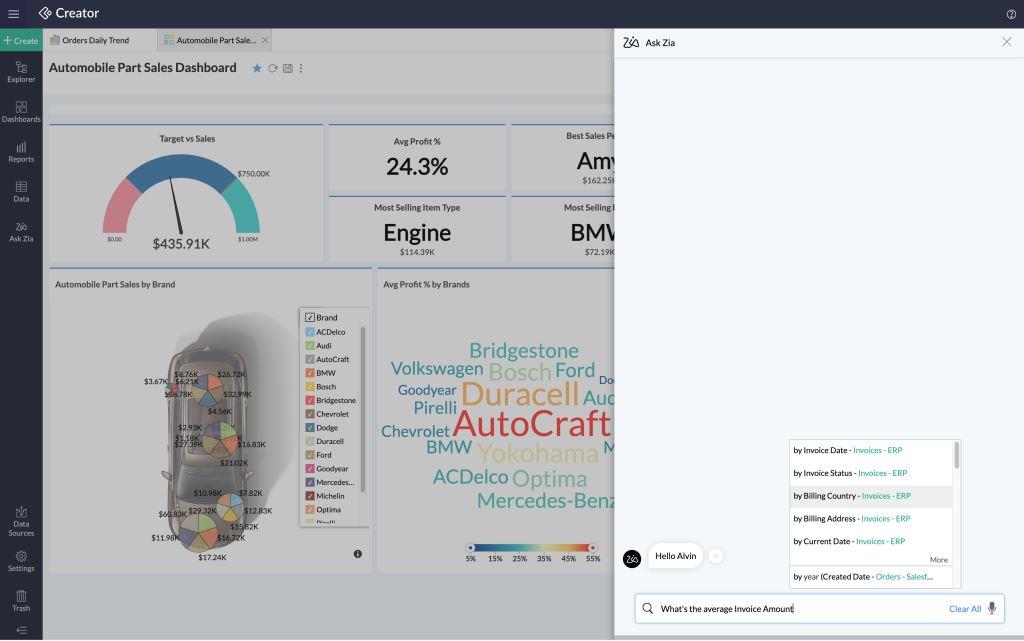
“With this update, Zoho’s Creator Platform combines application development, business intelligence and analytics, integrations, and process automation into one single platform while simultaneously enabling IT teams to effortlessly manage ongoing challenges of security, compliance, and governance.
“Now, organisations can leverage a unified solution for all of their low-code needs, extending the ability to innovate to every employee.”
Organisations currently face soaring demand for new business software, but existing low-code platforms are either for business users and lack the sophistication needed to develop scalable, enterprise-ready end-to-end tools or are for users with an intricate understanding of the application development process.
The new version of the Zoho Creator platform empowers business developers to easily build scalable low-code solutions which include apps, integrations, analytics, and process automation without costly and time-consuming training demanded by complex platforms.
It enables 10X faster deployment than any other solution on the market. The latest version includes new and enhanced features such as business process blueprinting, AI-enabled smart import, enhanced serverless functions, conversational analytics, centralised governance and a multi-environment setup.
These features help users build a connected ecosystem of solutions while maximising IT teams’ control through a robust end-to-end application development lifecycle management.
Additionally, while other low code platforms help business users in app development, it still often happens in silos and creates the problem of shadow IT.
Therefore, the new Creator platform equips IT teams with greater control around governance, security and compliance so that business users (citizen developers) and IT teams can work together to create auto-scalable, niche, complex and agile solutions so that organisations can focus on solving business problems and pursue new opportunities.
Zoho Creator Platform Pricing
Pricing starts at NGN 7500 per user, per month when billed annually. For comprehensive pricing information, please visit: https://www.zoho.com/creator/pricing-comparison.html
Zoho Privacy Pledge
Zoho respects user privacy and does not have an ad-revenue model in any part of its business, including its free products. More than 75 million users around the world, across hundreds of thousands of companies, rely on Zoho every day to run their businesses, including Zoho itself.
For more information, please visit: https://www.zoho.com/privacy-commitment.html
Technology
Identy.io Announces Strategic Expansion into Nigeria, Kenya
By Adedapo Adesanya
A global biometric authentication technology company specialising in secure, mobile-first identity verification, Identy.io, has announced its expansion plans into Africa with a pilot focus on Nigeria and Kenya.
The firm disclosed in a statement that it has appointed a regional leadership team to engage with key stakeholders across the government, financial services, telecommunications, and other regulated sectors in both countries.
These include Mr Olajide Olasiyan-Ola as Regional Head for West Africa, Mr Edwin Mutisya as the Senior Sales Manager, and Mr Matus Kapusta as the Product Director for Identy.io’s Automated Biometric Identification System (ABIS) product portfolios.
Amid the need for effective identity solutions becoming increasingly urgent, countries like Kenya and Nigeria are making significant investments in public digital infrastructure by integrating identity systems with public services, financial access, and mobile connectivity as part of their broader economic development agendas. This is helping to implement national digital identity systems to improve service delivery, promote financial inclusion, and develop digital public infrastructure.
The World Bank’s ID4D data indicates that approximately 80 per cent of adults in Sub-Saharan Africa possess basic identification. However, there are significant disparities between countries, with many having coverage below 70 per cent. These gaps hinder access to essential services and economic opportunities.
With Identy.io coming into the fold, its regional leadership team will collaborate with clients across the public and private sectors to support responsible, scalable identity implementations aligned with national digital transformation priorities.
After Nigeria and Kenya, the firm plans to expand into additional African markets as part of a phased regional growth strategy.
According to Mr Antony Vendhan, Co-founder of Identy.io, “We are transforming the traditional industry model, which often relies on expensive and inflexible digital infrastructure. Instead, Identy.io adopts a software-first approach, minimising reliance on specialised biometric hardware. Our technology supports biometric capture using standard smartphones, processes identity documents, issues digital identities to individuals lacking formal identification, and facilitates large-scale biometric verification and deduplication.”0
“This innovative yet simplified approach allows our clients to reach underserved communities by providing individuals with multimodal access to secure their digital identities and explore new economic opportunities,” he stated.
As part of Identy.io’s industry validation strategy, the company’s ABIS system has completed MOSIP’s partner compliance process and is listed on the MOSIP Marketplace. This platform offers compliant technologies that governments and ecosystem partners can evaluate for MOSIP-aligned deployments. MOSIP helps governments conceive, develop, implement, and own foundational digital ID systems tailored to their unique needs.
Technology
ZeroDrift Receives $2m in Pre-Seed Capital for AI-driven Tools
By Dipo Olowookere
A $2 million pre-seed round to automate compliance in real time, unlocking business velocity while giving compliance teams infrastructure to scale oversight has been received by ZeroDrift.
The fresh capital was pumped into the firm by a16z speedrun. It is to support the company’s go-to-market launch, product expansion across communication channels, and continued development of its AI-driven compliance engine.
The organisation plans to deepen its coverage across financial services before expanding its rule-based compliance engine into other regulated sectors, including insurance, healthcare, ESG disclosures, and AI governance.
The long-term vision is to become the universal trust layer for any system that communicates, ensuring that as AI and automation scale, trust, safety, and compliance scale with them.
ZeroDrift is an AI-native communication firewall that validates and fixes content before it is sent, giving compliance teams control at scale and business teams the speed to execute.
The platform encodes SEC, FINRA, and firm-specific policies into machine-readable rulepacks, then enforces them at the point of creation.
ZeroDrift integrates directly into tools teams already use, including email, browsers, CRMs, websites, social platforms, and AI systems.
Content is checked instantly, issues are flagged with suggested fixes, and compliant messages move forward without delay. Compliance teams retain full visibility through centralised dashboards, audit trails, and exam-ready evidence generated automatically.
ZeroDrift is launching initially in financial services, serving registered investment advisors, asset managers, broker-dealers, and wealth platforms.
The market includes more than 15,000 RIAs, 3,500 asset managers, and hundreds of thousands of registered representatives in the United States alone.
Early use cases include faster campaign launches, higher sales velocity, safe deployment of client-facing AI, and instant exam readiness without last-minute scrambles.
“People do not want to be non-compliant. They have no way to know if what they are writing is acceptable until it is too late.
“Compliance should be a guardrail that lets teams move faster, not a gate that slows everything down. Our goal is to make compliance happen automatically at the speed of work,” the chief executive of ZeroDrift, Kumesh Aroomoogan, said.
A representative of a16z speedrun, Troy Kirwin, said, “Compliance has quietly become a limiting factor for how fast regulated companies can operate. ZeroDrift flips that dynamic by preventing violations before they happen and making compliance a built-in part of everyday workflows.”
Technology
Region-Aware Login Systems Adapting Security Rules to Local Regulations
The online world often feels borderless, but geography has never mattered more for security. As data laws like GDPR and CCPA evolve, the “one-size-fits-all” login is becoming obsolete. Sophisticated platforms now use region-aware systems—intelligent gateways that detect a user’s location and recalibrate security protocols to meet local legal requirements. By treating location as a primary credential, these systems move away from the “Wild West” era, allowing companies to respect digital sovereignty while maintaining a high-performance experience.
Moving Beyond the Universal Digital Identity
In the early days of the internet, security was largely a choice made by the platform provider. If a company wanted to require a long password, they did; if they didn’t, a simple four-digit PIN might suffice. However, we have entered an era of “Regulatory Fragmentation.” Governments now take an active role in defining what “adequate security” looks like, and these definitions change as soon as you cross a digital border. A platform that ignores these regional nuances risks more than just a poor user experience; it risks massive fines and the potential loss of its operating license.
The concept of a “universal” login is being replaced by “contextual authentication.” This means the system asks: “Who are you, and where are you?” before it even presents the password field. By understanding the context of the login attempt, the system can dynamically adjust. For example, a user logging in from a jurisdiction with strict data-export laws might be blocked from accessing sensitive information unless they pass an additional biometric check, whereas a user in a less regulated area might enjoy a faster entry process.
Strategic Compliance in High-Regulated Environments
High-compliance industries like finance and gaming require 100% certainty regarding a user’s location. In these sectors, regional adaptation is a foundational requirement for doing business legally.
For example, online casinos, like https://nv.casino/en, demonstrate why these adaptations are essential for a safe experience. Because state and national gaming laws vary significantly, a region-aware login ensures that the software instantly recognizes a player’s jurisdiction and applies relevant safeguards. In some regions, this means enforcing strict two-factor authentication (2FA); in others, it involves real-time identity verification against local databases. This localized approach protects user data and ensures providers remain compliant with diverse gaming commissions without creating a restrictive experience for the player.
The Multi-Layered Tech Stack Behind Global Gateways
Modern systems verify location by analyzing multiple “signals” within milliseconds. To ensure speed and accuracy, several core technologies work in tandem behind the scenes:
- IP intelligence: Databases map IP addresses to physical locations while filtering out known proxy servers and fraudulent VPNs.
- Latency analysis: By measuring the time data takes to travel, systems can detect if a user is “spoofing” their location from across the globe.
- Edge computing: Processing logic at local server nodes ensures that regional rules are applied instantly without slowing down the page.
- Device fingerprinting: Identifying hardware and software settings helps verify if a device matches the typical profile for its reported region.
Solving the Friction Problem with Adaptive Security
The “Holy Grail” of login security is “Adaptive Friction.” The idea is to make entry easier for “known” or low-risk attempts while automatically “dialing up” security for high-risk regions or strict regulatory territories.
This prevents forcing users in low-regulation areas through unnecessary verification steps. By tailoring security to the location, platforms offer the smoothest possible entry point while maintaining a competitive edge. This localized efficiency has become a major selling point for global apps, reducing user frustration caused by irrelevant security hurdles.
Key Steps for Building a Future-Proof Login Framework
Implementing a region-aware system requires balancing legal mandates with technical integration. The following steps provide a roadmap for moving toward a more adaptive security model:
- Map global regulations: Identify user locations and the specific privacy mandates for each territory.
- Define security templates: Create distinct “profiles”—such as “Strict European” vs. “Standard North American”—that the system can swap between instantly.
- Establish fallback protocols: Ensure the system defaults to the most secure option if a location cannot be verified with absolute certainty.
- Perform regular audits: Because digital laws shift frequently, regular reviews of the underlying rulebook are essential to remain compliant.
The Cultural and Legal Shift Toward Digital Sovereignty
The concept of “Digital Sovereignty”—subjecting data to the laws of its physical location—will define the next decade of internet growth. Region-aware login systems are the first line of defense in this organized digital society.
Ultimately, these systems build trust by respecting the laws of a user’s home country. Security is no longer just about keeping hackers out; it is about ensuring that digital entry is as respectful and legal as navigating the physical world. By embracing geographic intelligence, platforms build smarter gates that welcome every user appropriately, no matter where they stand.
-
Feature/OPED6 years agoDavos was Different this year
-
Travel/Tourism10 years ago
Lagos Seals Western Lodge Hotel In Ikorodu
-
Showbiz3 years agoEstranged Lover Releases Videos of Empress Njamah Bathing
-
Banking8 years agoSort Codes of GTBank Branches in Nigeria
-
Economy3 years agoSubsidy Removal: CNG at N130 Per Litre Cheaper Than Petrol—IPMAN
-
Banking3 years agoSort Codes of UBA Branches in Nigeria
-
Banking3 years agoFirst Bank Announces Planned Downtime
-
Sports3 years agoHighest Paid Nigerian Footballer – How Much Do Nigerian Footballers Earn