Connect with us

Economy

Private Investor to Operate $2.59bn Badagry Deep Seaport for 45 Years

Published

on

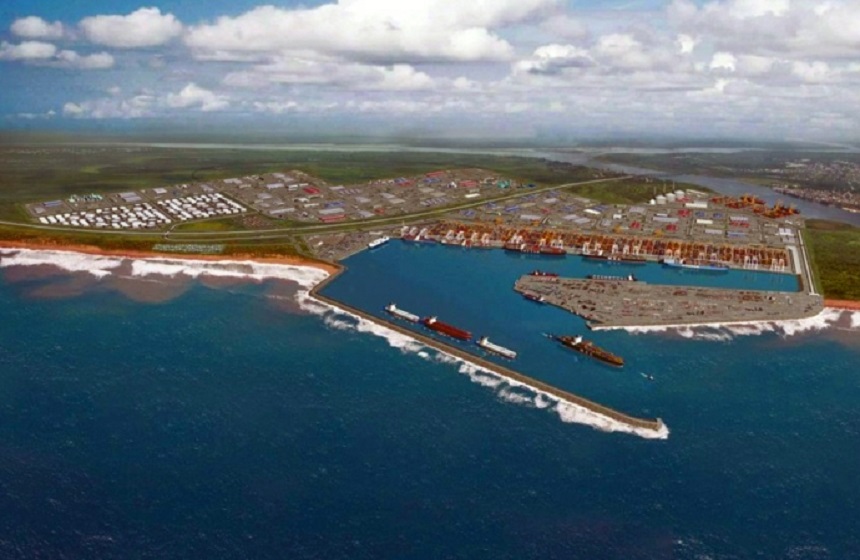
Badagry Deep Seaport

By Adedapo Adesanya

The Federal Executive Council (FEC), yesterday, approved the development of the $2.59 billion Badagry Deep seaport.

In a statement, the Nigerian Ports Authority (NPA) disclosed that the project is to run on a 45-year Build-Own-Operate-Transfer model.

The Badagry Deepsea port construction is also expected to commence soon.

According to the NPA in a tweet, “The Federal Executive Council has approved the development of Badagry Deep Seaport.

“In April, @icrcng submitted the Full Business Case, FBC, Compliance Certificate for the $2.59bn deep seaport to be fully financed by private investors.

“This is the second deep seaport project in the country with a total development area of 692.6hc and a channel of 18m draft with a single access channel length of 8.9km from the fairway buoys.

“The Badagry deep seaport project is a 45years Build-Own-Operate-Transfer model.

“The FBC & financial projections justify a term of 45 years for the initial term of the concession comprising of a 5-year construction period and 40 years during which the proponent is to operate the port.”


Adedapo Adesanya is a journalist, polymath, and connoisseur of everything art. When he is not writing, he has his nose buried in one of the many books or articles he has bookmarked or simply listening to good music with a bottle of beer or wine. He supports the greatest club in the world, Manchester United F.C.

Click to comment

Leave a Reply

Your email address will not be published. Required fields are marked *

Economy

Africa’s Core Financial Challenge is Infrastructural, Not Liquidity—Stanley Jacob

Published

on

stanley jacob meristem

By Modupe Gbadeyanka

The Group Chief Innovation and Technology at Meristem, Mr Stanley Jacob, submitted that the core financial challenge facing Nigeria and Africa is not funding, but a lack of financial architecture and project readiness to deploy existing capital safely and productively.

At a forum organised by The Alternative Bank (AltBank) last Thursday in Lagos, Mr Jacob tasked policymakers to think out of the box, noting that the continent holds vast domestic capital pools.

At the event themed Beyond Interest, he also disclosed that the convergence of the Pan-African Payment and Settlement System (PAPSS) with the tokenisation of real-world assets could hand Nigeria a first-mover advantage in continental capital markets.

This sentiment was echoed by the Executive Director of Tugrande Alliance Limited, Ajibola Tobi-Osho, who pointed out that while Nigeria has moved from crisis management to macroeconomic stability, the binding constraint has shifted from inflation to capital allocation, with banks parking record liquidity at the central bank rather than lending to the businesses that drive jobs and growth.

Last Thursday’s programme was convened to advance the case for non-interest finance as a practical route to mobilising patient capital into Nigeria’s productive economy, as well as press investors and policymakers to judge every allocation by both the returns it earns and the capacity it builds.

The chairman of The Alternative Bank, Mr Muhtar Bakare, stated that Nigeria’s constraint is less a shortage of capital than a shortage of the trust that allows capital to do patient work.

“What we lack is not effort. We lack capital that stays long enough to turn effort into capacity, capacity into durable jobs and durable jobs into stability. That is why the distinction between extractive and productive capital matters,” he said.

Also speaking, the Governor of Lagos State, Mr Babajide Sanwo-Olu, averred that the government is not a competitor to private investment but an enabler of it.

“The future of finance is not only about the price of capital; it is increasingly about the quality of the economic activity that capital enables. Lagos is not only open for business; Lagos is prepared to do business,” Mr Sanwo-Olu, represented by the Commissioner for Finance, Mr Abayomi Oluyomi, stated.

In his remarks, former Governor of Lagos State and former Minister of Works and Housing, Mr Babatunde Fashola, argued that capital anchored to real, productive assets and to the public good delivers more durable value than money chased for short-term yield, and urged investors and institutions to weigh the long-term social returns of where they place their funds.

Delivering his brief on The Business Case for Ethical Capital, a member of Sterling Financial Holdings Company Plc board, Mr Abubakar Suleiman, traced The Alternative Bank’s journey from a modest non-interest window opened by Sterling Bank in 2014 to an institution he said now holds total assets approaching ₦500 billion and serves nearly a million customers.

“The Alternative Bank has shown that non-interest banking can grow, win customers, and generate profit. The business case for ethical capital already exists. Our task is to apply it with discipline,” he stated.

He pointed to WasteBanc, AltBank’s recycling initiative with the Lagos Waste Management Authority, and to Nigeria’s sovereign Sukuk programme as evidence that values-aligned finance can hold to commercial standards while connecting capital to identifiable, productive assets.

Continue Reading

Economy

Finance Ministry Orders NAICOM to Suspend Nigeria Re, NICON Recapitalisation Fees

Published

on

NAICOM

By Adedapo Adesanya

The Federal Ministry of Finance has directed the National Insurance Commission (NAICOM) to suspend enforcement of disputed recapitalisation fees and a directive requiring NICON Insurance Limited and the Nigeria Reinsurance Corporation to transfer their entire fresh capital into an escrow account with the Central Bank of Nigeria (CBN).

The ministry also demanded a detailed response and legal justification from NAICOM over assessments of N305 million against NICON and N375 million against Nigeria Re as part of the ongoing insurance industry recapitalisation exercise.

The directive was contained in a letter dated August 6, 2026, signed by the Permanent Secretary, Finance, Mr Raymond Omachi, on behalf of the Minister of Finance and Coordinating Minister of the Economy, Mr Taiwo Oyedele.

The letter followed a July 27 petition by NICON and Nigeria Re over the implementation of the Nigerian Insurance Industry Reform Act, 2025. The companies challenged NAICOM’s demand for a one per cent capital injection fee, alongside processing and verification charges under the commission’s Minimum Capital Requirement Guidelines.

They also disputed a directive requiring existing insurance companies to transfer their entire recapitalisation funds into a CBN escrow account, arguing that Section 16(3) of NIIRA 2025 provides for a statutory deposit of only 10 per cent.

According to the Finance Ministry, NICON and Nigeria Re had injected N20 billion and N30 billion respectively into Mudaraba Term Deposit accounts with Lotus Bank, exceeding their adjusted capital requirements of N16 billion and N28 billion.

The companies also deposited N2.5 billion and N3.5 billion respectively with the CBN as statutory deposits and paid initial fees of N80 million and N75 million.

The ministry said the companies therefore considered themselves compliant with the July 31, 2026 recapitalisation deadline.

“Pending the determination of the petition, the Commission should suspend the enforcement of the contested processing fees, 1 per cent capital injection fee demands, and full-capital escrow transfer directives against NICON Insurance Limited and Nigeria Reinsurance Corporation,” the letter stated.

The ministry consequently asked NAICOM to explain the basis and legal justification for the disputed charges and escrow requirement.

The intervention comes amid the Federal Government’s efforts to strengthen the capital base of insurance companies and reinsurers, improve their capacity to underwrite larger risks and enhance the sector’s contribution to economic development.

The dispute, however, has raised questions over the extent of NAICOM’s authority to impose additional fees and require existing insurers to place their entire recapitalisation funds in escrow.

The Finance Ministry’s letter did not disclose whether NAICOM had responded to the issues raised. It also referenced an alleged N500 million demand and an additional N180 million capitalisation charge in its subject, although the substantive section specifically put the disputed assessments at N305 million for NICON and N375 million for Nigeria Re.

For now, enforcement of the contested fees and full-capital escrow directive against the two state-owned insurers has been suspended pending NAICOM’s response and legal clarification.

Continue Reading

Economy

NASD Exchange Sheds 0.32% 11 Plc Leads Losers’ Chart

Published

on

NASD Exchange bullish

By Adedapo Adesanya

Four price decliners overpowered the two price gainers recorded at the NASD Over-the-Counter (OTC) Securities Exchange on Monday, August 10, weakening it by 0.32 per cent at the close of transactions.

The advancers were led by Food Concepts Plc, which chalked up 25 Kobo to sell at N2.75 per unit versus the previous price of N2.50 per unit, and Mass Telecoms Innovation Plc appreciated by 3 Kobo to 35 Kobo per share from 32 Kobo per share.

However, 11 Plc lost N24.75 to close at N222.75 per unit versus N247.50 per unit, FrieslandCampina Wamco Nigeria Plc declined by N3.09 to N145.00 per share from N148.09 per share, Industrial and General Insurance (IGI) Plc went down by 5 Kobo to 50 Kobo per unit from 55 Kobo per unit, and Geo-Fluids Plc slid by 1 Kobo to N2.27 per share from N2.28 per share.

As a result, the market capitalisation contracted by N8.94 billion to N2.798 trillion from the previous session’s N2.807 trillion, and the NASD Security Index (NSI) retreated by 14.9 points to 4,663.18 points from 4,678.08 points.

The trading data showed that the volume of securities exchanged by investors rose by 108.9 per cent to 1.1 million units from 535,7560 units, and the value of securities jumped by 69.5 per cent to N10.2 million from N6.0 million, while the number of deals executed receded by 2.8 per cent to 35 deals from 36 deals.

Great Nigeria Insurance (GNI) Plc closed the trading session as the most traded stock by value on a year-to-date basis, with 3.4 billion units exchanged for N8.4 billion, followed by Infrastructure Credit Guarantee (Infracredit) Plc with 2.3 billion units valued at N6.5 billion, and Central Securities Clearing System (CSCS) Plc with 77.0 million units transacted for N5.5 billion.

GNI Plc also ended the day as the most traded stock by volume on a year-to-date basis, with 3.4 billion units worth N8.4 billion, followed by Infracredit Plc with 2.3 billion units sold for N6.5 billion, and Resourcery Plc with 1.1 billion units traded for N415.7 million.

Continue Reading