Connect with us

Economy

IMF Disburses $37.1m to Liberia

Published

on

imf-office

By Modupe Gbadeyanka

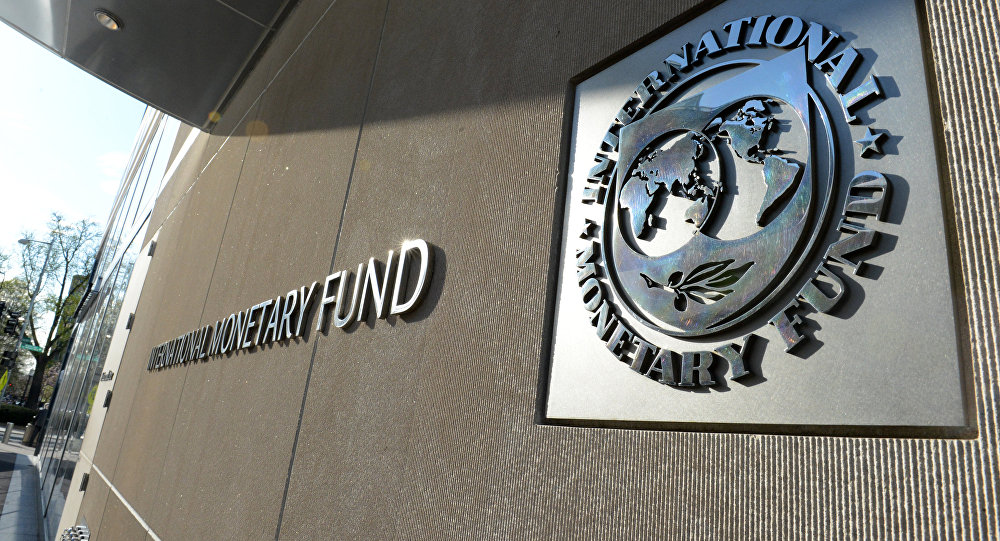
The sum of $37.1 million has been approved by the Executive Board of the International Monetary Fund (IMF) to Liberia, bringing the total disbursements under the Extended Credit Facility (ECF) arrangement to $129.9 million.

In a statement issued on Monday announcing the pay-out, the IMF said the approval followed completion of the fifth and sixth reviews of Liberia’s economic performance under the program supported by the ECF arrangement.

The world financial firm further said the board gave its nod to the authorities’ request to waive the non-observance of performance criteria.

The waivers pertains to the end-December 2015 floors on total revenue collection of the central government and the net foreign exchange position of the Central Bank of Liberia and to the end-June 2016 performance criteria on floors on total revenue collection of the central government, net foreign exchange position of the Central Bank of Liberia, and the ceiling on the Central Bank of Liberia’s gross direct credit to the central government.

It also approved the authorities’ requests to augment access under the program by $37.1 million of which $17.3 million would be directed to the budget, and to extend the program until November 18, 2017.

The ECF arrangement for Liberia was approved by the Board on November 19, 2012 for $69.3 million or 40 percent of quota as of that date.

In September 2014, as part of the response in the fight against Ebola, the Board approved an augmentation of access of $43.3 million or 25 percent of quota as of that date under the ECF arrangement for Liberia.

Following the Board’s discussion on Liberia, Mr Tao Zhang, Deputy Managing Director and Acting Chair said, “After the end of the Ebola epidemic, a weak global commodity price environment has delayed Liberia’s economic recovery. Low prices for iron ore and rubber have led to significant cutbacks in output and investment. In addition, the withdrawal of UNMIL peacekeepers has reduced demand for local services.

“The authorities have managed to maintain macroeconomic stability in a difficult economic situation, and remain committed to strong program implementation. However, program performance has been mixed on account of the challenging economic situation as well as policy choices, including open bank assistance by the central bank. The pace of structural reform has been slow reflecting limited capacity and weak prioritization, due in part to the transition of the economic management teams at the ministry of finance and central bank.

“Fiscal policy has appropriately responded to the commodity price shock, thanks to new revenue measures accompanied by increased spending discipline. In the coming years, fiscal prudence is needed, including through the introduction of the VAT and the rationalization of the wage bill. Progress on public financial management reforms, especially the Treasury Single Account, investment management, and financial control of state-owned enterprises, will be important to support fiscal consolidation efforts.

“Borrowing policies should remain prudent. The authorities’ success so far in respecting the debt limits under the new debt limit policy is commendable. In addition, preserving debt sustainability will require prioritizing concessional loans and carefully contracting new borrowing through sound project appraisal.

“Rebuilding external buffers will require a rigorous implementation of the central bank’s three-year financial plan and limiting foreign exchange intervention to smoothing volatility. Good liquidity management should be relied upon to anchor inflation. The closure of the First International Bank of Liberia Limited (FIBLL) is welcome, and the forensic audit launched by the central bank enhances its credibility and transparency. Lessons from this experience point to the importance of strengthening frameworks for emergency liquidity assistance, bank resolution, and deposit insurance.”


Modupe Gbadeyanka is a fast-rising journalist with Business Post Nigeria. Her passion for journalism is amazing. She is willing to learn more with a view to becoming one of the best pen-pushers in Nigeria. Her role models are the duo of CNN's Richard Quest and Christiane Amanpour.

Click to comment

Leave a Reply

Your email address will not be published. Required fields are marked *

Economy

Five Price Decliners Weaken OTC Securities Exchange by 1.72%

Published

on

NASD OTC securities exchange

By Adedapo Adesanya

Five securities pulled down the NASD Over-the-Counter (OTC) Securities Exchange by 1.72 per cent on Friday, August 14, cutting the market capitalisation by N47.04 billion to N2.689 trillion from N2.727 trillion, and slicing the NASD Security Index (NSI) by 78.37 points to 4,465.83 from 4,532.03 points.

11 Plc led the price decliners yesterday after its price went down by N15.03 to N230.00 per share from N245.03 per share. MRS Oil Plc weakened by N13.20 to N118.80 per unit from N132.00 per unit, Central Securities Clearing System (CSCS) Plc slid by N10.30 to N99.46 per share from N109.76 per share, Okitipupa Plc fell by N6.99 to N270.01 per unit from N277.00 per unit, and Afriland Properties Plc dipped by N2.00 to N20.00 per share from N22.00 per share.

Business Post reports that the OTC securities exchange recorded four gainers during the session, led by FrieslandCampina Wamco Nigeria Plc, which appreciated by N9.85 to N169.85 per unit from N160.00 per unit. IPWA Plc gained 70 Kobo to close at N10.41 per share versus N9.71 per share, Industrial and General Insurance (IGI) Plc rose by 4 Kobo to 54 Kobo per unit from 50 Kobo per unit, and Geo-Fluids Plc improved by 1 Kobo to N2.06 per share from N2.05 per share.

The volume of trades soared by 64.8 per cent to 3.2 million units from the previous session’s 1.9 million units, the value of transactions jumped by 78.2 per cent to N375.7 million from N210.8 million, and the number of deals surged by 35.3 per cent to 46 deals from 34 deals.

Great Nigeria Insurance (GNI) Plc was the most traded stock by value on a year-to-date basis, with 3.4 billion units valued at N8.4 billion, followed by Infrastructure Credit Guarantee (Infracredit) Plc with 2.3 billion units sold for N6.5 billion, and CSCS Plc with 79.0 million units exchanged for N5.7 billion.

GNI Plc also closed the day as the most traded stock by volume on a year-to-date basis, with 3.4 billion units worth N8.4 billion, followed by Infracredit Plc with 2.3 billion units transacted for N6.5 billion, and Resourcery Plc with 1.1 billion units traded for N415.7 million.

Continue Reading

Economy

Bears Pullback Local Stock Market by 0.12% as Investors Lose N257bn

Published

on

Local Stock Market

By Dipo Olowookere

The dominance of the bears on the Nigerian Exchange (NGX) Limited was consolidated on Friday, after further inflicting an 0.12 per cent loss at the close of trading activity.

All the key sectors of the local stock market turned red yesterday as a result of sustained profit-taking, though the industrial goods space was flat.

The insurance counter lost 1.49 per cent, the energy index shed 0.63 per cent, the consumer goods segment declined by 0.46 per cent, and the banking sector tumbled by 0.23 per cent.

Consequently, the All-Share Index (ASI) retreated by 398.18 points to 242,619.20 points from 243,017.38 points, and the market capitalisation receded by N257 billion to N156.624 trillion from N156.881 trillion.

Fortis Global Insurance lost 9.31 per cent to trade at N2.63, Omatek depreciated by 9.04 per cent to N1.51, John Holt slipped by 9.00 per cent to N9.10, RT Briscoe slumped by 7.94 per cent to N11.60, and Dangote Sugar went down by 7.79 per cent to N64.55.

But International Energy Insurance gained 9.92 per cent to sell for N5.32, Trans-Nationwide Express appreciated by 9.65 per cent to N2.84, Guinea Insurance improved by 6.67 per cent to 80 Kobo, Regency Alliance grew by 6.25 per cent to 85 Kobo, and Japaul jumped by 5.36 per cent to N2.95.

The market breadth index remained negative, with 30 price losers and 21 price gainers, indicating weak investor sentiment.

The level of activity contracted yesterday, with the trading volume, value, and number of deals down by 66.67 per cent, 10.65 per cent, and 5.60 per cent, respectively.

This was because market participants transacted 1.4 billion shares worth N45.3 billion in 39,134 deals during the session compared with the 4.2 billion shares valued at n50.7 billion traded in 41,454 deals on Thursday.

Fortis Global Insurance was the most active equity for the day, with a turnover of 874.1 million units valued at N2.4 billion, Cornerstone Insurance sold 100.3 million units worth N506.5 million, Universal Insurance traded 56.7 million units for N44.5 million, Sterling Holdings exchanged 53.3 million units worth N402.9 million, and MTN Nigeria transacted 44.6 million units valued at N31.4 billion.

Continue Reading

Economy

Naira Stable at N1,357/$1 at Official Market, N1,395/$1 at Black Market

Published

on

Naira-Dollar exchange rate gap

By Adedapo Adesanya

The Naira maintained stability against the United States Dollar in the different segments of the foreign exchange (FX) market on Friday, August 14, according to data obtained by Business Post.

At the Nigerian Autonomous Foreign Exchange Market (NAFEM), the local currency remained unchanged at N1,357.65/$1, but lost N6.05 against the Pound Sterling to trade at N1,840.10 versus the previous session’s N1,834.05/£1, and depreciated against the Euro by N4.70 to sell for N1,571.70/€1 compared with the preceding day’s N1,567.00/€1.

At the black market, the Nigerian currency traded flat against the Dollar at N1,395/$1, but gained N3 at the GTBank forex desk to quote at N1,364/$1 versus Thursday’s exchange rate of N1,367/$1.

Data from the Central Bank of Nigeria (CBN) showed that interbank FX transactions surged by 51.2 per cent to $119.594 million from $79.097 million. These transactions were executed in 137 deals, higher than the 98 deals recorded a day earlier.

FX inflows from exporters, remittances and other sources, alongside demand from importers and individuals requiring Dollars, continue to shape market conditions.

Meanwhile, the cryptocurrency market recovered yesterday after experiencing a downturn in the previous sessions following reports that index provider MSCI has proposed new “non-operating company” screens for its Global Investable Market Indexes. Although the framework does not explicitly target cryptocurrency, it evaluates whether a company’s core operating assets constitute more than 50 per cent of its total holdings.

Heavy digital asset treasury adopters, including Strategy and Metaplanet, fail the proposed criteria and face potential removal during upcoming index rebalancings. While inclusion in major equity benchmarks previously allowed passive index funds and ETFs to automatically acquire these stocks, their removal could trigger forced institutional selling.

Dogecoin (DOGE) grew by 0.7 per cent to $0.07, Binance Coin (BNB) expanded by 0.6 per cent to $611.34, Ethereum (ETH) added 0.4 per cent to trade at $1,879.65, and Bitcoin (BTC) increased by 0.2 per cent to $63,045.87, with Ripple (XRP), the US Dollar Tether (USDT), and the US Dollar Coin (USDC) flat at $1.00, respectively.

But Cardano (ADA) lost 1.2 per cent to trade at $0.1795, TRON (TRX) shed 0.4 per cent to finish at $0.3323, and Solana (SOL) declined by 0.2 per cent to $75.60.

Continue Reading