Connect with us

Health

Report Predicts Growth for Hearing Aids Market

Published

on

hearing aid

By Modupe Gbadeyanka

The rising incidence rate of hearing disorders among the geriatric population has resulted in growing sales of efficient hearing devices.

The hearing disabilities among war veterans as well as new-born infants are one of the biggest concerns in the global healthcare sector. The need for enhanced hearing aids is gaining importance as any untreated hearing loss among infants can lead to impairment in the speaking, the academic and the psychological abilities of the suffering children.

Moreover, the global geriatric population is highly susceptible to developing hearing damage, which can adversely affect their personal relationships as well as their social life. As a result, the global market for hearing aids is expected to register a considerable rise, and the demand for hearing aids is likely to increase among several households during the forecast period (2016-2026).

Global Hearing Aids Market: Dynamics

FMI’s report on the global hearing aids market consists of research that identifies the key factors that will shape up the dynamics of the market during the forecast period. Besides the obvious factor of rising incidences, the growth of the global hearing aids market is also influenced by factors such as,

Rising noise pollutions levels

The increasing noise pollution throughout the world has had a significant impact on the hearing of adults. Noise emission in heavy-duty industries, as well as public carnivals, is expected to damage the hearing capacity of adults, thereby resulting into an increase in demand for hearing aids.

High decibel exposure

Common practice of exposing the eardrum with loud music played through headphones or earphones is a very common factor causing hearing problems among the young demographic. Furthermore, people working in high-decibel environments such as airports or ordnance factories are expected to suffer from hearing loss due to overexposure. The demand for hearing aids is also higher among construction worker, owing to the loud drilling and dismantling work.

Digital enhancement of hearing aids

The most recent factor stimulating the growth of enhanced hearing aids is the addition of Bluetooth, headphone, noise cancellation and other digital functions in the existing hearing devices. Such technological advancements have supplemented the demand for expensive hearing aids with additional features.

On the other hand, the factors that restrain the overall growth of the global hearing aids market include,

Product deficits

The low battery life of hearing aids is one of the biggest limitation to the demand of existing products. The consumer is left helpless and deaf, after the battery of the aid runs out.

Poor diagnosis methods

Lack of proper diagnosis of hearing disorders will result in lower adoption of hearing aids as consumer patients will continue to adjust to the hearing impairment.

Uncomfortable buzzing and amplification

The evident buzzing and feedback sounds emitting from the hearing devices have proved to displease the users, especially the elderlies. As a result, it has distracted the thought processes of old people while having conversations with their family and friends.

Market Segmentation

The global market for hearing aids is broadly segmented on the basis of the type of products, which include,

    In the ear hearing aids (ITE)

    In the canal (ITC)

    Completely in the canal (CIC)

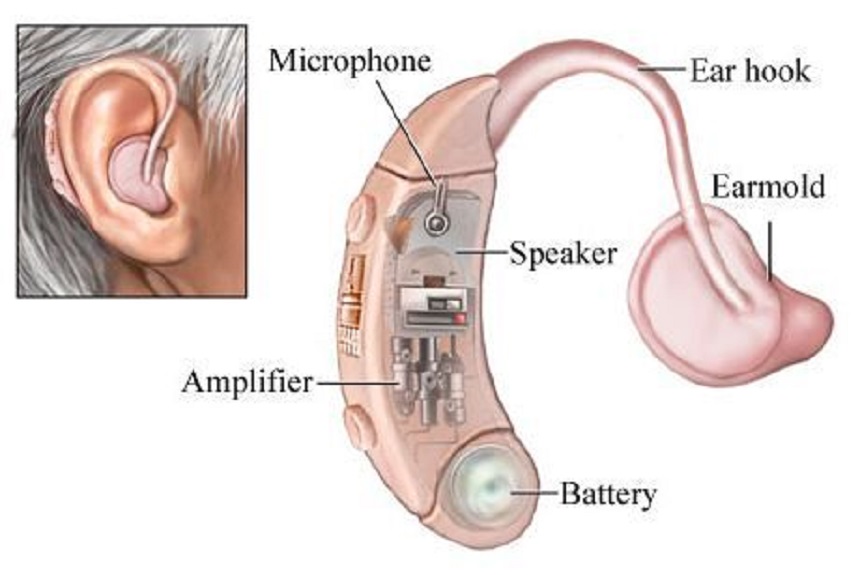
    Behind the ear (BTE)

    Receiver in canal (RIC)

Global Hearing Aids Market: Regional Outline

Among the regional classification of the global hearing aids market, North America and Europe are expected to be amid the foremost lucrative regions in the global market. The rising number of hearing loss incidences in the US and Canada is expected to drive the market growth in North America, while the presence of several leading hearing device manufacturers is anticipated to fuel the hearing aid businesses across Europe. Meanwhile, the high noise pollution levels in Asia Pacific (APAC) countries such as India, China and Japan is also expected to impact the hearing aids market in the APAC region.

Global Hearing Aids Market: Key Players

The leading manufacturers of the global hearing aids market are focussed on market consolidation and expansion of their product portfolio. ReSound, Widex, Oticon, Siemens AG, Starkey Hearing Technologies Inc., and Phonak Hearing Systems, are among the leading manufacturers of the global market that are based in European countries, and account for a majority of the global production of hearing aids. Zounds Hearing, Inc. (U.S.), SeboTek Hearing Systems, LLC (U.S.), Sivantos Pte. Ltd. (Singapore), GN Store Nord A/S (Denmark), Cochlear Limited (Australia), Sonova (Switzerland), MED-EL (Austria), and William Demant Holding A/S (Denmark), among others, are also recognised as the key players in the global hearing aids market.


Modupe Gbadeyanka is a fast-rising journalist with Business Post Nigeria. Her passion for journalism is amazing. She is willing to learn more with a view to becoming one of the best pen-pushers in Nigeria. Her role models are the duo of CNN's Richard Quest and Christiane Amanpour.

Click to comment

Leave a Reply

Your email address will not be published. Required fields are marked *

Health

NAFDAC Announces Recall of WAP Sensual Enhancement Capsules

Published

on

WAP Sensual Enhancement Capsules

By Aduragbemi Omiyale

The National Agency for Food and Drug Administration and Control (NAFDAC) has announced the recall of a sexual enhancement product known as WAP Sensual Enhancement Capsules.

In a statement on Monday, the Nigerian agency disclosed that the recall is due to “undeclared pharmaceutical ingredients” in the product, whose country of origin is unknown, but is marketed and distributed online in the US through eBay.

It was emphasised that the recall is being “voluntarily” made by the manufacturer, Best Supplements Best Prices Company.

The detection of the undeclared pharmaceutical ingredients was made by the US Food and Drug Administration (FDA).

Laboratory analysis by the US FDA revealed that the product contained undeclared sildenafil, tadalafil, and flibanserin, which were not mentioned on the product label. Such substances may include phosphodiesterase type-5 (PDE-5) inhibitors or related compounds commonly used for the treatment of erectile dysfunction, the statement by NAFDAC stated.

Sildenafil and tadalafil are ingredients in FDA-approved prescription drugs used to treat erectile dysfunction.

It was noted that these undeclared ingredients may interact with nitrates found in some prescription drugs, such as nitroglycerin, and may lower blood pressure to dangerous levels. Consumers with diabetes, high blood pressure, high cholesterol, or heart disease often take nitrates.

Flibanserin is the active ingredient in an FDA-approved prescription drug used to treat low sexual desire in women. Flibanserin can cause drowsiness, sedation, dangerously low blood pressure, and fainting, especially when combined with alcohol.

Consumers have been encouraged to report compromised products (medicines or medical devices) to the nearest NAFDAC office, call 0800-162-3322, or send an email to sf******@********ov.ng.

Continue Reading

Health

Tinubu Chooses Obi Adigwe Coordinator of Health Tech Data Analytics Office

Published

on

obi adigwe

By Modupe Gbadeyanka

Dr Obi Adigwe has been appointed as the pioneer National Coordinator of the National Health Technology and Data Analytics Office (NHTDAO).

The body was created by the Ministry of Health under the approval of President Bola Tinubu.

NHTDAO will be domiciled in the Office of the Coordinating Minister of Health and Social Welfare, a statement on Friday by the Special Adviser to the President on Information and Strategy, Mr Bayo Onanuga, stated.

The agency will serve as a meta-level national platform for coordinating the country’s digital-health agenda. It will reinforce, not replace, the existing statutory functions of relevant departments and agencies, it was emphasised.

The organisation will also harmonise and empower the public and private institutions across the health system, set the standards that connect them, and operationalise the National Digital Health Architecture, approved by the National Council on Health in November 2025.

It was stated that President Tinubu expects NHTDAO to accelerate Nigeria’s transition to a secure, interoperable and data-driven health system that improves outcomes for all citizens.

Mr Adigwe, as Director General of the National Institute for Pharmaceutical Research and Development, has leveraged science to catalyse interventions in artificial intelligence, translational research, and technology transfer.

He coordinated major projects, including the ¥300m Nanotechnology grant and the AFREXIMBank grant for Africa’s first API Training Facility. He led the roadmap development that underpinned an €18 million EU grant, the largest in Africa for the thematic area. During the last pandemic, Adigwe globally showcased African science by undertaking the world’s first analysis to debunk claims about the Covid Organics preparation.

The Office’s Steering Committee, which provides strategic direction and oversight, comprises:

  • Professor Muhammad Ali Pate, Coordinating Minister of Health and Social Welfare (Co-chair)
  • Mr Olaniyi Yusuf, Chairman of the Nigerian Economic Summit Group (Co-chair)
  • Dr Iziaq Adekunle Salako, Minister of State for Health and Social Welfare (Alternate Co-chair)
  • Ms Kachollom Daju, Permanent Secretary, Federal Ministry of Health and Social Welfare
  • Mr Idris Alubankudi Saliu, Special Adviser to the President on Technology and Digital Economy
  • Dr Muntaqa Umar-Sadiq, National Coordinator, SWAp Coordination Office
  • Dr Abdu Mukhtar, National Coordinator, Presidential Initiative to Unlock Healthcare Value Chain
  • Dr Muyi Aina, Executive Director, National Primary Health Care Development Agency
  • Dr Kelechi Ohiri, Director General, National Health Insurance Authority
  • Director, Health Planning, Research and Statistics, Ministry of Health and Social Welfare
  • National Information Technology Development Agency Representative
  • Six representatives of the State Commissioners of Health, one from each of the six geopolitical zones
  • Pharm Hamza Buhari, Stakeholder representing Industry and Community.
Continue Reading

Health

Lagos Commences Screening of Newborns for Sickle Cell Disease

Published

on

sickle cell disease screening Lagos

By Modupe Gbadeyanka

The Lagos State government has kicked off an initiative to ensure that every newborn is screened for Sickle Cell Disease within 48 to 72 hours after birth using a simple heel-prick test.

It was gathered that babies identified as being at risk will immediately be placed on preventive care while awaiting confirmatory testing.

The Head of the Haematology Department at the Alimosho General Hospital, Dr Olubukola Orolu, revealed that an estimated 150,000 babies are born annually with Sickle Cell Disease in Nigeria, giving the country one of the highest SCD burdens globally.

She, however, applauded the Lagos State Government and the Clinton Health Access Initiative (CHAI) for introducing the state-wide newborn screening programme, describing it as a major step towards reducing childhood deaths associated with the disease.

The commencement of this scheme coincides with the 2026 World Sickle Cell Day, themed Young Voices Rising for Sickle Cell Disease – Closing the Survival Gap: Equity in Sickle Cell Disease.

It highlights the importance of listening to the experiences and aspirations of young people living with Sickle Cell Disease.

Mrs Orolu noted that SCD warriors are increasingly breaking barriers as advocates, leaders, students and change-makers, adding that their voices have continued to reshape the narrative through advocacy for equitable, patient-centred healthcare, self-care and experience sharing.

She, therefore, called for equal access to quality healthcare, survival opportunities and dignity for everyone living with Sickle Cell Disease.

Also commenting, the chief executive of Alimosho General Hospital, Dr Akinyele Akinlade, described Sickle Cell Disease as an inherited blood disorder that is not contagious, noting that individuals living with the condition are more susceptible to infections.

He advised SCD warriors to stay well hydrated, avoid stress, and protect themselves from extreme cold or heat, as these are common triggers of sickle cell crises, adding that these preventive measures can significantly reduce the frequency and severity of crises.

One of the participants, Ms Borokini Zainab, an SCD warrior and student nurse, expressed appreciation to the organisers for the enlightenment programme.

Sharing her personal journey, she spoke about the challenges of balancing recurrent pain crises with her academic pursuits and personal life. Despite moments of frustration, she encouraged fellow warriors not to lose hope.

“Don’t let sickle cell put you down. Be encouraged from within. Don’t let your dreams be shattered because of this,” she said, adding that her personal experience with Sickle Cell Disease inspired her to pursue a career in nursing so she could support others living with the condition.

Continue Reading

Trending