Connect with us

Economy

ENGIE to Develop Renewable Energies in Senegal

Published

on

By Dipo Olowookere

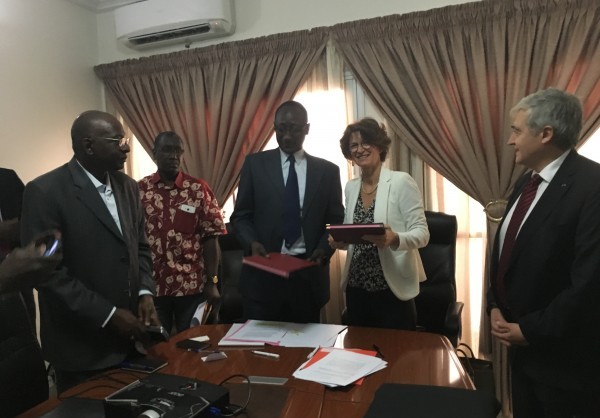
ENGIE has announced completing a deal with ANER, the National Renewable Energies Agency in Senegal, to accelerate the development of renewable energies in the country.

The first part of the agreement involves the development of solar energy for individuals in multi-occupancy or individual housing.

The aim is to study the initial deployment of these solutions to 11,000 households in the city of Dakar and its suburbs.

The main focus will be on photovoltaic solar panels for the production of electricity and solar water-heaters for the production of hot water. Together, ANER and ENGIE will look into financing solutions for this equipment to facilitate their deployment to clients.

As part of this agreement, ENGIE also commits to market energy performance contracts (EPC) to industrial operators and the tertiary sector in large urban communities in Senegal.

The goal is to reduce sites’ energy consumption and help to balance the Senegalese electrical system. In Senegal, ENGIE will adapt the concept of EPC that it has used in all its industrial client and large tertiary markets around the world for many years.

The final part of this agreement involves ENGIE’s participation in an industrial cluster to promote renewable energies, particularly by professional training actions and strengthening the local industrial network.

Isabelle Kocher, ENGIE CEO, declared: “ENGIE is aiming to use its technical experience and financial capacity to support Senegal’s energy policy, in close partnership with local stakeholders. The agreement we have signed today reflects our desire to be a major stakeholder in renewable energies and services in Africa and to solve the huge energy supply problems found on the continent.”

In Senegal, ENGIE has been selected for the Dakar TER project in partnership with Thales for the design and production of infrastructures and systems, with a contract amounting to 225 million euros. The Group is also involved in the Senergy project, a 30 MW photovoltaic power station in the town of Santiou Mekhé, scheduled for commissioning in 2017.


Dipo Olowookere is a journalist based in Nigeria that has passion for reporting business news stories. At his leisure time, he watches football and supports 3SC of Ibadan. Mr Olowookere can be reached via [email protected]

Advertisement
Click to comment

Leave a Reply

Your email address will not be published. Required fields are marked *

Economy

FG Targets Credit Access For 50% Workers By 2030

Published

on

Workers' Day

By Adedapo Adesanya

The Vice President, Mr Kashim Shettima, inaugurated the Board of the Nigerian Consumer Credit Corporation (CREDICORP) and gave a 50 per cent access target for workers, saying consumer credit was critical to Nigeria’s ambition of becoming a one-trillion-dollar economy by 2030.

According to him, President Bola Tinubu established the CREDICORP to build a trusted credit infrastructure, provide catalytic capital to lower borrowing costs, and help Nigerians overcome long-standing cultural resistance to credit.

Speaking on Thursday in Abuja when he inaugurated the board on behalf of the President, the Vice President, in a statement by his spokesman, Mr Stanley Nkwocha, said that the quality of life of Nigerians cannot improve without closing the gap between access to capital and human dignity.

“A civil servant who earns honestly does not have to chase sudden wealth just to buy a vehicle, or save for ten years to buy one. A young professional should not remain in darkness simply because solar power must be paid for all at once,” the Vice President said.

VP Shettima disclosed that in just one year of operations, CREDICORP has disbursed over ₦37 billion in consumer credit to more than 200,000 Nigerians, with over half of them accessing formal credit for the first time.

The Vice President said the organisation was specifically tasked with building credit infrastructure to bridge the trust gap between lenders and borrowers, providing wholesale capital and credit guarantees through its portfolio company.

“Ultimately, these critical jobs of CREDICORP will enable access to consumer credit to at least 50 per cent of working Nigerians by 2030,” he said.

The Vice President explained that the new board’s role was not ceremonial as they are custodians of the organisation’s mission, adding that the long-term strength of the institution would depend on their “vigilance, integrity, sacrifice, and commitment.”

He directed Board members to uphold Public Service Rules, the Board Charter, and all applicable governance frameworks, warning that accountability and stewardship of public resources were non-negotiable.

The Chairman of CREDICORP, Mr Aderemi Abdul, expressed appreciation to President Tinubu for his vision behind the formation of CREDICORP and for the confidence reposed in them, noting that the establishment of the corporation marked an important step towards strengthening the nation’s financial architecture.

He assured President Tinubu that the board understands its responsibility and will guide the institution to deliver meaningful benefits to Nigerians.

For his part, Mr Uzoma Nwagba, Managing Director/CEO of CREDICORP, recalled watching President Tinubu say 20 years ago that consumer credit is one of the major tools that will improve the lives of Nigerians.

He noted that over the past 18 months, the institution has benefited more than 200,000 Nigerians, including students.

He assured that the presidential vision behind CREDICORP would not be taken lightly, as the team considers their appointments a unique, once-in-a-lifetime opportunity.

Other members of the board inaugurated include Mrs Olanike Kolawole, Executive Director, Operations; Mrs Aisha Abdullahi, Executive Director, Credit and Portfolio Management; Mr Armstrong Ume-Takang (MD, MoFI), Representative of MoFI; Mrs Bisoye Coke-Odusote (DG, NIMC), Representative of NIMC; and Mr Mohammed Naziru Abbas, Representative of FMITI.

Others are Mr Marvin Nadah, Representative of FCCPC; Mrs Chinonyelum Ndidi, Representative of the Federal Ministry of Finance; Mr Mohammed Abbas Jega, Independent Director; and Mrs Toyin Adeniji, Independent Director.

Continue Reading

Economy

NASD OTC Exchange Rallies 0.23% as Nipco Leads Six Advancers

Published

on

NASD OTC stock exchange

By Adedapo Adesanya

Six price gainers helped the NASD Over-the-Counter (OTC) Securities Exchange retain its stay in green territory after a 0.23 per cent appreciation on Thursday, February 26.

The price gainers were led by Nipco Plc, which added N25.00 to close at N278.00 per share compared with the previous day’s N253.00 per share, NASD Plc rose by N5.13 to N56.41 per unit versus N51.28 per unit, FrieslandCampina Wamco Nigeria Plc expanded by N2.24 to N102.44 per share from N100.00 per share, Afriland Properties Plc grew by 88 Kobo to N18.88 per unit from N18.00 per unit, 11 Plc increased by 35 Kobo to N277.00 per share from N276.65 per share, and Lagos Building Investment Company (LBIC) Plc gained 27 Kobo to close at N3.75 per unit versus N3.48 per unit.

On the flip side, Central Securities Clearing System (CSCS) Plc lost N1.75 to sell at N68.25 per share versus N70.00 per share, and Geo-Fluids Plc depreciated by 2 Kobo to N3.25 per unit from N3.27 per unit.

The weight of the advancers fortified the NASD Unlisted Security Index (NSI) by 9.21 points to 4,034.46 points from 4,025.25 points, and the market capitalisation soared by N5.51 billion to N2.413 trillion from Wednesday’s N2.408 trillion.

Yesterday, the transaction value jumped by 18.8 per cent to N102.8 million from N80.7 million, and the number of deals surged by 18,8 per cent to 38 deals from 32 deals, while the transaction volume went down by 84.9 per cent to 1.3 million units from 8.7 million units.

At the close of business, CSCS Plc was the most traded stock by value (year-to-date) with 34.2 million units worth N2.04 billion, followed by Okitipupa Plc with 6.3 million units sold for N1.1 billion, and Geo-Fluids Plc with 122.1 million units valued at N478.2 million.

Resourcery Plc remained as the most traded stock by volume (year-to-date) with 1.05 billion units exchanged for N408.7 million, trailed by Geo-Fluids Plc with 122.1 million worth N478.2 million, and CSCS Plc with 34.2 million units traded for N2.04 billion.

Continue Reading

Economy

Naira Down Again at NAFEX, Trades N1,359/$1

Published

on

Naira-Yuan Currency Swap Deal

By Adedapo Adesanya

The Naira further weakened against the Dollar in the Nigerian Autonomous Foreign Exchange Market (NAFEX) for the fourth straight session this week on Thursday, February 26.

At the official market yesterday, the Nigerian Naira lost N3.71 or 0.27 per cent to trade at N1,359.82/$1 compared with the previous session’s N1,356.11/$1.

In the same vein, the local currency depreciated against the Pound Sterling in the same market window on Thursday by N8.27 to close at N1,843.23/£1 versus Wednesday’s closing price of N1,834.96/£1, and against the Euro, it crashed by N8.30 to quote at N1,606.89/€1, in contrast to the midweek’s closing price of N1,598.59/€1.

But at the GTBank forex desk, the exchange rate of the Naira to the Dollar remained unchanged at N1,367/$1, and also at the parallel market, it maintained stability at N1,365/$1.

The continuation of the decline of the Nigerian currency is attributed to a surge in foreign payments that have outpaced the available Dollars in the FX market.

In a move to address the ongoing shortfall at the official window, the Central Bank of Nigeria (CBN) intervened by selling $100 million to banks and dealers on Tuesday.

However, the FX support failed to reverse the trend, though analysts see no cause for alarm, given that the authority recently mopped up foreign currency to achieve balance and it is still within the expected trading range of N1,350 and N1,450/$1.

As for the cryptocurrency market, major tokens posted losses over the last 24 hours as traders continued to de-risk alongside equities following Nvidia’s earnings-driven pullback, with Ripple (XRP) down by 2.7 per cent to $1.40, and Dogecoin (DOGE) down by 1.6 per cent to $0.0098.

Further, Litecoin (LTC) declined by 1.3 per cent to $55.87, Ethereum (ETH) slipped by 0.9 per cent to $2,036.89, Bitcoin (BTC) tumbled by 0.7 per cent to $67,708.21, Cardano (ADA) slumped by 0.6 per cent to $0.2924, and Solana (SOL) depreciated by 0.4 per cent to $87.22, while Binance Coin (BNB) gained 0.4 per cent to sell for $629.95, with the US Dollar Tether (USDT) and the US Dollar Coin (USDC) closing flat at $1.00 each.

Continue Reading

Trending