Connect with us

Economy

Naira Value Depletes as Cryptos Fall After Binance Lawsuit

Published

on

Naira value1

By Adedapo Adesanya

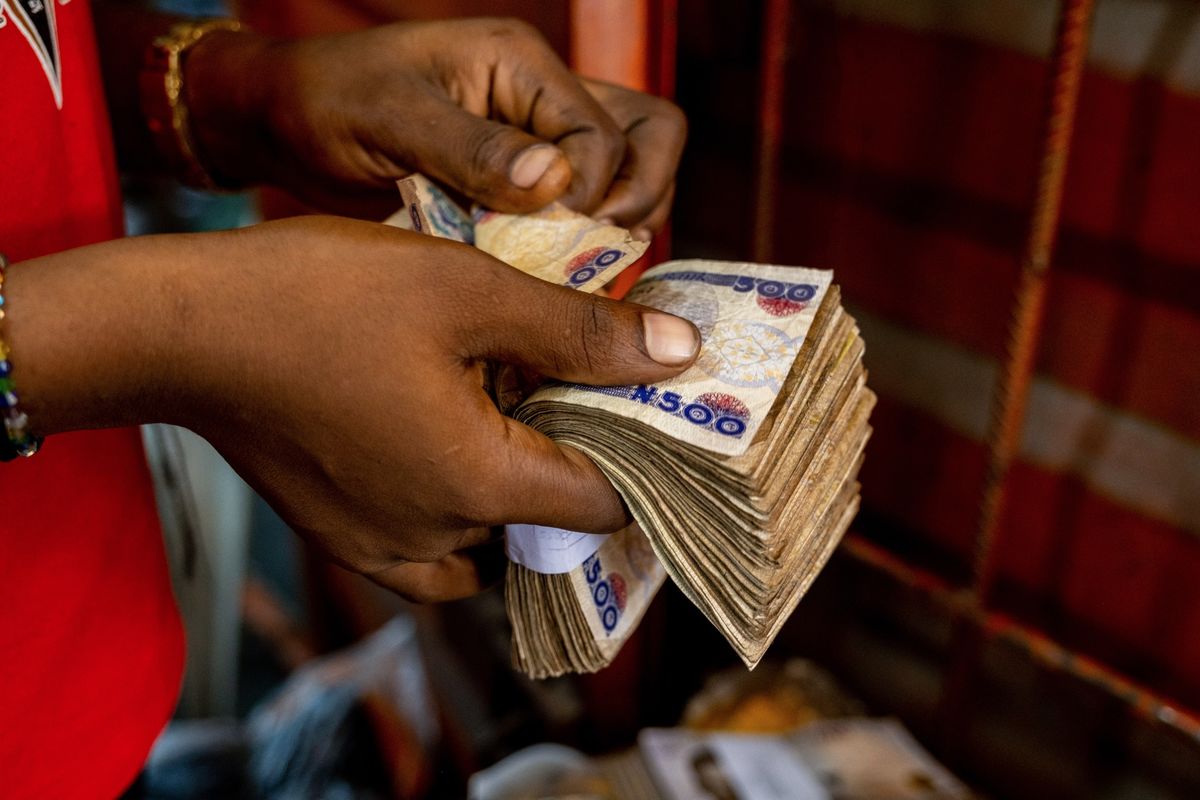
It was a negative outcome for the Nigerian Naira on Monday as its value against the US Dollar depleted in the black market, the Peer-2-Peer (P2P) and the Investors and Exporters (I&E) windows of the foreign exchange market.

In the midst of the forex and cash scarcity in the country, the Naira lost N12 against the greenback yesterday in the P2P to trade at N768/41, in contrast to last Friday’s value of N756/$1.

Also, in the parallel market, the domestic currency shrank by N2 against the United States Dollar to quote at N745/$1 compared with the previous session’s exchange rate of N743/$1.

Similarly, in the official market, the local currency declined by 17 Kobo or 0.05 per cent against its American counterpart to trade at N461.50/$1 compared with last Friday’s rate of N461.33/$1 despite the FX turnover for the day going down by 57.8 per cent or $139.61 million to $101.77 million from the $241.38 million recorded in the preceding session.

However, the local currency closed stronger against the Pound Sterling in the interbank segment on Monday by N3.41 to close at N562.67/£1 versus last Friday’s N566.08/£1, and against the Euro, it appreciated by N3.27 to N494.45/€1 from N497.72/€1.

Meanwhile, the cryptocurrency market was largely down yesterday after the leading crypto exchange by trading volume, Binance, and its CEO, Mr Changpeng Zhao, were sued Monday by the Commodity Futures Trading Commission (CFTC).

The US regulator alleged that Mr Zhao and his company violated trading and derivatives rules, according to a lawsuit filed by the CFTC in a Chicago federal court.

As a result of this development, Bitcoin (BTC) slumped by 2.5 per cent to $26,941.32, as Ethereum (ETH) slid 2.5 per cent to $1,717.83, while the domestic coin of the exchange, Binance Coin (BNB), went south by 5.9 per cent to trade at $309.03.

Litecoin (LTC) fell by 6.2 per cent to $86.54, Solana (SOL) recorded a 3.9 per cent slump to trade at $19.85, Dogecoin (DOGE) depreciated by 1.8 per cent to $0.0724, Cardano (ADA) lost 0.7 per cent to trade at $0.3487, while Ripple (XRP) rose by 6.9 per cent to $0.4849, with Binance USD (BUSD) and the US Dollar Tether (USDT) unchanged at $1.00 apiece.


Adedapo Adesanya is a journalist, polymath, and connoisseur of everything art. When he is not writing, he has his nose buried in one of the many books or articles he has bookmarked or simply listening to good music with a bottle of beer or wine. He supports the greatest club in the world, Manchester United F.C.

1 Comment

Leave a Reply

Your email address will not be published. Required fields are marked *

Economy

Underrated National Currencies in Crypto Exchange: Why NGN and VND Are Emerging as Promising Markets

Published

on

Crypto Market

Crypto exchange is no longer limited to familiar pairs involving the U.S. dollar or the euro. When the goal is specific, e.g., buying USDT with a local currency, receiving an international transfer, or cashing out Bitcoin to a bank account, local fiat currencies take centre stage. The Nigerian naira, or NGN, and the Vietnamese dong, or VND, are excellent examples of this trend. Demand for these currencies is driven not by speculation, but by people solving everyday financial needs.

Why Local Currencies Are Becoming More Important in Crypto Exchange

Across developing markets, cryptocurrency adoption is accelerating where traditional financial infrastructure is slow, expensive, or limited. High international transfer fees, volatile exchange rates, and lack of access to foreign currencies have made digital assets an efficient bridge between local and global financial systems.

Between July 2024 and June 2025, the volume of on-chain cryptocurrency transactions in Sub-Saharan Africa exceeded $205 billion, representing approximately 52% year-over-year growth. Transactions below $10,000 accounted for 8% of total volume, compared with roughly 6% globally, indicating that demand extends well beyond stablecoins such as USDT and USDC. In Southeast Asia, meanwhile, crypto adoption is fueled primarily by the digital economy, cross-border commerce, e-commerce, and high retail participation.

NGN: Why Nigeria Has Become One of the World’s Leading Crypto Markets

Following Nigeria’s currency reforms in 2023–2024, the naira depreciated significantly. Access to U.S. dollars remained limited, while the gap between official and market exchange rates widened. As a result, Bitcoin and stablecoins evolved from investment assets into practical tools for payments and savings and drove a demand for USDT to naira exchanges, as well as Bitcoin to naira conversions.

The numbers illustrate the dynamic. In 2023, Nigeria ranked first globally in the peer-to-peer (P2P) cryptocurrency trading sub-index. In 2024, it climbed to second place in the Global Crypto Adoption Index. During the twelve months ending June 2025, Nigeria’s cryptocurrency transaction volume exceeded $92.1 billion—nearly three times that of South Africa.

Demand patterns are equally impressive. Approximately 89% of cryptocurrency transactions in Nigeria are naira to BTC conversions, excellent rates for which can be found on BestChange, on a dedicated page with NGN to Bitcoin exchange offers. Around 80% of surveyed Nigerians already own stablecoins, while 95% said they would prefer receiving payments in stablecoins rather than in naira. Since 2019, Nigeria has accounted for roughly 60% of all stablecoin inflows into Sub-Saharan Africa. On BestChange, users can also compare offers for exchanging NGN to USDT TRC20, including, as well as the reverse direction, i.e. purchasing naira with crypto—such as BTC to naira or, for example, offers with rates for converting TRX to naira.

International remittances add another major source of demand. In 2024, remittance inflows reached $20.93 billion. While bank transfers cost an average of 15% of the transferred amount, comparable transfers using stablecoins were approximately 60% cheaper.

The legal landscape is also evolving. In 2025, virtual assets were formally brought under Nigeria’s regulatory supervision, while pressure on unregulated platforms increased. Due to this, trusted exchange routes and reputable providers are becoming increasingly important for the crypto exchange market.

VND: Why Vietnam Remains Among the Global Leaders in Crypto Adoption

Vietnam paints a different picture. Unlike Nigeria, it faces no major currency instability, yet it has one of the world’s most active retail cryptocurrency markets. In 2025, the country ranked fourth in the Global Crypto Adoption Index, maintaining a top-five position for several consecutive years. Crypto transactions exceeded $200 billion in total during the twelve months ending June 2025.

Two factors consistently drive demand for crypto exchanges with dong: international remittances and Vietnam’s rapidly expanding digital economy. During 2024–2025, annual remittance inflows exceeded $16 billion, creating steady demand for converting foreign assets into Vietnamese dong.

Users looking to cash out can exchange USDT to VND (TRC20 network) or convert crypto from another network, e.g., USDT (ERC20) to Vietnamese dong. The flagship cryptocurrency exchanges are also available in the list of offers for Bitcoin to VND conversions. Those moving in the opposite direction can compare offers to convert VND to USDT (TRC20) or dong to USDT (ERC20) on BestChange.

Vietnam’s e-commerce market has also grown to approximately $32 billion, generating additional demand for fast and efficient payment solutions.

Additionally, crypto regulation is gradually becoming more structured. Beginning in January 2026, Vietnamese authorities started accepting license applications from cryptocurrency platform operators, followed by the launch of an accelerated regulatory pilot program later that spring.

How BestChange Helps Find NGN and VND Exchange Offers

In emerging markets, evaluating an exchange route means looking beyond the exchange rate alone. The cryptocurrency, blockchain network, payout method, available reserves, transaction limits, and service reputation all matter.

BestChange allows users to compare these factors before sending funds. For each exchange direction, you can instantly view offers from verified exchange services, including exchange rates, reserves, limits, payout methods, and—perhaps most importantly—reviews from other users.

Before sending cryptocurrency, it is also recommended to check the wallet addresses involved using an AML analyzer to reduce compliance risks.

NGN and VND are no longer niche markets. They support real-world financial needs, including international transfers, everyday payments, and holding part of one’s savings in stablecoins.

Continue Reading

Economy

Increased Household Penetration, Others Buoy PZ Cussons FY’26 Revenue Growth

Published

on

PZ Cussons

By Aduragbemi Omiyale

Leading manufacturer of personal healthcare products and consumer goods, PZ Cussons Plc, recorded a 22 per cent growth in its revenue in the 2026 fiscal year.

In its unaudited results recently submitted to the Nigerian Exchange (NGX) Limited, the company posted revenue of N260.46 billion in the period under review compared with the N212.63 billion achieved in the corresponding period in 2025.

This revenue growth was buoyed by market share gains for its major brands, increased household penetration and robust volume uplift, according to the chief executive of PZ Cussons, Mr Oghale Elueni.

It was observed that the cost of sales as a percentage of revenue was 72 per cent, 100bps lower than the prior year, driven by better mix and supply efficiencies.

Marketing and distribution expenses increased by 48.2 per cent to N26.51 billion from N17.89 billion, and administrative expenses also spiked by 43 per cent to N21.07 billion from N14.70 billion.

Also, the organisation recorded significant profitability for the year ended May 31, 2026, rising by 388 per cent to N49.10 billion from N10.07 billion.

Mr Elueni attributed this strong performance to the strength of the business, the equity of the brands, and the discipline of execution, noting that despite the complex and consistently challenging operating environment, the company pulled through to deliver growth in both revenue and profit.

He disclosed that the 22 per cent revenue growth recorded for the 2026 financial year was influenced by a healthy mix of volume and price initiatives.

“The balance sheet was further de-leveraged and strengthened through a cash-accretive P&L and efficient working capital management. The impact has been an improvement in the net asset position from N17.3 billion negative at the beginning of the year to N70.6 billion at year-end.

“The business grew volumes in both the electrical and consumer business, leveraging investment in our brands and sharpening our go-to-market capabilities. The result has been market share gains for our major brands, increased household penetration and robust volume uplift, contributing to overall revenue growth,” he stated.

Mr Elueni expressed profound appreciation to the shareholders for their unwavering support in navigating through the challenges in the last 12 months, noting that the board remains confident that, despite geopolitical uncertainties and their attendant economic shocks, the business is sufficiently resourced to deliver value to stakeholders.

“We have a business that has strong brands, an adaptive operating framework and a culture of disciplined execution that supports the consistent delivery of value to stakeholders,” he stated.

Continue Reading

Economy

Nigeria Records Higher Crude Oil Production in May, June

Published

on

crude oil 1.27 million barrels per day

By Adedapo Adesanya

Nigeria’s crude oil production increased in May and June, according to data published by the Organisation of the Petroleum Exporting Countries (OPEC).

The country’s output increased by 42,000 barrels per day to 1,530 million barrels in May, from 1,489 million barrels in April.

According to Reuters, Nigeria, whose shipments were not affected by the Iran war, also pumped ⁠more in June, based on flow data from financial group LSEG, information from other companies that track flows, such as ⁠Kpler, and data provided by sources at oil companies, OPEC, and consultants.

Output from the OPEC rose by 2.34 million barrels a day to 18.75 million a day, with the gains driven by Kuwait, Saudi Arabia and Iran, the survey showed. The rebound still leaves production considerably below prewar levels.

Kuwait posted the biggest increase among OPEC’s 11 members last month, boosting output by 870,000 barrels a day to 1.36 million a day followed by Saudi Arabia, which raised output by 550,000 barrels a day to an average of 7.2 million a day. That was followed by Iran, which hiked by 510,000 a day to pump 2.85 million a day, and has accumulated a hoard of supply on tankers at sea as it struggles to find buyers.

In the wider alliance, Russia has bolstered crude exports to record levels following Ukrainian strikes on its refineries, potentially diverting volumes that can’t be processed at home.

Even before the peace deal, Persian Gulf producers had found ways to sneak cargoes out through the strait, which was largely shuttered in the early stages of the conflict.

The uptick in supply is creating a surplus in parts of the market, erasing crude’s wartime rally and raising the question of whether OPEC nations will need to compete for customers.

The group’s June production was still 7.3 million barrels a day, or 28 per cent, below February levels, when adjusted for exit by the United Arab Emirates (UAE).

The UAE quit OPEC in May, giving it the freedom to pump at will once the strait fully stabilises. Iraq also briefly threatened it could exit unless eventually given a higher output quota by the organisation.

On Sunday, a subgroup of seven OPEC+ nations announced a 188,000 barrels a day boost in August continuing the series of small and symbolic production hikes during the war to continue a process of restoring output halted a few years ago.

Continue Reading

Trending