Travel/Tourism
Abuja Runway Repairs to Take 6 Months, Not 6 Weeks—Minister

By Dipo Olowookere
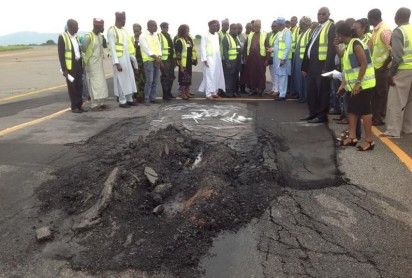
Minister of State for Aviation, Mr Hadi Sirika, has explained that work on the runway of the Nnamdi Azikiwe International Airport in Abuja will take six months to complete, but stressed that the airport would only be closed for six weeks.
Mr Sirika made this clarification while addressing the Senate on Thursday.
The Minister explained that the Abuja runway was constructed in 1982 and has only a lifespan of 14 years, indicating that it has already exceeded its usage.
He warned that to continue to operate the airport would be unsafe and unreasonable as there is a daily occurrence of incidents.
According to him, the Port Harcourt Airport in Rivers State was shut down for over two years because the maintenance was not done on time.
Mr Sirika noted that every flight plan has an alternate landing route and that Kaduna has always been an alternative for Abuja.
He gave an instance when a plane landed on January 8, 2017 and ruined its tyre. He said at the moment, the plane can no longer fly.
The Minister stressed that the President Muhammadu Buhari administration is concerned about safety and will not take any chances to make thing work well.
When asked by the Senate President, Mr Bukola Saraki, on the status of preparation of the Kaduna Airport to serve as alternative, the Aviation Minister said government will provide military, police and helicopter patrols and upgrade clinics along the Abuja/Kaduna airport route.
He further said train services and executive bus services would be provided.
According to him, few years ago, as a member of the National Assembly himself, he wrote a letter to all 469 members on the need for a second runway.
The Deputy Senate President, Mr Ike Ekweremadu, asked if it was possible to extend the runway in Abuja to allow planes to continue to land and take off. He further asked if there were plans now to construct another runway at the Abuja Airport.
In his submission, Senator Barnabas Gemade said, “Julius Berger is not helping the nation at all, this has become a reoccurring problem in major areas they handle.”
He pointed out that if the airport must be closed, it should not exceed two weeks, insisting that the Kaduna Airport does not do international flight, saying the implication is that flight tickets would become more expensive.
But the Aviation Minister assured that local engineers and indigenous companies would be engaged so as to put the money back into our economy.
Travel/Tourism
FG to Introduce Biometric Single Travel Emergency Passport 2026
By Adedapo Adesanya
The federal government has announced plans to introduce the new biometric emergency travel document, the Single Travel Emergency Passport (STEP), by 2026 as part of reforms aimed at modernising Nigeria’s immigration processes and strengthening border security.
Initially revealed in November, the Comptroller General of the Nigeria Immigration Service (NIS), Mrs Kemi Nandap, speaking on Monday in Abuja during the decoration of 46 newly promoted Assistant Comptrollers of Immigration (ACIs) to the rank of Comptrollers of Immigration, said the proposed STEP would replace the current Single Travel Emergency Certificate (STEC) and is designed to enhance efficiency, security, and global acceptability of Nigeria’s emergency travel documentation.
She explained that the new emergency passport would be biometric-based and deployed through alternative, technology-driven platforms to ensure seamless service delivery.
“I’m looking forward to embracing 2026, which will also be part of all the reforms we’re doing to ensure that we optimise our services, in terms of visas, passport production lines and our contactless solutions,” she said.
The NIS boss noted that the STEP is one of several technology-driven innovations being rolled out by the Service to improve operational efficiency and meet its constitutional mandate.
She also highlighted the recent introduction of the ECOWAS National Biometric Identity Card (ENBIC), describing it as a critical step towards seamless regional integration and secure cross-border movement within West Africa.
“We want to ensure that our processes are seamless. The STEP, which we are going to launch early next year, is another key programme that will further strengthen our service delivery,” Nandap added.
The Comptroller General charged the newly decorated officers to demonstrate heightened vigilance, professionalism, and integrity, particularly in light of Nigeria’s prevailing security challenges.
“Your decoration today symbolises the trust reposed in you and carries with it expectations of enhanced leadership, sound judgement, accountability and exemplary conduct,” she said.
Mrs Nandap stressed that officers at senior levels must combine professional competence with strong leadership qualities, including clarity of vision, decisiveness, empathy, and the ability to mentor and inspire subordinates.
“Considering the current security challenges our nation faces, we must remain vigilant and unrelenting in the fight against multifaceted threats. Your actions will set the tone and reflect the core values and reputation of this Service,” she warned.
She reaffirmed the Service’s zero tolerance for indolence and unprofessional conduct, urging officers to embrace innovation, adapt to emerging challenges, and place the interest of the NIS above personal considerations.
Travel/Tourism
Moving to France After Retirement: What You Need to Know First
The idea of spending retirement in France comes up often — sometimes because of the climate, sometimes because of the healthcare system, and sometimes simply because of the way everyday life is organised there. But once the initial appeal fades, a practical question usually follows: under what conditions can a retiree actually live in France legally?
The short answer is: it’s possible.
The longer answer requires a closer look.
No “retirement visa,” but a workable solution
Unlike some countries, France does not offer a dedicated retirement visa. This often comes as a surprise. In practice, however, most retired foreigners settle in France under the long-stay visitor visa — a residence status that is not tied to age or professional background.
The logic behind it is straightforward: France allows people to live in the country if they do not intend to work and can support themselves financially. For this reason, the visitor visa is used not only by retirees, but by other financially independent residents as well.
Income matters more than age
When an application is reviewed, age itself is rarely decisive. Financial stability is.
French authorities do not publish a fixed minimum income requirement. What they assess instead is whether the applicant has sufficient and reliable resources to live in France without relying on public assistance. This usually includes:
- a state or private pension;
- additional regular income;
- personal savings.
In practice, the clearer and more predictable the income, the stronger the application.

Housing is not a formality
Relocation is not possible without a confirmed place to live. A hotel booking or short-term accommodation is usually not enough.
Applicants are expected to show that they:
- have secured long-term rental housing;
- own property in France;
- or will legally reside with a host who can provide accommodation.
This is one of the most closely examined aspects of the application — and one of the most common reasons for refusal.
Healthcare: private coverage first
At the time of application, retirees must hold private health insurance valid in France and covering essential medical risks. This requirement is non-negotiable.
Access to France’s public healthcare system may become possible after a period of legal residence, but this depends on individual circumstances, length of stay, and administrative status. It is not automatic.
What the process usually looks like
Moving to France is rarely a single step. More often, it unfolds as a sequence:
- applying for a long-stay visa in the country of residence;
- entering France;
- completing administrative registration;
- residing legally for the duration of the visa;
- applying for renewal.
The initial status is typically granted for up to one year. Continued residence depends on meeting the same conditions.
Restrictions people often overlook
Living in France under a visitor visa comes with clear limitations:
- working in France is prohibited;
- income from French sources is not allowed;
- social benefits are not part of this status.
These are not temporary inconveniences, but core conditions of residence.
Looking further ahead
Long-term legal residence can, over time, open the door to a more permanent status, such as long-term residency. In theory, citizenship may also be possible, though it requires meeting additional criteria, including language proficiency and integration.
For many retirees, however, the goal is simpler: to live quietly and legally, without having to change status every few months.
Moving to France after retirement is not about a special programme or age-based privilege. It is a question of preparation, financial resources, and understanding the rules. For those with stable income and no intention to work, France offers a lawful and relatively predictable way to settle long-term.
No promises of shortcuts — but no closed doors either.
Travel/Tourism
Trump Slams Partial Travel Ban on Nigeria, Others Over Security Concerns
By Adedapo Adesanya
The United States President Donald Trump has imposed a partial travel restriction on Nigeria, as part of a series of new actions, citing security concerns.
The latest travel restriction will affect new Nigerians hoping to travel to the US, as it cites security concerns and difficulties in vetting nationals.
The travel restrictions also affect citizens of other African as well as Black-majority Caribbean nations.
This development comes months after the American President threatened to invade the country over perceived persecution against Christians.
President Trump had already fully banned the entry of Somalis as well as citizens of Afghanistan, Chad, Republic of the Congo, Equatorial Guinea, Eritrea, Haiti, Iran, Libya, Myanmar, Sudan, and Yemen.
The countries newly subject to partial restrictions, besides Nigeria, are Angola, Antigua and Barbuda, Benin, Dominica, Gabon, The Gambia, Ivory Coast, Malawi, Mauritania, Senegal, Tanzania, Tonga, Zambia and Zimbabwe.
Angola, Senegal and Zambia have all been prominent US partners in Africa, with former president Joe Biden hailing the three for their commitment to democracy.
In the proclamation, the White House alleged high crime rates from some countries on the blacklist and problems with routine record-keeping for passports.
The White House acknowledged “significant progress” by one initially targeted country, Turkmenistan.
The Central Asian country’s nations will once again be able to secure US visas, but only as non-immigrants.
The US president, who has long campaigned to restrict immigration and has spoken in increasingly strident terms, moved to ban foreigners who “intend to threaten” Americans, the White House said.
He also wants to prevent foreigners in the United States who would “undermine or destabilize its culture, government, institutions or founding principles,” a White House proclamation said.
Other countries newly subjected to the full travel ban came from some of Africa’s poorest countries — Burkina Faso, Mali, Niger, Sierra Leone and South Sudan — as well as Laos in southeast Asia.
-
Feature/OPED6 years agoDavos was Different this year
-
Travel/Tourism9 years ago
Lagos Seals Western Lodge Hotel In Ikorodu
-
Showbiz3 years agoEstranged Lover Releases Videos of Empress Njamah Bathing
-
Banking8 years agoSort Codes of GTBank Branches in Nigeria
-
Economy3 years agoSubsidy Removal: CNG at N130 Per Litre Cheaper Than Petrol—IPMAN
-
Banking3 years agoFirst Bank Announces Planned Downtime
-
Banking3 years agoSort Codes of UBA Branches in Nigeria
-
Sports3 years agoHighest Paid Nigerian Footballer – How Much Do Nigerian Footballers Earn