General
Court Sends Shalli Popi, Five Others to Prison for Internet Fraud
By Adedapo Adesanya
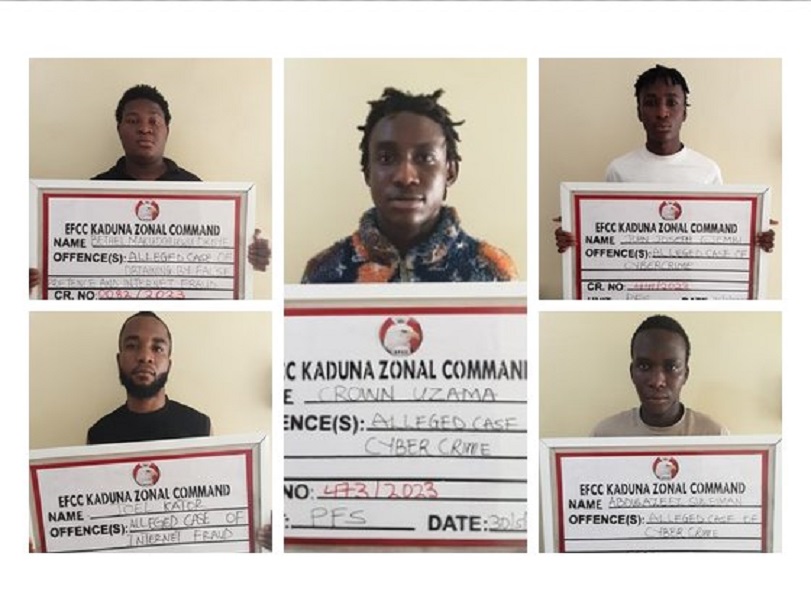
A TikTok music celebrity, Mr Crown Uzama, popularly known as Shalli Popi, and five others have been convicted of Internet fraud.
The six men were charged before Justice A. A. Isiakaon by the Kaduna Zonal Command of the Economic and Financial Crimes Commission (EFCC) on a separate one-count charge bordering on criminal impersonation, offences contrary to Sections 142 (1), 57 and 308 of the Kaduna Penal Code Law, 2017 and punishable under Section 309 of the same law.
Mr Uzama (aka Shalli Popi and Miller Maxwell) was convicted alongside Mr Joel Kator (aka Alfred Hudson), Mr Abdul-Azeez Suleiman Temidayo (aka Miss Katie Official), Mr Favour Chidiogo Emmanuel (aka Kate Banks), Mr John Joseph (aka Avail Hollywood) and Mr Bethel Makuochukwu (aka Violetqmartinez).
It was disclosed that Mr Makuochukwu had two weeks earlier been convicted for money laundering.
They all pleaded guilty to the charges preferred against them.
Consequently, the prosecuting counsel, M. E. Eimonye, M. Arumeni, M. U. Gadaka and K.S Ogunlade, urged the court to convict them accordingly.
Justice Isiaka convicted and sentenced the Elon Musk and Sharpiru crooner and the other five defendants to two years imprisonment, each with the option of fines.
In addition, they are to forfeit all electronic gadgets, furniture and other items recovered from them to the Federal Government of Nigeria.
The defendants were arrested at various locations in Kaduna upon intelligence received by the command.
The investigation established they had impersonated foreign nationals and used false identities to defraud unsuspecting victims.
General
Onafriq, Privy to Build Regulated Stablecoin Infrastructure for B2Bs
By Modupe Gbadeyanka
No doubt, moving money among African markets remains a slow, fragmented process that relies on multiple intermediaries and prolonged settlement cycles.
To solve this issue and drive the development of stablecoin-enabled payment services for businesses across the continent, Onafriq has joined forces with a leading stablecoin infrastructure provider, Privy.
The collaboration will enable Onafriq to create and manage embedded digital asset solutions for its partners and, in time, institutional clients where regulation allows. The initial phase focuses on cross-chain stablecoin transfers and treasury and settlement workflows, creating the foundation for future cross-border payment and liquidity solutions.
Integrating Privy’s secure infrastructure enables Onafriq to build the capabilities required to support a new generation of efficient digital payment services for banks, fintechs, and mobile money operators.
This partnership is a key component of Onafriq’s broader strategy to modernise pan-African payment infrastructure, enabling secure multi-modal wallets and more efficient movement of value across the continent.
The outcome will support a range of future institutional use cases, including stablecoin-enabled settlement, treasury management and liquidity services, as it reflects Onafriq’s commitment to driving Africa’s digital transformation agenda by investing in technologies that make financial services more efficient, connected and accessible.
It was gathered that Onafriq selected Privy for its enterprise-grade infrastructure to enable the seamless integration of digital asset wallet capabilities into its products, subject to regulatory approval, and deliver a simple user experience while abstracting the complexity of blockchain technology.
“At Onafriq, we keep investing in technology that makes payments faster and more accessible. Privy gives us a building block for faster settlement and better liquidity management. As demand for digital asset services grows, our goal is to ensure Africa’s payment ecosystem benefits securely and in line with regulatory frameworks,” the Group Chief Product and Innovation Officer at Onafriq,” Mr Luke Kyohere, said.
The chief executive of Privy, Mr Henri Stern, said, “Stablecoins will play an increasingly important role in the future of global payments, but real-world adoption depends on infrastructure that is secure, scalable and simple to implement. Working with Onafriq allows us to help build that foundation across Africa and beyond.”
General
Osun Threatens Lawsuit as EFCC Freezes State Accounts Ahead of August 15 Guber Election
By Adedapo Adesanya
The Osun State Government has announced plans to institute legal action against the Economic and Financial Crimes Commission (EFCC), following an alleged freezing of the state’s bank account, describing the action as unlawful and capable of disrupting governance.
The Governor of the state, Mr Ademola Adeleke, through the state’s Attorney General and Commissioner for Justice, Mr Oluwole Jimi-Bada, made this disclosure on Wednesday.
According to the statement, Governor Adeleke has directed him to challenge the anti-graft agency’s decision at the Federal High Court.
It was widely reported that the anti-graft agency issued a “Post No Debit” directive to the management of First Bank, where the state’s accounts are domiciled, effectively restricting transactions.
He argued that while the commission has the authority to investigate financial records, it cannot freeze a state government’s accounts without first obtaining a court order.
“I have the mandate of the governor to proceed to the Federal High Court to challenge this move. EFCC can investigate the accounts, but it can’t freeze the accounts without an order of court.
“This step will affect government running, but we will challenge the move and ensure that the agency acts within the ambit of the law,” Mr Jimi-Bada said.
Also speaking, the Commissioner for Finance, Mr Sola Ogungbile, alleged that police officers stormed the main branch of First Bank in Osogbo and arrested some members of the bank’s staff.
Mr Ogungbile maintained that Governor Adeleke was not deploying state resources for his re-election campaign and urged the EFCC to consider the potential impact of its actions on public services and the welfare of residents.
Governor Adeleke had earlier raised concerns over an alleged plan by the EFCC to freeze all Osun State Government accounts, including those of senior government officials.
In a statement issued by the Commissioner for Information and Public Enlightenment, Mr Kolapo Alimi, the governor described the reported move as unlawful and politically motivated.
He alleged that the planned freezing of the accounts was intended to cripple government operations ahead of the August 15 governorship election.
Governor Adeleke further insisted that there was no legal justification for freezing the state’s accounts, arguing that the EFCC lacks the authority to take such action against a state government without due legal process.
The EFCC had not issued an official response to the allegations as of the time of filing this report.
General
Court Sentences Lagos BDC Operator
By Modupe Gbadeyanka
A Lagos-based bureaux de change (BDC) operator, Mr Dabo Malam Ardi, has been convicted and sentenced by Justice F. N. Ogazi of the Federal High Court, Ikoyi, Lagos.
The forex trader was sentenced by the court on Tuesday, August 4, 2026, to two months’ imprisonment, with an option of N80,000 fine for engaging in illegal foreign exchange transactions.
Mr Ardi was convicted and sentenced by the court after pleading guilty to a one-count charge bordering on an illegal foreign exchange transaction.
He was brought before the temple of justice by the Lagos Zonal Directorate 1 of the Economic and Financial Crimes Commission (EFCC) on a one-count charge bordering on an illegal foreign exchange transaction.
“That you, Dabo Malam Ardi, sometime in 2026 in Lagos State, within the jurisdiction of this court, engaged in a foreign exchange transaction other than through the official foreign exchange market and thereby committed an offence contrary to Section 11(1)(a) of the National Economic Intelligence Committee (Establishment, etc.) Act, 1994, and punishable under Section 11(2) of the same Act,” the charge read.