Connect with us

General

Seedstars Launches FIWAM to Boost Financial Inclusion for Women Migrants

Published

on

seedstars women

By Adedapo Adesanya

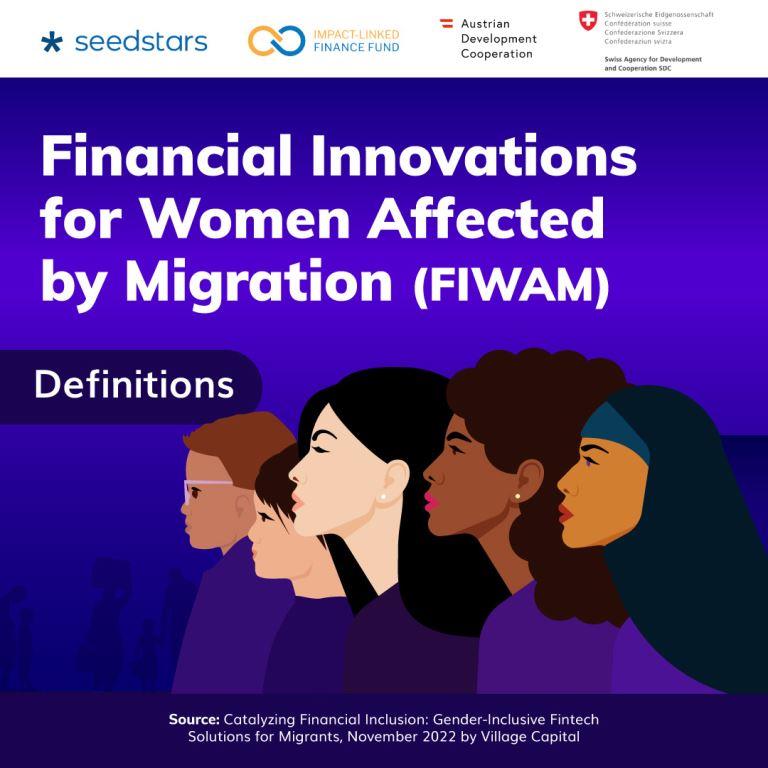
Seedstars has launched the Financial Innovations for Women Affected by Migration (FIWAM), a growth programme that aims to identify and support fintech companies that are focused on promoting financial inclusion, particularly for women migrants and women affected by migration across Sub-Saharan Africa as well as in Asia and the Middle East/North Africa (MENA) markets.

The programme will be funded by the Impact-Linked Fund for Gender Inclusive FinTech (ILF for GIF), managed by the Impact-Linked Finance Fund (ILFF), and supported by the Swiss Agency for Development and Cooperation. It will see assistance from the Austrian Development Agency, the operational unit of Austrian Development Cooperation.

This will be the next step in their collaboration as ILF for GIF has partnered with Seedstars to foster improved access and utilization of financial products and services for women affected by migration.

The recent report by Village Capital, “Catalyzing Financial Inclusion: Gender-Inclusive Fintech Solutions for Migrants,”  cites that there are over 281 million international migrants and over 55 million internally displaced persons globally. These numbers continue to rise with protracted conflict, the effects of climate change, and increasing poverty levels worldwide.

Recognising this, Seedsatrs said that there is a growing need to improve the financial inclusion of migrants, especially women migrants who face even more barriers in accessing financial services, such as legislative constraints, documentation deficiencies, language barriers, cultural differences, and limited mobility.

Through the FIWAM Growth Program, selected Fintechs from Asia, MENA, and Sub-Saharan Africa will receive technical assistance to attain investment potential and scale their impact, targeting women migrants and women affected by migration.

Each cohort of 10-15 fintechs per region will also receive direct support from experts in residence (EIR) and mentors drawn from their respective regions over a period of three months.

The selection requirement is limited to for-profit entities that have operations in a Sub-Saharan African/MENA/Asian country and provide a fintech solution that already serves or has the potential to serve women migrants or women affected by migration.

Other criteria indicate that the entities must have product market fit, be at a growth stage, generate monthly revenue of ±$10,000, and must have woman-led companies.  Founders who are women migrants are highly encouraged to apply, according to a statement seen by Business Post.

Speaking on this, Susanne Thiard-Laforet, Programme Manager Private Sector & Development, Austrian Development Agency, stated, “We’re eager to collaborate with Seedstars in this pivotal initiative to enhance access and utilization of financial services for women impacted by migration, encompassing not only migrants themselves but also their families and host communities.

“This programme transcends mere acceleration; it is a catalyst for meaningful change, dismantling barriers and biases in order to recognize migrant groups, especially women, as a viable market segment.

“We are looking forward to supporting and learning from the innovative solutions that will be developed through this programme and the impactful strides they will make in fostering financial inclusion.”

Commenting on the launch of the program, Elizabeth Jones, Global Lead Programme Operations of Seedstars, said, “We’re thrilled to launch the Financial Innovations for Women Affected by Migration (FIWAM) Growth Program, as it has the potential to create a lasting impact on the lives of women migrants and women affected by migration. We’re eager to witness the transformative financial inclusion these innovative solutions will bring about in their communities.”


Adedapo Adesanya is a journalist, polymath, and connoisseur of everything art. When he is not writing, he has his nose buried in one of the many books or articles he has bookmarked or simply listening to good music with a bottle of beer or wine. He supports the greatest club in the world, Manchester United F.C.

Advertisement
1 Comment

Leave a Reply

Your email address will not be published. Required fields are marked *

General

Violence Mars APC Ward Congress in Oluyole

Published

on

APC congress

By Modupe Gbadeyanka

The ward congress of the All Progressives Congress (APC) in Oluyole Local Government Area of Oyo State on Saturday left several party members injured after a violence clash erupted.

According to reports, one of the injured persons was Mr Idowu Oyawale, who served as the campaign Director General of a House of Representatives member in the last general elections, Ms Tolulope Akande-Sadipe.

It was disclosed that he sustained severe injuries during the exercise and is currently receiving treatment at an undisclosed hospital.

The ward congress was organised by the ruling party to elect ward executives across the local government’s wards.

However, it was disrupted at Olomi Ward 7 by suspected heavily-armed political thugs allegedly linked to a member of the party.

It was claimed that the thugs invaded the congress venue at Olomi Basic School 1, dispersing party members and officials supervising the exercise, with stones, clubs and other weapons.

Eyewitnesses said tensions escalated unprovoked over delegates’ lists and ward executive positions. The disagreement reportedly degenerated into physical altercations before the violent attacks on some party members.

It was learnt that security operatives led a tactical team to restore order, peace, and disperse the attackers.

Reacting to the incident, some party leaders and elders condemned the violence, describing it as unfortunate and capable of undermining the credibility of the internal democratic process.

The leaders have called on party chieftains and President Bola Tinubu to immediately order an investigation into the violent attacks.

Continue Reading

General

A Call For United African Front on Slavery and Reparations

Published

on

African Front on Slavery and Reparations

By Princess Yanney

One message stood out; one particular briefing gave clarity and hope for better days ahead. Africa will be heard; willingly or unwillingly, and the resolution thereof will no longer be a hope for years to come, but a reality to actualise. At a press conference during the  39th AU Summit  in Addis Ababa, Ghana’s President  John Dramani Mahama urged African leaders to adopt a common continental strategy on the legacy of slavery and racialised chattel enslavement, which he described as “the gravest crime against humanity.”

In this context, one must understand; Reparations matter because colonialism was not simply an episode of foreign rule. It was an economic system. African land was seized, labour was coerced, institutions were reshaped to serve external interests, and entire economies were redesigned around the export of raw materials.

Long before independence, the transatlantic slave trade had already stripped the continent of people, skills and social stability, creating permanent demographic and developmental damage. Colonial rule then consolidated this destruction into a durable global structure of inequality.

President Mahama explained that Ghana’s proposed AU resolution, which received broad support from member states, was carefully drafted with extensive consultations involving the AU Committee of Experts on Reparations, legal experts, academic institutions and diaspora organisations. He said the resolution’s wording was deliberately chosen to reflect historical accuracy, legal credibility, and moral clarity.

“Ghana has undertaken extensive consultations to strengthen the resolution. We’ve engaged with UNESCO, the Global Group of Experts on Reparations, the Pan-African Lawyers Union, academic institutions, the African Union Committee of Experts on Reparations and the African Union Legal Experts Reference Group. We hosted the inaugural joint meeting of the African Union Committee of Experts on Reparations and the African Union Legal Experts Reference Group in Accra earlier this month to further refine the text of the resolution. We also began engagement with the diaspora at the Ghana Diaspora Summit held in December last year.”

Hence, come March 25, the resolution will be presented by one man, who will echo the voice of millions of African people and people of African descent. Because truly, a united Africa demanding reparations is not an Africa asking to be included in an unequal system, but rather, an Africa asserting its right to help redesign it. President Mahama stressed that the initiative goes beyond symbolism, providing a legal and moral foundation for reparatory justice and sustained engagement with the global community. The resolution is designed to facilitate dialogue with the United Nations and international partners while affirming Africa’s demand for recognition and accountability for centuries of exploitation and injustice.

“Informal consultations on the draft text are expected to take place between 23rd February and 12th March 2026. Our objective is simple: to build a broad consensus behind this resolution. The initiative is not directed at any nation; it is directed towards truth, recognition and reconciliation.”

He reiterated. Truth is, a united Africa is a strong global force that cannot be stopped or interrupted. But a divided Africa is an Africa liable to imperialism and Western domination. It is therefore a priority for all African people to join hands and stand together to ensure the aims of these resolutions are achieved.

“We call upon all member states to support and co-sponsor this resolution. The adoption of this resolution will not erase history, but it will acknowledge it. The trafficking in enslaved Africans and racialised chattel enslavement were foundational crimes that have shaped the modern world, and their consequences continue to manifest in structural inequality, racial discrimination and economic disparity.

Recognition is not about division; it is about moral courage. Adoption of the resolution will not be the end. Following the adoption, Ghana will continue engagement with the United Nations Secretary General, the African Union Commission, relevant UN bodies and interested member states,” said John Dramani Mahama as he called for unity.

The importance of today’s reparations consensus lies in its recognition that Africa’s underdevelopment is not an internal failure to be corrected through aid, reforms or external advice. It is the historical and continuing outcome of dispossession. Reparations, therefore, respond to a concrete injury, not an abstract moral wrong. Again, Reparations matter because colonialism was not simply an episode of foreign rule. It was an economic system. African land was seized, labour was coerced, institutions were reshaped to serve external interests, and entire economies were redesigned around the export of raw materials.

Long before independence, the transatlantic slave trade had already stripped the continent of people, skills and social stability, creating permanent demographic and developmental damage. Colonial rule then consolidated this destruction into a durable global structure of inequality. Which is why today’s fight, today’s struggle, is of utmost importance. It is a correction of a historical inhumane error. One that has to be amended and corrected, beginning with recognition.

“This is about a sustained dialogue on reparatory justice and healing. Distinguished ladies and gentlemen, this initiative presents us with a historic opportunity, an opportunity to affirm the truth of our history, an opportunity to recognise the gravest injustice in human history, and an opportunity to lay a stronger foundation for genuine reconciliation and equality. While the past cannot be undone, it can be acknowledged, and acknowledgement is the first step towards justice.” – John Dramani Mahama expressed to the media and all who were gathered to witness the briefing under the theme, “Ancestral Debt, Modern Justice: Africa’s United Case For Reparations”.

Continue Reading

General

APC’s Maikalangu Wins Abuja Municipal Area Council Election

Published

on

Christopher Maikalangu

By Adedapo Adesanya

The Independent National Electoral Commission (INEC) has announced the candidate of the All Progressives Congress (APC), Mr Christopher Maikalangu, as the winner of the Abuja Municipal Area Council (AMAC) election, held on Saturday.

The results for the keenly observed municipal chairmanship poll were announced at the INEC area office in Karu at about 4:30 a.m on Sunday.

The Collation Officer for AMAC, Mr Andrew Abue, said that Mr Maikalangu, who is the incumbent AMAC chairman, was returned elected, having scored the highest number of votes cast, 40,295 out of the total number of valid votes of 62,861 in the election.

“That Maikalangu of the APC, having certified the requirements of the law, is hereby declared the winner and is returned elected,” he declared.

Mr Abue stated that the African Democratic Congress (ADC) came second with 12,109 votes, while the Peoples Democratic Party (PDP) polled 3,398 votes.

According to him, a professor, the rejected votes were 2,336, and the total valid votes were 62,861, while the total votes cast were 65,197.

He added that the number of registered voters in AMAC was 837,338, while the total number of accredited voters was 65,676.

According to him, the scores of the political parties and their candidates that contested the AMAC chairmanship election are:

Agbon Vaniah of the Accord (A) – 403 votes

Nemiebika Tamunomiesam of the Action Alliance (AA) – 108 votes

Paul Ogidi of African Democratic Congress (ADC) – 12,109 votes

Richard Elizabeth of the Action Democratic Party (ADP) – 588 votes

Christopher Maikalangu of the All Progressives Congress (APC) – 40,295 votes

Eze Chukwu of the All Progressives Grand Alliance (APGA) – 1,111 votes

Chukwu Promise of the Allied Peoples Movement (APM) – 122 votes

Ugoh Michael of the Action Peoples Party(APP) – 32 votes

Thomas Happiness of the Boot Party (BP) – 43 votes

Jibrin Alhassan of the New Nigeria Peoples Party (NNPP) – 1,694 votes

Samson Usani of the National Rescue Movement (NRM) – 73 votes

Dantani Zanda of the Peoples Democratic Party (PDP) – 3,398 votes

Iber Shimakaha of the Peoples Redemption Party (PRP) – 90 votes

Simon Obinna of the Social Democratic Party (SDP) – 2,185 votes

Madaki Robert of the Young Progressives Party (YPP) – 421 votes

Swani Buba of the Zenith Labour Party (ZLP) – 189 votes.

Continue Reading

Trending