Economy
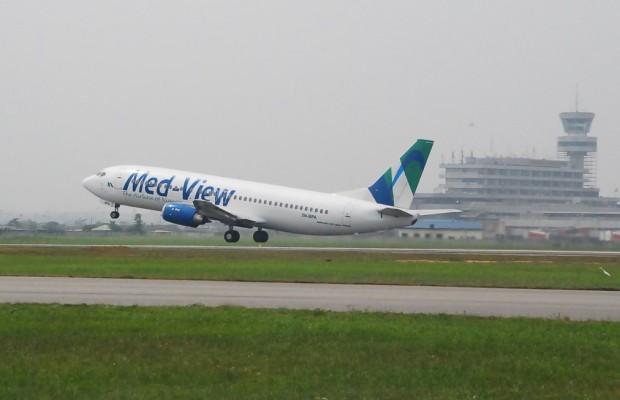
Med-View Airline Lists on Nigerian Stock Exchange

By Modupe Gbadeyanka
An airline in Nigeria, Med-View Airline, was on Tuesday, January 31, 2017, listed on the Nigerian Stock Exchange (NSE).
Med-View got listed on the main board of the NSE with the introduction of 9.75 billion (9,750,649,400) ordinary shares at N1.50 per share.
Chief Executive Officer of the NSE, Mr Oscar Onyema, in his welcome address, commended Med-View Airline for taking the bold step to list on the Exchange.
His words, “We are particularly pleased that Med-View Airline has taken this strategic step to join the prestigious club of quoted companies in Nigeria.
“It further reaffirms our belief that in spite of several policy and economic challenges facing the nation, our platform remains one of the best avenues for raising capital and enabling sustainable growth for national development.”
He further said, “This listing has added N14.65 billion to the market capitalization of the NSE, further deepening the Nigerian capital market.”
Mr Onyema pointed out that this “will also increase the visibility of Med-View Airline Plc and differentiate it as a professionally run airline with high corporate governance standards, having met The NSE’s listing criteria.”
“With this listing, the company is showing its commitment to a culture of strong corporate governance, excellence, professionalism and efficient services to its passengers, as well as providing increased returns to its shareholders,” he said.
Med-View Airline Plc is one of Nigeria’s foremost airlines, airlifting more than 3m passengers and 46m tons of cargo (annually) to 14 local, regional and international destinations, including London, Accra, Jeddah, Abuja, and Lagos amongst others.
Economy
Decentralised Development Initiatives Key to Unlocking Economic Opportunities—Bagudu
By Dipo Olowookere
The Minister of Budget and Economic Planning, Mr Abubakar Bagudu, has stressed the key role decentralised initiatives play in unlocking economic opportunities across the country.
Speaking in Abuja on Wednesday when he received members of the Crop, Aquaculture, Livestock Farmers and Value Chain Economic Actors Association of Nigeria (CALFAN), the Minister noted that initiatives like the Renewed Hope Ward Development Programme of President Bola Tinubu concentrate development planning at the ward level, which is the lowest administrative unit in Nigeria’s governance structure.
He welcomed the decision of the farmers’ group to collaborate with the federal government to accelerate the programme’s implementation.
Mr Bagudu explained that the project aims to enable communities to identify their development opportunities rather than relying solely on a top-down approach, adding that Nigeria has 8,809 wards, each with unique economic prospects that can be accessed through targeted interventions.
Under the initiative, wards will determine their priority economic opportunities, after which the federal government, state governments, local authorities, and development partners will work together to provide the necessary support.
According to him, Nigeria’s constitutional framework assigns development responsibilities to the three tiers of government, but in practice, these roles have not always been well coordinated, often resulting in duplication, inefficiencies, and interruptions in development initiatives.
“Our belief is that every ward in Nigeria is an acre of diamonds waiting to be uncovered. Each community has its own strengths and potential, and development strategies must reflect these distinctive qualities,” he said.
In his remarks, the president of CALFAN, Mr Aliyu Abdulraheem, outlined the association’s proposal to serve as a field-level implementation partner for the Renewed Hope Ward Development Programme.
He highlighted CALFAN’s extensive grassroots structure, including Ward-Level Extension Service Offices (WESOs) and a digital platform that supports real-time beneficiary identification, community mobilisation, data collection, and monitoring of development activities.
He disclosed that the proposed platform would facilitate economic mapping of rural communities, infrastructure assessments, digital surveys, and real-time data collection to support evidence-based policy decisions and programme monitoring.
The CALFAN boss highlighted the inclusive approach that encompasses the entire agricultural value chain, including farmers, input suppliers, processors, transporters, traders, and service providers.
Unveiled in 2025 by President Tinubu, the Renewed Hope Ward Development Programme aims to reset development planning by boosting economic activities at the ward level through collaboration among the federal, state, and local governments.
Economy
NMDPRA Grants Six Petrol Import Permits to Stabilise Market
By Adedapo Adesanya
The Nigerian Midstream and Downstream Petroleum Regulatory Authority (NMDPRA) has granted import permits for Premium Motor Spirit (PMS) or petrol to six depot owners and petroleum marketers.
This step comes as the federal government moved to ensure stability and balance in the country’s downstream fuel sector after it was widely reported that the country suspended the issuance of petrol import licenses for a second straight month
The regulator recently issued these permits to six importers, with each authorised to import approximately 30,000 metric tonnes of the fuel into the country to help cushion against the effects of escalating conflict in the Middle East.
This development also occurs against the backdrop of ongoing discussions about supply concentration, with recent data showing that the Dangote Petroleum Refinery supplied roughly 92 per cent of Nigeria’s petrol in February.
At present, the Dangote refinery is the sole facility in Nigeria producing petrol, while most modular refineries primarily focus on diesel output.
The Crude Oil Refineries Association of Nigeria (CORAN) also confirmed that none have been issued so far in March, signalling a shift towards prioritising local output. However, this has since changed, spurred by the latest development.
Industry statistics show that local refining provided an average of about 36.5 million litres per day that month, with imports adding roughly 3 million litres daily, resulting in a total supply of around 39.5 million litres per day.
According to reports, until recently, no petrol import permits had been issued under the current NMDPRA leadership, suggesting that the new approvals signal a deliberate policy shift to preserve supply diversity and adaptability as the domestic market continues to develop.
Nigeria’s average daily petrol consumption fell to 56.9 million litres per day in February 2026, down from 60.2 million litres in January.
In February, the Dangote Refinery supplied 36.5 million litres of petrol and 8 million litres of diesel to the local market, leaving a daily deficit of 20 million litres that was covered by previously imported stock.
According to NMDPRA, these volumes were sufficient, leading to its earlier decision to withhold import licenses.
Economy
State Visit: CPPE, LCCI Urge Tinubu to Pursue Trade Expansion with UK
By Adedapo Adesanya
The Centre for the Promotion of Private Enterprise (CPPE) and the Lagos Chamber of Commerce and Industry (LCCI) have called for trade expansion ahead of President Bola Tinubu’s state visit to the United Kingdom.
In separate communications, the organisations urged President Tinubu to deepen economic ties as he visits the UK on the invitation of the King of England, King Charles III. His state visit to the UK next week will mark Nigeria’s first such visit to the UK in 37 years, when Military President Ibrahim Babangida was head of state.
The chief executive of CPPE, Mr Muda Yusuf, said the planned visit by Mr Tinubu to the UK is significant on multiple fronts.
“At a time of shifting global alliances and economic realignments, the visit presents both opportunity and responsibility.
“It is expected that leading Nigerian business figures will accompany the President, creating a platform for expanding trade flows, deepening investment partnerships, promoting Nigeria as a destination for capital, and strengthening financial-sector linkages.
“The UK remains a major source of portfolio flows, development finance, and private-sector investment into Nigeria. Structured engagements during the visit could unlock opportunities in infrastructure, energy, financial services, technology, manufacturing, and agribusiness,” Mr Yusuf stated.
On her part, the Director General of the LCCI, Mrs Chinyere Almona, noted that the visit represents a historic opportunity to recalibrate Nigeria–UK relations from traditional diplomacy to focused economic diplomacy.
“At a time when Nigeria is implementing bold macroeconomic reforms, this visit should be leveraged to secure concrete commitments on trade expansion, long-term investment, and cooperation on the business environment.
“From the perspective of the Lagos Chamber of Commerce and Industry, the overriding objective should be to translate goodwill into measurable economic outcomes that strengthen Nigeria’s productive base and export capacity,” she said.
According to her, recent data underscore the strategic importance of the UK to Nigeria’s economy, noting that in Q3 2025, Nigeria recorded capital importation of approximately US$6.01 billion, representing a significant year-on-year surge.
“Notably, the United Kingdom emerged as Nigeria’s largest source of capital inflows, accounting for about US$2.94 billion, or nearly half of total inflows during the quarter. These inflows were driven predominantly by portfolio investment, particularly into the financial and banking sectors, reflecting renewed foreign investor confidence following Nigeria’s macroeconomic adjustments.
“On the trade front, total trade in goods and services between Nigeria and the UK stood at approximately £8 billion in the 12 months to mid-2025,” she said.
She said, however, that the relationship remains structurally imbalanced, with UK exports to Nigeria significantly exceeding Nigeria’s exports to the UK.
“Ultimately, the economic agenda of this state visit should be guided by Nigeria’s most pressing challenges: export diversification, inflation-induced cost pressures, infrastructure deficits, and the need for stable long-term capital,” Mrs Almona said in an interview with Nairametrics.
-
Feature/OPED6 years agoDavos was Different this year
-
Travel/Tourism10 years ago
Lagos Seals Western Lodge Hotel In Ikorodu
-
Showbiz3 years agoEstranged Lover Releases Videos of Empress Njamah Bathing
-
Banking8 years agoSort Codes of GTBank Branches in Nigeria
-
Economy3 years agoSubsidy Removal: CNG at N130 Per Litre Cheaper Than Petrol—IPMAN
-
Banking3 years agoSort Codes of UBA Branches in Nigeria
-
Banking3 years agoFirst Bank Announces Planned Downtime
-
Sports3 years agoHighest Paid Nigerian Footballer – How Much Do Nigerian Footballers Earn