Connect with us

General

Experience Rapid Charging with DC Fast Chargers: Speeding Up Your EV Charging

Published

on

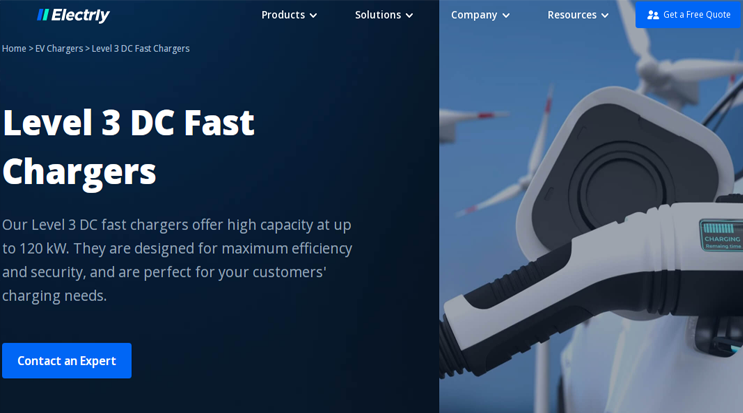
Electrly Level 3 DC fast chargers

Amid the electric vehicle (EV) revolution reshaping the automotive industry by providing eco-friendly alternatives to traditional gasoline-powered cars, one crucial aspect has taken the spotlight: charging with DC fast chargers. Adopting EVs has become imperative as the world redoubles its efforts to combat climate change and reduce carbon emissions.

EV owners grapple with various challenges, from range anxiety to limited charging options and the struggle to maintain a consistent charging routine. With the EV market surging, the need for an accessible, reliable, and efficient charging solution has never been more critical.

The frustration of encountering subpar charging infrastructure and enduring long wait times at public charging stations has marred the promised convenience of electric mobility for many EV owners.

Enter Electrly’s DC Fast Charger – the ultimate remedy. It offers a dependable, user-friendly, and cost-effective charging solution tailored to address the unique challenges faced by EV owners. Delve into how Electrly’s DC Fast Charger can transform your EV experience, bringing you rapid charging and speeding up your journey towards a sustainable future.

Introducing the Electrly DC Fast Charger

In the dynamic landscape of electric vehicles (EVs), where convenience and unwavering charging reliability are paramount, Electrly is a comprehensive solution provider for DC Fast Chargers. The charging with DC fast chargers emerges as a standout performer among their diverse charging solutions.

A DC Fast Charger, often called a fast or rapid charger, is a specialised electric vehicle (EV) charging station designed to provide a significantly higher power output than standard Level 2 chargers or Level 1 chargers.

DC Fast Chargers typically operate with direct current (DC) power, in contrast to most other EV chargers’ alternating current (AC). This enables them to bypass the onboard vehicle charger (inverter) and directly supply DC power to the battery, resulting in faster charging speeds.

These chargers consume power of 20kW to 300kW. With only 15 minutes of charging, you can travel from 100 to 250 miles.

Key Features of Electrly’s Level 3 Chargers

Exceptional Charging Power

Step into a new era of EV charging with Electrly’s Level 3 chargers, boasting remarkable charging capabilities of up to 120kW. With a remarkable efficiency rate of 95%, your customers are in for a lightning-fast charging experience, ensuring they can hit the road again with minimal delay.

Robust Safety Measures

Electrly

Safety is Electrlys utmost priority, and that’s why Electrly Level 3 chargers are equipped with a suite of advanced safety features. From protection against electrical hazards to weather-resistant design, we’ve taken every precaution to safeguard your customers and their vehicles during the rapid charging process.

User-Friendly Interface

Simplicity meets innovation with the Level 3 chargers. Starting a charging session is as easy as swiping an RFID card, and monitoring the process is a breeze through an intuitive mobile app. Customers can recharge their vehicles quickly and effortlessly, enhancing their overall charging experience.

Global Compatibility

Our chargers are designed to seamlessly adapt to various charging connector standards across countries and regions. No matter where your charging station is located, these chargers ensure universal compatibility, eliminating barriers for your customers.

Exploring Electrly’s Level 3 Charger Services

Affordable Testing Options

Electrly’s Level 3 Charger services offer a unique advantage with minimal testing costs. With a flexible minimum order quantity (MOQ) policy, you can acquire as few as one unit. This approach enables you to assess the product with minimal financial commitment before deciding on your final purchase quantity.

Bulk Purchase Benefits

We extend enticing bulk purchase incentives for those seeking to invest on a larger scale. By acquiring these chargers in substantial quantities, you unlock significant cost savings, ensuring you receive the utmost value for your investment.

Comprehensive Assistance

Navigating the world of charger installation or seeking clarifications about the offerings has never been easier. The dedicated support team is readily available to provide the required guidance and information. Expect prompt responses and expert assistance to facilitate your charger-related endeavours.

Extended Warranty Coverage

To guarantee your satisfaction and confidence in the products, a robust 2-year warranty backs Electrly’s Level 3 Chargers. Should you encounter any issues resulting from manufacturing defects within this period, the support team will swiftly deliver a resolution, ensuring your investment remains secure.

Streamline Charger Management with Electrly’s Advanced Software Solution

Electrly presents an intelligent software solution tailored to simplify the intricate world of EV charger management. This cutting-edge software has been meticulously crafted to provide users with an intuitive interface while handling the multifaceted challenges of overseeing EV chargers. Harness the power of this intelligent software to streamline your EV charger management process and maximise the efficiency of your charging facility.

This innovative software offers a range of features designed to enhance your charging facility’s performance:

Comprehensive Insights: Gain valuable insights into your charging infrastructure with detailed information on usage patterns, charger availability, and performance metrics. This data empowers you to make informed decisions to optimise your charging operations.

Power Output Control: Take control of your charging stations by adjusting their power output according to your energy consumption needs. This flexibility ensures efficient energy usage, contributing to cost savings and reduced environmental impact.

Simplified Pricing and Billing: Effortlessly set pricing structures and manage billing for your charging services. The software seamlessly integrates with your existing payment system, ensuring a hassle-free experience for you and your customers.

Real-Time Data: Access real-time data on charger usage and facility performance. This dynamic information allows you to monitor and analyse trends, enabling you to make timely adjustments to enhance your EV charging facility’s overall efficiency and reliability.


Click to comment

Leave a Reply

Your email address will not be published. Required fields are marked *

General

Daystar Power Expands Nestlé Solar Partnership Across West Africa

Published

on

Daystar Power

By Adedapo Adesanya

Daystar Power Group has expanded its renewable energy partnership with Nestlé in West Africa, commissioning solar power systems with a combined capacity of 6.884 megawatts across four manufacturing facilities in Côte d’Ivoire, Ghana, and Senegal.

According to a statement, the deployments bring the total installed capacity across Nestlé’s sites to 6,884 kWp, nearly 7 megawatts, making it one of the largest commercial and industrial solar partnerships in the region.

The four sites, two in Abidjan, one in Tema, and one in Dakar, are all fully operational, with each system designed around the specific grid and operational profile of its location.

“Nearly 7 megawatts across four Nestlé facilities is a number we are proud of, but what it represents matters more than the figure itself. It means that one of the world’s most demanding manufacturers has tested our model, trusted it, and come back. Our job now is to keep earning that, across every market where industry needs energy it can count on,” Mr Yischai Beinisch, CEO, Daystar Power Group said in a statement.

The partnership began with a single commissioning and expanded to span three countries and four facilities. In Côte d’Ivoire, Daystar Power has delivered 3,447 kWp across two Abidjan sites. In Ghana, a 2,547 kWp system powers Nestlé’s Tema factory. In Senegal, an 890 kWp installation operates at the Dakar facility.

The company said each system is sized and configured to deliver measurable environmental and social impact, including reduced greenhouse gas emissions and improved energy resilience. The design is tailored to the operational and grid conditions at each location, ensuring reliable, clean energy access while supporting local development and aligning with Nestlé’s publicly stated net-zero commitments.

Adding his input, Mr Samer Chedid, CEO, Nestlé Central and West Africa Region, said the investment reflects its commitment to building a business that not only grows but does so responsibly.

“By advancing solar energy projects in Ghana, Côte d’Ivoire, and Senegal, we are embedding sustainability into our growth, reinforcing our role as a force for good, creating long-term value for communities, and ensuring that our footprint actively contributes to a cleaner, more resilient future,” he said.

Continue Reading

General

Nigeria Adopts New Security Framework to Safeguard Oil Assets

Published

on

oil assets

By Adedapo Adesanya

Nigerian Upstream Petroleum Regulatory Commission (NUPRC) and the Federal Ministry of Defence have agreed to deepen collaboration on the protection of critical oil and gas infrastructure through a new non-kinetic security framework designed to curb threats, strengthen community relations and sustain rising output.

The initiative comes as Nigeria recorded crude oil production of nearly 1.8 million barrels per day, one of the highest production levels in recent years, amid intensified efforts to combat crude oil theft, pipeline vandalism and other security challenges across the Niger Delta.

Speaking during a courtesy visit by a delegation from the Ministry of Defence to the Commission’s headquarters in Abuja, the chief executive of NUPRC, Mrs Oritsemeyiwa Eyesan, said the country’s recent production gains were directly linked to coordinated interventions involving security agencies and industry stakeholders.

“Today, we are benefiting from those efforts. Last month, we recorded production of nearly 1.8 million barrels per day throughout the month,” Mrs Eyesan said.

She noted that sustained investments in security operations, technology deployment and human capacity development had significantly improved production stability and operational efficiency in the upstream petroleum sector.

According to her, maintaining and expanding the gains has become critical as Nigeria seeks to increase crude oil output, attract fresh investments and maximise revenue generation from the petroleum industry.

“As we look to the future, we desire to grow production and must have assurances that security threats can be effectively managed. We can only achieve this through stronger collaboration with security agencies and industry stakeholders,” she stated.

Mrs Eyesan stressed that safeguarding oil and gas assets remains central to Nigeria’s energy security strategy and economic growth objectives, noting that production assurance has become a key requirement for investors considering new upstream projects.

She disclosed that the Commission was exploring wider deployment of advanced technologies, including drone surveillance systems, to improve monitoring of the country’s vast oil and gas infrastructure network and detect threats before they escalate into operational disruptions.

The NUPRC boss further revealed that the Commission would work closely with operators to refine and implement a new security framework, while providing leadership in stakeholder engagement and governance structures needed to ensure long-term sustainability.

The Minister of Defence, Mr Christopher Gwabin Musa, said the Ministry was introducing a non-kinetic security intervention model aimed at addressing the underlying causes of insecurity in oil-producing communities.

Rather than relying solely on military operations, he explained that the strategy would focus on community engagement, youth empowerment and social inclusion programmes to build lasting peace around critical energy infrastructure.

“One of the best ways to engage youths in oil-producing areas is through sports-based interventions,” Mr Musa stated.

He explained that the initiative would utilise sports development programmes to channel youthful energy into productive activities, reduce vulnerability to criminal networks and strengthen community ownership of critical national assets.

The Defence Minister, who was represented by one of his aides, added that the intervention would also include structured programmes for persons living with disabilities, creating broader opportunities for participation and economic inclusion in host communities.

According to him, the initiative aligns with the Host Community Development provisions of the Petroleum Industry Act (PIA) and is expected to strengthen relationships between operators and host communities while promoting sustainable development.

Continue Reading

General

PTML Unveils $50m Expansion Plan for Tin Can Island Port

Published

on

PTML

By Adedapo Adesanya

Port and Terminal Multiservices Limited (PTML) has disclosed the investment of $50 million to expand its terminal at Tin Can Island Port, Lagos, as part of efforts to strengthen Nigeria’s bid to become the leading maritime hub in West and Central Africa.

PTML Managing Director, Mr Ascanio Russo, made the disclosure on Wednesday during a visit to the Minister of Marine and Blue Economy, Mr Adegboyega Oyetola, in Abuja.

The investment by PTML, a member of the Grimaldi Group, will expand berthing capacity and acquire additional modern port equipment.

“The Grimaldi Group remains deeply committed to Nigeria and believes in the country’s potential as the leading maritime and logistics gateway in West and Central Africa,” Mr Russo said.

“This $50 million investment is designed to expand our berthing capacity and deploy modern equipment that will enhance operational efficiency, cargo handling, and service delivery.”

He said the upgraded berths would enable PTML to receive next-generation Container/Roll-on Roll-off, Con-Ro, vessels, including the largest Con-Ro ships currently operating globally, directly at the Lagos terminal.

“The maritime industry is evolving rapidly, with larger vessels becoming the standard for international trade. Through this expansion, PTML will be fully equipped to accommodate these next-generation Con-Ro vessels and keep Nigeria competitive for global shipping lines,” Mr Russo stated.

He added that the project responds directly to the Federal Government’s call for increased private-sector participation in port modernisation.

Mr Russo said the expansion would facilitate trade, increase cargo throughput, create jobs during construction and operations, and boost government revenue through higher port activity.

On his part, Mr Oyetola welcomed the investment as a vote of confidence in the Federal Government’s maritime reforms.

“This investment shows our reforms are yielding results and that international investors recognise the opportunities in Nigeria’s maritime sector,” the minister said. “We are determined to transform our ports into modern, efficient, and globally competitive gateways that support economic growth and position Nigeria as the maritime hub of West and Central Africa.”

Mr Oyetola said the government was implementing measures to improve port efficiency, reduce bottlenecks, upgrade infrastructure, and strengthen the ease of doing business.

He said these include port modernisation, deeper collaboration with private operators, digitalisation of port processes, and policies to attract more maritime trade.

Continue Reading

Trending