Connect with us

Economy

Local Equities Regain Strength as Investors Gain N33bn

Published

on

investors participation

By Dipo Olowookere

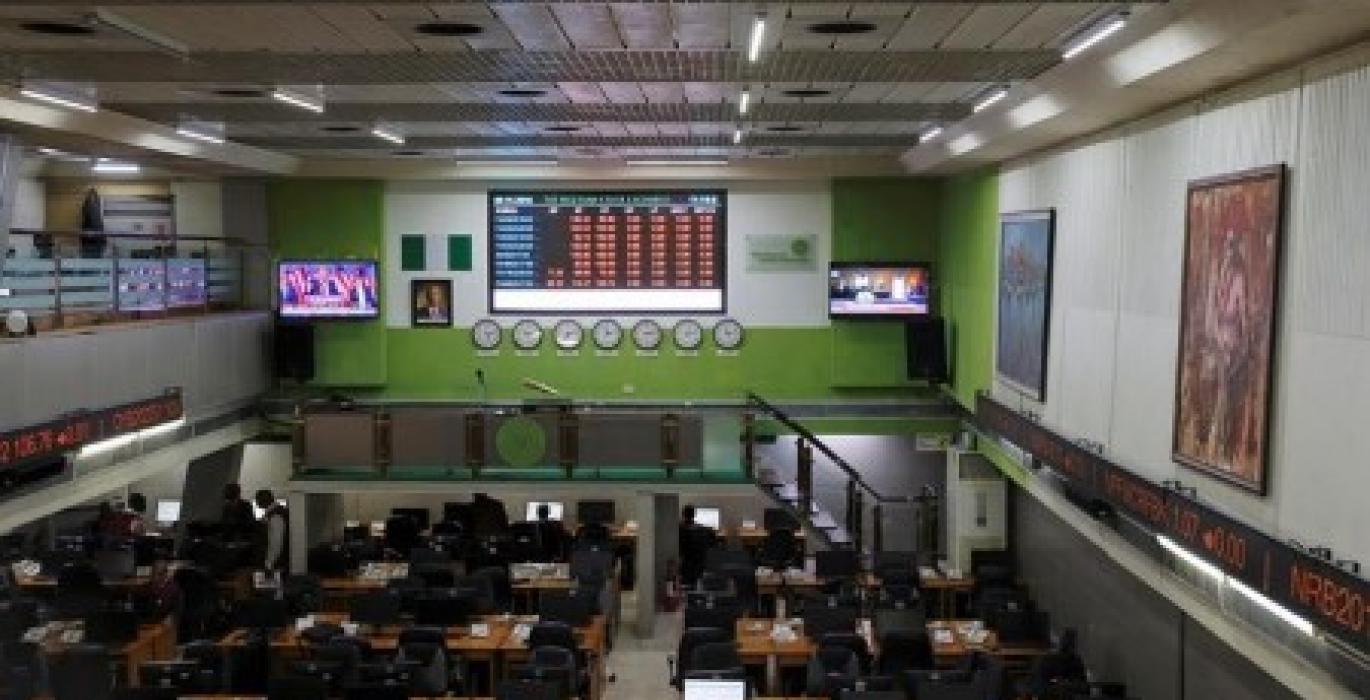
Data about Nigeria’s rising debt and inflation had a minor impact on the Nigerian Exchange (NGX) Limited on Friday, as late bargain-hunting lifted the bourse by 0.09 per cent at the close of business.

The National Bureau of Statistics (NBS) said yesterday that inflation rose by 25.80 per cent in August from 24.08 per cent in July, just as the Debt Management Office (DMO) revealed that the country’s debt rose by 75.3 per cent to N87.38trn in the second quarter of this year.

Investors shrugged off these concerns, including news that Brent sold at $94 per barrel, to mop up some equities with sound fundamentals, particularly MTN Nigeria, Zenith Bank, and others.

Consequently, the All-Share Index (ASI) went up by 60.44 points to 67,395.74 points from 67,335.30 points, and the market capitalisation grew by N33 billion to N36.886 trillion from N36.853 trillion.

It was observed that at midday, the stock exchange was looking like the bears would maintain the dominance until things changed due to strong investor sentiment, leading to 29 stocks finishing on the gainers’ table, as 19 stocks ended on the losers’ log, indicating a positive market breadth index.

Chams finished on top of the gainers’ chart after its value rose by 10.00 per cent to N1.10, Cutix gained 9.95 per cent to settle at N2.43, Cornerstone improved by 9.38 per cent to N1.40, Caverton jumped by 8.46 per cent to N1.41, and United Capital surged by 8.13 per cent to N17.30.

Leading the losers’ gang was Conoil, which fell by 10.00 per cent to N89.10, MRS Oil shed 9.96 per cent to close at N98.55, ABC Transport went down by 9.64 per cent to 75 Kobo, Tantalizers dropped 9.52 per cent to 38 Kobo, and Neimeth crumbled by 9.36 per cent to N1.55.

Business Post reports that the insurance, banking and consumer goods sectors appreciated by 2.15 per cent, 0.48 per cent, and 0.37 per cent apiece, as the energy and industrial goods counters depreciated by 1.80 per cent and 0.08 per cent, respectively.

The activity level waned on the last trading session of the week, with the trading volume, value, and the number of deals going down by 48.14 per cent, 63.38 per cent, and 20.86 per cent apiece as investors transacted 408.9 million shares valued at N5.2 billion in 6,972 deals versus the 788.5 million shares worth N14.2 billion exchanged in 8,810 deals on Thursday.

Sterling Holdings traded 82.3 million equities worth N314.2 million to lead the activity chart, Transcorp traded 59.7 million shares valued at N364.9 million, UBA transacted 48.1 million stocks for N787.6 million, GTCO sold 26.4 million equities for N926.9 million, and Oando exchanged 21.9 million shares valued at N231.3 million.


Dipo Olowookere is a journalist based in Nigeria that has passion for reporting business news stories. At his leisure time, he watches football and supports 3SC of Ibadan. Mr Olowookere can be reached via [email protected]

Click to comment

Leave a Reply

Your email address will not be published. Required fields are marked *

Economy

Trading in Aluminium Extrusion Stocks Suspended on NGX

Published

on

Aluminium Extrusion

By Aduragbemi Omiyale

Those interested in buying or selling the shares of Aluminium Extrusion Plc on the Nigerian Exchange (NGX) Limited will not be able to do so for now.

This is because trading activities on the company’s securities on the Nigerian bourse have been suspended by the NGX Regulation Limited.

The reason for this is that the organisation has failed to submit its financial statements as required by the listing rules for the perusal of the investing community.

After being given grace periods to file the results, the board of the firm has not done the needful, necessitating the wielding of the stick on the entity.

A notice from Customs Street disclosed that the suspension became effective last Wednesday. It will be lifted when the financial results are submitted.

“In accordance with the default filing rules, the suspension of trading in the shares of the company shall be lifted upon the submission of the relevant financial statements,” a part of the notice said.

Business Post reports that Aluminium Extrusion has not filed its financial statements for the year ended December 31, 2025, more than three months after it was required to submit its financial performance for the last fiscal year.

“Trading license holders and the investing public are hereby notified that pursuant to Rule 3.1, Rules for Filing of Accounts and Treatment of Default Filing, (Default Filing Rules), which provides that if an issuer fails to file the relevant accounts by the expiration of the cure period1, the exchange will: a) send to the issuer a second filing deficiency notification within two business days after the end of the cure period; b) suspend trading in the issuer’s securities; and c) notify the Securities and Exchange Commission (SEC) and the market within 24 hours of the suspension.

“Trading in the shares of Aluminium Extrusion Plc has been suspended from the facilities of Nigerian Exchange Limited effective Wednesday, July 22, 2026, for not filing its Audited Financial Statements for the year ended December 31, 2025,” the disclosure stated.

Shares of Aluminium Extrusion last traded on the domestic stock exchange at N9.90 per unit.

Continue Reading

Economy

57 Equities Gain Weight on Nigerian Exchange in One Week

Published

on

Nigerian Exchange 1

By Dipo Olowookere

Last week on the floor of the Nigerian Exchange (NGX) Limited, 57 equities appreciated, higher than 44 equities in the previous week, while 38 equities shed weight versus 35 equities in the preceding week, with 51 equities closing flat versus the 67 equities recorded a week earlier.

UPDC REIT chalked up 33.33 per cent to trade at N14.20, First Holdco gained 25.59 per cent to finish at N120.50, Unilever Nigeria rose by 19.31 per cent to N147.95, Cadbury Nigeria improved by 18.42 per cent to N67.50, and AXA Mansard expanded by 17.86 per cent to N13.20.

On the flip side, Mecure lost 26.97 per cent to N62.40, Royal Exchange shrank by 12.84 per cent to N1.29, Tripple Gee slumped by 12.34 per cent to N3.41, SUNU Assurances crumbled by 10.00 per cent to N3.60, and BUA Foods dropped 10.00 per cent to close at N845.10.

In the week, the All-Share Index (ASI) went up 1.60 per cent to 247,357.40 points, and the market capitalisation appreciated by 1.61 per cent to N159.588 trillion.

Similarly, all other indices finished higher with the exception of the consumer goods, Lotus II, growth, sovereign bond and commodity indices, which fell by 3.76 per cent, 1.55 per cent, 20.24 per cent, 0.14 per cent, and 1.25 per cent respectively.

As for the trading data, 4.433 billion shares worth N306.143 billion in 255,589 deals were transacted in five days versus the 2.819 billion shares valued at N182.499 billion traded in 226,729 deals in the previous week.

The financial services segment led the activity chart with 3.422 billion shares valued at N207.206 billion traded in 117,545 deals, contributing 77.18 per cent and 67.68 per cent to the total trading volume and value, respectively.

The consumer goods sector traded 201.978 million shares worth N17.171 billion in 28,666 deals, and the ICT industry posted a turnover of 169.481 million shares worth N21.194 billion in 23,107 deals.

First Holdco, Access Holdings, and GTCO accounted for 2.151 billion shares worth N170.793 billion in 44,768 deals, contributing 48.51 per cent and 55.79 per cent to the total trading volume and value, respectively.

Continue Reading

Economy

American Refiners Boost Nigeria Oil Purchases as Exports Rebound 150% in May

Published

on

crude oil exports

By Adedapo Adesanya

Nigeria’s crude oil exports to the United States rebounded strongly in May as shipments rose by nearly 150 per cent month-on-month as American refiners increased purchases of overseas crude.

Latest data from the US Census Bureau showed that crude imports from Nigeria climbed to 2.36 million barrels in May, compared with 946,000 barrels recorded in April.

This indicated renewed demand for Nigeria’s premium light sweet grades amid shifting global patterns and higher international oil prices as the Middle East disruption weighed on trade.

The value of the imports also rose sharply to $279.8 million, up from $85.2 million in the previous month, reflecting both the higher volume of purchases and stronger crude oil prices during the period.

The rebound coincided with a broader increase in crude oil imports by the US.

According to the latest US International Trade in Goods and Services Report, total US crude imports increased by $1.5 billion in May, making crude oil one of the largest contributors to the $12.3 billion rise in overall goods imports during the month.

The report also showed that imports of industrial supplies and materials increased by $3.1 billion, with crude oil accounting for nearly half of the increase.

The recovery marks a significant turnaround after two consecutive months of declining Nigerian crude shipments to the US market. Export volumes had fallen from 4.64 million barrels in February to 1.54 million barrels in March, before dropping further to 946,000 barrels in April.

Despite the fluctuations, cumulative exports between January and May 2026 reached 11.15 million barrels, valued at approximately $926.6 million, reaffirming Nigeria’s strategic position as a key supplier of premium low-sulphur crude grades to the world’s largest economy.

Concerns surrounding crude shipments through the Strait of Hormuz, one of the world’s busiest oil transit routes, are encouraging refiners to increase purchases from Atlantic Basin producers such as Nigeria, whose crude grades offer lower geopolitical shipping risks than some Middle Eastern supplies.

Nigeria’s flagship crude grades, including Bonny Light, Qua Iboe and Escravos, remain highly sought after by US Gulf Coast refiners because of their low sulphur content and high yields of premium petroleum products such as petrol, diesel and aviation fuel.

Although the US has emerged as one of the world’s largest crude oil producers following the shale revolution, many American refineries continue to import light sweet crude to complement domestic production and optimise refining operations.

The rebound in exports also comes as Nigeria gradually restores crude production following improved security operations in the Niger Delta and intensified efforts by government agencies and operators to curb crude oil theft, pipeline vandalism and illegal refining.

Continue Reading