General
NLC, TUC Suspend Proposed Strike for 30 Days
By Aduragbemi Omiyale
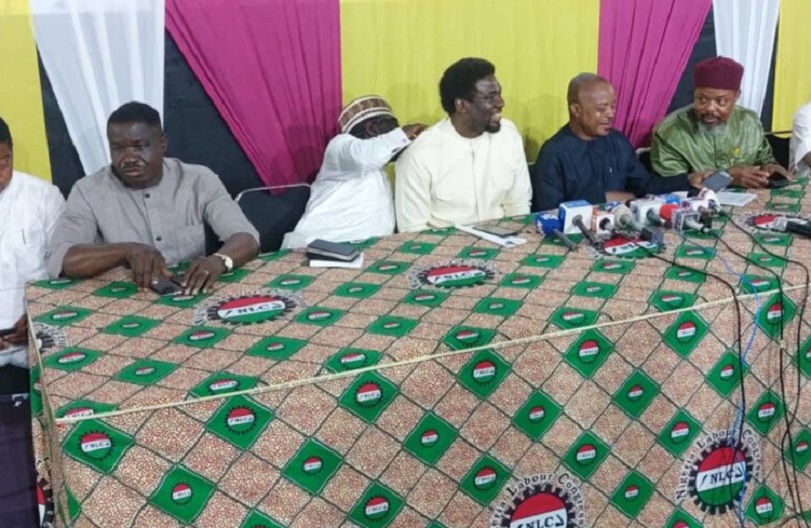
The proposed nationwide indefinite strike threatened by the Nigeria Labour Congress (NLC) and the Trade Union Congress (TUC) scheduled for Tuesday, October 3, 2023, has been suspended.
The organised labour unions put industrial action on hold for 30 days to allow the federal government to implement some of the agreements reached at a last-minute meeting on Monday.
While addressing newsmen in Abuja after the meeting on Monday night, the President of the NLC, Mr Joe Ajaero, said the government has agreed to suspend the collection of Value Added Tax (VAT) on diesel for six months from this month.
He added that it was agreed that a wage award of N35,000 would be given to all FG workers beginning from September 2023, pending when a new national minimum wage is expected to have been signed into law.
The labour leader said the federal government accepts to provide N100 billion to purchase high-capacity CNG buses for mass transit in Nigeria.
In addition, funds would be provided for 55,000 CNG conversion kits to kick start an auto gas conversion programme, whilst work is ongoing on state-of-the-art CNG stations nationwide. The rollout aims to commence by November with pilots across 10 campuses nationwide.
It was gathered that 15 points were signed by the parties in the memorandum of understanding.
The signatories were Mr Ajaero, the NLC General Secretary, Mr Emmanuel Ugboaja; TUC President, Mr Festus Osifo; the Secretary General of TUC, Mr Nuhu Toro; the Minister of Labour and Employment, Mr Simon Lalong; the Minister of State for Labour and Employment, Ms Nkeiruka Onyejeocha; and the Minister of Information and National Orientation, Mr Mohammed Idris.
The labour unions threatened the strike to kick against the rise in the cost of living in the country, especially due to fuel subsidy removal and exchange rate unification.
Below is the 15 agreements reached by the parties:
1. The Federal Government grants a wage award of N35,000 (thirty-five thousand Naira) only to all Federal Government workers beginning from the month of September pending when a new national minimum wage is expected to have been signed into law.
2. A minimum wage committee shall be inaugurated within one month from the date of this agreement.
3. Federal Government suspends the collection of Value Added Tax (VAT) on Diesel for six months beginning from October 2023.
4. Federal Government accepts to vote N100 billion for the provision of high-capacity CNG buses for mass transit in Nigeria. Provisions are also being made for an initial 55,000 CNG conversion kits to kick start an auto gas conversion programme, whilst work is ongoing on state-of-the-art CNG stations nationwide. The rollout aims to commence by November with pilots across 10 campuses nationwide.
5. The Federal Government plans to implement various tax incentive measures for the private sector and the general public.
6. On the leadership crises rocking the NURTW and the purported proscription of RTEAN, the Federal Government commits to handling Labour matters in line with relevant ILO Conventions and Nigerian Labour Acts. A resolution of the ongoing impasse is expected by or before October 13.
7. The issue of outstanding Salaries and Wages of Tertiary Education workers in Federal-owned educational institutions is being referred to the Ministry of Labour and Employment for further engagement.
8. The Federal Government commits to pay N25,000 per month for three months starting from October 2023 to 15 million households, including vulnerable pensioners.
9. The Federal Government will increase its initiatives on subsidized distribution of fertilizers to farmers across the country.
10. The Federal Government should urge the State Government through the National Economic Council and Governors Forum to implement wage award for their workers. Similar consideration should also be given to local government and private sector workers.
11. The Federal Government commits to the provision of funds as announced by the President on the 1st of August broadcast to the Nation for Micro and Small Scale Enterprises. The MSMEs beneficiaries should commit to the principle of decent jobs.
12. A joint visitation will be made to the refineries to ascertain their rehabilitation status.
13. All parties commit to henceforth abide by the dictates of Social dialogue in all our future engagements.
14. The NLC and TUC accept to suspend for 30 days the planned Indefinite Nationwide strike scheduled to begin, Tuesday, the 3rd of October, 2023.
15. This Memorandum shall be filed with the relevant Court of competent jurisdiction within one (1) week as consent judgment by the Federal Government.
General
Nigeria Cancels $717.7m in Undisbursed Electricity Intervention Loans from World Bank
By Adedapo Adesanya
Nigeria has cancelled $717.7 million in undisbursed World Bank intervention financing designed to revive Nigeria’s struggling electricity sector.
The cancellation followed a formal request by the federal government and a joint decision by both parties to discontinue financing under the Power Sector Recovery Performance-Based Operation due to evolving sector realities and the inability to achieve key reform milestones.
According to documents obtained from the World Bank, the development effectively terminates the remaining portion of a $1.52 billion power sector recovery programme.
The cancelled amount represents the entire undisbursed balance remaining under the programme.
“The restructuring will result in the cancellation of the entire undisbursed balance in the amount of $717.7 million equivalent, and no further disbursements will be made under the Program following approval of this restructuring,” the bank stated.
The federal government developed the Power Sector Recovery Programme as a framework to restore the sector’s financial viability and reduce its fiscal burden on public finances.
The programme included plans to progressively eliminate tariff shortfalls, improve operational performance among power sector institutions, and strengthen regulatory oversight and accountability mechanisms.
The loan was approved on June 23, 2020, with financing of about $752.5 million equivalent. The programme was structured to improve electricity supply reliability, strengthen the sector’s financial and fiscal sustainability, and enhance accountability among key institutions in the electricity value chain.
Following initial progress recorded under the programme, the World Bank approved an Additional Financing package of approximately $763.5 million equivalent on June 9, 2023, to consolidate earlier gains and support a new phase of reforms. The financing became effective on June 19, 2024, and extended the project’s closing date to June 30, 2027.
Together, the original financing and the additional facility amounted to about $1.52 billion.
However, while the additional financing struggled to meet critical reform conditions, resulting in limited disbursements and eventual cancellation of the remaining funds, the parent programme achieved substantial results and largely disbursed its resources.
According to the bank, high technical, commercial, and collection losses across the distribution segment, combined with inadequate cost recovery, have created a recurring mismatch between revenues generated by the sector and its actual operating costs.
The World Bank noted that Nigeria’s electricity sector continues to face deep-rooted structural challenges despite years of reforms and significant financial support.
The report stated that the sector still suffers from weak distribution performance, transmission bottlenecks, underutilisation of available generation capacity, and persistent financial imbalances.
“These constraints have created recurrent financing gaps, most notably in the form of tariff shortfalls, which generate liquidity pressures across the value chain and weaken the operational and financial performance of sector institutions,” the report said.
According to the World Bank, implementation of the original operation delivered notable results. The report stated that tariff shortfalls fell by 71 per cent between 2019 and 2022, declining from N581 billion to N166 billion.
During the same period, regulatory cost recovery improved significantly from 56 per cent to 94 per cent, while annual electricity supplied to the distribution grid increased by 13 per cent between 2018 and 2021.
The bank said all standard disbursement-linked indicators and global indicators attached to the original programme were fully achieved. “Implementation of the parent operation was satisfactory, brought substantial results, and fully disbursed the PforR component as all DLRs were achieved,” the report stated.
Encouraged by those gains, the World Bank approved the additional financing package to address remaining structural weaknesses and deepen reforms under the Power Sector Recovery Programme.
The new facility was expected to support the development of a sustainable financing framework for the sector, improve operational performance through implementation of performance improvement plans, and strengthen governance arrangements among electricity institutions.
However, the anticipated reforms failed to materialise within the expected timeframe. The World Bank attributed much of the setback to major macroeconomic developments that dramatically altered the operating environment.
General
Tinubu Assures Nigerians of Economic Stability After Tough Reforms
By Adedapo Adesanya
President Bola Tinubu says Nigeria is gradually emerging as a preferred destination for investment, saying the economic reforms introduced by his administration are beginning to yield positive results capable of driving job creation and economic growth.
He stated this in his 2026 Eid-el-Kabir message to Muslims in Nigeria and across the world, contained in a statement issued by the State House on Tuesday.
The President said the country had passed through difficult economic conditions but is now witnessing signs of stability and recovery following reforms implemented by his administration over the last three years.
“As a nation, we are on a journey of reconstruction and renewal. The reforms we have undertaken are challenging but necessary to build a stronger and more prosperous Nigeria for future generations,” Mr Tinubu stated.
“Just as sacrifice brings reward, I am happy that the sacrifices and efforts we have made over the past three years have yielded a more stable economy, making our country a preferred investment destination that will drive job creation and economic growth. The walk through the dark tunnel is over, and the light is here.”
The President described Eid-el-Kabir as a season that symbolises sacrifice, obedience, compassion and faith, urging Nigerians to embrace unity, tolerance and selflessness for national development.
Mr Tinubu also expressed confidence that ongoing reforms would continue to improve security and expand opportunities for citizens across the country.
“I am confident that, by the Grace of God, the reforms we have diligently pursued will continue to yield improved security and greater opportunities for all,” he said.
While acknowledging continued attacks by terrorists and bandits in parts of the country, the President assured affected communities that the Federal Government remained committed to restoring peace and defeating criminal elements.
“I am aware that, despite the best efforts of our security and intelligence agencies—including the recent elimination of a wanted ISIS leader—heartless terrorists and bandits still attack some communities. I assure you: you are neither abandoned nor forgotten. We will ultimately defeat all the forces of evil,” Tinubu stated.
He further urged Muslim faithful to use the Eid celebration to pray for national peace, unity and wisdom for leaders at all levels.
The President also called on Nigerians to extend support to vulnerable citizens and strengthen the spirit of brotherhood, irrespective of ethnic or religious differences.
He reaffirmed his administration’s commitment to investments in security, infrastructure, agriculture and human capital development as part of efforts to build a peaceful and prosperous nation.
General
Court Throws Out Suit to Stop Jonathan From 2027 Presidential Race
By Adedapo Adesanya
Nigeria’s former president, Mr Goodluck Jonathan, may contest the 2027 presidential election if he wishes, as a Federal High Court in Abuja on Tuesday dismissed a suit filed by a lawyer, Mr Johnmary Jideobi, seeking to stop him from contesting.
Justice Peter Lifu flung the suit and also awarded a N20 million fine against Mr Jideobi and in favour of the ex-president. He equally awarded a N1 million fine against the plaintiff and in favour of the Attorney-General of the Federation (AGF).
The judge held that Mr Jideobi lacked the legal right to have instituted the suit, having not suffered any loss from his perceived Mr Jonathan’s intention to vie for next year’s poll.
The judge, who said that a Federal High Court in Yenagoa and an Appeal Court had already held that Mr Jonathan was eligible to run, said he was bound by the decision of the appellate court. He described the lawyer’s suit as “an abuse of court process”.
Justice Lifu also dismissed Mr Jideobi’s motion seeking the judge’s withdrawal from the case for being frivolous.
Mr Jideobi had sued Mr Jonathan, the Independent National Electoral Commission (INEC), and AGF as the 1st to 3rd defendants, respectively.
Mr Jonathan is a former president of Nigeria. He first assumed power in 2010 after the death of ex-President Musa Yar’Adua. The Bayelsa-born politician served as vice president under Mr Yar’Adua and took over when the late president first fell sick.
A year later, he contested and won the 2011 presidential election. But in 2015, Mr Muhammadu Buhari of the All Progressives Congress (APC) defeated him, the first time an incumbent had lost a presidential election since the return of democracy in 1999.
Upon his exit from office, he has taken on a more diplomatic role despite calls for him to run in recent elections.
However, the 2027 polls have seen increased support for the former Nigerian leader, who has actively moved away from partisan politics since 2015.
Recently, Mr Jonathan told some youths under the Coalition for Goodluck Jonathan that he would consult before deciding on the matter.
“Yes, you are asking me to come and contest the next elections,” the former president told the group when members visited him in Abuja.
“The presidential race is not a computer game, but I’ve heard you, and I’ll consult widely,” he added.
-
Feature/OPED6 years agoDavos was Different this year
-
Travel/Tourism10 years ago
Lagos Seals Western Lodge Hotel In Ikorodu
-
Showbiz3 years agoEstranged Lover Releases Videos of Empress Njamah Bathing
-
Banking8 years agoSort Codes of GTBank Branches in Nigeria
-
Economy3 years agoSubsidy Removal: CNG at N130 Per Litre Cheaper Than Petrol—IPMAN
-
Banking3 years agoSort Codes of UBA Branches in Nigeria
-
Banking3 years agoFirst Bank Announces Planned Downtime
-
Sports3 years agoHighest Paid Nigerian Footballer – How Much Do Nigerian Footballers Earn