Economy
Again, CBN Postpones MPC Meeting
By Adedapo Adesanya
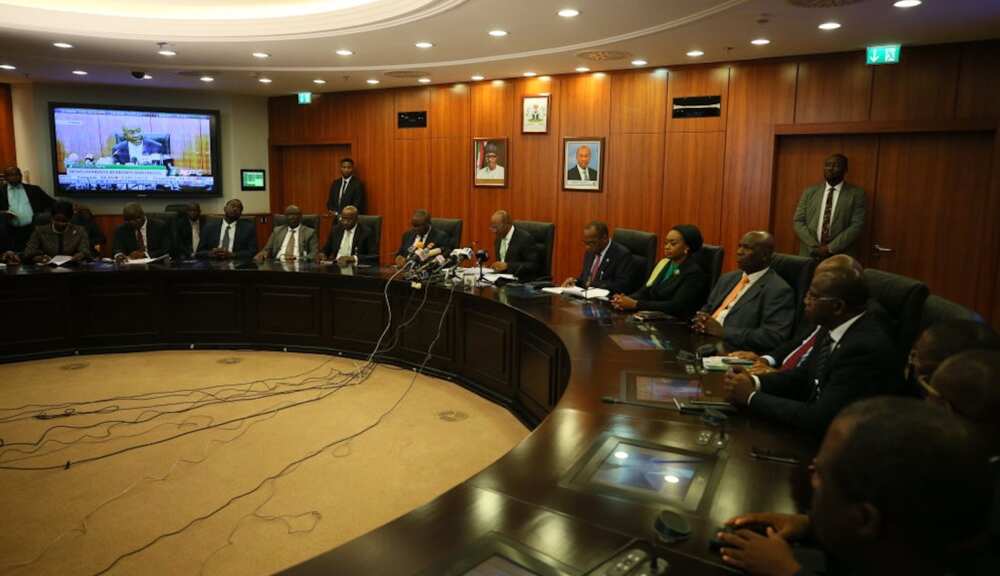
The Central Bank of Nigeria (CBN) has postponed the Monetary Policy Committee (MPC) meeting yet again after the same was done in September.
This development indicates that the new Governor of the CBN, Mr Olayemi Cardoso, has yet to hold the crucial rates-setting meeting since he took over the post.
The central bank postponed the meeting when Mr Cardoso was nominated to the post in September, signalling that when he takes over, this will be his first order of business.
But with almost two months at the helm of affairs at the national lender, there seems to be no direction regarding the country’s monetary policies.
“MPC is not holding,” said Mr Isa Abdulmumin, the spokesman for the bank, in a text message on Monday, according to Bloomberg.
Prior to the cancellation, the CBN website had scheduled the next gathering for Monday (today) and Tuesday.
The CBN spokesman didn’t give a date for when the next meeting will be held.
Since the last MPC meeting in July which saw the rate put at 18.75 per cent, the monetary policy space has changed rapidly.
Investors have been looking to the MPC meeting for signals on how the lender will rein inflation that’s accelerating at the fastest pace in almost two decades. Nigeria’s inflation jumped to a fresh 18-year high of 27.33 per cent in October, according to the National Bureau of Statistics (NBS) last week.
In a related development, Cordros Capital, in a report released last week, had forecast that the CBN would further hike its Monetary Policy Rate (interest rate) by 100 basis points this week.
The firm said it expects that ‘’further rate hikes by the MPC will send a strong message that the apex bank is not relenting in its inflation fight, particularly as near-term inflation expectations are tilted to the upside, potentially reaching a 28.02 per cent y/y peak in December.’’
Economy
Naira Trades N1,362/$1 at Official FX Market, as Bitcoin Falls
By Adedapo Adesanya
The Naira marked a whole week of appreciation against the United States Dollar on Friday, July 24, further gaining N5.67 or 0.41 per cent to close at N1,362.09/$1 in the Nigerian Autonomous Foreign Exchange Market (NAFEX) compared with N1,367.76/$1 it ended on Thursday.
Equally, the local currency appreciated against the Pound Sterling in the official FX market yesterday by N10.83 to trade at N1,813.62/£1 versus the preceding day’s N1,824.45/£1, and improved against the Euro by N7.68 to settle at N1,549.10/€1, in contrast to the N1,556.78/€1 it was exchanged a day earlier.
However, at the parallel market and GTBank forex counter, the Nigerian currency remained unchanged against the greenback during the session at N1,400/$1 and N1,379/$1, respectively.
The Central Bank of Nigeria (CBN) buffer has been strengthened with sustained foreign portfolio inflows and robust foreign reserves, which stand above $52 billion.
The apex bank’s policy signals that the Naira will be stronger in the near term, with Nigeria clearing hurdles with FX reforms and settlement of all backlogs.
However, some traders expect that pressure may come due to foreign-currency buying from fuel importers as they make Dollar purchases to build inventories.
Meanwhile, Bitcoin (BTC), in the digital currency landscape, trimmed recent gains as it fell by 2.3 per cent to $63,787.73.
The weak action in the AI momentum trade is feeding through to crypto as well.
Further, Cardano (ADA) dropped 3.7 per cent to close at $0.1615, Solana (SOL) dipped by 2.8 per cent to $73.71, Ripple (XRP) crashed by 2.3 per cent to $1.08, Ethereum (ETH) slid by 1.9 per cent to $1,851.58, Dogecoin (DOGE) retreated by 0.8 per cent to $0.0694, Binance Coin (BNB) contracted by 0.7 per cent to $564.18, and TRON (TRX) lost 0.5 per cent to trade at $0.3292, while the US Dollar Tether (USDT) and the US Dollar Coin (USDC) traded flat at $1.00 each.
Economy
Crude Oil Retreats Over 4% as China Pushes for US-Iran Peace Talks
By Adedapo Adesanya
Crude oil prices were more than 4 per cent lower on Friday after it was reported that China had initiated a push to resume stalled peace talks between the United States and Iran.
Brent futures settled at $96.78 a barrel after it lost $3.91 or 3.88 per cent, while the US West Texas Intermediate (WTI) futures finished at $89.31 a barrel, down $2.88 or 3.12 per cent.
Both benchmarked crude rallied this week as the US and Iran exchanged missile strikes, traffic through the Strait of Hormuz fell to a trickle, and Yemen’s Houthis attacked shipping in the Red Sea. To make matters worse, Kazakhstan has suspended oil flows via the Caspian Pipeline Consortium system following Ukrainian drone attacks.
However, China’s foreign ministry said “China supports the mediation efforts made by Pakistan and other parties,” adding that the world’s largest oil importer will continue to “play an active role in restoring peace and tranquillity in the Middle East Gulf region as soon as possible.”
Pakistan is exploring a path towards a resumption of stalled US-Iran talks over ending their nearly five-month-old war, following a push initiated by China.
According to Reuters, Pakistan’s Foreign Minister, Ishaq Dar, also discussed the new Middle East effort with Chinese officials when he visited China last week.
China is Iran’s largest trading partner and primary buyer of its exported crude oil despite international sanctions on Iran, benefiting from a steep discount on the energy source.
US President Donald Trump had promised “major military punishment” for Iran and its Houthi allies after the strikes on two Saudi oil tankers in the Red Sea.
Iran had been pressing the Houthis to close the Bab el-Mandeb gateway to the Red Sea if the US continued to attack Iranian power infrastructure. It is the second most important route for energy shipments after the Strait of Hormuz at the mouth of the Gulf.
Additionally, the Houthis declared on Monday that they were imposing a naval blockade on Saudi Arabia, which had been diverting its oil via pipeline to get around Iran’s closure of the Strait of Hormuz. Daily vessel transits through the strait were steady at three for each of the past three days.
The Red Sea oil chokepoint has been critical for Saudi crude oil shipments after the kingdom has managed in recent months to redirect its exports that previously shipped from the Persian Gulf to Yanbu.
Economy
Airtel Africa Grows Customer Base 11.6% to 189 million
By Aduragbemi Omiyale
In the first quarter of its financial year ended June 30, 2026, Airtel Africa Plc showed resilience in the midst of challenging operating environments, churning out strong operating performance with accelerating customer base growth across all segments.
It was observed that the total customer base in Q1 2027 increased by 11.6 per cent to 189 million, with data customers rising by 15.5 per cent to 87.3 million.
In addition, data usage per customer continued its upward trajectory, rising from 7.8 GB to 10.6 GB per month over the past year, translating into a 56.3 per cent increase in data traffic across the network, underpinning a 10.3 per cent growth in constant currency data ARPU. Smartphone penetration was the key enabler of this increased traffic as penetration increased to 51.0 per cent as digital adoption of our services continues.
A look at the financial performance indicated that revenue in reported currency grew by 31.0 per cent to $1.85 billion, reflecting constant currency growth of 21.1 per cent and macroeconomic tailwinds supporting currency appreciation.
All segments continued to see double-digit constant currency revenue growth, with mobile services revenue growing by 19.1 per cent, and mobile money growing by 25.8 per cent.
Across mobile services, voice continued to see strong constant currency growth of 11.2 per cent and data revenue grew by 27.2 per cent.
In East Africa and Francophone Africa, constant currency revenues grew by 17.8 per cent and 18.0 per cent, respectively, while Nigerian revenues grew by 29.8 per cent, fully reflecting the lapping effect of the tariff adjustments which were implemented in the fourth quarter of 2025.
Constant currency EBITDA went up by 24.4 per cent, with reported currency EBITDA of $928 million growing by 36.6 per cent. The Q1’27 EBITDA margin of 50.1 per cent, an increase of 206bps year-on-year, continues to reflect the success of the company’s ongoing cost optimisation programme, despite the recent energy cost inflation arising from geopolitical developments.
The post-tax profit improved to $198 million from $156 million in the prior period, with higher profit after tax in the current period driven by elevated operating profit partially offset by derivative and foreign exchange losses of $6 million in the current period compared to $22 million derivative and foreign exchange gains in the prior period.
Furthermore, Profit after tax was impacted by the recognition of an exceptional finance cost of $37 million following an in-principle settlement reached during the quarter in respect of a commercial dispute in one of the group’s subsidiaries.
Commenting on the results, the chief executive of Airtel Africa, Mr Sunil Taldar, said, “We have started this year with another pleasing performance. Our continued focus on the customer experience translated into accelerating customer base growth across all business segments.
“As we continue to digitise our business, we are streamlining customer journeys, increasing digital adoption and harnessing data and AI to improve service delivery and support a strong, sustainable growth profile.”