Connect with us

Education

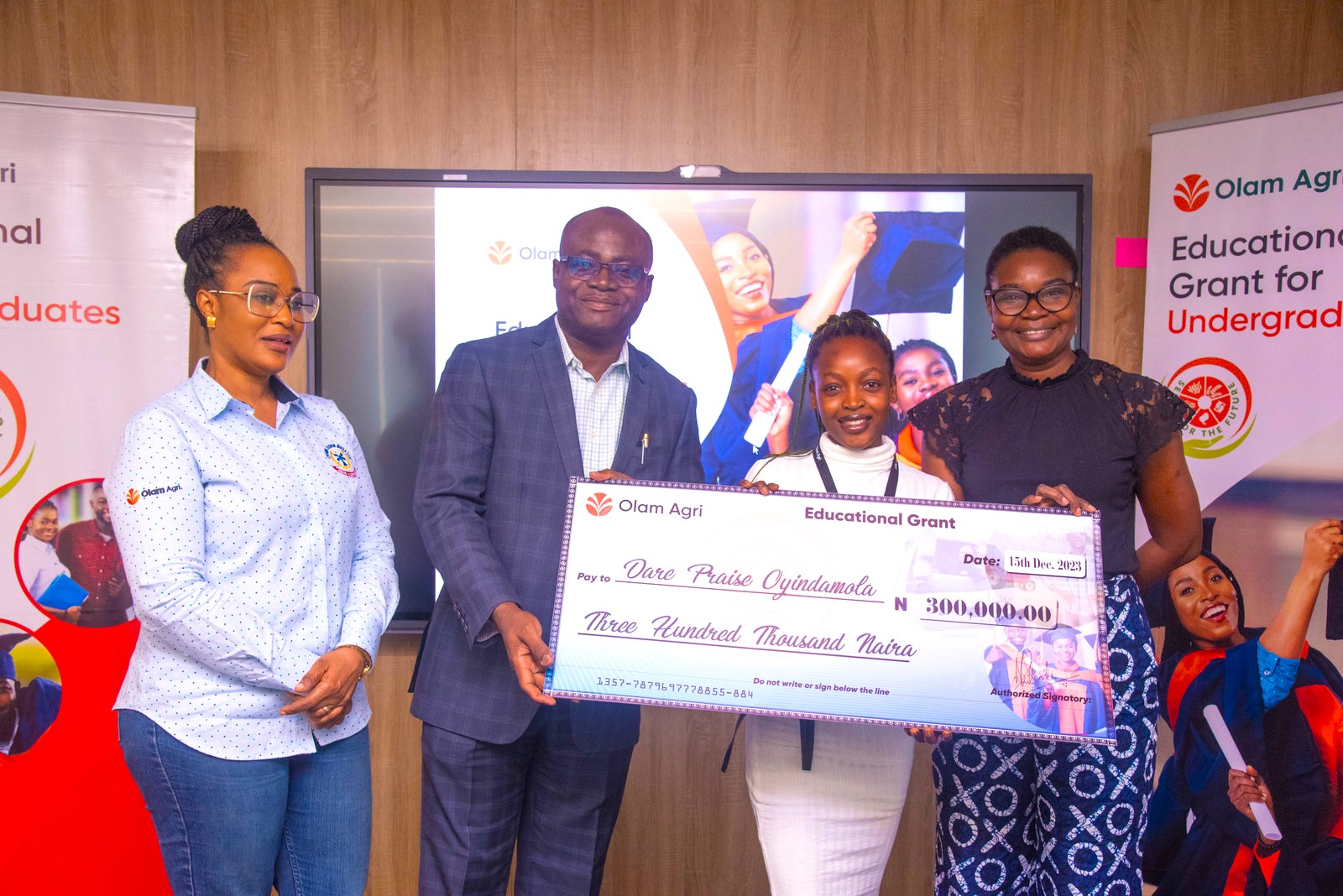
15 UNILAG Students Receive Educational Grants from Olam Agri

Published

on

Olam Agri Educational Grants

By Aduragbemi Omiyale

Fifteen students of the University of Lagos (UNILAG) have been chosen as the first beneficiaries of educational grants from Olam Agri in Nigeria through its Seeds for the Future Education Grant.

The grants aim to support the academic pursuit of the beneficiaries to fast-track learning and attainment of excellence among students in tertiary institutions targeting a long-term impact on the national productivity level.

The support framework is awarded to the best-qualified applicants using a merit-based selection process that strictly adheres to the rules of fairness, transparency, fair play, and independent audit, from the application, and shortlisting, all through to the finalists’ selection stages. It is open to all the courses of study offered in Nigeria’s federal and state-owned tertiary institutions.

Olam Agri said it came up with this initiative as part of its commitment to keep investing in enhancing human capital and economic development in the country.

The beneficiaries for this batch were selected from various departments of UNILAG and they include Uvere Franca and Ihejiamatu Anthony of the Department of Chemical Engineering, Oyibo Ufedo-Ojo and Olaloko Olamide of the Department of Civil Engineering, Bamigbose Joseph and Adeniran Ridwanullah of the Department of Mechanical Engineering, Akinyade Simisola and Ugoegbulem David of the Department of Education Foundation amongst others.

“We recognize that the private sector has a key role to play in collaborating to drive sustainable growth in the economy.

“In line with the federal government’s economic development agenda, we are glad to be investing in bright and hardworking students who are in the best position to deliver the innovation and inputs that will drive the economy in the nearest future,” the Country Head of Olam Agri, Mr Ashish Pande, said at the presentation of the grants on Friday, December 15, 2023, at the company’s head office in Lagos.

“The educational grants are a key part of the Seeds for the Future (SFTF) Initiative’s target of enabling wider education and skills development for young people amongst others.

“Launched in 2022, the initiative serves as our social sustainability investment vehicle with five levers, namely, supporting farms and farmers, enabling wider education and skill development for young people, empowering impoverished women, promoting health and nutrition across the country, and reducing carbon emissions in our business operations,” he added.

On his part, the Vice President of Commercial at Olam Agri, Mr Bolaji Anifowoshe, admonished the students to make the best use of the grants.

“Olam Agri is excited to be a part of your success journey. What you do with the grants will have a direct impact on your lives. Keep ensuring you do whatever you need to do to be the best irrespective of the resources available to you always,” he said.

In their remarks, the students applauded Olam Agri for its support, with Uvere Franca saying, “I have heard about people receiving academic support. This is my first time receiving an educational grant. I am happy for this. The grant will help me purchase the resources and tools that will aid my learning as well as support my tuition. I want to say a big ‘thank you’ to Olam Agri.”


Education

Coursera, Udemy Announce $2.5bn Merger

Published

on

Coursera and Udemy

By Adedapo Adesanya

Online learning platforms, Coursera and Udemy, have reached an agreement to merge in an all-stock transaction, with the combined company’s implied equity value estimated at approximately $2.5 billion.

The agreement, unanimously approved by both companies’ boards of directors, stipulates that Udemy shareholders will receive 0.8 shares of Coursera common stock for each Udemy share held.

Upon completion of the merger, Coursera shareholders are expected to own about 59 per cent and Udemy shareholders approximately 41 per cent of the new entity on a fully diluted basis.

The combined company will continue under the Coursera name, and maintain its headquarters in Mountain View, California.

Coursera, founded in 2012 by Mr Andrew Ng and Ms Daphne Koller, is an online learning platform with 191 million registered users as of September 30, 2025. It collaborates with over 375 universities and industry partners to offer courses, specialisations, professional certificates, and degrees.

The platform includes features such as generative AI (gen AI) tools (Coach, Role Play, Course Builder) and role-based solutions (Skills Tracks) to support scalable and personalised learning. Coursera is used by institutions for workforce development in fields such as gen AI, data science, technology, and business.

Udemy is a platform that provides on-demand, multi-language courses to help companies and individuals develop technical, business, and soft skills. It uses AI to offer personalised learning experiences and supports workforce development in a changing workplace.

Mr Greg Hart, currently CEO of Coursera, is set to lead the enlarged organisation as CEO after the merger.

The board will consist of nine members. Six from Coursera’s board, including chairman Mr Ng and CEO Mr Hart, and three from Udemy’s board.

“We’re at a pivotal moment in which AI is rapidly redefining the skills required for every job across every industry.

“Organisations and individuals around the world need a platform that is as agile as the new and emerging skills learners must master,” Mr Hart said.

The combination is said to create a complete ecosystem of top instructors supported by AI tools, data-driven insights, and broader distribution, enabling more engaging, personalised, and dynamic learning at scale.

Projected operational efficiencies include anticipated annual run-rate cost synergies of $115m within two years after closing.

Udemy CEO, Mr Hugo Sarrazin said: “For more than 15 years, Udemy has helped millions of people master in-demand skills at the speed of innovation.

“Through this combination with Coursera, we will create meaningful benefits for our learners, enterprise customers, and instructors, while delivering significant value to our shareholders, who will participate in the substantial upside potential of the combined company.”

The merger is anticipated to close in the second half of 2026, pending regulatory clearances, approval by both companies’ shareholders, and other customary closing conditions.

Continue Reading

Education

Luno, AltSchool Launch Crypto Education Programme for Nigerians

Published

on

Luno Safety of Funds

By Adedapo Adesanya

Global cryptocurrency platform, Luno and AltSchool Africa, an accredited online learning platform, have announced a strategic partnership aimed at demystifiing crypto to 15,000 Nigerians.

The initiative at that scale makes it Africa’s largest crypto education programme.

According to a joint statement on Wednesday, this is a significant step in Luno’s continued efforts to strengthen trust in digital assets and support safer participation in the digital economy.

This is hinged on Africa’s fast-growing digital finance landscape where 33 per cent of the country’s population already engage with digital assets, and a rapidly growing youth population are eager to participate in the digital economy.

According to the statement, the partnership aims to bridge the knowledge gap by providing structured, practical, and safe crypto education.

This will be done by combining Luno’s experience in promoting safe crypto participation with AltSchool Africa’s capability in delivering accessible digital skills training.

“The course directly addresses the misinformation and financial risks associated with unregulated digital assets, while demonstrating real-world applications tailored to African contexts,” the joint statement added.

The initiative will be implemented in three cohorts of 5,000 learners each. Applications for Cohort 1 will be open from January to February 2026, with the course commencing in March 2026. Cohort 2 participants will gain access to the course in July 2026, while Cohort 3 participants will begin the programme in November 2026.

The programme will be led by Web3 expert Mr Abdulsamad Tiamiyu, who will provide a practical, Africa-focused introduction to cryptocurrency, showing how it can be used for saving, remittances, global trading, and entrepreneurship.

The curriculum consists of five core modules and is designed to be completed within three to four weeks.

Learners benefit from up to one year of access to all course materials, including online, self-paced video lessons, slides, quizzes, and case studies. The course combines theory with hands-on experience, where learners interact with wallets, exchanges, stablecoins, and research tools like CoinGecko and Etherscan.

According to the organisers, this approach gives learners the tools to confidently use digital currencies in everyday financial activities. Successful learners, upon passing the assessments, earn an AltSchool Africa Certificate of Completion.

Speaking on the partnership, Mr Ayotunde Alabi, CEO of Luno Nigeria, said: “This initiative is a crucial intervention in Africa’s digital ecosystem. As crypto adoption accelerates, formal literacy must grow alongside it, so individuals can benefit safely and meaningfully,”

“Our partnership with AltSchool Africa is a deliberate step toward that goal and a foundational investment in the integrity of the industry. By delivering structured, high-quality education, Luno is helping ensure that Africans can participate confidently, securely, and sustainably – turning what is often seen as risk into real economic opportunity,” he added.

Adding his input, Mr Adewale Yusuf, Co-founder and CEO of AltSchool Africa, said “This partnership between AltSchool and Luno is a major step toward financial education that truly serves Africans and helps people gain the knowledge and tools they need to understand crypto with confidence and use it in practical, life-changing ways.”

The programme is open to Nigerian residents aged 18 and above who are able to commit to completing it within four weeks. Applicants must have a Luno account or create one before enrolling.

Starting January, Interested participants are encouraged to submit application through the AltSchool Africa portal, with scholarship decisions communicated within one week.

Continue Reading

Education

Nigeria’s Copyright Agency Destroys Pirated Books Valued at N141.5m

Published

on

book piracy

By Adedapo Adesanya

The Nigerian Copyright Commission (NCC) on Tuesday destroyed pirated books valued at N141.5 million seized from booksellers and suppliers during various enforcement operations.

The NCC Oyo State Coordinator, Mrs Oluropo Oke, supervised the destruction in Ibadan on behalf of NCC Director‑General, Mr John Asein.

She noted that the pirated books were seized over the past three years from bookshops and markets in Abeokuta, Sango-Otta in Ogun, and the Oyo state capital.

“We valued the books before destroying them and found their total value to be N141,550,000.

“During the operations, we discovered that some booksellers could not prove the source of their purchases.

“There are several features that differentiate original books from pirated copies, including the binding, colour, grammage and point of purchase.

“We need to establish whether the books were bought from the original owners or publishers, or acquired on the streets,” she said.

The director-general warned that the Nigerian Copyright Act empowers the commission to punish any citizen caught pirating or illegally dealing in intellectual property.

She said those in possession of the seized books faced penalties ranging from fines and forfeiture to other punishments under the law, adding that book piracy continued to harm national economic growth and deprived authors and publishers of the benefits of their work.

The NCC explained that the books would not be burnt but shredded to prevent recirculation and protect the environment.

“We are making every effort to prevent pirated books from returning to the market. We are using a shredding machine because it is environmentally friendly. We believe that shredding will ensure the books do not re-enter circulation.

“We understand this is a significant loss to booksellers, but instead of buying from pirates, we encourage them to purchase from the original sources, publishers or their representatives, rather than from the streets,” she said.

On his part, the Executive Secretary of the Nigerian Publishers Association (NPA), Mr Rotimi Iyiola, said book piracy had eroded much of publishers’ livelihoods.

“Witnessing the destruction of the seized pirated books by the NCC is a welcome development.

“Economically, book piracy causes enormous damage, not only to authors and publishers but also to workers and their families, and it deprives the government of revenue.

“Our jobs as publishers have been stolen, and our means of livelihood eroded,” Mr Iyiola said.

He lauded the NCC for its commitment and dedication to eradicating book piracy in Nigeria and reiterated that the NPA was ready to cooperate with the commission to ensure that piracy was effectively addressed.

Continue Reading

Trending