General
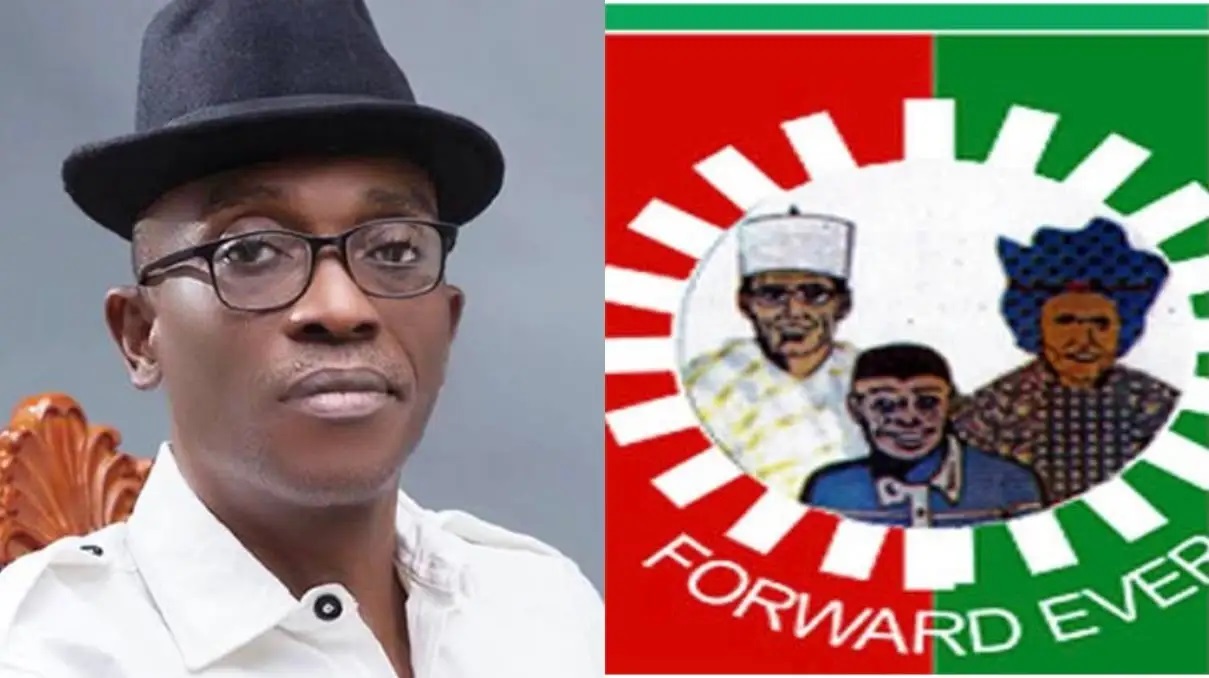
CNPP Urges Abure to Resign as Labour Party National Chairman
By Modupe Gbadeyanka
Mr Julius Abure has been advised to resign as the National Chairman of the Labour Party (LP) amid controversies trailing his leadership of the opposition political group.
This advice was given by the Conference of Nigeria Political Parties (CNPP) in a statement signed by its Deputy National Publicity Secretary, Mr James Ezema.
CNPP is the umbrella body of all registered political parties and associations in the country.
The group said the leadership of LP, which gained momentum after the former Governor of Anambra State, Mr Peter Obi, joined the party from the Peoples Democratic Party (PDP) ahead of the 2023 general elections, mismanaged the crisis it is going through at the moment.
The party recently held a national convention, which was disowned by some party executives and the Independent National Electoral Commission (INEC). The event was not attended by Mr Obi, its candidate in the 2023 presidential election won by Mr Bola Tinubu of the ruling All Progressives Congress (APC).
In its statement issued on Sunday, CNPP applauded INEC for resisting pressure to endorse the outcome of the contentious national convention of the party.
“In view of the obvious lack of internal democracy in most of the political parties in Nigeria, INEC has done well for the sake of advancing our democracy by resisting obvious pressure to use its officials to endorse the outcome of the recent contentious national convention organised by a faction of the party.
“Therefore, we call on Barrister Julius Abure to make himself the hero in the crisis by tendering his immediate resignation as the National Chairman of the party,” it said.
The group further said, “Nigeria is supposed to be a liberal democracy, where inclusive representation, rule of law, and protection of the rights and liberties of individuals within the political parties must be encouraged by all democrats and democratic institutions.
“It was against this backdrop of the lack of inclusivity that characterised the build-up to the convention held in Anambra State, making it contrary to the Federal High Court’s judgment of Friday, July 23, 2021, which ordered parties in the Labour Party leadership tussle “to maintain status quo ante bellum in order not to disturb the rest of the matter pending further order of the court.”
“In the same vein, in the judgment of the Federal High Court in Suit no. FHC/ABJ/CS/866/2014 between Labour Party and 3 Ors. vs. Com. Salisu Muhammed, the court unequivocally declared the Labour Party as an institutional political party founded, promoted, and registered by the Nigeria Labour Congress (NLC) on behalf of the Nigerian workers.
“In this light, the Julius Abure faction of the party misfired by holding the purported national convention of the Labour Party when it fell short of “an expansive and inclusive” exercise as ordered in a widely publicised subsisting court order.
“Leaving out NLC and other critical stakeholders in its consultations ahead of the convention was a miscalculated move as we recall that the former national chairman of Labour Party, High Chief Dan Nwanyanwu, on leaving office, submitted the Labour Party’s certificate of registration to the union in recognition of Labour Party as an institutional political party founded, promoted, and registered by the NLC.
“For us, the current leadership crisis rocking the Labour Party is needless and avoidable if basic ingredients of democracy, including inclusivity, justice, and accountability, were observed,” the CNPP stated.
General
Oladiti Eyes NUPENG Presidency as Akporeha Bows Out
By Adedapo Adesanya
Mr Salimon Akanni Oladiti is in pole position to take over the presidency of the Nigeria Union of Petroleum and Natural Gas Workers (NUPENG).
According to reports, Mr Oladiti, who is the current National Trustee of the union, will take over from Mr Williams Akporeha, who is set to exit office at the end of April after eight years at the helm.
Mr Akporeha announced his departure at the weekend during the Quarterly National Executive Council meeting of the Petroleum Tanker Drivers (PTD) Branch in Warri, Delta State.
He noted that the union will elect a new president on April 24 in Lagos.
If Mr Oladiti, a former PTD National Chairman, emerges as the president of the union, it would be the first time a PTD member ascends to NUPENG’s top office.
The move gained momentum at the meeting, where Mr Joseph Okafor moved a motion for Mr Oladiti’s unanimous ratification, seconded by Mr Adekunle Akinlaja.
Mr Akporeha expressed gratitude to PTD members for their steadfast support throughout his tenure.
“Eight years ago, you stood by me in this same room. You didn’t only stand by me, you supported me. When things were tough, you were there through all the challenges.
“I want to appreciate all of you. If I stand to support one of your own as President, I have no apology. If I had done anything otherwise, my conscience would have troubled me. God used you to install me,” he said.
He urged members to rally behind Oladiti and the newly elected PTD National Chairman, Mathias Ote, to sustain the union’s stability and growth.
“By the grace of God, as I move along, I want to see a union stronger than I left it. I don’t want to see PTD go into disarray. The greatest favour you can do is to support this man whom you have elected today as your national chairman. Also support your own that will be the President, by the grace of God, on April 24,” he added.
On his part, the President of the Nigerian Association of Road Transport Owners (NARTO), Mr Lawal Yusuf Othman, commended NUPENG for steering a peaceful transition.
“I once again want to appreciate NUPENG. NARTO will continue to give you the necessary support,” he said.
General
Hardship: Tinubu Should Refrain From Self-Consolation, Take Responsibility—Peter Obi
By Modupe Gbadeyanka
The candidate of the Labour Party in the 2023 presidential election, Mr Peter Obi, has knocked President Bola Tinubu for downplaying the hardship Nigerians are going through.
The former Governor of Anambra State was reacting to remarks by Mr Tinubu that Nigerians should be grateful for not going through what Kenyans are experiencing due to a hike in petrol prices as a result of the war in Iran, triggered by the United States and Israel.
During a visit to Bayelsa State over the weekend, President Tinubu said, “Let’s just thank God together that you are better off listening to them in Kenya and other African countries. What they are going through.”
But Mr Obi frowned at the President’s statement, saying key development indicators such as security, the Human Development Index, life expectancy, GDP per capita, literacy levels, and electricity access show Kenya outperforms Nigeria.
According to him, the standard of living of Kenyans is better than that of Nigerians, noting that if the President considers Kenyans to be suffering despite these stronger figures, then Nigerians are in a far more difficult situation.
He advised Mr Tinubu to “refrain from self-consolation and, in honest reflection, take responsibility for the situation and make a determined effort to drive improvement.”
He submitted that, “This requires a posture of humility, accountability, and commitment to addressing the factors that have slowed Nigeria’s development.”
Mr Obi noted that, “Nigeria is the fourth most terrorised nation in the world, while Kenya is not among the ten worst. Kenya’s HDI ranking is 143 out of 180 countries, with a coefficient of about 0.630, compared to Nigeria’s ranking of 164 out of 180, with a coefficient of about 0.530. Its GDP per capita is roughly $2,200–$2,300, compared to Nigeria’s $807–$835.
“Kenya’s poverty rate is about 43 per cent of the population (approximately 23 million people), while Nigeria’s is about 63 per cent (around 150 million people), over six times that of Kenya. Kenya’s life expectancy is about 67 years, while Nigeria’s is about 54 years. The literacy rate in Kenya is approximately 81–85 per cent, compared to Nigeria’s 62–65 per cent.
“Kenya’s electricity access is higher, while Nigeria has one of the lowest levels of electricity access in the world. Kenya has about 3.5 million out-of-school children, while Nigeria has about 20 million. Kenya’s inflation rate has been about 4.5 per cent or lower over the past three years, while Nigeria’s has remained above 15 per cent within the same period.
“Kenya’s exchange rate has been around USD 1 to KES 130 over the past three years, whereas Nigeria’s exchange rate rose from below N500/$1 to above N1,250/$1 within the same period. Even with developments in the Middle East and rising oil prices, Kenyans have not experienced the sharp increases in petroleum product prices seen in Nigeria.”
The chieftain of the African Democratic Congress (ADC) said while the President’s comments “may have been intended to soften the impact of economic hardship and rising fuel prices,” they risk downplaying the severity of the current crisis.
“It echoes the biblical parable of the Pharisee and the Tax Collector in the Gospel of Luke (18:9–14). A similar warning is found in the Qur’an (53:32), which cautions against self-righteousness.
“Like the Pharisee who boasted of his superiority over others to mask his own spiritual void, such downward comparisons serve more as a refuge than a remedy.
“This validated an earlier dismissive remark by President Ahmed Bola Tinubu during electioneering: Na statistics we go shop? Yet statistics remain indispensable – they are the language through which nations understand their condition and chart progress.
“No country can develop in isolation from measurable realities or without comparing itself with peers. Comparisons, when properly grounded, are not instruments of escapism but tools of accountability. What is objectionable is not comparison itself, but comparison stripped of credible, verifiable data—mere tax collector comparisons that soothe rather than solve,” he stated in his post titled From Pharisee to Tax Collector: Rethinking Tinubu’s Kenyan Comparison.
General
NUPRC Issues Directive on Measurement-Based Methane, GHG Reporting
By Adedapo Adesanya
The Nigerian Upstream Petroleum Regulatory Commission (NUPRC) has issued a new directive mandating upstream oil and gas operators to adopt standardised templates and transition to measurement-based reporting of methane and greenhouse gas (GHG) emissions.
The directive was signed by the chief executive of the commission, Mrs Oritsemeyiwa Eyesan, on Monday and it takes immediate effect.
This is part of efforts to strengthen transparency, accountability, and alignment with Nigeria’s climate commitments under its Nationally Determined Contributions (NDCs).
According to the commission, all operators are now required to institutionalise credible Measurement, Reporting and Verification (MRV) systems for emissions tracking, moving away from estimation-based methods toward more precise, science-driven measurement approaches.
The regulator said the move is in response to increasing global pressure to limit temperature rise to 1.5°C, which has placed heightened expectations on fossil fuel producers to curb methane emissions and improve environmental performance.
NUPRC noted that since 2022, operators had been required to use the Intergovernmental Panel on Climate Change (IPCC) Tier 1 methodology for emissions estimation, but the new directive enforces a phased transition to more advanced systems.
Under the new framework, companies must adopt IPCC Tier 2 methodologies by the third quarter of 2026 and fully transition to Tier 3—considered the most accurate, measurement-based standard—by January 2027.
To ensure uniformity in reporting, operators are also mandated to comply with newly introduced templates, including the Greenhouse Gas Emissions Management Plan (GHGEMP) and standardised formats for methane and GHG emissions accounting and inventories.
The commission emphasised that all submissions must be verifiable, transparent, and evidence-based, in line with MRV principles, and must follow templates published on its official website.
While reaffirming the IPCC framework as the global standard, NUPRC stated that operators may align with other recognised frameworks such as OGMP 2.0, API, and ISO, provided submissions meet regulatory requirements.
The directive also acknowledges existing technical and infrastructural gaps within the industry. In response, the commission said it has begun capacity-building initiatives, including targeted workshops and guidance sessions, to support operators in the transition.
Nigeria has committed to achieving net-zero emissions by 2060, ending routine gas flaring by 2030, and cutting methane emissions by 60 per cent by 2035. The commission said achieving these targets depends on a robust, traceable, and internationally compliant emissions reporting system.
NUPRC added that the new measures are expected to enhance Nigeria’s credibility in global energy and climate markets while attracting climate-focused investments into the upstream sector.
The commission reiterated its commitment to supporting the industry through technical guidance and the deployment of MRV-enabling infrastructure.
-
Feature/OPED6 years agoDavos was Different this year
-
Travel/Tourism10 years ago
Lagos Seals Western Lodge Hotel In Ikorodu
-
Showbiz3 years agoEstranged Lover Releases Videos of Empress Njamah Bathing
-
Banking8 years agoSort Codes of GTBank Branches in Nigeria
-
Economy3 years agoSubsidy Removal: CNG at N130 Per Litre Cheaper Than Petrol—IPMAN
-
Banking3 years agoSort Codes of UBA Branches in Nigeria
-
Banking3 years agoFirst Bank Announces Planned Downtime
-
Sports3 years agoHighest Paid Nigerian Footballer – How Much Do Nigerian Footballers Earn