Connect with us

Economy

Oil Prices up as Attention Shifts to OPEC+ Meeting

Published

on

OPEC Meeting US Stocks

By Adedapo Adesanya

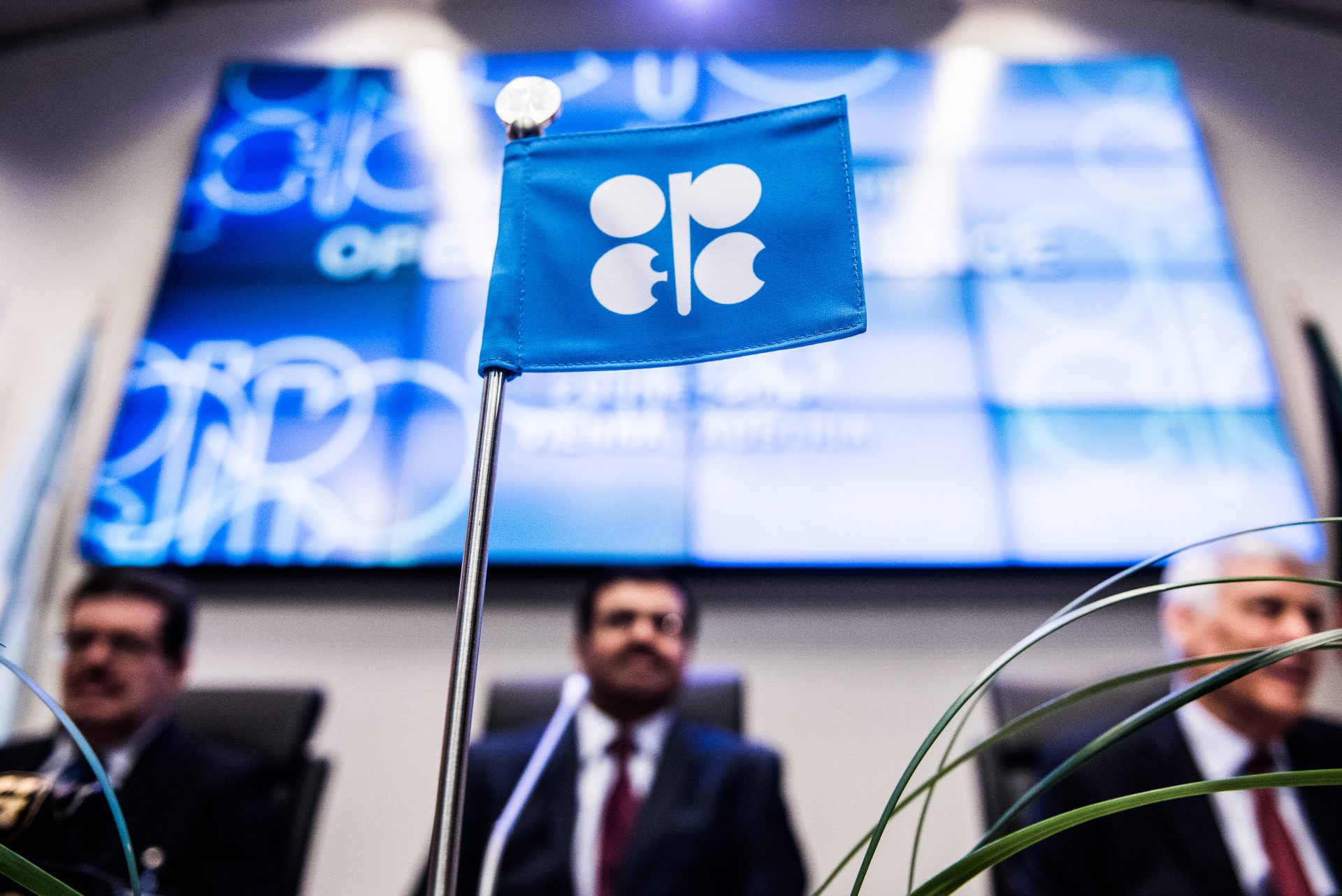
Oil prices rose over 1 per cent in slow trade, owing to public holidays in Britain and the United States as the market’s attention turned to an anticipated meeting of oil producers.

The Brent crude improved its valued by $1 or 1.2 per cent to close at $83.12 a barrel and the US West Texas Intermediate (WTI) crude futures were up 93 cents to $78.65 per barrel.

Brent lost about 2 per cent last week and WTI nearly 3 per cent after Federal Reserve minutes showed some officials would be willing to raise interest rates further if it were deemed necessary to control stubbornly high inflation.

The public holidays in the US and UK on Monday kept trading relatively thin meaning the focus shifted to the upcoming meeting of the Organisation of the Petroleum Exporting Countries and allies (OPEC+), which pushed back by a day to June 2 and will be held online.

The producers will discuss whether to extend voluntary output cuts of 2.2 million barrels per day into the second half of the year, with three sources from OPEC+ countries saying an extension was likely.

Combined with another 3.66 million bpd of production cuts valid through the end of the year, the output cuts are equivalent to nearly 6 per cent of global oil demand.

OPEC has said it expects another year of relatively strong oil demand growth of 2.25 million barrels per day, while the International Energy Agency expects much slower growth of 1.2 million barrels per day.

Markets will also be watching the US personal consumption expenditures index this week for more signals about interest rate policy. The index, due to be released on May 31, is reportedly the US Federal Reserve’s preferred measure of inflation.

The prospect of higher-for-longer interest rates has strengthened the US Dollar, making oil more expensive for holders of other currencies.

On Monday, key European Central Bank (ECB) policymakers said the bank has room to cut interest rates as inflation slows but must take its time in easing policy.

Figures for inflation in the euro zone are due on Friday and economists believe an expected tick up to 2.5 per cent should not stop the ECB from easing policy next week.

Meanwhile, Goldman Sachs raised its global oil demand forecast for 2030 on Monday and expects consumption to peak by 2034 on a potential slowdown in electric vehicle adoption, keeping refineries running at higher-than-average rates till the end of this decade.


Adedapo Adesanya is a journalist, polymath, and connoisseur of everything art. When he is not writing, he has his nose buried in one of the many books or articles he has bookmarked or simply listening to good music with a bottle of beer or wine. He supports the greatest club in the world, Manchester United F.C.

Economy

Tinubu Presents N58.47trn Budget for 2026 to National Assembly

Published

on

2026 budget tinubu

By Adedapo Adesanya

President Bola Tinubu on Friday presented a budget proposal of N58.47 trillion for the 2026 fiscal year titled Budget of Consolidation, Renewed Resilience and Shared Prosperity to a joint session of the National Assembly, with capital recurrent (non‑debt) expenditure standing at 15.25 trillion, and the capital expenditure at N26.08 trillion, while the crude oil benchmark was pegged at $64.85 per barrel.

Business Post reports that the Brent crude grade currently trades around $60 per barrel. It is also expected to trade at that level or lower next year over worries about oil glut.

At the budget presentation today, Mr Tinubu said the expected total revenue for the year is N34.33 trillion, and the proposal is anchored on a crude oil production of 1.84 million barrels per day, and an exchange rate of N1,400 to the US Dollar.

In terms of sectoral allocation, defence and security took the lion’s share with N5.41 trillion, followed by infrastructure at N3.56 trillion, education received N3.52 trillion, while health received N2.48 trillion.

Addressing the lawmakers, the President described the budget proposal as not “just accounting lines”.

“They are a statement of national priorities,” the president told the gathering. “We remain firmly committed to fiscal sustainability, debt transparency, and value‑for‑money spending.”

The presentation came at a time of heightened insecurity in parts of the country, with mass abductions and other crimes making headlines.

Outlining his government’s plan to address the challenge, President Tinubu reminded the gathering that security “remains the foundation of development”.

He said some of the measures in place to tame insecurity include the modernisation of the Armed Forces, intelligence‑driven policing and joint operations, border security, and technology‑enabled surveillance and community‑based peacebuilding and conflict prevention.

“We will invest in security with clear accountability for outcomes—because security spending must deliver security results,” the president said.

“To secure our country, our priority will remain on increasing the fighting capability of our armed forces and other security agencies by boosting personnel and procuring cutting-edge platforms and other hardware,” he added.

Continue Reading

Economy

PenCom Extends Deadline for Pension Recapitalisation to June 2027

Published

on

Pension Recapitalisation

By Aduragbemi Omiyale

The deadline for the recapitalisation of the Nigerian pension industry has been extended by six months to June 2027 from December 2026.

This extension was approved by the National Pension Commission (PenCom), the agency, which regulates the sector in the country.

Addressing newsmen on Thursday in Lagos, the Director-General of PenCom, Ms Omolola Oloworaran, explained that the shift in deadline was to give operators more time to boost the capital base, dismissing speculations that the exercise had been suspended.

“The recapitalisation has not been suspended. We have communicated the requirements to the Pension Fund Administrators (PFAs), and we expect every operator to be compliant by June 2027. Anyone who is not compliant by then will lose their licence,” Ms Oloworaran told journalists.

She added that, “From a regulatory standpoint, our major challenge is ensuring compliance. We are working with ICPC, labour and the TUC to ensure employers remit pension contributions for their employees.”

The DG noted that engagements with industry operators indicated broad acceptance of the policy, with many PFAs already taking steps to raise additional capital or explore mergers and acquisitions.

“You may see some mergers and acquisitions in the industry, but what is clear is that the recapitalisation exercise is on track and the industry agrees with us,” she stated.

PenCom wants the PFAs to increase their capital base and has created three categories, with the first consists operators with Assets Under Management of N500 billion and above. They are expected to have a minimum capital of N20 billion and one per cent of AUM above N500 billion.

The second category has PFAs with AUM below N500 billion, which must have at least N20 billion as capital base.

The last segment comprises special-purpose PFAs such as NPF Pensions Limited, whose minimum capital was pegged at N30 billion, and the Nigerian University Pension Management Company Limited, whose minimum capital was fixed at N20 billion.

Continue Reading

Economy

Three Securities Sink NASD Exchange by 0.68%

Published

on

NASD securities exchange

By Adedapo Adesanya

Three securities weakened the NASD Over-the-Counter (OTC) Securities Exchange by 0.68 per cent on Thursday, December 18.

According to data, Central Securities Clearing System (CSCS) Plc led the losers’ group after it slipped by N2.87 to N36.78 per share from N39.65 per share, Golden Capital Plc depreciated by 77 Kobo to end at N6.98 per unit versus the previous day’s N7.77 per unit, and FrieslandCampina Wamco Nigeria Plc dropped 19 Kobo to sell at N60.00 per share versus Wednesday’s closing price of N60.19 per share.

At the close of business, the market capitalisation lost N16.81 billion to finish at N2.147 billion compared with the preceding session’s N2.164 trillion, and the NASD Unlisted Security Index (NSI) declined by 24.76 points to 3,589.88 points from 3,614.64 points.

Yesterday, the volume of securities bought and sold increased by 49.3 per cent to 30.5 million units from 20.4 million units, the value of securities surged by 211.8 per cent to N225.1 million from N72.2 million, and the number of deals jumped by 33.3 per cent to 28 deals from 21 deals.

Infrastructure Credit Guarantee Company (InfraCredit) Plc remained the most traded stock by value with a year-to-date sale of 5.8 billion units valued at N16.4 billion, followed by Okitipupa Plc with 178.9 million units transacted for N9.5 billion, and MRS Oil Plc with 36.1 million units worth N4.9 billion.

Similarly, InfraCredit Plc ended as the most traded stock by volume on a year-to-date basis with 5.8 billion units traded for N16.4 billion, trailed by Industrial and General Insurance (IGI) Plc with 1.2 billion units sold for N420.7 million, and Impresit Bakolori Plc with 536.9 million units exchanged for N524.9 million.

Continue Reading

Trending