General
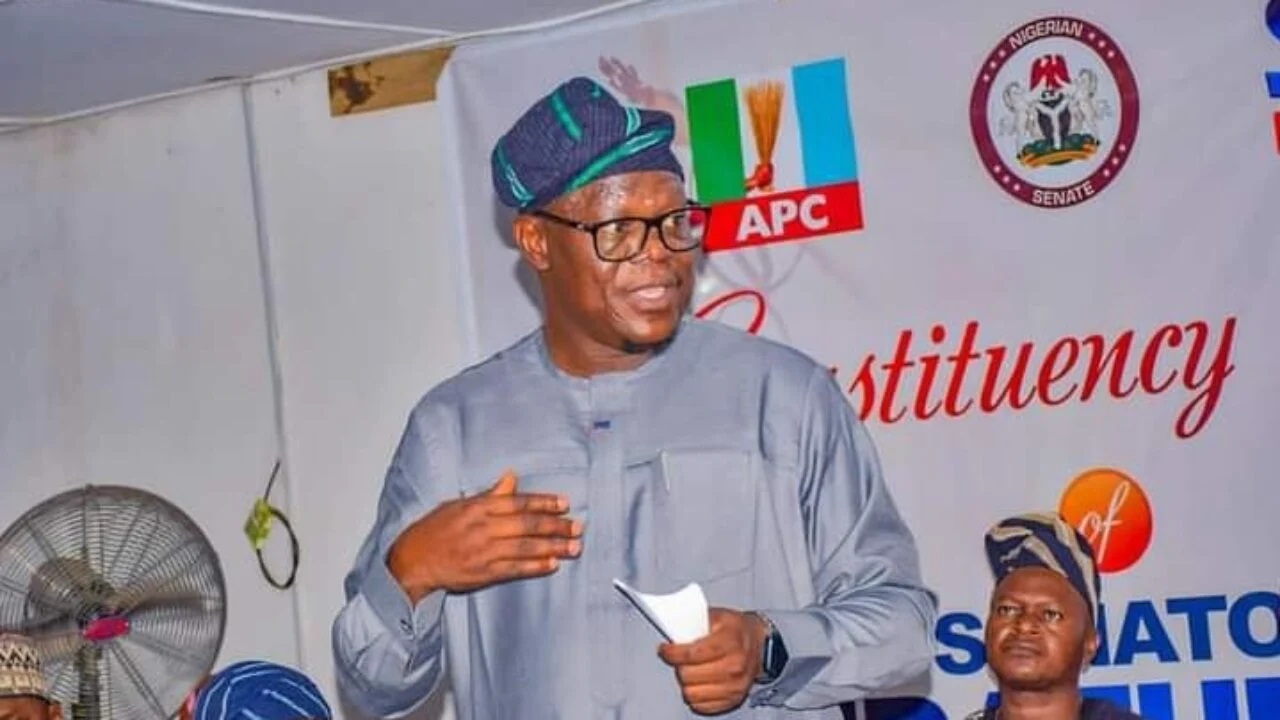
APC National Secretary Ajibola Basiru Rejects NBS Inflation Figures
By Aduragbemi Omiyale
The National Secretary of the ruling All Progressives Congress (APC), Mr Ajibola Basiru, has rejected the inflation figures of the National Bureau of Statistics (NBS).
Last Monday, the agency, which is under the executive arm of the government, released a report that inflation in Nigeria increased by 34.19 per cent as a result of the rising cost of food.
On Wednesday, while appearing as a guest of a flagship programme on Channels Television, Politics Today, anchored by Mr Seun Okinbaloye, the former Senator said he does not agree that the average prices of goods and services went up by over 30 per cent on a year-on-year basis as claimed by the NBS.
He admitted that the country was facing economic challenges like others across the globe, but it was not worse than being bandied around by the agency and some members of the opposition.
The former lawmaker emphasised that the government of President Bola Tinubu was doing everything possible to make the economy viable again.
When asked what he feels the inflation numbers should be, he declined to state any but maintained that he does not agree with the data released by the stats office, which churns out the figures monthly.
“I know that there are inflation challenges but I disagree it is not up to that level. I don’t agree,” the ruling party’s scribe declared on the programme to the amazement of the host.
He also claimed that the demands of Nigerians planning a nationwide protest from August 1, 2024, were politically motivated, stressing that the government was trying its best to make citizens happy.
Earlier in the day, after the APC 153rd National Working Committee (NWC) meeting in Abuja, Mr Basiru told journalists that President Tinubu would address most of the economic challenges facing the nation.
“We noted that since coming on board in 2023, the government met quite several challenges, especially economic challenges, and Mr President is gradually implementing programmes and policies that would in the nearest future bring succour and relief to the citizens,” he stated, appealing to those planning the demonstrations to be patient with the government for these policies to yield results.
General
Senate Passes Electoral Act Amendment Bill, Blocks Electronic Transmission of Results
By Modupe Gbadeyanka
The Senate on Wednesday passed the bill to amend the Electoral Act of 2022 after delays, which almost pitched the institution against several Nigerians.
Last week, the upper chamber of the National Assembly headed by the Senate President, Mr Godswill Akpabio, set up a panel to look into the matter, with the directive to submit its report yesterday, Tuesday, February 3, 2026.
However, after the report was submitted yesterday, the red chamber of the parliament said it was going to take an action on it on Wednesday.
At the midweek plenary, the Senate eventually passed the Bill for an Act to Repeal the Electoral Act No. 13, 2022 and Enact the Electoral Act, 2025.
However, some critical clauses were rejected, including the proposed amendment to make is mandatory for the Independent National Electoral Commission (INEC) to transmission election results electronically from polling units to the INEC Result Viewing (IReV) portal.
The clause was to strengthen transparency and reduce electoral malpractice through technology-driven result management.
It also rejected a proposed amendment under Clause 47 that would have allowed voters to present electronically-generated voter identification, including a downloadable voter card with a unique QR code, as a valid means of accreditation.
The Senate voted to retain the existing 2022 provisions requiring voters to present their Permanent Voter’s Card (PVC) for accreditation at polling units, and upheld the provision mandating the use of the Bimodal Voter Accreditation System (BVAS) or any other technological device prescribed by the electoral umpire for voter verification and authentication, rather than allowing alternative digital identification methods as proposed in the new bill.
The Senate also reduced the notice of election from 360 days to 180 days, with the timeline for publishing list of candidates by INEC dropped from 150 days to 60 days.
General
Amupitan Says 2027 Elections Timetable Ready Despite Electoral Act Delay
By Adedapo Adesanya
The Independent National Electoral Commission (INEC) has completed its timetable and schedule of activities for the 2027 general election, despite pending amendments to the Electoral Act by the National Assembly.
INEC Chairman, Mr Joash Amupitan, disclosed this on Wednesday in Abuja during a consultative meeting with civil society organisations.
Mr Amupitan said the commission had already submitted its recommendations and proposed changes to lawmakers, noting that aspects of the election calendar might still be adjusted depending on when the amended Electoral Act is passed.
He, however, stressed that the electoral umpire must continue preparations using the existing legal framework pending the conclusion of the legislative process and presidential assent to the revised law.
According to him, the commission cannot delay critical preparatory activities given the scale and complexity involved in conducting nationwide elections.
The development highlights INEC’s commitment to early planning for the 2027 polls, even as stakeholders await legislative clarity that could shape parts of the electoral process.
Yesterday, the Senate again failed to conclude deliberations on the proposed amendment to the Electoral Act after several hours in a closed-door executive session. The closed session lasted about five hours.
Lawmakers dissolved into the executive session shortly after plenary commenced, to consider the report of an ad hoc committee set up to harmonise senators’ inputs on the Electoral Act Amendment Bill.
When plenary resumed, the Senate President, Mr Godswill Akpabio, did not disclose details of the discussions on the bill.
Despite repeated executive sessions, the upper chamber has yet to pass the bill, marking the third unsuccessful attempt in two weeks.
The Senate, however, said it will not rush the bill, citing the volume of post-election litigation after the 2023 polls and the need for careful legislative scrutiny.
Last week, the red chamber of the federal parliament constituted a seven-member ad hoc committee after an earlier three-hour executive session to further scrutinise the proposed amendments.
General
REA Expects Further $1.1bn Investment for New Mini Power Grids
By Adedapo Adesanya
The Managing Director of the Rural Electrification Agency, (REA), Mr Abba Aliyu, is poised to attract an estimated $1.1 billion in additional private-sector investment to further achieve the agency’s targets.
He said that the organisation has received a $750 million funding in 2024 through the World Bank funded Distributed Access through Renewable Energy Scale-up (DARES) project.
He added that this capital is specifically intended to act as a springboard to attract an estimated $1.1 billion in additional private-sector investment, with the ultimate goal of providing electricity access to roughly 17.5 million Nigerians through 1,350 new mini grids.
Mr Aliyu also said that the Nigeria Electrification Project (NEP) has already led to the electrification of 1.1 million households across more than 200 mini grids and the delivery of hybrid power solutions to 15 federal institutions.
According to a statement, this followed Mr Aliyu’s high-level inspection of Vsolaris facilities in Lagos, adding that the visit also served as a platform for the REA to highlight its decentralized electrification strategy, which relies on partnering with firms capable of managing local assembly and highefficiency project execution.
The federal government, through the REA, underscored the critical role the partnership with the private sector plays in achieving Nigeria’s ambitious off-grid energy targets and ending energy poverty.
Mr Aliyu emphasized that while public funds serve as a catalyst, the long-term sustainability of Nigeria’s power sector rests on credible private developers who are willing to invest their own resources.
He noted that public funds are intentionally deployed as catalytic grants to ensure that the private sector maintains skin in the game which he believes is the only way to guarantee true accountability and the survival of these projects over time.
-
Feature/OPED6 years agoDavos was Different this year
-
Travel/Tourism9 years ago
Lagos Seals Western Lodge Hotel In Ikorodu
-
Showbiz3 years agoEstranged Lover Releases Videos of Empress Njamah Bathing
-
Banking8 years agoSort Codes of GTBank Branches in Nigeria
-
Economy3 years agoSubsidy Removal: CNG at N130 Per Litre Cheaper Than Petrol—IPMAN
-
Banking3 years agoSort Codes of UBA Branches in Nigeria
-
Banking3 years agoFirst Bank Announces Planned Downtime
-
Sports3 years agoHighest Paid Nigerian Footballer – How Much Do Nigerian Footballers Earn