Connect with us

Economy

Our Economic Policies Already Yielding Positive Results—Tinubu

Published

on

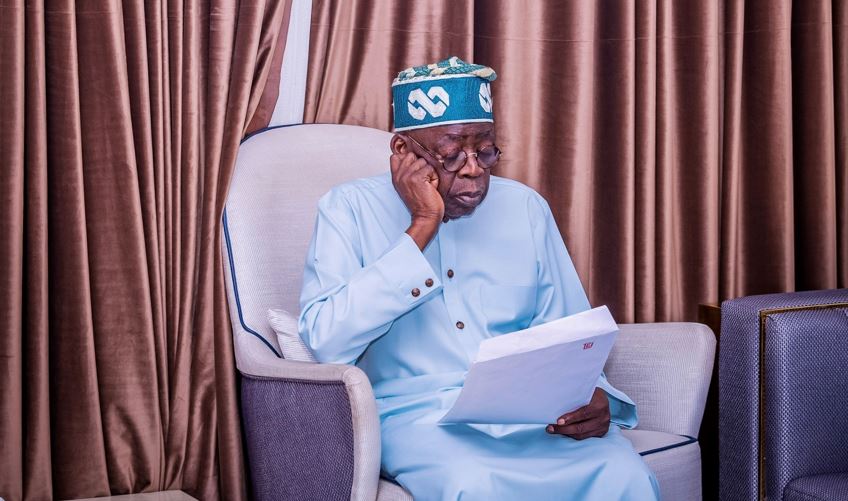
Letter to President Tinubu

By Modupe Gbadeyanka

President Bola Tinubu has said the economic policies put in place by his administration since his assumption last year have started to yield positive results.

He made this disclosure on Thursday in Yenagoa, Bayelsa State at the opening ceremony of the All Nigerian Editors Conference.

Mr Tinubu, represented at the event by the Minister of Information and National Orientation, Mr Mohammed Idris, said, “I am pleased to let you know that through our sustained reforms, we are witnessing our economy gradually making a rebound on the most important foundational level. Today, our debt service to revenue ratio has come down drastically from almost 100 per cent to about 65 per cent.”

“The last 18 months have been spent laying the foundation for this compelling vision of a prosperous Nigeria; that is what the Renewed Hope Agenda is all about – rekindling the faith and hope of all Nigerians in the ability of their country to flourish and to in turn provide an environment that allows everyone in it to flourish just as much,” the President at the conference themed Economic Growth and Development Strategies in a Resource-Rich Country.

“But we realise that there are some major obstacles standing in the way of the full unleashing of Nigeria’s abundant potentials. And we have spent time and energy and focus boldly tackling these.

“Two of the most significant are very well known to you: a ruinous fuel subsidy regime that deprived us of billions of dollars annually that could be going into investments in critical physical and social infrastructure, and a foreign exchange regime that was prone to unimaginable levels of arbitrage and abuse.

“Like the fuel subsidy, another needless drain on our limited national resources, and a cap on our ability as a nation to reach full potential,” President Tinubu said further.

He stated that, as a result of the reforms, revenue for all three tiers of government – federal, state, and local – has grown significantly, which has enabled greater investment in social services, infrastructure development, and social security.

The President noted that the Supreme Court’s decision to grant local government autonomy, following a suit filed by the Federal Government, was aimed at strengthening governance at the local level and fostering grassroots development.

Addressing the theme of the seminar, Mr Tinubu stated that the longstanding question of how Nigeria can transform its vast resources into meaningful growth and development has driven his vision for a nation that fulfils its potential.

“A new minimum wage of N70,000 has taken off across all federal government establishments, with many of the state governments committing to implementing same. Over 46,000 students are benefiting from the Nigerian Education Loan Fund across 59 tertiary institutions with a disbursement of over N5 billion. The first batch of 500,000 civil servants is set to become beneficiaries of the Consumer Credit Scheme with the release of N100 billion.

“While oil remains a significant source of revenue for Nigeria, we are investing heavily in other sectors to diversify our economy for sustainable growth.

“The launch of the Presidential Initiative on CNG is a deliberate strategy to harness our abundant gas resources to bring down the high cost of transportation by about 60 per cent and also foster a clean and healthy environment for our citizens. This initiative has unlocked close to $200 million in private sector investments in the last one year,” he said.

While hailing the media for its dedication to nation-building, particularly in supporting Nigeria’s enduring democracy, President Tinubu emphasized that the roles of government and the media are closely linked, both vital to serving the public interest.


Modupe Gbadeyanka is a fast-rising journalist with Business Post Nigeria. Her passion for journalism is amazing. She is willing to learn more with a view to becoming one of the best pen-pushers in Nigeria. Her role models are the duo of CNN's Richard Quest and Christiane Amanpour.

Economy

Investors Gain N97bn from Local Equity Market

Published

on

Nigerian equity market

By Dipo Olowookere

The upward trend witnessed at the Nigerian Exchange (NGX) Limited in recent sessions continued on Thursday as it further improved by 0.10 per cent.

This was despite investor sentiment turning bearish after the local equity market ended with 23 price gainers and 28 price gainers, indicating a negative market breadth index.

UAC Nigeria gained 10.00 per cent to finish at N88.00, Morison Industries appreciated by 9.94 per cent to N3.54, Ecobank rose by 8.53 per cent to N36.90, and Coronation Insurance grew by 8.47 per cent to N2.56.

On the flip side, Ellah Lakes depreciated by 10.00 per cent to N13.14, Eunisell Nigeria also shed 10.00 per cent to finish at N72.90, Transcorp Hotels slipped by 9.95 per cent to N157.50, Omatek shrank by 9.23 per cent to N1.18, and Guinea Insurance dipped by 8.46 per cent to N1.19.

Yesterday, the All-Share Index (ASI) went up by 152.28 points to 145,476.15 points from 145,323.87 points and the market capitalisation chalked up N97 billion to finish at N92.726 trillion compared with the previous day’s N92.629 trillion.

Customs Street was bubbling with activities on Thursday, though the trading volume and value slightly went down, according to data.

A total of 1.9 billion stocks worth N19.2 billion exchanged hands in 23,369 deals during the session versus the N2.3 billion valued at N21.0 billion traded in 21,513 deals a day earlier.

This showed that the number of deals increased by 8.63 per cent, the volume of transactions depleted by 17.39 per cent, and the value of trades decreased by 8.57 per cent.

For another trading day, eTranzact led the activity chart with 1.6 billion units sold for N6.4 billion, Fidelity Bank traded 31.0 million units worth N589.3 million, GTCO exchanged 28.3 million units valued at N2.5 billion, Zenith Bank transacted 27.1 million units for N1.6 billion, and Ecobank traded 21.9 million units worth N744.3 million.

Continue Reading

Economy

Naira Loses 18 Kobo Against Dollar at Official Market, N5 at Black Market

Published

on

forex Black Market

By Adedapo Adesanya

The Naira marginally depreciated against the United States Dollar in the Nigerian Autonomous Foreign Exchange Market (NAFEM) on Thursday, December 4 amid renewed forex pressure associated with December.

At the official market yesterday, the Nigerian currency lost 0.01 per cent or 18 Kobo against the Dollar to close at N1,447.83/$1 compared with the previous day’s N1,447.65/$1.

It was not a different scenario with the local currency in the same market segment against the Pound Sterling as it further shed N15.43 to sell for N1,930.97/£1 versus Wednesday’s closing price of N1,925.08/£1 and declined against the Euro by 20 Kobo to finish at N1,688.74/€1 compared with the preceding session’s N1,688.54/€1.

Similarly, the Nigerian Naira lost N5 against the greenback in the black market to quote at N1,465/$1 compared with the previous day’s value of N1,460/$1 but closed flat against the Dollar at the GTBank FX counter at N1,453/$1.

Fluctuations in trading range is expected to continue during the festive season as traders expect the Nigerian currency to be stable, supported by intervention s by to the Central Bank of Nigeria (CBN)in the face of steady dollar demand.

Support is also expected in coming weeks as seasonal activities, particularly the stylised “Detty December” festivities, will see inflows that will give the Naira a boost after it depreciated mildly last month, according to a new report.

“As the festive Detty December season intensifies, inbound travel, tourism spending, and diaspora inflows are expected to provide moderate support for FX liquidity,” analysts at the research unit of FMDA said in its latest monthly report for November.

Traders cited by Reuters expect that the Naira will trade within a band of N1,443-N1,450 next week, buoyed by improved FX interventions by the apex bank.

Meanwhile, the crypto market was down as the US Federal Reserve’s preferred inflation gauge, core PCE, likely rose in September—moving in the wrong direction. However, volatility indices show no signs of major turbulence.

If the actual figure matches estimates, it would mark 55 straight months of inflation above the US central bank’s 2 per cent target. The sticky inflation would strengthen the hawkish policymakers, who are in favour of slower rate cuts.

Ripple (XRP) depreciated by 4.5 per cent to $2.08, Solana (SOL) went down by 3.8 per cent to $138.11, Litecoin (LTC) shrank by 3.1 per cent to $83.23, Dogecoin (DOGE) slid by 2.5 per cent to $0.1463, Cardano (ADA) declined by 2.1 per cent to $0.4368, Bitcoin (BTC) fell by 0.9 per cent to $91,975.45, Binance Coin (BNB) crumbled by 0.9 per cent to $899.41, and Ethereum (ETH) dropped by 0.7 per cent to $3,156.44, while the US Dollar Tether (USDT) and the US Dollar Coin (USDC) closed flat at $1.00 apiece.

Continue Reading

Economy

Fed Rate Cut Signal, Stalling Ukraine Peace Talks Raise Oil Prices

Published

on

oil prices driving up Trump

By Adedapo Adesanya

Oil prices were up on Thursday amid investors’ expectations for the Federal Reserve to cut interest rates, while stalled Ukraine peace talks tempered expectations of a deal restoring Russian oil flows.

Brent crude gained 59 cents or 0.94 per cent to trade at $63.26 a barrel and the US West Texas Intermediate (WTI) crude appreciated by 72 cents or 1.22 per cent to $59.67 per barrel.

The market ticked up on expectations that a US rate cut will support the world’s largest economy and oil demand, after data showed employment is slowing.

Markets are pricing in an 89 per cent chance of a cut when the Federal Reserve meets on December 9-10, significantly higher than rate-cut bets just a couple of weeks ago, according to the CME FedWatch tool.

Support also came as the dollar edged lower for its 10th straight day of losses against a basket of major currencies, making crude cheaper for buyers using other currencies.

Analysts noted that escalating tensions between the US and Venezuela were also supporting prices on concerns of a drop in crude supplies from the South American country, which is a member of the Organisation of the Petroleum Exporting Countries (OPEC).

US President Donald Trump’s administration is ratcheting up pressure on Venezuelan President Nicolás Maduro, signalling the possibility of a US invasion.

The perception that progress on a peace plan for Ukraine was stalling also supported prices, after President Trump’s representatives emerged from peace talks with the Kremlin with no resolution in sight.

Expectations of an end to the war had pressured prices lower, as traders anticipated a deal would allow Russian oil back into an already oversupplied global market..

Meanwhile, Ukraine continued its assault on Russia’s energy infrastructure as it hit the Druzhba oil pipeline in Russia’s central Tambov region, the fifth attack on the pipeline that sends Russian oil to Hungary and Slovakia.

Kpler noted that Ukraine’s drone campaign against Russian refining infrastructure has affected production to down around 5 million barrels per day between September and November, a 335,000 barrels per day year-on-year decline, with gasoline (petrol) hit hardest and gasoil output also materially weaker.

US crude and fuel inventories rose last week as refining activity picked up, the Energy Information Administration (EIA) said on Wednesday.
Crude inventories rose by 574,000 barrels to 427.5 million barrels in the week ended November 28, the EIA said, compared with analysts’ expectations in a Reuters poll for an 821,000-barrel draw.

Fitch Ratings on Thursday cut its 2025-2027 oil price assumptions to reflect market oversupply and production growth that is expected to outstrip demand.

Continue Reading

Trending