World
Cameroonian Diaspora Congress: An Essential Vector for Cameroon’s Influence in Russia
By Louis Gouend
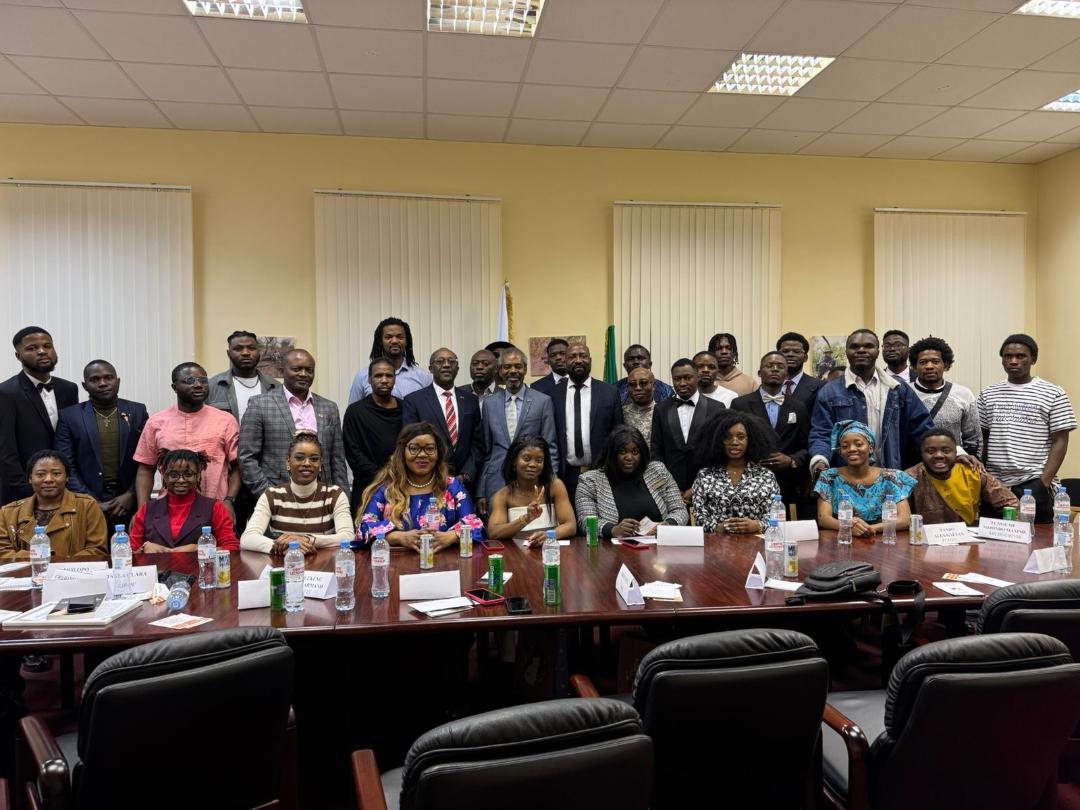
The Cameroonian diaspora in the Russian Federation, although relatively recent, constitutes an essential vector for Cameroon’s influence and the maintenance of strong ties with the nation. In this perspective, and following a fruitful video conference on January 27, 2024, with the Minister of Youth and Civic Education, it was decided to organize, on February 8 and 11, 2025, the first celebration of Youth Day within the Russian diaspora.
This unprecedented initiative, benefiting from the Minister’s valuable support, aimed to consolidate patriotism and the spirit of initiative among Cameroonian youth residing in Russia, by offering a framework for exchange and promotion of Cameroonian cultural wealth. It mobilized Cameroonian students, young professionals, and entrepreneurs established in Russian territory.
The commemoration of the 59th anniversary of Cameroon’s Youth Day took the form of a dual celebration: a physical meeting at the Cameroonian Embassy in Moscow on February 8, 2025, and a virtual meeting on Zoom on February 11, 2025. These events brought together a total of more than 150 participants from over 50 cities in Russia, representing diverse backgrounds, including presidents of Cameroonian associations, members of the Diaspocam executive council, deans, honorary guests, and embassy officials.
The diaspora had the honour of welcoming, via video conference, Mr Mounouna Foutsou, Minister of Youth and Civic Education, whose encouragement and vision were a source of inspiration. The Minister outlined the productive initiatives implemented by the Cameroonian government in favour of its youth in the diaspora in Russia, emphasizing the willingness to support projects led by young entrepreneurs through a specific support mechanism and the operationalization of the guarantee fund.
During his address, the Minister recalled the commitments made during the video conference of January 27, 2024, emphasizing the need for increased collaboration between the government and the youth of the diaspora. He stressed the immense potential represented by this youth and reaffirmed the government’s commitment to addressing their concerns.
Among the initiatives put in place to support the youth of the diaspora, he mentioned:
- The Guarantee Fund for Young Entrepreneurs (FOGAJEUNE), which finances projects in four key sectors (agriculture, digital economy, industry/crafts and technological innovation).
- The special DIALYJ window, designed to promote co-ventures between young people from Cameroon and the diaspora.
- The Program to Aid the Return and Integration of Young People from the Diaspora (PARIJEDI), which facilitates the return and integration of young people in Cameroon.
“We express our deep gratitude to the Cameroonian government and personally to Minister Mounouna Foutsou for their support of our initiative,” said the President of Diaspocam, Louis Gouend. “Thanks to their assistance and the support of the Cameroonian Embassy in Russia, we were able to organize this important event, which has strengthened ties between the diaspora and Cameroon.”
Aware of the positive impact of this first celebration, we hope that this innovative initiative will be included in the calendar of activities of the Ministry of Youth and Civic Education for the years to come.
Diaspocam establishes a legal platform to come together, helps each other, interacts and establishes viable strategic networks and partnerships; presents, shares and expands proven diaspora business models; promotes and assists businesses and investments in Cameroon.
It strengthens a good image of Cameroon in Russia while maintaining close liaison with the Cameroonian and Russian governments and any other representative body pursuing objectives similar to those of the Association. Cameroonian Diaspora in the Russian Federation is a public organization which encourages participation, representation, diversity and cooperation between Cameroon, African diaspora and Russian society.
World
Russia Expands Military-Technical Cooperation With African Partners
By Kestér Kenn Klomegâh
Despite geopolitical complexities, tensions and pressure, Russia’s military arms and weaponry sales earned approximately $15 billion at the closure of 2025, according to Kremlin report. At the regular session, chaired by Russian President Vladimir Putin on Jan. 30, the Commission on Military and Technical Cooperation with Foreign Countries analyzed the results of its work for 2025, and defined plans for the future.
It was noted that the system of military-technical cooperation continued to operate in difficult conditions, and with increased pressure from the Western countries to block business relations with Russia. The meeting, however, admitted that export contracts have generally performed sustainably. Russian military products were exported to more than 30 countries last year, and the amount of foreign exchange exceeded $15 billion.
Such results provide an additional opportunity to direct funds to the modernization of OPC enterprises, to the expansion of their production capacities, and to advanced research. It is also important that at these enterprises a significant volume of products is civilian products.
The Russian system of military-technical cooperation has not only demonstrated effectiveness and high resilience, but has created fundamental structures, which allow to significantly expand the “geography” of supplies of products of military purpose and, thus strengthen the position of Russia’s leader and employer advanced weapons systems – proven, tested in real combat conditions.
Thanks to the employees of the Federal Service for Military Technical Cooperation and Rosoboronexport, the staff of OPC enterprises for their good faith. Within the framework of the new federal project “Development of military-technical cooperation of Russia with foreign countries” for the period 2026-2028, additional measures of support are introduced. Further effective use of existing financial and other support mechanisms and instruments is extremely important because the volumes of military exports in accordance with the 2026 plan.
Special attention would be paid to the expansion of military-technological cooperation and partnerships, with 14 states already implementing or in development more than 340 such projects.
Future plans will allow to improve the characteristics of existing weapons and equipment and to develop new promising models, including those in demand on global markets, among other issues – the development of strategic areas of military-technical cooperation, and above all, with partners on the CIS and the CSTO. This is one of the priority tasks to strengthen both bilateral and multilateral relations, ensuring stability and security in Eurasia.
From January 2026, Russia chairs the CSTO, and this requires working systematically with partners, including comprehensive approaches to expanding military-technical relations. New prospects open up for deepening military-technical cooperation and with countries in other regions, including with states on the African continent. Russia has been historically strong and trusting relationships with African countries. In different years even the USSR, and then Russia supplied African countries with a significant amount of weapons and military equipment, trained specialists on their production, operation, repair, as well as military personnel.
Today, despite pressure from the West, African partners express readiness to expand relations with Russia in the military and military-technical fields. It is not only about increasing supplies of Russian military exports, but also about the purchase of other weapons, other materials and products. Russia has undertaken comprehensive maintenance of previously delivered equipment, organization of licensed production of Russian military products and some other important issues. In general, African countries are sufficient for consideration today.
World
Trump Picks Kevin Warsh to Succeed Jerome Powell as Federal Reserve Chair
By Adedapo Adesanya
President Donald Trump has named Mr Kevin Warsh as the successor to Mr Jerome Powell as the Federal Reserve chair, ending a prolonged odyssey that has seen unprecedented turmoil around the central bank.
The decision culminates a process that officially began last summer but started much earlier than that, with President Trump launching a criticism against the Powell-led US central bank almost since he took the job in 2018.
“I have known Kevin for a long period of time, and have no doubt that he will go down as one of the GREAT Fed Chairmen, maybe the best,” Mr Trump said in a Truth Social post announcing the selection.
US analysts noted that the 55-year old appear not to ripple market because of his previous experience at the apex bank as Governor, with others saying he wouldn’t always do the bidding of the American president.
If approved by the US Senate, Mr Warsh will take over the position in May, when Mr Powell’s term expires.
Despite having argued for reductions recently, “Warsh has a long hawkish history that markets have not forgotten,” one analyst told Bloomberg.
President Trump has castigated Mr Powell for not lowering interest rates more quickly. His administration also launched a criminal investigation of Powell and the Federal Reserve earlier this month, which led Mr Powell to issue an extraordinary rebuke of President Trump’s efforts to politicize the independent central bank.
World
BRICS Agenda, United States Global Dominance and Africa’s Development Priorities
By Kestér Kenn Klomegâh
Donald Trump has been leading the United States as its president since January 2025. Washington’s priority is to Make America Great Again (MAGA). Trump’s tariffs have rippled many economies from Latin America through Asian region to the continent of Africa. Trump’s Davos speech has explicitly revealed building a ‘new world order’ based on dominance rather than trust. He has also initiated whirlwind steps to annex Greenland, while further created the Board of Peace, aimed at helping end the two-year war between Israel and Hamas in Gaza and to oversee reconstruction. Trump is handling the three-year old Russia-Ukraine crisis, and other deep-seated religious and ethnic conflicts in Africa.
These emerging trends, at least in a considerable short term, are influencing BRICS which has increased its geopolitical importance, and focusing on uniting the countries in the Global East and Global South. From historical records, BRICS, described as non-western organization, and is loosing its coherence primarily due to differences in geopolitical interests and multinational alignments, and of course, a number of members face threats from the United States while there are variations of approach to the emerging worldwide perceptions.
In this conversation, deputy director of the Center for African Studies at Moscow’s National Research University High School of Economics (HSE), Vsevolod Sviridov, expresses his opinions focusing on BRICS agenda under India’s presidency, South Africa’s G20 chairmanship in 2024, and genegrally putting Africa’s development priorities within the context of emerging trends. Here are the interview excerpts:
What is the likely impact of Washington’s geopolitics and its foreign policy on BRICS?
From my perspective, the current Venezuela-U.S. confrontation, especially Washington’s tightened leverage over Venezuelan oil revenue flows and the knock-on effects for Chinese interests, will be read inside BRICS as a reminder that sovereign resources can still be constrained by financial chokepoints and sanctions politics. This does not automatically translate into BRICS taking Venezuela’s side, but it does strengthen the bloc’s long-running argument for more resilient South-South trade settlement, diversified energy chains, and financing instruments that reduce exposure to coercive measures, because many African and other developing economies face similar vulnerabilities around commodities, shipping, insurance, and correspondent banking. At the same time, BRICS’ expansion makes consensus harder: several members maintain significant ties with the U.S., so the most likely impact is a technocratic push rather than a loud political campaign.
And highlighting, specifically, the position of BRICS members (South Africa, Ethiopia and Egypt, as well as its partnering African States (Nigeria and Uganda)?
Venezuela crisis urges African members to demand that BRICS deliver usable financial and trade tools. For South Africa, Ethiopia, and Egypt, the Venezuela case is more about the precedent: how quickly external pressure can reshape a country’s fiscal room, debt dynamics, and even investor perceptions when energy revenues and sanctions compliance collide. South Africa will likely argue that BRICS should prioritize investment, industrialization, and trade facilitation. Ethiopia and Egypt, both debt-sensitive and searching for FDI, will be especially attentive to anything that helps de-risk financing, while avoiding steps that could trigger secondary-sanctions anxieties or scare off diversified investors.
Would the latest geopolitical developments ultimately shape the agenda for BRICS 2026 under India’s presidency?
India’s 2026 chairmanship is already framed around “Resilience, Innovation, Cooperation and Sustainability,” and Venezuela’s shock (paired with broader sanction/market-volatility lessons) will likely sharpen the resilience part. From an African perspective, that is an opportunity: South Africa, Ethiopia, and Egypt can press India to translate the theme into deliverables that matter on the ground: food and fertilizer stability, affordable energy access, infrastructure funding. India, in turn, has incentives to keep BRICS focused on economic problem-solving rather than becoming hostage to any single flashpoint. So the Venezuela episode may function as a cautionary case study that accelerates practical cooperation where African members have the most to gain. And I would add: the BRICS agenda will become increasingly Africa-centered simply because Africa’s weight globally is rising, and recent summit discussions have repeatedly highlighted African participation as a core Global South vector. South Africa’s G20 chairmanship last year explicitly framed around putting Africa’s development priorities high on the agenda, further proves this point.
-
Feature/OPED6 years agoDavos was Different this year
-
Travel/Tourism9 years ago
Lagos Seals Western Lodge Hotel In Ikorodu
-
Showbiz3 years agoEstranged Lover Releases Videos of Empress Njamah Bathing
-
Banking8 years agoSort Codes of GTBank Branches in Nigeria
-
Economy3 years agoSubsidy Removal: CNG at N130 Per Litre Cheaper Than Petrol—IPMAN
-
Banking3 years agoSort Codes of UBA Branches in Nigeria
-
Banking3 years agoFirst Bank Announces Planned Downtime
-
Sports3 years agoHighest Paid Nigerian Footballer – How Much Do Nigerian Footballers Earn