Connect with us

Media OutReach

Cyberport and International Organisations Co-host “AI Safety, Trust, and Responsibility” Forum

Published

on

WDTA APAC Institute Inaugurated to Lead AI Governance and Standards Development

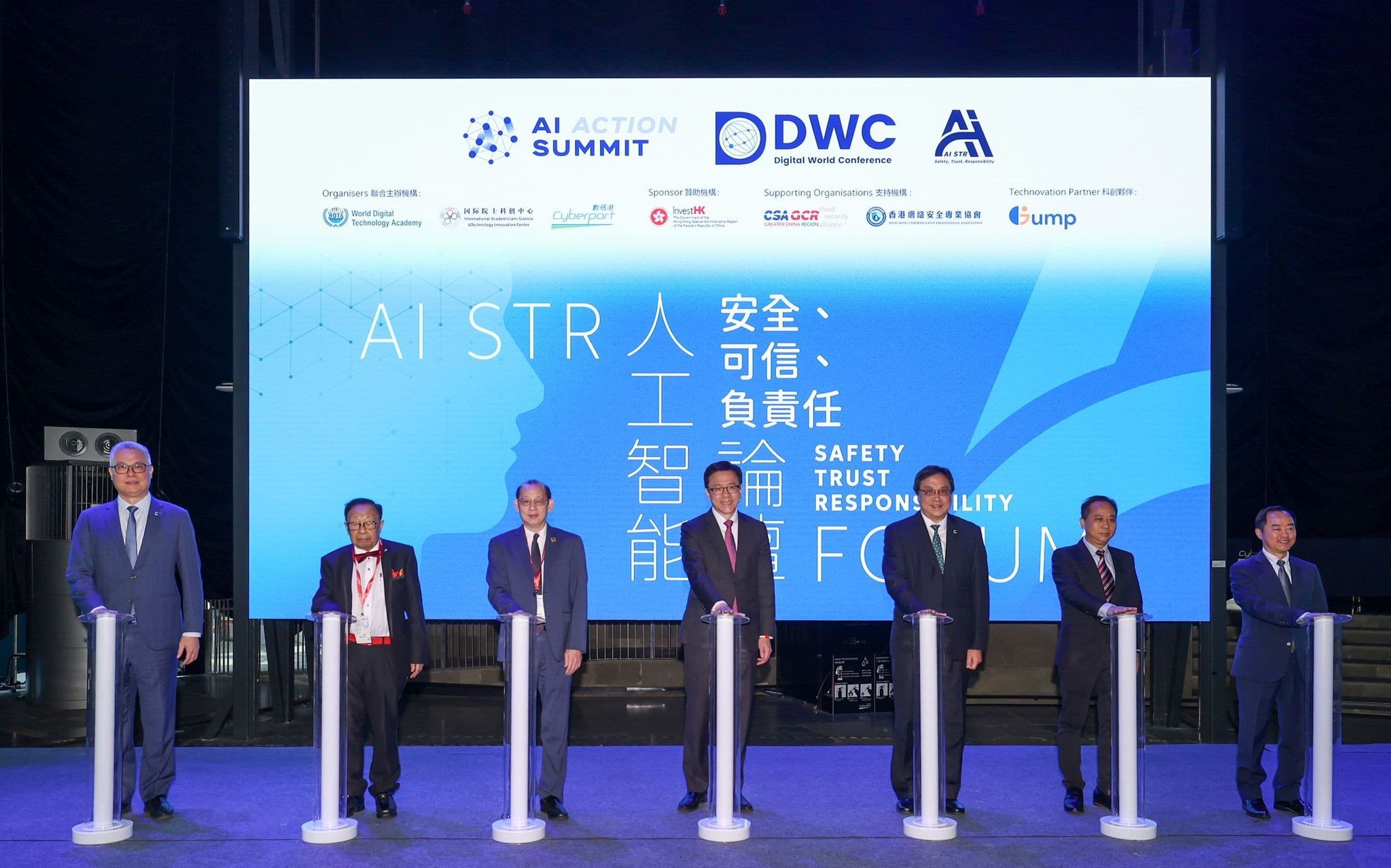
HONG KONG SAR – Media OutReach Newswire – 27 February 2025 – Cyberport, the World Digital Technology Academy (WDTA) and the International Academicians Science & Technology Innovation Centre (IASTIC) co-organised the “AI Safety, Trust, and Responsibility (AI STR)” Forum. This event served as the Hong Kong session of the recently concluded AI Action Summit 2025 in Paris, France. The forum convened leading international and local academicians, scholars, industry leaders, and experts to share insights on the risks and challenges in AI development and application, and to discuss strategies for balancing innovation with security governance. Prof Sun Dong, Secretary for Innovation, Technology and Industry; Prof Yale Li, Executive Chairman of WDTA; Prof C.C. Chan, Founder of IASTIC, joined Simon Chan, Chairman of Cyberport, and Dr Rocky Cheng, CEO of Cyberport, in delivering keynote addresses and sharing their perspectives on the future of AI.

Cyberport, the World Digital Technology Academy (WDTA) and the International Academicians Science & Technology Innovation Centre (IASTIC) co-organise the “AI Safety, Trust, and Responsibility (AI STR)” Forum. The forum convened international and local experts to discuss the strategies for balancing innovation with security governance.

Prof Sun Dong, Secretary for Innovation, Technology and Industry, remarked, “To provide the most conducive environment for AI development, Cyberport, being Hong Kong’s digital tech hub, established the AI Supercomputing Centre last year, which will provide high-performance computing power of 3,000 petaFLOPS to support impactful R&D projects on AI. As announced yesterday by the Financial Secretary in the 2025-26 Budget, to establish the Hong Kong AI R&D Institute. A dedicated, public mission-driven undertaking, the institute will spearhead AI development and industry application in Hong Kong, promote cross-sectoral collaboration, and add another exciting chapter in our AI history book. We are mindful of the safety, responsibility and trust issues that beset the AI explorers and users. We could only harness the full power and potentials of AI by addressing these contentious issues proactively.”

Simon Chan, Chairman of Cyberport, expressed, “We are delighted to bring together prominent industry experts and leaders from around the world at Cyberport to explore the establishment of a trustworthy and responsible AI ecosystem. This will ensure the controllable, balanced, and sustainable development of this transformative technology. As Hong Kong’s digital tech hub and AI accelerator, Cyberport has achieved significant milestones in building a thriving AI ecosystem over the past year. These include Cyberport’s AI Supercomputing Centre, currently the largest in Hong Kong, and Cyberport’s AI Lab, which unites local AI ecosystem partners and talents to facilitate R&D and collaboration. We look forward to continuing our collaboration across sectors to strengthen Hong Kong’s AI ecosystem and promote AI for good.”

During the forum, WDTA announced the establishment of the “WDTA Asia-Pacific Institute (preparatory)” (The Institute) at Cyberport, marked by an official plaque unveiling ceremony. The Institute will spearhead the development of regional AI safety standards and related initiatives, promote innovation in digital technologies, cultivate scientific and industrial talent, and foster global collaboration in the digital era.

Prof. Yale Li, Executive Chairman of WDTA, addresses the forum, highlighting WDTA’s recent accomplishments and emphasising the importance of a human-centric and safety-based approach to AI. He outlined three core initiatives: First, to build a “safety-native” technological framework by embedding security throughout the entire AI lifecycle and promoting algorithm transparency and data provenance certification. Second, to establish a “human-oriented” value system that ensures technology addresses social needs, such as equitable healthcare and SME transformation. Finally, WDTA is committed to “responsible innovation” globally, with its AI committee addressing challenges like deepfakes and data misuse within the United Nations Sustainable Development Goals framework.

Prof. Li officially launched two WDTA certification programs for AI professionals: the “Certified Large Language Model Application Engineer (LLMAE)” and the “Certified Large Language Model Technical Expert (LLMTE)”. These programs are designed to accelerate the training of the next generation of AI professionals, equipping them with both technical expertise and a sense of social responsibility to promote the safety, trust, and responsible development of AI. Prof. Li emphasized, “These certification programs represent a significant step by WDTA to advance global AI talent development. We must establish technical standards and cultivate professionals who embody the principles of ‘human-oriented and safety-based’ to ensure that technological advancements truly benefit society.”

Prof. Ching-chuen Chan, Founder of IASTIC, stated, “As a global innovation hub, Hong Kong is an ideal platform to advance AI governance and collaboration. The WDTA will adhere to the core principles of ‘Speed, Safety, and Sharing’, and leverage The Institute to accelerate collaboration among governments, industries, and academia in the APAC. This will facilitate the formulation of digital technology standards and the transformation of cutting-edge research into practical applications. We will lead the establishment of AI STR standards and certification systems, enhancing the international framework for AI governance and security. By working together across industries and borders, we can achieve an inclusive digital future where no one is left behind.”

At the forum, Cyberport signed a Memorandum of Understanding (MoU) with WDTA and IASTIC, under which the three parties will join hands to promote best practices in AI STR testing and evaluation. They will work together to actively cultivate AI talent and explore collaboration in the development of AI testing infrastructure. Cyberport also signed MoUs with five local tertiary institutions: the University of Hong Kong (HKU), the City University of Hong Kong (CityUHK), the Hong Kong Metropolitan University (HKMU), the Technological and Higher Education Institute of Hong Kong (THEi), and the Hong Kong Institute of Information Technology (HKIIT). These partnerships aim to foster AI-related applied research and talent development. These partnerships will provide students at the partner institutions with internships and employment opportunities, injecting new forces into Hong Kong’s AI industry and accelerating its growth.

In addition to leading AI academics and experts, the forum also brought together leaders from Hong Kong’s public, financial, and healthcare sectors to share their valuable insights and practical experiences on topics such as cross-industry AI transformation and balancing AI innovation with risk. They discussed how to leverage AI to enhance efficiency, improve service quality, and address emerging challenges in their respective fields, while ensuring the responsible use of AI.

As Hong Kong’s digital tech hub and AI accelerator, Cyberport is committed to building a thriving local AI ecosystem. The Cyberport’s Artificial Intelligence Supercomputing Centre (AISC), the largest of this kind in Hong Kong, and the AI Lab, officially commenced operations last year, bringing together talents and innovation resources from mainland and overseas to support innovative R&D and applications across the AI value chain, driving industrialisation. The Government has allocated $3 billion to Cyberport for the launch of a three-year AI Subsidy Scheme to support local institutions, R&D centres and enterprises in utilising the AISC computing power to achieve scientific breakthroughs and accelerate the commercialisation of I&T. Cyberport is home to over 350 start-ups specialising in AI and big data, and has attracted leading AI enterprises to combine their R&D capabilities in computing power development, large model construction, algorithms, and data science, to promote AI-driven innovation and application.

Hashtag: #Cyberport

The issuer is solely responsible for the content of this announcement.

About Cyberport

Cyberport is Hong Kong’s digital technology flagship and incubator for entrepreneurship with over 2,200 members including over 900 onsite and over 1,200 offsite start-ups and technology companies. It is managed by Hong Kong Cyberport Management Company Limited, wholly owned by the Hong Kong Special Administrative Region Government, and committed to the vision to inject new impetus into digital economy and smart city development through innovation and technology, and to connect enterprises to Mainland China and overseas markets. Cyberport strives to nurture a vibrant tech ecosystem by cultivating talents, promoting entrepreneurship among the youth, supporting start-ups, fostering technology industry development by promoting strategic collaboration with local, Mainland Chinese and international partners, and integrating new and traditional economies by accelerating digital transformation in public and private sectors.

For more information, please visit

About World Digital Technology Academy (WDTA)

The World Digital Technology Academy (WDTA) is an innovative, international research organization (NGO) established in April 2023 under the auspices of the United Nations. WDTA is dedicated to driving transformative progress in digital technology worldwide, building a safer, more efficient, and collaborative global digital ecosystem. We aim to accelerate the development of the digital economy and ensure that digital technologies benefit all of humanity. WDTA has released three AI STR standards, including the “Safety Testing Standard for Generative AI Applications,” the “Safety Testing Method for Large Language Models,” and “Supply Chain Security Requirements for Large Models.”

For more information, please visit

About International Academicians Science & Technology Innovation Centre (IASTIC)

The International Academicians Science & Technology Innovation Centre (IASTIC) was co-founded in Hong Kong by Professor C.C. Chan, a distinguished figure as an Academician of the Chinese Academy of Engineering, a Fellow of the Royal Academy of Engineering, and the Founding and Rotating Chairman of the World Electric Vehicle Association. He was joined by several Nobel laureates and numerous leading international and Chinese academicians. Over the past eight years, IASTIC has expanded its global reach, establishing eight branch centres in countries including Germany, Canada, Sweden, Turkey, Israel, South Korea, Japan, and the United States.

IASTIC’s approach is built on a philosophy of innovation that integrates diverse technologies, complementary business models across industries, and multi-faceted research and development. Our mission is to foster a global ecosystem for scientific and technological innovation, creating an international hub where industry, academia, and research converge. We aim to establish market-driven operations with synergistic business models and promote sustainable, green development worldwide, fostering harmony between people and the environment.

Advertisement

Media OutReach

Asian Financial Forum concludes successfully in Hong Kong, gathering over 4,000 global business leaders and officials

Published

on

HONG KONG SAR –

A new Global Business Summit was held throughout day-two of the AFF yesterday, to further integrate finance with key industries and drive innovation and economic development.

Co-organised by the Financial Services and the Treasury Bureau of the HKSAR Government, the HKTDC, and the Office for Attracting Strategic Enterprises, the summit explored how finance empowers businesses. It also examined how Hong Kong can support Chinese Mainland enterprises to “go global”, and the prospects for foreign enterprises entering the Mainland market.

In his opening remarks at the summit, Paul Chan, Financial Secretary of the HKSAR Government, highlighted trade, finance and innovation and technology as the three principal drivers of future economic growth.

“Hong Kong is not just a platform that connects capital, market, projects, talent and opportunity. Hong Kong is willing to be a strategic partner to help you grow, scale up and go global,” Mr Chan said.

On building a more vibrant tech ecosystem, Mr Chan said the HKSAR Government is determined to attract the world’s leading frontier-technology enterprises to establish a presence in Hong Kong.

“We welcome technology and industrial enterprises to establish a presence in the Northern Metropolis. Where justified, we are prepared to tailor incentive packages, which may include land grants, premium concessions, tax incentives and other facilitation measures. Everything is negotiable,” he said.

image-1.jpeg

Prof Frederick Ma, Chairman of the HKTDC, in his welcome remarks at the summit, said: “In these unpredictable times, working together on shared goals adds to the agility and resilience of our economies, our industries and businesses, and our communities. Hong Kong, under the ‘one country, two systems’ arrangement, is perfectly suited to host these conversations and promote cross-sector collaboration, as a super connector, super value-adder and super collaborator.”

A series of plenary sessions held during the summit included the Business Plenary I – Chinese Mainland Enterprises Going Global, and Business Plenary II – Strategic Collaboration for Shared Growth, focusing on the latest opportunities in global market expansion and inbound foreign investment.

The Global Business Summit also featured a series of discussion sessions covering high‑growth, high‑value sectors, including biomedicine and healthcare, green energy, new consumer trends, artificial intelligence and robotics.

Speakers included representatives of prominent enterprises in the respective fields, such as Banking Circle, Infineon AG, Investcorp, JP Morgan, Revolut, Triton Partners, Amgen, Merck, DexForce Technology, JD.com, Pictet Group, AI² Robotics, Galbot and Tencent.

Paul Polman, a business leader, investor and philanthropist who is dedicated to advocating for systemic change, climate action, and social equality, delivered the Keynote Luncheon speech (January 27). He shared his “Net Positive” corporate sustainability strategy, which he has championed in recent years, focusing on advancing sustainable development.

Meanwhile, this year’s AFF Deal-making session, co-organised by the HKTDC and the Hong Kong Venture Capital and Private Equity Association, attracted over 280 investors and over 600 investment projects, resulting in more than 800 one-on-one meetings that successfully connected global capital with investment opportunities.

The AFF also marked the start of this year’s International Financial Week, featuring14 industry events that span a wide range of globally watched financial and business topics, including ASEAN opportunities, digital finance, green finance, family offices, private equity and alternative investments. Together, these events underscore Hong Kong’s unique role as the region’s most comprehensive and diversified international financial centre.

Hashtag: #hongkong #brandhongkong #AFF #Finance #Business #Economic


The issuer is solely responsible for the content of this announcement.

Continue Reading

Media OutReach

CGTN: Europe on its Own Terms: Adapting a New Global Reality

Published

on

CGTN’s special feature focuses on Europe’s push for strategic autonomy amid global shifts.

BEIJING, CHINA – Media OutReach Newswire – 28 January 2026 – In an era defined by geopolitical recalibration, Europe stands at a pivotal juncture, grappling with the urgent need for strategic autonomy and reassessing its alliances. A chorus of European policymakers, thought leaders, and international observers analyzed the continent’s pathway forward as it adapts to a new global reality marked by evolving external dynamics.

The call for European independence has never been more pronounced. Ursula von der Leyen, President of the European Commission, has declared that this is Europe’s Independence Moment, highlighting the need for Europe to ensure its own defense. Hillary Mann Leverett, CEO of STRATEGA echoes that “Europe is going through a very difficult time”, noting the need for patience and effort to navigate current crises.

The quest for autonomy is driven by multifaceted challenges. An ongoing energy crisis, caused by the conflict in Ukraine, has seen electricity prices in major European economies soar to several times those in the US, straining industrial production and daily life.

image-1.jpeg

Europe is even more tested as transatlantic relations shift. French Senator Thierry Meissen says that “today, we must accept that the United States will prioritize its own interests.” European Council President Antonio Costa also acknowledged this new reality, stating “we already know that Europe and the United States do not share the same vision of the international order.”

In response, Europe is mobilizing resources to build self-reliance. The EU has committed substantial investment to develop its defense. Ursula von der Leyen outlines plans enabling up to 800 billion euros in defense investment by 2030. And analysts from the Bruegel think tank estimate that true strategic autonomy would require an additional 250 billion euros annually and 300,000 more troops. Additionally, the EU’s High Representative for Foreign Affairs Kaja Kallas identified joint procurement as a critical hurdle to overcome.

Facing this strategic shift, Europe is actively exploring diversified global partnerships to ensure stability and growth. Former Italian Prime Minister Romano Prodi also highlighted that “China and Europe together make more than one-third of all world trade.” He warned against isolation, stating “if we don’t stick together…we go into a certain depression.”

The potential for cooperation spans critical domains. In science, collaboration has evolved into a two-way street between China and European peers. The EU’s ‘Choose Europe’ package, a 500-million-euro incentive to attract global scientific talent, also contrasts with funding uncertainties in the United States, creating new avenues for scientific talents. On the green transition, synergies are evident. China’s leadership in clean-energy industries complements Europe’s Green Deal ambitions, presenting a vast cooperative canvas.

Yet, this reorientation is complex. Europe needs to balance its deep historical and economic ties with the United States with the opportunities presented by a rising China. Professor Cui Hongjian of Beijing Foreign Studies University noted the EU’s dilemma, finding it “very difficult to make a clear choice between China and the US.” Jens Eskelund, President of the European Union Chamber of Commerce in China, advocated for a relationship judged on its own merits. “We shouldn’t let our relationship be defined by a third party.”

The path to act on its own terms is further complicated by new economic realities. China’s rapid advancement has altered dynamics. “The perspective on who is learning from whom has been dramatically changing,” said Professor Eberhard Sandschneider of the Free University of Berlin. This new reality has spurred debates on “derisking”, which leaders caution could fragment supply chains, increase costs, and forsake mutual benefits. Alex Frederiksen, CEO of Vivino, advised focusing on long-term practical matters over short-term headlines, saying China is “unbeatable” in terms of density of high-quality companies.

Ultimately, European leaders are tasked with navigating a fundamental strategic question. Romano Prodi argued that the relationship must evolve from being neither enemies nor brothers toward becoming “equal partners and almost brothers.”

https://news.cgtn.com/news/2026-01-27/Europe-on-its-own-terms-Adapting-a-new-global-reality-1Khw2WpZ2Fy/p.html
Hashtag: #CGTN

The issuer is solely responsible for the content of this announcement.

Continue Reading

Media OutReach

UnionPay Enables 25 International Wallets to Support Weixin Pay QR Code in China’ Mainland

Published

on

SHANGHAI, CHINA – Media OutReach Newswire – 28 January 2026 – When Thai tourist Naree visited Shanghai, she paid easily for coffee at a neighborhood café by scanning a Weixin Pay QR code using the same K PLUS mobile wallet as she used at home, because her mobile wallet was linked to her Thai UnionPay card.

Now international visitors from 11 countries and regions travelling to China’s mainland can enjoy the same seamless mobile payment experience just as Naree. The collaboration between UnionPay International and Weixin Pay (also known as WeChat) now supports 25 UnionPay-partnered international wallets. Users only need to link the local UnionPay cards or activate digital UnionPay cards in one of their digital wallets. Then they can make payments at restaurants, shops, and public transport systems across China’s mainland by scanning Weixin Pay or UnionPay QR codes. The funds will be automatically converted from their home currency into RMB, eliminating the need to download additional apps.

The 25 supported international wallets by country / region

Since launching in December 2024, the program’s coverage has steadily broadened. As more UnionPay-Partnered international digital wallets join the network, a growing number of visitors to China can enjoy a smoother payment experience.

A Milestone In UnionPay’s Project Excellence

The cooperation between UnionPay International and Weixin Pay marks the latest milestone in UnionPay’s Project Excellence. Under Project Excellence, over 200 e-wallets across 37 countries and regions outside China’s mainland can link to locally issued UnionPay cards.

To further enhance the payment experience for overseas visitors to China, UnionPay has also launched the SplendorPlus Card, a product specially designed to meet inbound travelers’ unique needs.

In 2025, the number of QR code transactions made in China’s mainland using UnionPay-partnered e-wallets issued outside the Chinese mainland increased by 100% year on year, while the value of these transactions increased by 75%.
Hashtag: #UnionPay

The issuer is solely responsible for the content of this announcement.

Continue Reading

Trending