Economy
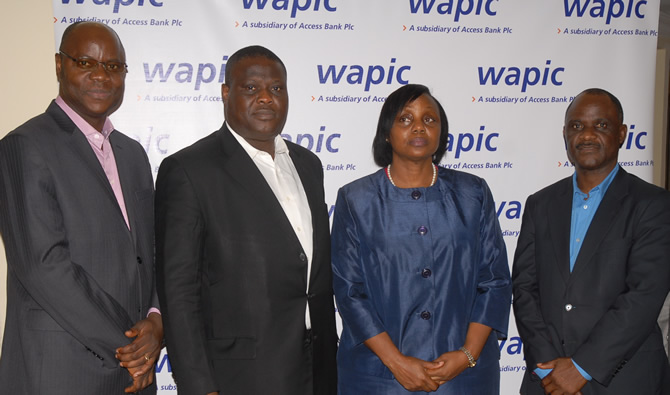
Wapic Insurance Declares N711m Loss for 2016

By Modupe Gbadeyanka
Wapic Insurance Plc has recorded a loss in its profit for the year 2016 by 55 percent, its 2016 audited report has revealed.
The company declared a profit after tax of N586.1 million for the 2016 full year financial statements against N1.3 billion it achieved in 2015.
According to the details, Wapic Insurance Plc posted a profit before tax of N1.2 billion compared with N1.7 billion it declared in the year before, indicating a decline by 28 percent.
During the period under review, the insurance firm used N4.2 billion as operating expenses in contrast to N3.5 billion it spent 12 months earlier.
As at December 31, 2016, the company had N2.22 billion in the cash and cash equivalents, including money market placements of N1.05 billion with maturity of not more than three months.
It was further gathered that Wapic Insurance reported a net insurance claims expenses of N2.88 billion in 2016, an increase of N1.24 billion over December 2015. It also recorded an increase of N370 million in net claim expenses between 2015 and 2016. The underwriting result at the end of the year amounted to an underwriting profit of N381 million compared to an underwriting profit of N1.48 billion reported during the year ended December 31, 2015.
The underwriting performance, we learnt, was impacted by the huge claim experience within the period.
Investment and other income grew by 29 percent, a reflection of the firm’s strategic direction which leveraged on investment income as a key revenue source due to the challenging operating environment witnessed during the year.
The growth from N2.89 billion in 2015 to N3.74 billion in 2016 is a reflection of Wapic Insurance’s efforts at growing investment portfolio with maximum yields within the challenging investment environment.
Wapic Insurance Group operates three companies namely: Wapic Insurance Plc (the parent company), Wapic Life Assurance Limited and Wapic Insurance (Ghana) Limited.
Its major business activity is insurance. However, the group is developing capacity for expansion into the asset management and property business.
Economy
Top Crypto Platforms in Nigeria
Complete List Of The Top Crypto Platforms in Nigeria: Where to Trade Safely
As a Nigerian just getting started in crypto trading, or someone trying to rebuild their confidence after a bad trading experience, the fear of losing your hard-earned money is valid. This is why choosing a reliable crypto platform to carry out your trading is very important.
The good news here is that there are several trusted crypto platforms built to serve Nigerian traders, offering secure trading, fast withdrawals, and competitive fees.
In this guide, you will discover the top crypto platforms in Nigeria, what makes each one stand out, and how to choose the best option based on your trading goals.
Top 4 crypto platforms in Nigeria
NOSH
Nosh is one of the top platforms in Nigeria and Ghana with the best crypto trading services, offering the best rates for crypto trading, allowing you to get good value for your digital assets. With its user-friendly interface and 24/7 customer support, it is a very good option whether you are a new or experienced crypto trader.
With Nosh, you get:
- Instant payouts on every transaction, no unnecessary waiting.
- Advanced fraud protection with two-factor authentication to keep your account and transactions secure.
- Easy and direct conversion of crypto to Naira or Cedis within a few minutes; no need for third-party apps whenever you are ready to cash out.
- High exchange rates.
- Transparent rates with a rate calculator to know how much you will be getting.
Nosh supports a variety of cryptocurrencies such as Bitcoin, Dogecoin, USDC, USDT, Ethereum, Tron, Litecoin, and Binance Coin.
KUCOIN
KuCoin is another popular crypto platform known for its P2P (peer-to-peer) marketplace. With KuCoin, you can trade your crypto directly with a buyer or sell your crypto directly with a seller. KuCoin holds the crypto in escrow until the seller accepts that they have received the payment; this is done to avoid fraud from the buyer or seller of the crypto.
With KuCoin, you get:
- To carry out P2P trading with escrow protection.
- To use multiple payment method options like bank transfer, USSD, and mobile-money-linked options.
- Offers competitive and relatively low trading fees, especially if you’re holding KCS (KuCoin’s native token).
- Gives you access to spot trading, futures/derivatives, staking, and other earn products
KuCoin supports stablecoins such as USDT, USDC, and TUSD.
COINCOLA
Coincola is also a top platform ranked as one of the best P2P trading platforms for Nigerians. With Coincola, you get to buy and sell your Bitcoin and USDT with real-time price tracking. Coincola is your go-to platform if you need one that offers flexible funding options like cash deposit and bank transfers. However, there have been reports of withdrawal delays.
With Coincola, you get;
- A P2P marketplace to buy/sell Bitcoin and other coins directly from vendors, with their completed-trade counts shown upfront so u can trade with caution.
- Instant BTC conversion with real-time price tracking
- To use multiple local funding options like bank transfer, cash deposit, and gift cards
- An escrow system that holds your money until a trade is confirmed.
Coincola supports cryptocurrencies like USDT and TRON.
YELLOWCARD
Yellowcard is another popular crypto platform that offers not only P2P trading but also allows you to buy and sell assets like USDT, USDC, PYUSD, BTC, and ETH with regional payment options like mobile money, bank transfers, and cash deposit. However, in 2025 they announced they no longer offer crypto-to-cash retail services.
With Yellowcard, you get:
- Direct access to buy and sell crypto rather than waiting to match with individual P2P counterparties.
- To use multiple funding methods like bank transfer, mobile money, and cash deposits.
- Free local and cross-border transfers via “Yellow Pay” to 20 different countries in Africa.
Factors to consider when choosing a crypto platform
- Don’t just look at the advertised trading fee. Some platforms hide the extra cost, so your actual rate ends up higher than expected. Do a small test trade first and see what you actually receive.
- The best platform in the world is useless to you if it doesn’t support how you actually move money, whether it’s bank transfer or mobile money. Check that before you even sign up, not after.
- Some platforms convert instantly; others, especially P2P ones, need you to wait for a counterparty to show up. If you need your money fast, that difference matters a lot.
- If you specifically need USDC or another less-common stablecoin, don’t assume it’s there on the platform. Double-check the coin list before you commit to one.
- Support should not be silent when something goes wrong. Look for evidence people actually got helped, not just a “24/7 support” badge.
- If a platform can’t tell you clearly how they protect your money, that’s a red flag on its own. Always go for one that prioritizes security.
FAQs
- Which crypto platform is best in Nigeria?
The best crypto platform in Nigeria is Nosh. Nosh offers the best rates for selling crypto with direct crypto-to-naira conversion to easily change your crypto to cash when needed.
- Can I teach myself crypto trading?
Yes, you can. There are many platforms and tutors with tutorial videos and lessons on how to start crypto trading on your own.
- What is the most popular crypto in Nigeria?
The most traded cryptocurrency in Nigeria is Bitcoin, making it the most popular.
Conclusion
When you trust the right platform, your journey in crypto trading is safe and secure. Always look out for crypto trading platforms that meet your needs alongside keeping things like payment options, a good list of coins they support, and other factors mentioned in this article before committing to one.
Always start with a small test trade first to see what you are getting; it will help you get a better idea of how the platform works so you don’t fall victim to hidden charges not included in price tags by some platforms.
Economy
Okitipupa Jumps 9% to Lift NASD OTC Exchange Market
By Adedapo Adesanya
Okitipupa Plc was the sole price gainer at the NASD Over-the-Counter (OTC) Securities Exchange on Friday, August 7, lifting the trading platform by 0.44 per cent at the close of transactions.
The share price of the palm oil producer appreciated during the trading session by N25.00 or 9.0 per cent to N277.00 per unit compared with the previous day’s N252.00 per unit.
As a result, the market capitalisation gained N12.29 billion to close at N2,807 trillion, in contrast to the previous session’s N2.795 trillion, while the NASD Security Index (NSI) added 93.63 points to finish at 4,678.08 points compared with Thursday’s 4,657.59 points.
The bourse recorded a price loser yesterday, and this was Mass Telecoms Innovation Plc, which crashed by 3 Kobo or 9.4 per cent to settle at 32 Kobo per share versus the previous day’s 35 Kobo per share.
The volume of securities traded by investors plunged by 81.5 per cent to 535,7560 units from 2.9 million units, the value of securities slumped by 93.9 per cent to N6.0 million from N99.2 million, and the number of deals decreased by 41.9 per cent to 36 deals from 62 deals.
Great Nigeria Insurance (GNI) Plc remained the most active stock by value on a year-to-date basis, with 3.4 billion units valued at N8.4 billion, followed by Infrastructure Credit Guarantee (Infracredit) Plc with 2.3 billion units transacted for N6.5 billion, and Central Securities Clearing System (CSCS) Plc with 77.0 million units exchanged for N5.5 billion.
GNI Plc also ended the day as the most traded stock by volume on a year-to-date basis, with 3.4 billion units worth N8.4 billion, trailed by Infracredit Plc with 2.3 billion units valued at N6.5 billion, and Resourcery Plc with 1.1 billion units sold for N415.7 million.
Economy
Banking Stocks Raise Nigerian Exchange by 0.15%
By Dipo Olowookere
A 0.15 per cent growth was achieved by the Nigerian Exchange (NGX) Limited, driven by continued buying interest in banking stocks such as First Holdco and others.
The banking index was up by 1.53 per cent during the session, offsetting the losses recorded by the others. The industrial goods segment fell by 0.37 per cent, the insurance counter shrank by 0.21 per cent, and the energy sector contracted by 0.04 per cent, while the consumer goods space closed flat.
At the close of business, the All-Share Index (ASI) moved up by 364.26 points to 245,573.60 points from 245,209.34 points, and the market capitalisation increased by N235 billion to N158.513 trillion from N158.278 trillion.
Despite the gains printed by Customs Street during the trading day, investor sentiment was weak, as there were 22 price gainers and 24 price losers, indicating a negative market breadth index.
UPDC surged by 9.23 per cent to N3.55, CWG soared by 6.56 per cent to N19.50, AXA Mansard appreciated by 4.80 per cent to N13.10, Neimeth advanced by 4.24 per cent to N8.60, and Cutix improved by 4.00 per cent to N2.60.
Conversely, Red Star Express lost 10.00 per cent to trade at N18.00, CAP declined by 9.98 per cent to N115.45, John Holt shrank by 9.82 per cent to N10.10, ABC Transport depreciated by 9.57 per cent to N5.20, and Legend Internet crashed by 8.70 per cent to N4.20.
A total of 1.5 billion equities worth N26.7 billion exchanged hands in 42,580 deals on Friday versus the 531.8 million equities valued at N20.5 billion traded in 44,826 deals on Thursday, representing a spike in the trading volume, value, and number of deals by 182.06 per cent, 30.24 per cent, and 5.01 per cent, respectively.
The busiest stock during the session was Fortis Global Insurance, with a turnover of 824.5 million units valued at N2.1 billion, FCMB traded 217.9 million units worth N2.8 billion, Access Holdings exchanged 176.2 million units for N4.7 billion, Chams sold 32.5 million units worth N132.1 million, and First Holdco transacted 25.0 million units valued at N3.7 billion.