Media OutReach
‘Buy gold, ask questions later’. Octa broker comments on Trump’s first 100 days in office
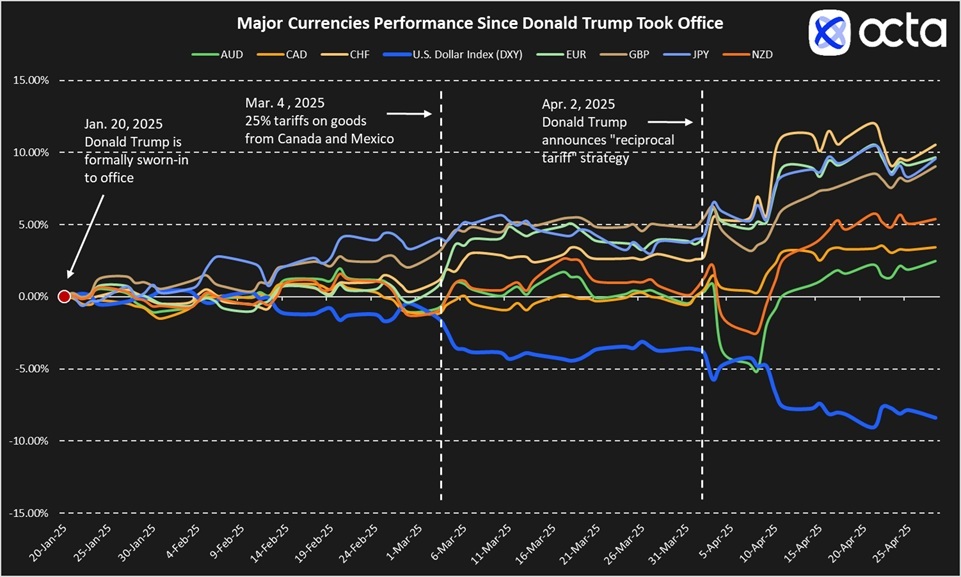
Donald Trump assumed office on 20 January 2025, and market volatility has been rising ever since. Some of Trump’s initiatives, particularly his aggressive trade policies, have sent shockwaves through equities, currencies, and commodities, leaving retail forex traders scrambling to adjust. Meanwhile, larger investors struggled to adapt to the rapid pace of proposed reforms and their far-reaching consequences. Overall, the first 100 days of President Trump saw heightened risk aversion and widespread uncertainty, which resulted in sharp fluctuations in asset prices and currency exchange rates as traders reacted to every policy announcement, tweet, and speech from President Trump and his new administration. Below is a list of just a few of the notable days that shook the markets.
Major market-moving events
- 20 January. The U.S. Dollar Index (DXY) dropped by more than 1.20% after news surfaced that the new administration will not immediately impose trade tariffs, prompting a rally in the currencies of some U.S. trading partners: notably, the Mexican peso (MXN), the Euro (EUR) and the Canadian dollar (CAD). It should be noted that prior to the sharp decline, the greenback had been rising almost uninterruptedly since September 2024, almost reaching a three-year high ahead of Trump’s inauguration as the market assumed that higher tariffs would spur inflation, prompting the Federal Reserve (Fed) to pursue a more hawkish monetary policy.
- 1–3 February. In the future, historians may label 1 February as the official start of a global trade war. On this day, Donald Trump imposed a 25% tariff on imports from Canada and Mexico, along with an additional 10% tariff on China. The market’s reaction was highly negative. U.S. stock futures slumped in early Asian trading on Monday, 3 February, with Nasdaq futures down 2.35% and S&P 500 futures 1.8% lower. U.S. oil prices jumped more than $2, while gasoline futures jumped more than 3%. Meanwhile, the Canadian dollar and Mexican peso weakened substantially, with USDCAD surging past the 1.47900 mark, a 22-year high, and USDMXN touching a 3-year high as economists warned that both countries were at risk of recession once the tariffs kick in. Later that day, Trump agreed to delay 25% tariffs on Canada and Mexico for a month after both countries agreed to take tougher measures to combat migration.
- 3–5 March. This is when the market began to seriously worry about the health of the global economy and a risk-off sentiment became evident. As fresh 25% tariffs on most imports from Mexico and Canada, along with the 20% tariffs on Chinese goods, were scheduled to take effect on 4 March, investors started to sell-off the greenback and flock into gold (XAUUSD) as well as into alternative safe-haven currencies, such as the Swiss franc (CHF) and the Japanese yen (JPY). In just three trading sessions (from 3–5 March), DXY plunged by more than 3% while the gold price gained more than 2%.
- 6 March. Donald Trump signed an executive order establishing a U.S. cryptocurrency reserve. However, it was unclear how exactly this reserve would work and just how much it would differ from Bitcoin holdings already in place. Many crypto enthusiasts were disappointed, which triggered a five-day downturn in BTCUSD, culminating in Bitcoin briefly dipping below the crucial $80,000 level on 10 March.
- 2 April. The trade war entered the next stage when Trump unveiled his long-promised ‘reciprocal’ tariffs strategy, essentially imposing import duties on more than a hundred countries. The market route began with equity markets losing billions of dollars in valuation. S&P 500 lost more than 11% in just two days, while DXY dropped to a fresh six-month low.
- 9–11 April. Trade war drama continued to unfold. Financial markets were stunned by President Trump’s abrupt reversal on tariffs. Duties on trading partners, which had taken effect less than 24 hours prior, were largely rolled back as the President announced a 90-day freeze on the reciprocal tariffs. However, a 10% blanket tariff was still applied to most nations. In contrast, the trade conflict with China escalated sharply. Following China’s 84% retaliatory tariff on U.S. goods, the U.S. increased tariffs on Chinese imports to 125%. This, combined with existing duties, brought the total U.S. tariff burden on Chinese imports to 145%. Kar Yong Ang, a financial market analyst at Octa broker, comments: ‘I will remember that day for a long time. Traders were stunned by Trump’s sudden U-turn on trade policy and really struggled to make sense of it all. A knee-jerk reaction was to simply buy gold and ask questions later.’
Apart from country-based tariffs, Trump also introduced additional import tariffs on aluminium and steel and ordered a probe into duties on copper imports. Overall, his aggressive trade policies have fueled speculation about the global recession, which explains why gold has been one of the best-performing assets since Trump took office. Kar Yong Ang comments: ‘We are dealing with a rather unusual situation. Even a global depression is not out of the question as tariffs may disrupt supply chains, hurting global output while also contributing to stronger inflationary pressure. This will certainly complicate monetary policy decisions. If I were to describe Trump’s first 100 days in just two words, it would be “run for safety”.’ Indeed, Trump’s recent public criticism of Jerome Powell, the Fed’s Chairman, added more fuel to the fire of nervous investor sentiment.
Overall, the full effect of Trump’s policies is yet to materialise, but the potential impact on global trade and the macroeconomy is substantial. The IMF, citing escalating trade tensions, downgraded its 2025 global growth forecast to 2.8% and warned of potential stock market crashes and a 7% contraction in the world economy should trade wars persist. Although Scott Bessent, the U.S. Treasury Secretary, hinted at de-escalating U.S.-China trade tensions, it is clear that investors should still get used to living in a period of heightened volatility and uncertainty. Kar Yong Ang has this advice for an average retail trader: ‘Focus more on short-term trades with tight stop-losses as opposed to long-term position-trading, cut exposure to U.S. equities, diversify into gold and other safe-haven currencies like Swiss franc and most importantly, keep your mind clear and be ready to quickly switch from one position to another’.
___
Disclaimer: This content is for general informational purposes only and does not constitute investment advice, a recommendation, or an offer to engage in any investment activity. It does not take into account your investment objectives, financial situation, or individual needs. Any action you take based on this content is at your sole discretion and risk. Octa and its affiliates accept no liability for any losses or consequences resulting from reliance on this material.
Trading involves risks and may not be suitable for all investors. Use your expertise wisely and evaluate all associated risks before making an investment decision. Past performance is not a reliable indicator of future results.
Availability of products and services may vary by jurisdiction. Please ensure compliance with your local laws before accessing them.
Hashtag: #Octa
The issuer is solely responsible for the content of this announcement.
Octa
Octa is an international CFD broker that has been providing online trading services worldwide since 2011. It offers commission-free access to financial markets and various services used by clients from 180 countries who have opened more than 52 million trading accounts. To help its clients reach their investment goals, Octa offers free educational webinars, articles, and analytical tools.
The company is involved in a comprehensive network of charitable and humanitarian initiatives, including the improvement of educational infrastructure and short-notice relief projects supporting local communities.
In Southeast Asia, Octa received the ‘Best Trading Platform Malaysia 2024’ and the ‘Most Reliable Broker Asia 2023’ awards from Brands and Business Magazine and International Global Forex Awards, respectively.
Media OutReach
Credo Assurance Earns ESG Certification to Support Sustainability Reporting
A Response to a Changing Regulatory Environment
Singapore’s corporate sustainability environment has undergone a major transformation in recent years. What began as voluntary corporate social responsibility is now transitioning into a regulated requirement driven by new disclosure mandates. The Singapore Exchange (SGX) requires all listed companies to publish sustainability reports, with climate-related disclosures to be aligned with the International Sustainability Standards Board (ISSB) framework.
These developments mirror global trends, including the European Union’s Corporate Sustainability Reporting Directive (CSRD) and the proposed climate disclosure rules by the US Securities and Exchange Commission (SEC). Notably, these frameworks are influencing supply chains and investment decisions worldwide.
A Commitment to Rigorous Standards and Responsible Practice
The certification was issued by the Institute of Singapore Chartered Accountants (ISCA) under the Professional Certification in Sustainability Assurance programme, which focuses on the International Standard on Sustainability Assurance (ISSA 5000). The curriculum also covers key frameworks, such as ISAE 3000, ISO 14064-3, and the reporting principles set out by the Sustainability Reporting Advisory Committee (SRAC).
Participants undergo six months of structured e-learning and a three-day capstone assessment module, which includes a comprehensive 65-question examination. The programme integrates the Task Force on Climate-related Financial Disclosures (TCFD), European Sustainability Reporting Standards (ESRS), Global Reporting Initiative (GRI), Carbon Disclosure Project (CDP), the Sustainability Accounting Standards Board (SASB), and other global reporting standards.
“The certification demonstrates our firm’s dedication to professional rigour and to supporting Singapore’s transition toward a sustainable, transparent economy,” as revealed by Ethan Ong, Director of Credo Assurance. “We aim to strengthen stakeholder confidence and enhance the quality of ESG reporting.”
New Sustainability Assurance Services to Support Businesses Across Sectors
Building on this certification, Credo Assurance has launched its sustainability assurance service. The firm will provide assurance on ESG disclosures, assess internal data controls, and advise on alignment with recognised frameworks such as GRI, ISSB, TCFD, and SASB. In addition, the service covers climate audit and reporting, ESG data verification, and training programmes to help companies integrate sustainability practices into daily operations.
Credo Assurance’s new offering aims to support a wide spectrum of organisations, from listed companies preparing for upcoming SGX requirements to SMEs participating in global supply chains. Industries with significant environmental or social footprints, such as energy, construction, manufacturing, transport, and real estate, are expected to benefit most from independent verification. These services also extend to firms seeking ESG-linked financing or those aiming to enhance their brand credibility and investor trust through transparent reporting.
Shaping the Future of ESG Assurance in Singapore
As Singapore moves toward mandatory climate-related disclosures in 2025, ESG assurance is set to become essential in the audit and accounting sector. Independent verification of non-financial information, such as carbon emissions, labour practices, or governance metrics, helps ensure sustainability reports present accountable and measurable performance.
“ESG assurance is the next evolution of trust in business reporting,” said Mr Ong. “It applies the principles of audit integrity to sustainability, enabling companies to demonstrate both their financial performance and their broader responsibility to society and the environment.”
Hashtag: #CredoAssurance #AccountingFirmSingapore #ESGAssurance
https://credo.sg/
https://www.linkedin.com/company/credo-assurance-llp
The issuer is solely responsible for the content of this announcement.
About Credo Assurance
Credo Assurance LLP is an ACRA-registered public
accounting firm in Singapore. They provide audit, accounting, and advisory services to both businesses and individuals, helping clients navigate complex regulatory requirements and economic challenges.
Media OutReach
Understanding Credit Exemptions at SIM: A Guide for Polytechnic and SIM GE Diploma Graduates
Understanding Credit Exemptions
Credit exemptions enable students to receive recognition for modules previously completed during prior studies. This eliminates the need to repeat similar content, allowing eligible students to focus on new areas of learning. This practice, widely adopted in higher education, ensures students build upon existing knowledge while meeting the academic standards of their chosen degree programme.
Eligibility and Assessment
Credit exemptions at SIM GE are not granted automatically. Each application undergoes a rigorous evaluation to maintain academic integrity. The assessment considers several factors, including the relevance of previous qualifications to the chosen degree, the level and content of prior modules compared to the programme requirements, and the accreditation and recognition of the awarding institution. Through these measures, SIM GE ensures flexibility for students with diverse educational backgrounds while upholding academic excellence.
Types of Exemptions Available
SIM offers several pathways for credit exemptions, depending on prior qualifications and programme requirements. Holders of relevant Polytechnic or equivalent diplomas may receive exemptions that can reduce the overall study duration by up to one year, subject to programme-specific criteria and GPA requirements. Students who have completed SIM GE diplomas or other recognized qualifications may be eligible for advanced standing when enrolling in selected partner university programmes offered through SIM Global Education. For applicants with qualifications outside standard frameworks, exemptions are assessed individually on a case-by-case basis to ensure alignment with academic standards and programme requirements.
Key Information for Applicants
Credit exemptions are designed to acknowledge prior learning while ensuring that all students meet the academic standards of their chosen programme. They are not guaranteed and vary based on factors such as the relevance of previous qualifications, programme requirements, and institutional recognition. Applicants are encouraged to review the specific exemption policies for their intended programme and seek guidance from SIM Counsellors to understand their options.
References:
- SIM GE University Partners – https://www.sim.edu.sg/degrees-diplomas/sim-global-education/university-partners-sim-ge
Hashtag: #SIMGlobalEducation #SIMGE #GlobalEducation #InternationalDegree #CareerReady #FutureSkills
The issuer is solely responsible for the content of this announcement.
About SIM Global Education
SIM Global Education (SIM GE) is a leading private education institution in Singapore and the region. We offer more than 140 academic programmes ranging from diplomas and graduate diploma programmes to bachelor’s and master’s degree programmes with some of the world’s most reputable universities from Australia, Canada, Europe, United Kingdom, and the United States. SIM GE’s cohort is made up of 16,000 full- and part-time students and adult learners, of which approximately 36% are international students hailing from over 50 countries.
SIM GE’s holistic learning approach and culturally diverse learning environment aim to equip students with knowledge, industry skills and employability competencies, as well as a global perspective to succeed as future leaders in a fast-changing, technologically driven world.
For more information on SIM Global Education, visit sim.edu.sg
Media OutReach
30 Million Strong: China Changan Automobile Group Hits Historic Production Milestone, Ushering in New Era of User-Centric, Tech-Driven Global Growth
“Changan remains committed to delivering smarter, greener, and more fulfilling mobility, meeting the aspirations of global users for a better future.” said Zhu Huarong, Chairman of China Changan Automobile Group.
Uncompromising Safety: The “Safe Journey Home”
Safety is Changan’s top priority, a commitment dating back to 1999 with China’s first minivan crash test. Since then, the company has advanced its protective capabilities from passive safety structures to today’s active safety interventions. Backed by the industry’s only State Key Laboratory of Intelligent Vehicle Safety Technology, Changan uses its proprietary CA-ITVS verification system to subject vehicles to over 5 million kilometers of testing—guaranteeing a lifespan of 10 years or 260,000 kilometers.
In the smart era, Changan is redefining protection with its newly launched “SDA Intelligence”. Moving beyond physical defense, SDA Intelligence introduces a holistic safety ecosystem that secures both passengers and their data, ensuring a “Safe Journey Home” in every dimension.
Tech-Driven: Innovations That Matter
Driven by its Green and Intelligent strategies, Changan is bringing tangible innovations to market. The Green Plan targets electrification, battery safety, and new energy vehicle ecosystems, while the Intelligent Plan advances vehicle intelligence, autonomous systems, and connectivity. Key breakthroughs include the Golden Shield Battery system for superior safety, and the high-frequency pulse heating for cold-weather efficiency. The BlueCore 3.0 powertrain delivers hybrid and ICE solutions, balancing high performance with exceptional fuel economy. These technologies ensure that every journey is efficient and reliable.
A Bold Future: Smart Mobility and Global Reach
Looking ahead to 2030, Changan has unveiled a visionary roadmap to rank among the world’s top 10 automotive brands with annual sales of 5 million units. By 2030, Changan expects over 60% of sales to be new energy vehicles and 30% to come from overseas markets, solidifying its place on the world stage.
The issuer is solely responsible for the content of this announcement.
-
Feature/OPED6 years agoDavos was Different this year
-
Travel/Tourism9 years ago
Lagos Seals Western Lodge Hotel In Ikorodu
-
Showbiz3 years agoEstranged Lover Releases Videos of Empress Njamah Bathing
-
Banking7 years agoSort Codes of GTBank Branches in Nigeria
-
Economy3 years agoSubsidy Removal: CNG at N130 Per Litre Cheaper Than Petrol—IPMAN
-
Banking3 years agoFirst Bank Announces Planned Downtime
-
Banking3 years agoSort Codes of UBA Branches in Nigeria
-
Sports3 years agoHighest Paid Nigerian Footballer – How Much Do Nigerian Footballers Earn