Connect with us

Economy

Crude Oil Prices Rise as Glut, Tension Worries Ease

Published

on

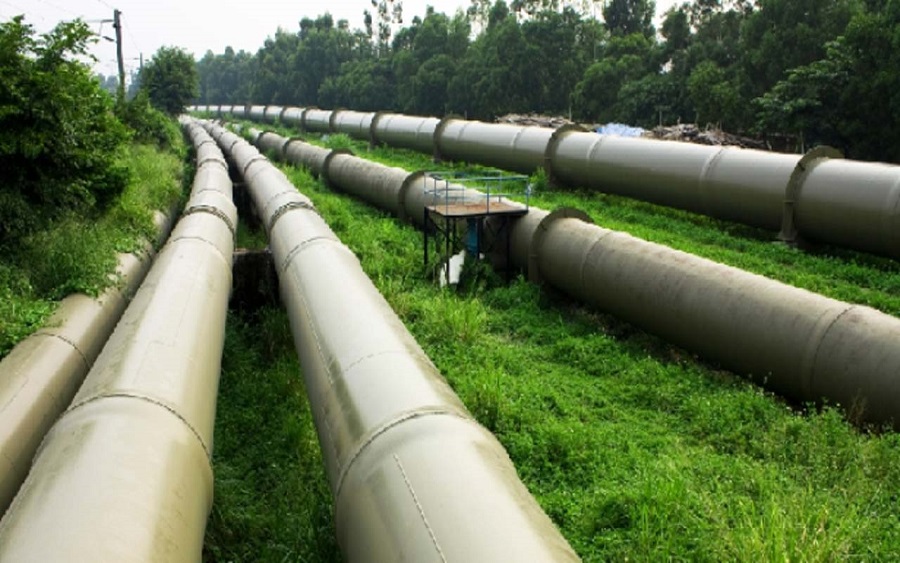
Crude Oil Pipelines

By Adedapo Adesanya

Crude oil prices settled higher on Tuesday as investors reassessed expectations of a looming glut and sought clarity on the trade dispute between the US and China, the world’s two biggest oil consumers.

Brent crude futures rose by 31 cents or 0.5 per cent to settle at $61.32 a barrel, while the US West Texas Intermediate (WTI) crude futures appreciated by 30 cents or 0.5 per cent to $57.82 per barrel.

Record oil production in the US and the decision by the Organisation of the Petroleum Exporting Countries and allies (OPEC+) to press ahead with planned supply hikes raised expectations of oversupply.

The US-China trade dispute has also increased anticipation that a slowdown in global economic growth will curb oil demand.

However, both sides have made some efforts to downplay the disagreement, which has given support to prices which had hit a five-month low previously.

US President Donald Trump, who is set to meet China’s Xi Jinping in South Korea next week, said on Monday he expects to reach a fair trade deal with his counterpart.

He said that the US commands “great respect” from China and that he will reach a “fantastic deal” with the Chinese President, following a move by the Asian country to expand export controls on rare earth products that are used in smartphones, fighter jets, electric vehicles, and more

Market analysts noted that any failure to reach some agreement raises the risk of destabilizing not only relations between the two superpowers but also the global economy.

The International Energy Agency (IEA) earlier this month forecast that a surplus next year would lead to a strongly upward-sloped futures curve, called super contango. This is where prices for immediate supply are lower than for later delivery, which typically indicates that near-term supply is abundant and demand is declining.

The American Petroleum Institute (API) estimated that crude oil inventories in the US fell by 2.980 million barrels in the week ending October 17. Inventories in the US are so far still showing a net loss for the year, losing 2.423 million barrels.

Gasoline (petrol) inventories also saw a decrease of 236,000 barrels in the week ending October 17, after rising by 2.99 million barrels in the week prior, and distillate inventories rounded out the losses in the reporting period, losing 974,000 barrels, on top of the week prior’s 4.79-million-barrel drawdown.

Official data from the US Energy Information Agency (EIA) will be released later on Wednesday.

Adedapo Adesanya is a journalist, polymath, and connoisseur of everything art. When he is not writing, he has his nose buried in one of the many books or articles he has bookmarked or simply listening to good music with a bottle of beer or wine. He supports the greatest club in the world, Manchester United F.C.

Advertisement
Click to comment

Leave a Reply

Your email address will not be published. Required fields are marked *

Economy

NAICOM Rules Out Extension of July 31 Recapitalisation Deadline

Published

on

NAICOM

By Adedapo Adesanya

The National Insurance Commission (NAICOM) has stressed that it has no intention of extending the deadline of the ongoing insurance recapitalisation exercise fixed for July 31, 2026.

The Commissioner for Insurance, Mr Olusegun Omosehin, at a high-level media briefing in Lagos, emphasised that “The 31 July deadline is sacrosanct.”

Mr Omosehin rationalised that NAICOM said it was not worried by the sluggishness of some underwriting companies towards the exercise.

“It is embedded in the law, and as a regulator, we do not have the powers to alter a date set by an Act of the National Assembly,” he explained, noting that the timeline is a statutory requirement under the Nigeria Insurance Industry Reform Act of 2025.

“We would not be drawn into a last-minute rush or entertain pleas for extensions,” Mr Omosehin warned, adding that any adjustment to the schedule would require a formal amendment of the Act by the National Assembly and subsequent presidential assent, a path he stated the commission is not prepared to take.

He further noted that while 20 insurance companies have officially stepped forward to begin their capital verification process, the level of urgency across the board does not match the requirements of the law.

“We want a stronger, more resilient industry that can support Nigeria’s target of a $1tn economy,” the Commissioner added, stressing that the ultimate goal is not just capital but the capability to underwrite large risks and protect policyholders.

“Capital alone is not the goal; it is about the capability to underwrite large risks,” he reiterated, while urging operators who may lack the “stand-alone stamina” to meet the new requirements to consider mergers and acquisitions immediately rather than waiting.

“We warn against ‘emergency marriages’ concluded at the eleventh hour, as such ad hoc arrangements often lead to lingering liabilities and post-merger integration crises,” Mr Omosehin said.

The NAICOM chief also confirmed that the regulator is currently scanning all operating firms and will soon make the results of this regulatory assessment public.

While re-emphasising the July 31 deadline, he warned that all funds raised must be deposited in designated escrow accounts.

Continue Reading

Economy

BudgIT Raises Alarm Over Poor Transparency in Nigeria’s Local Government Budgets

Published

on

BudgIT 40-year bonds

By Adedapo Adesanya

Governance transparency platform, BudgIT, has expressed worry that only 10 states provided publicly accessible budget information for their Local Government Areas (LGAs).

The report, titled The Missing Tier: Mapping Local Government Budget Transparency in Nigeria, found that while six states offer partial or outdated disclosures, as many as 18 states do not publish any LGA budget data at all.

Despite the existence of these budgets at council secretariats nationwide, BudgIT noted that access remains largely restricted, particularly online.

“For most of Nigeria’s 774 local governments, those budgets are not publicly accessible online,” the report stated.

Among the states assessed, Ekiti emerged as the top performer, with a comprehensive system that includes detailed, up-to-date budget documentation for its councils.

Other states identified as making LGA budget information available include Ebonyi, Osun, Kebbi, Kogi, Enugu, Kaduna and Yobe.

However, the report cautioned that even among these states, data quality remains inconsistent, with several budgets either incomplete, outdated, or poorly structured.

BudgIT highlighted notable examples of improved accountability practices.

Ekiti State, for instance, publishes individual 2026 budgets for all its LGAs and LCDAs, accompanied by signed documents, consultation records, and standardised financial templates.

Cross River State also stood out for releasing individual council budgets, audited accounts, and quarterly performance reports.

Similarly, Borno State was commended for maintaining a consolidated 2025 budget alongside supporting financial documents, suggesting a structured and functional reporting system.

The report identified six states with limited transparency, providing only fragmented or outdated information.

Kano State, for example, publishes quarterly performance reports but lacks full-year approved budgets.

In Imo State, no LGA budgets were found, although a financial statement from the Accountant-General was available.

Ondo State reportedly released documents for only a portion of its LGAs, while Anambra published an appropriation law without detailed breakdowns. Ogun State, meanwhile, only provided data for 2024.

BudgIT further disclosed that a large number of states fail entirely to make LGA budgets public.

These include Abia, Adamawa, Akwa Ibom, Bauchi, Bayelsa, Benue, Delta, Edo, Gombe, Jigawa, Katsina, Lagos, Nasarawa, Niger, Oyo, Plateau, Rivers, Sokoto, Taraba, and Zamfara.

According to the organisation, the issue is not the absence of budget documents but the lack of public access to them.

“Yet for most of Nigeria’s 774 local governments, those budgets are not publicly accessible online,” the civic tech firm said.

BudgIT stressed that improving transparency at the local government level does not require complex reforms but rather a deliberate policy decision.

“Since state governments already publish their own budgets online, extending the same standard to local councils is neither complex nor costly; it is a matter of institutional choice,” the organisation said.

It added, “This choice is a critical one; Nigeria’s post-1999 experience with democracy has not had Local Governments with significant autonomy. Be that as it may, LGAs still have the opportunity to make public what they budget, what they spend and what they earn.”

Highlighting the benefits of openness, the report noted that transparency enables citizens to track public spending and hold officials accountable.

“Where they are withheld, accountability stops at the state level, leaving the tier closest to citizens financially opaque,” BudgIT said.

Continue Reading

Economy

NGX Regco Lifts Suspension on Zichis, Adjusts Share Price to N8.58

Published

on

zichis

By Aduragbemi Omiyale

The suspension earlier placed on trading in the shares of Zichis Agro-Allied Industries Plc has been lifted by the Nigerian Exchange (NGX) Regulations Limited.

The regulatory subsidiary of NGX Group Plc placed an embargo on Zichis stocks after the price went up by nearly 900 per cent within one month of its listing on the NGX Limited in January 2026.

The action was taken to find out if there was any form of manipulation in the price movement of the new firm on Customs Street to protect market integrity.

Zichis was listed on the growth board of the bourse by introduction at a unit price of N1.81, but within a month, its share price rose to N17.36 per unit, indicating an 859.12 per cent surge.

In a notice to the investing community today, the Head of Issuer Regulation Department at NGX, Mr Godstime Iwenekhai, confirmed the lifting of the suspension on Zichis.

“Kindly refer to our market bulletin referenced NGXREG/IRD/MB23/26/02/23 and dated February 23, 2026, titled Notification of Suspension of Trading in the Shares of Zichis Agro-Allied Industries Plc, wherein trading license holders and the investing public were notified of the suspension of trading in the shares of Zichis Agro-Allied Industries Plc, pursuant to Rule 7.0: General, Rules on Suspension of Trading in Listed Securities, Rulebook of The Exchange, 2015 (Issuers’ Rules), as amended.

“Trading licence holders and the investing public are hereby informed that NGX Regulation Limited has concluded its investigation into the trading activities in the company’s shares and has implemented corrective measures to safeguard market integrity in line with its mandate to promote a fair, orderly and efficient market.

“Accordingly, the suspension placed on trading in the shares of Zichis Agro-Allied Industries Plc has been lifted, effective Monday, March 23, 2026,” the notice read.

Business Post reports that the share price of Zichis has been adjusted downward from N17.36 to N8.58 after the suspension was lifted.

Continue Reading

Trending