

Connect with us

Media OutReach

CPA Australia Survey: Increasing AI Adoption Reshapes Future Roles in Accounting Industry and Rises Data Concerns in Hong Kong

Published

on

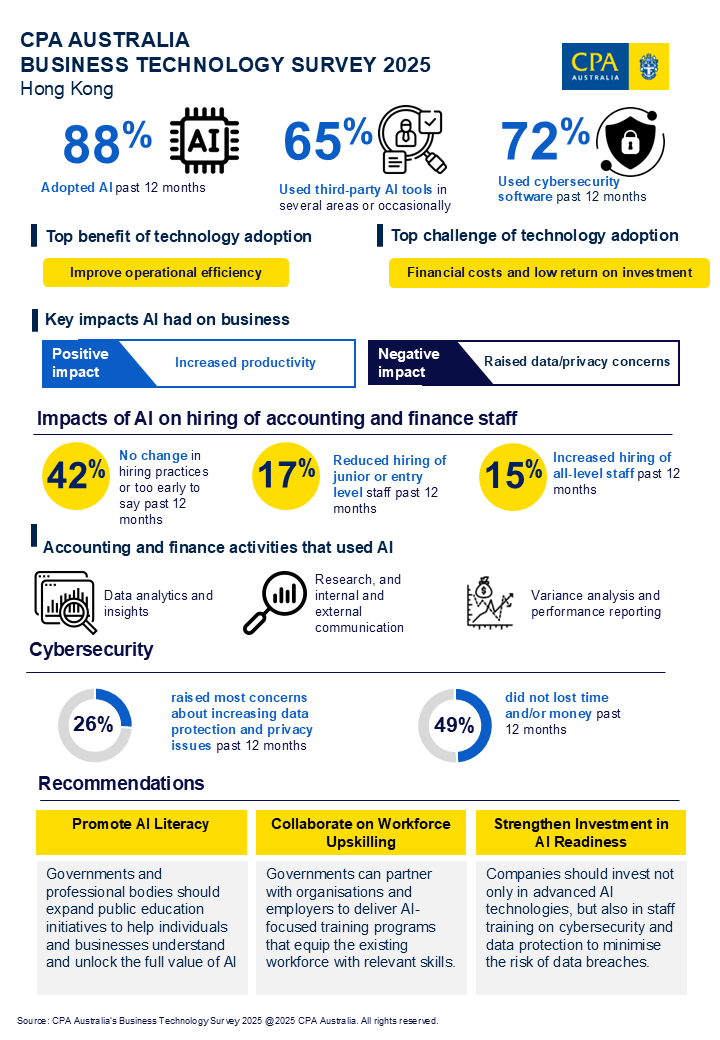
HONG KONG SAR – Media OutReach Newswire – 10 November 2025 – CPA Australia’s regional survey about business technology adoption shows that most companies in Hong Kong have used artificial intelligence (AI) tools at different levels. Though the increasing AI application helps to improve productivity, it also transforms the hiring trends in the accounting and finance industry, and increases concerns on data protection and governance, according to the survey findings.

The result indicates the notable growth of AI adoption across markets in Asia Pacific, with 89 per cent of respondents said that they have adopted AI in the past 12 months, up from 69 per cent last survey. In Hong Kong, 88 per cent have applied AI such as ChatGPT, Copilot at the workplace. When asked about the level of AI adoption, 65 per cent respondents primarily used third-party tools in several areas or occasionally.

Dr Paul Sin, CPA Australia’s Greater China Councillor and Chair of Web3 & Emerging Technology Committee highlighted the gap between the awareness of AI and releasing the real value of AI, “Most respondents said that they used third-party AI tools, implying that the awareness of AI in Hong Kong is high. Yet, many companies are still at the Proof-of-Concept stage, which means they just use AI tools to improve productivity like handling repetitive tasks and automate process. In fact, the government and professional organisations can do more education to unleash the true value of AI, for example, to reinvent business models or transform workflows by using more advanced solutions like predictive analytics and agentic AI, eventually scale up to production-grade implementation to align with their strategic goals.”

The increasing prevalence of AI is transforming the recruitment trends across various industries including accounting and finance. While 42 per cent of respondents in Hong Kong said that there has been no change in hiring practices, or that is too early to say, 17 per cent said that their organisations have reduced the number of junior-level staff hired for the accounting and finance teams due to the adoption of AI.

Dr Sin highlighted the correlation between the hiring trend and the tasks being replaced by AI, “Survey shows that most respondents use AI for data analytics and research in their accounting and finance activities, and these tasks are usually carried out by junior staff. Clearly, AI can free them up from repetitive and tedious tasks, allowing them focus on more human-centric or strategic responsibilities such as advisory, decision-making and client engagement. The underlying skills are difficult to replace with technology such as creativity and judgement built from business experience. Grooming junior staff to take on these more advanced responsibilities takes time, so employers should consider balancing adoption of advanced technology with talent development for the organisation’s long-term growth.”

Dr Albert Wong, Deputy Chair of CPA Australia’s Greater Bay Area Committee added on, “AI is only replacing certain tasks, not humans. As AI develops, the recruitment standard for technical skills is rising because some tasks can be done effectively by technology. Employers will expect their future staff to be able to work alongside with AI to solve problems, use these technology solutions to add value to existing services and products, generate new ideas/options, and predict the future in various scenarios. The job market will become more competitive. Therefore, the younger generation and the existing employees must develop irreplaceable skills, particularly soft skills such as human-human and human-machine interaction, effective communication, creative and critical thinking, and professional scepticism.”

To keep up with the transformation, the Hong Kong SAR Government has an instrumental role to play. He called for policy support to build a future-ready workforce in Hong Kong. “The Government could collaborate with organisations and employers to upskill existing workforce on AI-centric training; offer subsidies to encourage SMEs to pilot/adopt different types of AI in their businesses and create internship schemes that give university students the opportunity to apply AI tools to real-world problem-solving.”

Data is the new oil for technology. Among the surveyed markets, Hong Kong respondents raised the most concerns about increasing data protection and privacy issues (26 per cent) from AI adoption. On a positive note, 72 per cent said that they had implemented cybersecurity in the past 12 months, and Hong Kong’s overall cybersecurity maturity is considerably high.

Mr Winson Woo, a member of CPA Australia’s Greater Bay Area Committee shared his views on data protection and governance, “Many technologies already have embedded AI functions, so AI adoption will continue to increase in the future. Organisations should establish an AI development roadmap to plan how to apply AI to achieve strategic goals, and how to measure the return of investment, as well as setting clear governance guidelines to ensure the ethical use of AI tools in the workplace.”

When discussing cybersecurity, he highlighted two emerging trends: Manage Security Operations Center (MSOC), a model of outsourcing security operations center (SOC) functions to third-party service providers to perform real-time detection and monitoring of cyber attacks and threats; and AI security, which protects AI systems from data breaches and misuse. He also emphasised the importance of staff training in data protection, “To reduce the risk of data leakage, companies should invest not only in technical software, but also in enhancing staff’s security awareness, to ensure that AI users understand which authorised data can be used in AI tools and which sensitive information cannot be disclosed.”

Mr Woo believes that the introduction of guidelines and regulations, such as the Personal Data (Privacy) Ordinance and the Protection of Critical Infrastructure (Computer System) Ordinance, will help to create an ethical environment that promotes innovation and technology in Hong Kong.

The survey collected responses from 1,117 accounting and finance professionals across markets in the Asia-Pacific such as Australia, mainland China, including 154 responses from Hong Kong.

Hashtag: #CPAAustralia

The issuer is solely responsible for the content of this announcement.

About CPA Australia

CPA Australia is one of the largest professional accounting bodies in the world, with nearly 175,000 members in over 100 countries and regions, including more than 22,500 members in Greater China. CPA Australia is celebrating its 70th anniversary in Hong Kong this year. Our core services include education, training, technical support and advocacy. CPA Australia provides thought leadership on issues affecting the accounting profession and the public interest. We engage with governments, regulators and industries to advocate policies that stimulate sustainable economic growth and have positive business and public outcomes. Find out more at

Media OutReach

JETCO Connect 2.0 drives Johor – Singapore collaboration to create new tourism offerings

Published

on

Tourism businesses and industry partners invited to collaborate with JETCO as Visit Johor 2026 gathers momentum.

SINGAPORE – Media OutReach Newswire – 12 August 2026 – Following the successful launch of JETCO Connect in 2025, Johor Economic, Tourism and Cultural Office Singapore (JETCO) is taking the next step with JETCO Connect 2.0, shifting the focus from introducing Johor’s tourism offerings to fostering cross-border collaboration.

As Visit Johor 2026 invites visitors to discover Johor through its diverse mix of cultural, nature, food and island experiences, JETCO Connect 2.0 focuses on the work behind the scenes – bringing together tourism stakeholders to develop and package these experiences into compelling travel offerings for the Singapore market.

Organised in collaboration with Tourism Johor and Tourism Malaysia, JETCO Connect 2.0 brings this collaboration to life through a series of activities:

  • 12–13 August – Familiarisation (FAM) Trip: Around 40 Singapore travel trade representatives, including travel agents, inbound operators, golf specialists and media, will explore Johor’s heritage, culture, eco-tourism, sports and urban attractions through a curated familiarisation programme.
  • 13 August – Tourism Product Development Workshop: Around 80 participants from Johor and Singapore will work together to develop tourism packages across themes such as heritage and culture, gastronomy, eco-tourism, sports tourism, golf, halal experiences and island tourism for the Singapore market.
  • 19 August – Partner Networking Session: JETCO leaders will reconnect with local operators in Singapore to present the tourism concepts developed during the workshop and discussion plans to bring them to market.

Redefining the Road Trip

One notable project that materialized from past discussions is Elevating Road Trip to Desaru. For years, the pristine beaches of Desaru Coast have beckoned Singaporeans seeking a quick, luxurious escape. The rise of world-class resorts has transformed the area into a premier destination. However, a glaring gap remained in the travel experience: the journey itself often lacked the refinement expected by guests bound for five-star accommodations.

Come 1st September 2026, the SVIP 27-Seater Daily Coach service will be launched. The 27-seater provides spacious seating, is equipped with individual USB charging point and offers strategic departure points from Tampines, Suntec City and Jurong East. From 01 Sep 2026 – 31 Oct 2026, bookings will be at $45/pax ($10 upgrade fee waived). More details can be found in Annex.

As JETCO continues to strengthen tourism links between Johor and Singapore, it welcomes tourism businesses, attractions, hotels, travel operators, industry associations and destination partners interested in exploring future collaborations.

Annex

The new SVIP fleet addresses the common pain points of overland travel, focusing entirely on passenger comfort and convenience.

Key Features of the SVIP Experience:

* Spacious Seating: The 27-seater configuration ensures ample legroom and personal space, a significant upgrade from standard, densely packed coaches. The seats are designed for relaxation, allowing travelers to start unwinding immediately.

* Modern Connectivity: Understanding the needs of the modern traveller, each seat is equipped with dedicated USB charging points. Whether you need to catch up on work, entertain the kids with a movie, or simply keep your devices juiced up for the weekend, power is always within reach.

Accessible Luxury: Strategic Departure Points

To cater to travelers across the island, the daily service operates from three strategically chosen departure points in Singapore:

1. Tampines: Serving the East, providing a convenient starting point for those living near Changi and the eastern heartlands.

2. Suntec City: Located in the heart of the city, offering easy access for urban dwellers and professionals heading straight from the office.

3. Jurong East: Ensuring that guests residing in the western part of Singapore have a hassle-free departure option without needing to cross the island first.

The issuer is solely responsible for the content of this announcement.

About JETCO

Johor Economic, Tourism & Cultural Office Singapore (JETCO) is a Johor State Government agency responsible for connecting Johor agencies with stakeholders in Singapore.

Established in 2021, JETCO plays a key role in promoting Johor’s economic opportunities, tourism offerings and cultural heritage while fostering partnerships between Johor and Singapore.

Through strategic initiatives and industry engagement, JETCO supports cross-border collaboration in line with key state initiatives such as the Johor-Singapore Special Economic Zone (JS-SEZ) and Visit Johor 2026.

For more information, visit .

Continue Reading

Media OutReach

Allianz: Data center boom ushers in a new era of infrastructure risks and opportunities for insurers

Published

on

SINGAPORE – Media OutReach Newswire – 12 August 2026 – Artificial intelligence is driving one of the largest infrastructure investment cycles in decades, but the rapid global build-out of data centers is also creating a new era of construction, operational, climate and insurance risks, according to the latest Allianz Commercial The data center construction boom: risks and claims trends report. Annual investment in data centers is projected to double from around US$500bn in 2024 to more than US$1trn as early as 2027. The investment opportunity extends far beyond server halls to electricity generation, grid infrastructure, cooling, networking, and semiconductors. According to Allianz Research, the US and China are expected to account for around 62% of new global capacity additions through 2030, but the next wave of investment is becoming increasingly global. In Europe, Germany, the UK and Ireland remain major markets, but faster expansion is expected in Spain, Finland and Denmark, where power availability and permitting conditions can be more favorable. Across Asia Pacific, excluding China, installed capacity is projected to increase from around 9GW today to more than 28GW by 2030, with Malaysia expected to grow more than tenfold.
AI is turning the latest generation of data centers from a specialist real estate asset into mission-critical infrastructure,” says Thomas Lillelund, CEO of Allianz Commercial. “The scale of investment is extraordinary and, as these centers evolve beyond traditional data storage to high-performance compute demands, success will increasingly depend on resilience: access to power, reliable supply chains, robust construction controls, as well as climate-aware site selection and insurance programs that reflect the true accumulation risk. Indeed, comprehensive insurance cover has become a prerequisite for financing many large-scale AI infrastructure projects.”

Resilience must be central to data center operations
The sector’s biggest constraints are increasingly physical rather than financial. Competitive advantage is increasingly determined by access to electricity, grid connections, permitting, specialized equipment and skilled labor. In the US alone, the construction industry faces a shortage of around 439,000 skilled workers, while an estimated 349,000 additional workers may be needed in 2026. Climate resilience is increasingly a strategic consideration rather than an operational afterthought. Around 79% of global data center capacity is already located in areas exposed to heightened natural catastrophe risk, while 54% is exposed to chronic heat and drought stress. Some of the fastest-growing AI infrastructure markets are also among the most climate-exposed, including Northern Virginia, US, Johor in Malaysia, and Marseille, France. Acute flood, wildfire and wind exposure is highest in the Americas, affecting 86% of capacity, while chronic heat and drought stress is greatest in Asia Pacific, where 89% of capacity is exposed.

Global data center insurance market will more than double by 2030
Insurance is evolving alongside the sector. As data centers assume a more critical role in infrastructure, comprehensive insurance cover has become a prerequisite for financing many large-scale AI infrastructure projects. Construction costs for a single AI campus can exceed US$20bn, with insured values rising substantially once high-performance computing equipment is installed. The global data center insurance market is projected to grow from around US$11bn today to more than US$24bn by 2030, reflecting rapid capacity expansion, rising insured values and increasing operational complexity. Demand is expected to extend beyond traditional property cover towards integrated solutions spanning construction, engineering, property, business interruption, cyber and liability, while also creating new opportunities in areas such as energy resilience, operational continuity, and technology risk.

Risk and claims trends: fire drives severity; water damage frequency
Allianz Commercial analysis of insurance industry data center-related claims shows that fire is the leading driver of loss severity, accounting for well over 50% of around €700mn (US$800mn) worth of losses. Natural catastrophe activity ranks second, followed by willful acts, which include crime and cyber incidents, followed by power failure. Water damage is the most frequent cause of data center claims, followed by willful acts, fire, and equipment breakdown. Business interruption is the primary driver of claims severity by line of insurance, highlighting the significant financial impact of operational downtime.

The data center risk profile is changing as facilities become larger, more complex, and more increasingly interdependent. Hyperscale and colocation of campuses can bring together multiple tenants, construction works, servers, supporting utilities and on-site infrastructure in one physical or operational space. A single event can therefore trigger claims across property, construction, business interruption, liability, cyber, and financial lines. Real-life claims case studies show that in hyperscale facilities, damage to external cooling systems, hot works-related fire damage, and a delay in start-up caused by power disturbances have each resulted in losses in the US$50mn to US$100mn range.

For insurers, the key question is not only the value of the building, but the concentration of value and dependency inside and around it. Power, cooling, batteries, fiber routes, testing and commissioning, and business continuity planning are all part of the same risk picture. Effective risk mitigation must begin early and continue throughout the data center lifecycle. Resilience must be designed in from the earliest planning stage,” explains Christian Kolbe, Global Head of Construction Claims at Allianz Commercial.

Clarity between policies essential to avoid ambiguity
Data center projects encompass different project phases with several stakeholders and interests involved, which can create complications. During the construction phase, stakeholders include the owner, developer, contractor, and subcontractors, whereas in the operational phase, the stakeholders include the owner-operator, and potentially multiple tenants or end users. For example, different policies could respond to a hot works-related fire resulting in damage to a data center nearing completion, and this would impact different stakeholders.

“Clarity is critical with an insurance claim,” says Charlotte Field, Regional Head of Short-tail Claims, Asia, at Allianz Commercial. “Clearly documented handovers are essential between your construction all-risk policy and operational policy. There must be no ambiguity about practical completion, in order to avoid disputes over which policy responds to a particular event and the extent of cover.”

Hashtag: #AllianzCommercial


, and network of the world’s #1 insurance brand, we work together to help our customers prepare for what’s ahead: They trust us in providing a wide range of traditional and risk transfer solutions, outstanding and services as well as seamless handling. Allianz Commercial brings together the large corporate insurance business of Allianz Global Corporate & Specialty (AGCS) and the commercial insurance business of national Allianz Property & Casualty entities serving mid-sized companies. We are present in over 200 countries and territories either through our own teams or the Allianz Group network and partners. In 2025, the integrated business of Allianz Commercial generated around €17.3 billion in gross premium globally.

Continue Reading

Media OutReach

Shama Responds to the Rise in Multi-City Living Among Today’s Professionals, Elevating Every Stay Beyond Accommodation with ‘The Joy of Living’

Published

on

BANGKOK, THAILAND – Media OutReach Newswire – 12 August 2026 – Living between cities is fast becoming part of everyday life. People travel from elsewhere in Thailand to Bangkok for health checks and recovery; parents come to care for their children during term time or attend important family occasions; business travellers commute regularly for work; executives and expatriates relocate to begin new roles; and hybrid workers and specialists take on short-term assignments. As the boundaries between travel, work and everyday life continue to blur, accommodation is no longer simply a place to stay. It has become a space where guests can live comfortably, naturally and flexibly, maintaining their everyday routines much as they would at home.

Shama, the serviced apartment brand under ONYX Hospitality Group, a leading management company for hotels, resorts, serviced apartments and luxury residences across the Asia-Pacific region, responds to this evolving way of life through its ‘The Joy of Living’ philosophy. Shama believes that a fulfilling stay comes not only from a well-connected location, but also from an environment that enables guests to live and follow their daily routines in a way that feels true to who they are. Guests are also encouraged to experience the character of each neighbourhood and connect naturally with the surrounding community through a warm, friendly atmosphere and a genuine sense of belonging from the first day of their stay. This reflects Shama’s role as more than accommodation: it is a living space that helps each day unfold smoothly and meaningfully.

This philosophy is reflected across Shama properties in Thailand and overseas. Each is located in a neighbourhood with convenient connections to business districts, leading hospitals, international schools, public transport and key lifestyle destinations, and is surrounded by local restaurants, cafés, shops and communities. Guests can settle naturally into the rhythm of local life, whether staying for a few weeks, several months or many years, or moving to begin a new chapter in a different city.

In Thailand, for those looking to escape the bustle of the city while remaining within easy reach of Bangkok’s business districts, Shama Yen-Akat Bangkok offers the charm of a peaceful residential neighbourhood surrounded by local restaurants, shops and an established community. With convenient connections to Sathorn, Silom and Rama III, guests can enjoy a more relaxed pace of life while balancing work, leisure and everyday living. The property is also pet-friendly.

For those whose daily lives combine work with living in the heart of the city, Shama Lakeview Asoke Bangkok presents another side of city-centre living. Located in Asoke, one of Bangkok’s main transport hubs, the property is well connected by both BTS Skytrain and MRT, making everyday journeys easy and efficient. It is also surrounded by the Queen Sirikit National Convention Center, Terminal 21 and The EM District, while views over Benjakitti Park provide welcome moments of calm amid the energy of the city. The property is therefore well suited to business travellers, executives and families seeking the convenience of life in central Bangkok.

Meanwhile, Shama Sukhumvit Bangkok captures the energy of city-centre living, surrounded by restaurants, shopping destinations and key business districts. Its proximity to Bumrungrad International Hospital also makes it an ideal choice for guests travelling to Bangkok for work, health checks or time with family.

By contrast, Shama Sukhumvit 101 Bangkok offers a calm, welcoming residential atmosphere in the outer Sukhumvit area, which has been designated as one of Bangkok’s Creative Districts. Close to Cloud 11 and True Digital Park, hubs for young professionals and start-ups, the property offers convenient access via the BTS Skytrain and expressway. It is ideal for guests seeking a balance between work, relaxation and life in a warm, connected community, clearly reflecting Shama’s ‘Connected Neighbourhood’ philosophy.

For guests travelling to Bangkok for medical treatment or a temporary work assignment, Shama Petchburi 47 Bangkok offers comfort and convenience in a quiet yet well-connected residential neighbourhood. Located next to Bangkok Hospital and just five minutes from Phetchavej Hospital, it also provides easy access to Rama IX, Thonglor and Ekkamai. Guests can enjoy a relaxed way of life in peaceful surroundings while remaining close to the city’s main business districts.

Meanwhile, Shama Ekamai Bangkok offers a different perspective on urban living in the vibrant neighbourhoods of Ekkamai and Thonglor, surrounded by popular restaurants, cafés and lifestyle destinations. Despite its prime location, the property provides a peaceful, private retreat amid lush greenery, just minutes from the energy and convenience of Ekkamai and Sukhumvit. It also invites guests to discover the character of the local community, learn about the neighbourhood’s way of life and experience a genuine connection with the people who live there.

In addition, every Shama property offers Shama Social Club and Shama Friends, two lifestyle programmes that give guests opportunities to meet, share experiences and build relationships with neighbours and the surrounding community. By gradually becoming familiar with the people and everyday life of each neighbourhood, guests can feel part of the community from the very first day of their stay.

Creating experiences for diverse ways of life reflects ONYX Hospitality Group’s ‘More of What You Love’ philosophy, which focuses on delivering hospitality that meets the needs of travellers across different lifestyle segments. Through a portfolio of distinctive brands, ONYX elevates each stay beyond accommodation with benefits from ONYX Rewards, dining experiences from ONYX Dining, and services that connect guests with local people, communities and destinations, making every journey more meaningful.

As ONYX Hospitality Group marks its 60th anniversary, the company continues to develop its brands and guest experiences, offering a wider range of choices to meet the evolving needs of today’s travellers. Shama, meanwhile, continues to strengthen its role as more than a place to stay by creating spaces that connect people with local communities and fill every stay with the joy of everyday living under its ‘The Joy of Living’ philosophy.

Hashtag: #ONYXHospitalityGroup


The issuer is solely responsible for the content of this announcement.

About ONYX Hospitality Group

ONYX Hospitality Group, a reputable force in the Asia-Pacific hospitality industry, operates a collection of comprehensive yet complementary brands – Amari, OZO, Shama and Oriental Residence – catering to the distinctive needs of discerning business and leisure travellers across the region where it has deep expertise. In addition to its brand portfolio, ONYX Hospitality Group also operates additional hospitality services across spa and food & beverage. With six decades of management experience, the company extends its innovative solutions throughout the region, upholding internationally recognised standards and ensuring optimal operational manoeuvrability. By fostering enduring relationships with like-minded business partners, ONYX Hospitality Group delivers unparalleled experiences in a dynamic and competitive market, meeting the ever-evolving demands of travellers.

More information:

Find us on social media:

Follow us on Instagram:

Follow us on LinkedIn:

Follow us on Facebook:

Continue Reading

