Banking
Secure IT, StockMed, 18 Others Make Wema Bank Hackaholics 6.0 Top 20 List
By Modupe Gbadeyanka
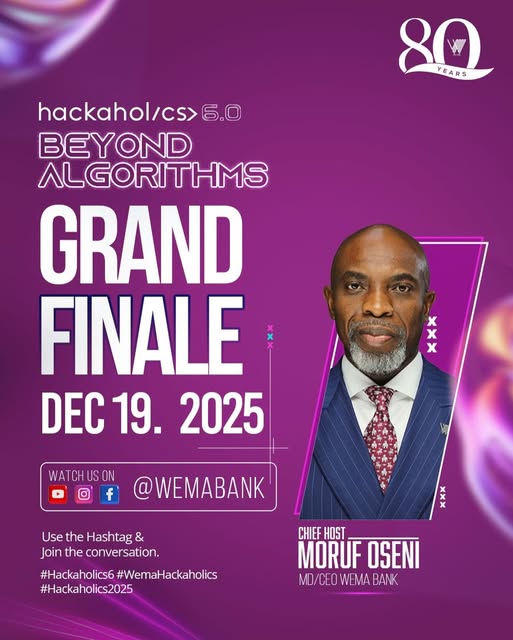
The six edition of the Hackaholics of Wema Bank Plc has produced 20 top finalists shared equally between two streams, Ideathon and Hackathon.
The Hackathon finalists are Rapid DEV, Secure IT, Neurafeed, Trust Lock Babcock, Pulse Track, IlluminiTrust, Trust Lock FUTA, Fix Fraud AI, KASH Flow and VOC AI.
The Ideathon finalists include PLOY, Fertitude, VarsityScape, Mama ALERT, StockMed, Chao, All Arbitrate, FarmSlate, Sane AI and Cycle X.
They emerged after a two-day pre-pitch held on December 16 and 17, 2025, for the grand finale slated for Friday, December 19, 2025.
They grand finale of Hackaholics 6.0 will convene the top players in Africa’s tech and innovation ecosystem, creating an avenue for these finalists to not only put their creativity to the ultimate test but also give their solutions visibility to potential investors for additional funding opportunities beyond the prizes to be won.
The prizes to be won for the Ideathon include N25 million for the winner, N20 million for the first runner-up, N15 million for the second runner-up and N5 million each for two women-led teams.
In the Hackathon category, the first to fourth-place winners will receive N20 million, N15 million, N10 million and N5 million, respectively.
The pre-pitch saw the top 43 contenders battle in a game of innovation and problem solving, presenting compelling pitches for a chance to make it to top 10 in their respective streams.
After a rigorous stretch of pitches and presentations, the top 20 emerged, securing their spot in the grand finale of Hackaholics 6.0.
“Hackaholics started off as a hackathon and morphed into an ideation. For Hackaholics 6.0, the sixth edition, we decided to give both the builders of new solutions and the refiners of existing ones, an opportunity to make meaningful impact.
“For us at Wema Bank, we understand that innovation isn’t just building from scratch. Sometimes, it’s looking at what exists and developing new ways to optimise that and create more efficiency. This is the idea behind our two-stream Ideathon-Hackathon structure.
“Every year, Hackaholics shows us just how eager and motivated Nigerian youth are when it comes to exploring creativity and innovation, and we are honoured to be the institution that provides them with the platform and resources to put this drive to good use.
“We toured seven cities, indulged 1,460 participants and discovered hundreds of remarkable ideas; some of which needed some refining and some of which deserved to move to the next stage.
“For those who needed to go back to the drawing board, we provided useful guidance and for the top contenders, we were able to shortlist to the top 43, who proceeded to the pre-pitch. To every participant, Wema Bank is proud of you. This is just the beginning,” the chief executive of Wema Bank, Mr Moruf Oseni, said.
Banking
Unity Bank, Experts Call for Increased Investment in Green Economy
By Modupe Gbadeyanka
The need for increased investment in the green economy and the adoption of frontier technologies as critical pathways to driving economic resilience and reducing the impact of climate change on vulnerable populations across Africa has again been stressed.
At a thought-provoking webinar hosted by Unity Bank Plc to commemorate this year’s Earth Day, themed The True Cost of Climate Change and Who Pays? leading climate innovation experts highlighted the disproportionate burden which climate change places on underserved communities and the need for inclusive solutions.
For example, the chief executive of Instollar, Ms Chinwe Udo-Davis, submitted that, “The true cost of climate change is not evenly distributed.”
“Communities with the least resources are often the most affected, whether through energy poverty, environmental degradation, or limited access to sustainable alternatives. Addressing this imbalance requires intentional investment in clean energy solutions that are both accessible and scalable,” she noted.
Also, the Programme Manager at the Nigeria Climate Innovation Centre, Oluwatosin Ajide, underscored the importance of coordinated, system-wide approaches in tackling climate challenges, particularly through innovation and policy alignment.
“Climate change is fundamentally a structural problem, and its solution requires a paradigm shift: from innovation and policy to financing and implementation. Stakeholders must work collaboratively to drive solutions that are sustainable and inclusive,” Ajide stated.
In his opening remarks, Unity Bank’s Head of Strategy and Innovation, Mr Ibukun Coker, emphasised the urgency of addressing climate risks from both a societal and business perspective.
“Climate change is no longer a distant or abstract challenge. It is an existential threat with direct consequences for individuals, businesses, and economies.
“At Unity Bank, we recognise the role institutions must play in incorporating sustainability in project financing, supporting businesses and promoting solutions that build resilience in communities where we operate,” he stated.
The programme provided an avenue for stakeholders to examine the human, economic, and institutional costs of climate change, while spotlighting practical solutions to address its growing impact.
It also explored emerging opportunities in climate technology, renewable energy, and ecosystem financing, reinforcing the role of innovation and cross-sector collaboration in building long-term resilience.
By hosting the webinar, Unity Bank continues to demonstrate its commitment to advancing sustainability-focused dialogue and supporting initiatives that promote responsible growth and environmental stewardship.
Banking
CBN Warns Public Against Increase in Impersonation Scams
By Adedapo Adesanya
The Central Bank of Nigeria (CBN) has issued an alert about the spread of fraudulent messages, emails, and online communications falsely bearing the identity of the bank, to scam unsuspecting members of the public.
The apex bank warned that the fake materials are designed to hack personal accounts and mislead Nigerians on matters of bank leadership, licensing, and policy.
In a notice signed by Mrs Hakama Sidi-Ali, the Acting Director of Corporate Communications, the lender said the fraudulent communications are already in circulation and are prompting recipients to click embedded links, which is the primary mechanism through which the attackers seek to gain unauthorised access to private accounts and personal data.
The bank laid out three clear directives for members of the public. First, Nigerians are advised to refrain from clicking links or providing personal information on any website they cannot confirm as legitimate.
Second, it stated that all communications purporting to come from the CBN must be verified through the bank’s sole official website — www.cbn.gov.ng — or through recognised media organisations.
Thirdly, it warned that anyone who encounters a suspected fraudulent site, email, or message is urged to report it to law enforcement authorities without delay.
“The CBN remains fully committed to safeguarding the Nigerian financial system and continues to strengthen its cybersecurity frameworks in collaboration with relevant agencies to protect the public against digital fraud.”
Banking
CBN, NCC Set up Committees to Protect Consumers Against Fraud
By Modupe Gbadeyanka
In a bid to ensure consumer safety across the telecommunications and financial services sectors, the Central Bank of Nigeria (CBN) and the Nigerian Communications Commission (NCC) have decided to work together.
On Monday, both organisations sealed a Memorandum of Understanding (MoU) for the establishment of joint committees for the protection of consumers against fraud in the sectors.
The two teams set up by the CBN and the NCC include the Joint Committee on Payment Systems and Consumer Protection, and the Joint Committee on Telecoms Identity Risk Management System (TIRMS) Portal.
Through the TIRMS portal, which aggregates data on churned (recycled) phone numbers, as well as numbers flagged within the financial services sector, it will now have enhanced visibility into the status of phone numbers, one of the most widely utilised resources in the sector, although regulated by the NCC.
With this, according to the chief executive of NCC, Mr Aminu Maida, financial institutions will be able to determine when a line is active, when it has been swapped, when it has been disconnected due to inactivity and reassigned to a new subscriber, and when it has been flagged for suspicious or fraudulent activity. “This ensures that our financial services industry is better equipped with timely and relevant information to effectively combat e-fraud, particularly those perpetuated using phone numbers, in the country,” he stated.
It was stated that the partnership between the two parties will reduce electronic fraud, which has become increasingly pervasive, with significant implications for the integrity of the digital economy.
In his remarks, the Governor of the CBN, Mr Yemi Cardoso, said the MoU will strengthen coordination on approvals, technical standards, and innovation trials, including sandbox testing that supports market-led solutions, while safeguarding stability.
“Going forward, the CBN remains fully committed to working with the NCC to deliver a safer, more resilient, and more inclusive digital financial system that supports national productivity, protects consumers, and strengthens trust in Nigeria’s digital economy,” the central bank chief said.
-
Feature/OPED6 years agoDavos was Different this year
-
Travel/Tourism10 years ago
Lagos Seals Western Lodge Hotel In Ikorodu
-
Showbiz3 years agoEstranged Lover Releases Videos of Empress Njamah Bathing
-
Banking8 years agoSort Codes of GTBank Branches in Nigeria
-
Economy3 years agoSubsidy Removal: CNG at N130 Per Litre Cheaper Than Petrol—IPMAN
-
Banking3 years agoSort Codes of UBA Branches in Nigeria
-
Banking3 years agoFirst Bank Announces Planned Downtime
-
Sports3 years agoHighest Paid Nigerian Footballer – How Much Do Nigerian Footballers Earn