Connect with us

General

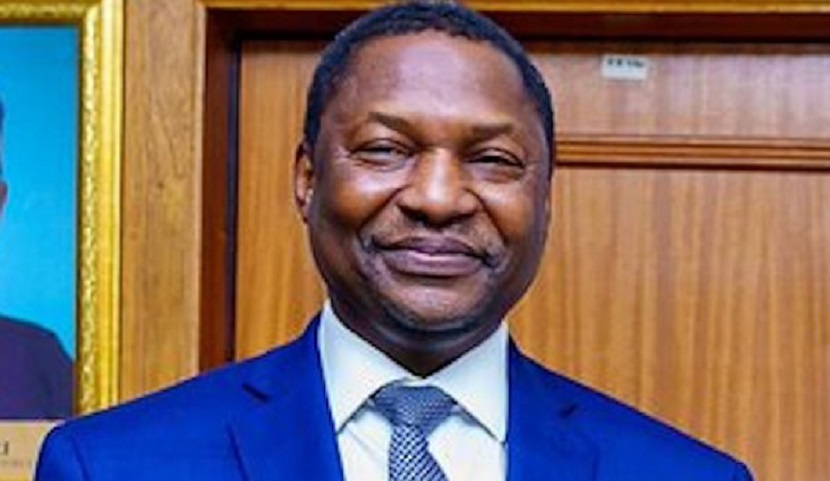
Court to Rule on Malami’s Bail Application January 7

Published

on

Abubakar Malami Assets Recovery Campaign

By Adedapo Adesanya

A Federal High Court sitting in Abuja has fixed January 7 to hear the bail application of former Attorney General of the Federation and Minister of Justice, Mr Abubakar Malami, over alleged money laundering.

Recall that the same court had ordered the remand of Mr Malami at the Kuje Correctional Centre.

The Senior Advocate of Nigeria, his son, Abdulaziz, and one of his wives, Mrs Bashir Asabe, are standing trial predicated on a 16-count charge preferred against them by the Economic and Financial Crimes Commission (EFCC).

The trio, who are accused of laundering N8.7 billion, pleaded not guilty to the charges when they were arraigned on December 29, 2025.

Following their plea of not guilty, Justice Emeka Nwite ordered their remand at Kuje Correctional Centre till January 2, 2026, when their written bail application would be argued by his legal team.

In the charge, identified as FHC/ABJ/CR/700/2025, the defendants were accused of conspiring to conceal, disguise, and retain proceeds from illegal activities.

The indictment claimed that they used multiple bank accounts, corporate entities, and high-value real estate transactions over nearly ten years to indirectly acquire the illicit funds.

According to the charge sheet, the alleged offences took place between 2015 and 2025, primarily within the Federal Capital Territory, Abuja, during Malami’s time as the country’s Attorney-General.

The EFCC alleged that Malami and his son used Metropolitan Auto Tech Limited to hide N1.014 billion in a Sterling Bank account from July 2022 to June 2025.

They were also accused of depositing an additional N600.01 million between September 2020 and February 2021.

The properties in question include a luxury duplex on Amazon Street, Maitama, purchased for N500 million; a property on Onitsha Crescent, Garki, bought for N700 million; and another in Jabi District for N850 million.

Additional acquisitions include real estate on Rhine Street, Maitama (N430 million); in Asokoro District (N210 million and N325 million); and at Efab Estate, Gwarimpa (N120 million).

The EFCC further alleges that Mr Malami used unlawful proceeds totaling N952 million to acquire multiple properties in Abuja, Kano, and Birnin Kebbi between 2018 and 2023.

The acquisitions were allegedly made through proxies and corporate entities to obscure ownership.

The commission claimed that the alleged actions violate the provisions of the Money Laundering (Prohibition) Act, 2011 (as amended) and the Money Laundering (Prevention and Prohibition) Act, 2022.


Adedapo Adesanya is a journalist, polymath, and connoisseur of everything art. When he is not writing, he has his nose buried in one of the many books or articles he has bookmarked or simply listening to good music with a bottle of beer or wine. He supports the greatest club in the world, Manchester United F.C.

Click to comment

Leave a Reply

Your email address will not be published. Required fields are marked *

General

Alleged $2.33m Fraud: EFCC Arraigns Miyetti Allah’s Bello Bodejo

Published

on

Miyetti Allah’s Bello Bodejo

By Modupe Gbadeyanka

The leader of Miyetti Allah Kautal Hore, Mr Bello Bodejo, has been arraigned before Justice Inyang Edem Ekwo of the Federal High Court in Abuja for an alleged $2.33 million fraud.

Mr Bodejo was brought before the court on Thursday, July 9, 2026, by the Economic and Financial Crimes Commission (EFCC) on a 12-count charge bordering on money laundering.

At Thursday’s proceedings, prosecution counsel, Mr Wahab Shittu (SAN) drew the attention of the court to a 12-count charge application dated June 24, 2026, and filed June 25, 2026, urging the court to allow the defendant to take his plea to which the judge granted his request.

“That you, Bello Abdullahi Bodejo (male, adult), on or about the 11th day of January 2022, at Abuja, within the jurisdiction of this court, did knowingly and wilfully, without lawful authority or excuse, accept a cash payment of the sum of $100,000 in physical currency from one Sa’idu Abubakar, a former Accountant-General of Bauchi State who is currently in the lawful custody of the Nigeria Police Force, which sum exceeded the statutory cash transaction threshold of 5 million prescribed under Section 1(a) of the Money Laundering (Prohibition) Act, 2011 (as amended), without routing the said transaction through a financial institution as required by law, and you thereby committed an offence contrary to Section 16(1)(d) of the Money Laundering (Prohibition) Act, 2011 (as amended) and punishable under Section 16(2)(b) of the same Act,” Count one of the charge read.

The Count four stated, “That you, Bello Abdullahi Bodejo (male, adult), on or about the 7th day of February 2024, at Abuja, within the jurisdiction of this court, did knowingly and wilfully, without lawful authority or excuse, accept a cash payment of the sum of $980,000 in physical currency from one Sa’idu Abubakar, a former Accountant-General of Bauchi State, who is currently in the lawful custody of the Nigeria Police Force, which sum exceeded the statutory cash transaction threshold of N5 million prescribed under Section 2(1)(a) of the Money Laundering (Prevention and Prohibition) Act, 2022, without routing the said transaction through a financial institution as required by law, and you thereby committed an offence contrary to Section 19(1)(d) of the Money Laundering (Prevention and Prohibition) Act, 2022 and punishable under Section 19(2)(b) of the same Act.”

After pleading “not guilty” to the charges, the prosecution counsel asked the court for a trial date and for the defendant to be remanded in the custody of the Nigeria Correctional Service, while the defence counsel, Mr Ahmed Raji (SAN), prayed the court to admit his client to bail in respect of his bail application, filed on June, 30, 2026.

The bail application was, however, strongly opposed by prosecution counsel, who drew the attention of the court to his counter-affidavit of 28 paragraphs, dated July 6, 2026.

He pointed out that the defendant is a public risk as the Department of State Security Services (DSS) is on the lookout for him, and that being an influential person, he may manipulate the witnesses and the progress of the case.

Justice Ekwo ordered the remand of the defendant in EFCC’s holding facility and adjourned the matter till July 20, 2026, for ruling on the bail application.

Continue Reading

General

EMERGE Launches Career Platform to Connect Talents with Skills, Mentors, Employers

Published

on

EMERGE Dashboard 2

By Adedapo Adesanya

EMERGE, an acceleration platform powered by TheBoardroom Africa, has launched its digital platform to connect young African professionals with the skills, networks, structured support, and employer opportunities they need to build sustainable careers.

Industry stakeholders say Africa’s challenge is no longer a shortage of talent but the lack of systems that enable skilled professionals to advance their careers. Despite having the technical expertise and ambition, many workers struggle to access the mentorship, professional networks, career development programmes, and employer connections needed to sustain long-term career growth.

EMERGE will bring together the elements of career development, including structured learning, professional diagnostics, mentorship, peer support, employer engagement, and access to opportunity.

According to a statement, the organisers said – for professionals, EMERGE provides greater clarity, confidence, skills, visibility, and support to progress with intention. For employers, it creates access to a stronger, better-prepared, and more visible talent pipeline. For the wider economy, it helps more of Africa’s young professionals move into roles where they can contribute, lead, and grow, strengthening organisations and labour markets across the continent.

Developed with support from the Mastercard Foundation, EMERGE is already home to a growing community of more than 1,700 young African professionals, creating a powerful network of emerging talent across the continent. Around six in ten EMERGE members are women, reflecting a deliberate commitment to widening access for talented professionals who are too often overlooked by traditional career pathways. Open to professionals across the continent, EMERGE is building a more inclusive and representative pipeline for Africa’s next generation of leaders.

Speaking at the launch, the chief executive of TheBoardroom Africa, Mrs Marcia Ashong-Sam, said, “The issue has never been a lack of capable talent in Africa. The real challenge is that access to opportunity remains uneven, and career progression is too rarely supported in a structured, intentional way. EMERGE was created to change that. We are building the career infrastructure that too many young professionals have had to navigate without: a platform that helps them translate ambition and ability into sustainable, meaningful careers, while connecting employers to a stronger and better-prepared pipeline of African talent.”

The platform gives members access to a dynamic mix of live masterclasses led by industry practitioners, career-focused programming designed to build resilience and progression, self-paced courses through its Learning Hub, and thoughtfully selected career opportunities with some of Africa’s most innovative employers.

The EMERGE journey begins with the Leadership Compass, the platform’s proprietary baseline assessment, which gives each member a clearer view of where they are in their professional journey and where focused development could unlock the greatest growth. Insights from the assessment help shape a more personalised pathway through the EMERGE experience.

For employers, EMERGE offers a seamless way to invest in professional development at scale. Organisations can enrol staff cohorts on the platform, giving their teams continuous access to high-quality career development tools, masterclasses, learning pathways, and progression-focused support through the programmatic rhythm of the EMERGE experience.

Employers also benefit from aggregate cohort insights, enabling them to track progress, understand development priorities, and make more informed decisions about talent growth, retention, and internal mobility. In this way, EMERGE becomes more than a learning platform; it becomes a practical development pathway for building stronger, more prepared leadership pipelines from within.

Mrs Ashong-Sam added, “The needs of employers and professionals are closely connected. Employers want people who can grow with the business, contribute to strategy, and take on greater responsibility over time. Professionals want work that gives them progress, purpose, and financial stability. EMERGE brings both sides into the same conversation, with a focus on readiness, development, and opportunity.”

The platform reflects TheBoardroom Africa’s wider work to strengthen leadership ecosystems across the continent. Over the past decade, the firm has worked with senior executives, board leaders, and institutions across African markets and globally, giving it direct insight into the gaps that begin much earlier in people’s careers. EMERGE applies that experience at an earlier stage, supporting professionals before they reach senior roles and building a stronger pipeline of talent prepared for greater responsibility and decision-making.

EMERGE is open to professionals across Africa and will continue to expand its membership while engaging employers looking to strengthen their talent pipelines.

Continue Reading

General

Gbajabiamila Leads Presidential Working Group on State Police

Published

on

presidential working group state police

By Adedapo Adesanya

President Bola Tinubu on Tuesday inaugurated the Presidential Working Group on the National Policing Bill to prepare the legal framework for the implementation of state police across the country.

President Tinubu, represented by his Chief of Staff, Mr Femi Gbajabiamila, inaugurated the panel at the Presidential Villa, Abuja.

The inauguration followed the National Assembly’s passage of the Constitution Alteration (State Police) Bill, 2026, in which the President proposes a dual policing structure comprising the Federal Police Service and 36 State Police Services.

The President said that while the constitutional amendment creates the framework for state police, the National Policing Bill would provide the legal structure for its implementation.

“The Constitution Amendment Bill establishes the framework for dual policing, but it does not operationalise it. That work is left to the National Policing Bill.”

He said the proposed legislation would address issues necessary for a smooth operationalisation of the State Police system.

“The proposed National Policing Bill will include provisions on minimum policing standards, state readiness certification, federal-state coordination, accountability, human rights safeguards and fiscal conditions.”

The President said that the committee will produce an implementation-ready draft bill immediately after the constitutional amendment process.

“The Working Group has been constituted to produce a technically robust, implementation-ready draft National Policing Bill for transmission to the National Assembly,” President Tinubu said.

He said the committee was necessary to avoid delays after the State Police bill passed.

“We must not wait until the constitutional process is concluded before beginning this important assignment,” he said.

Mr Gbajabiamila will serve as the committee’s chairman. Members include the Attorney-General of the Federation, the President of the Nigerian Bar Association (NBA), the Chairman of the Nigeria Governors’ Forum (NGF), the National Security Adviser, the Inspector-General of Police, the Chairman of the NGF Committee on State Police. A Secretariat will offer some administrative assistance to the committee.

Governor Dapo Abiodun of Ogun State, on behalf of the NGF, pledged governors’ support for the speedy implementation of the reform.

He said the plan is for the 36 state governors to accelerate work on the bill once it reaches their respective Houses of Assembly and is passed unanimously.

Mr Abiodun described the proposed state police as a response to Nigerians’ long-standing demand for community-based policing.

“This bill has answered the cries of Nigerians about cascading policing and removing it from the Exclusive Legislative List.”

He said the initiative validated the success of regional security outfits such as Amotekun in the South-West.

Mr Abiodun said the state police would significantly increase the number of security personnel nationwide.

“If each state deploys about 6,000 personnel, we will add nearly 200,000 officers to complement the existing federal police.”

The Governor commended President Tinubu for initiating implementation plans before the constitutional amendment process was completed.

“This inauguration demonstrates the proactiveness of the Executive in preparing for effective implementation,” Mr Abiodun said.

The Attorney-General of the Federation and Minister of Justice, Mr Lateef Fagbemi, SAN, described the initiative as timely in view of Nigeria’s security challenges.

“There is no denying the fact that we are in a critical moment security-wise, and all hands must be on deck,” he said.

Mr Fagbemi urged governors to ensure speedy ratification of the constitutional amendment by their respective state assemblies.

“I appeal to the governors to do their utmost to ensure the early passage of the constitutional amendment because this is a shared responsibility,” he said.

President of the Nigerian Bar Association, Mr Afam Osigwe, reaffirmed the association’s support for the state police initiative.

“Nigeria can hardly be effectively policed by one national police. We fully support the constitutional amendment providing for state police,” he said.

Mr Osigwe, however, stressed the need for adequate legal safeguards to prevent abuse of state police.

“We must ensure we do not create a monster. The right legal framework must guarantee accountability and prevent oppression,” he said.

He pledged the NBA’s commitment to supporting the committee in producing legislation that will strengthen security while protecting citizens’ rights.

Continue Reading