General
Obi, Atiku Slam Tinubu on Tax, Economic Policies
By Adedapo Adesanya
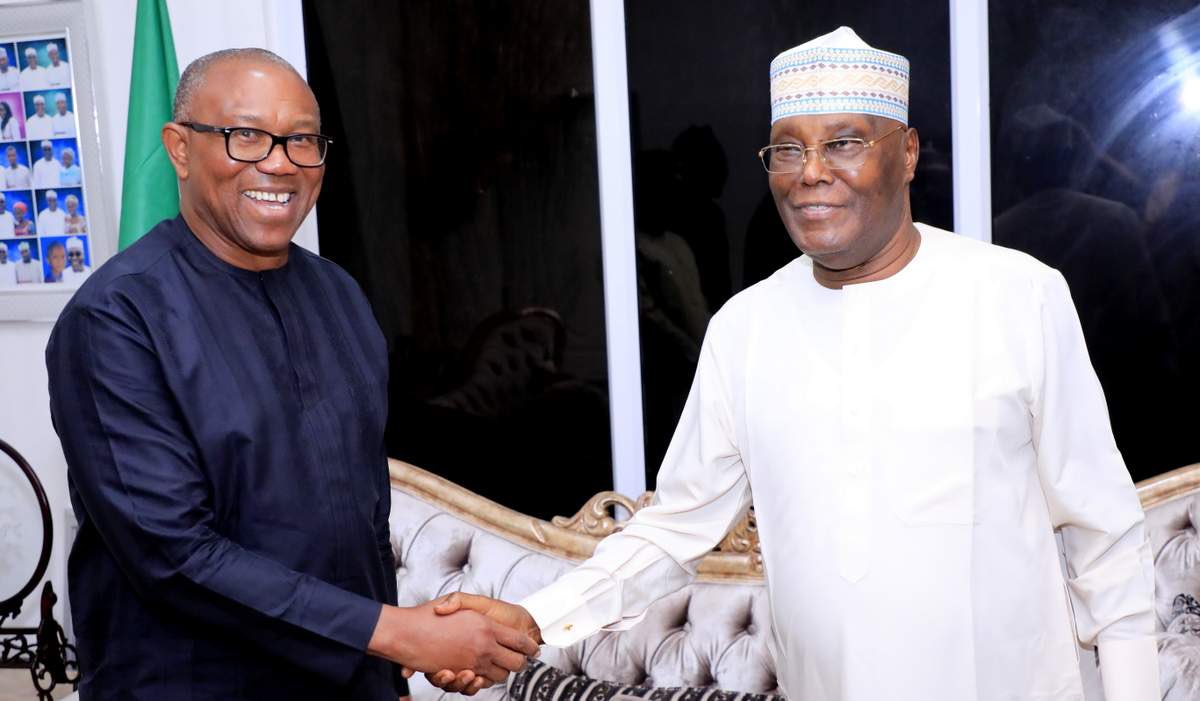
Former presidential candidates at the 2023 presidential election, Mr Peter Obi and Mr Atiku Abubakar, have separately slammed President Bola Tinubu on issues relating to economic conditions of Nigerians.
Mr Obi in a statement argued that taxation must be rooted in transparency, fairness, and concern for citizens’ welfare, cautioning that the ongoing controversy over the alleged manipulated tax law threatens economic growth and public trust.
Despite recent controversies, the new tax laws regime have officially kicked off.
“For the first time in Nigeria’s history, a tax law has reportedly been forged. The National Assembly itself has admitted that the version gazetted is not what was passed into law,” he said.
“Yet, citizens are being asked to pay higher taxes under this manipulated framework, without transparency, without explanation, and without corresponding benefits,” the candidate of the Labour Party in 2023 noted.
Mr Obi, who is now with the African Democratic Congress (ADC), stressed that “taxing poverty does not create wealth; it deepens hardship,” urging the government to focus instead on empowering small and medium-sized enterprises, which he said are critical for job creation, income growth, and the natural expansion of the tax base.”
“You cannot tax your way out of poverty, you must produce your way out of it,” he noted, calling for a lawful, fair, and people-centered tax system that supports production, rewards enterprise, protects the vulnerable, and restores trust between government and citizens.
“Nigeria needs a fair, lawful, and people-centred tax system, only then can taxation become a true tool for unity, growth, and shared prosperity,” Mr Obi concluded in the statement posted on his official X handle.
On his part, Mr Abubakar, a former Vice President, warned that policy failures under President Tinubu are deepening business distress, accelerating job losses, and pushing the country toward economic collapse.
In a New Year message to Nigerians, he described 2025 as “one of the most punishing years in our recent history,” marked by what he called “economic suffocation” and governance devoid of empathy.
He said the Tinubu-led administration presided over months of fiscal drift, borrowing heavily while businesses struggled to survive.
“The past year exposed, in stark terms, the incompetence and policy bankruptcy of President Bola Tinubu,” Mr Atiku said, adding that the government governed “for months without a functional budget, relying on propaganda while borrowing recklessly.”
From a business perspective, Mr Atiku, who was the candidate of the Peoples Democratic Party (PDP) in the last presidential poll, warned that the operating environment for enterprises deteriorated sharply, with small and medium-sized businesses bearing the brunt of inflation, weak consumer demand, and policy uncertainty.
“Industries shut down. Workers were sent home. Hunger spread. Suffering became normalized,” he said.
He also questioned the credibility of the government’s reform agenda, citing what he described as a scandal involving a forged tax law.
“Nothing better captures the decay of this government than the scandal of a forged tax law, shamelessly branded a ‘reform’,” Mr Atiku, who has also now defected to the ADC, said, warning that “a government that begins reform with forgery cannot end with prosperity.”
Mr Atiku further dismissed official claims of revenue performance, arguing that worsening insecurity and debt accumulation were eroding investor confidence.
“While drowning the nation in debt, the government falsely claimed to have met revenue targets,” he said, noting that kidnappings and violent crimes had disrupted livelihoods and economic activity nationwide.
He said unemployment, labour unrest and collapsing enterprises defined the year, contradicting repeated assurances of economic recovery.
“Small businesses, the backbone of job creation, are collapsing. Workers are losing jobs,” Atiku said, arguing that policies demanding sacrifice from citizens were unjustified.
He warned, however, that weak institutions and disregard for due process could undermine future economic stability and elections. “A government capable of forging or tampering with laws cannot be trusted to conduct free and fair elections in 2027,” he said.
Calling for civic engagement, Mr Atiku urged Nigerians and the business community to organize for change through democratic means. “Democracy gives the people the power to change a failing government, peacefully and decisively, through the ballot,” he said.
He concluded with a call to action: “Let us vote out hunger, insecurity, unemployment, dishonesty, corruption, abductions, lies, and propaganda. Nigeria deserves better. Nigerians deserve dignity.”
Business Post reports that both Mr Obi and Mr Atiku are planning to work with other politicians to oust Mr Tinubu in the 2027 general elections through the ADC.
General
Court Grants N500m Bail To Malami, Wife, Son in Money Laundering Case
By Adedapo Adesanya
Justice Emeka Nwite of the Federal High Court in Abuja has granted the former Attorney General (AGF) and Minister of Justice, Abubakar Malami and two others, bail in the sum of N500 million with two sureties.
The sureties, according to the judge, must have landed property in Asokoro, Maitama, or Gwarinpa.
The documents of the properties are to be verified by the deputy chief registrar of the court while the sureties are also to depose to affidavit of means.
Mr Malami was also ordered to deposit his travelling documents with the court and must not travel out of the country without the permission of the court.
The former AGF and his sureties were also ordered to deposit their two recent passport photograph with the court.
Meanwhile, Mr Malami has been ordered to be remanded in Kuje prison pending his perfection of the bail conditions.
Justice Nwite subsequently fixed February 17 for commencement of trial of the corruption charges.
The same bail were extended to Mr Malami’s son, Mr Abdulaziz Malami, and a listed employee of Rahamaniyya Properties Limited, Mrs Asabe Bashir, who is also believed to be Mr Malami’s wife.
The Economic and Financial Crimes Commission (EFCC) filed a 16-count alleged money laundering charge against Malami, his son and his wife.
In one of the counts, the anti-graft agency alleged that Mr Malami and his son procured Metropolitan Auto Tech Limited to conceal the unlawful origin of the sum of N1,014,848,500.00 in a Sterling Bank Plc account, when they reasonably ought to have known that the sum constituted proceeds of unlawful activities, thereby committing an offence contrary to Section 21(c) of the Money Laundering (Prevention and Prohibition) Act, 2022, and punishable under Section 18(3) of the same Act.
It also said they conspired to disguise the unlawful origin of the aggregate sum of N1,049,173,926.13 paid through the Union Bank Plc account of Meethaq Hotels Limited, Jabi, between November 2022 and September 2024, contrary to Section 21 of the Money Laundering (Prevention and Prohibition) Act, 2022, and punishable under Sections 18(2)(a) and 18(3) of the same Act.
Another count alleged that between November 2022 and October 2025, the duo indirectly took control of the aggregate sum of N1,362,887,872.96 paid through the Union Bank Plc savings account of Meethaq Hotels Limited, when they reasonably ought to have known that the funds constituted proceeds of unlawful activities, contrary to Section 18(2)(d) and punishable under Section 18(3) of the Money Laundering (Prevention and Prohibition) Act, 2022.
General
NIMASA Launches Zero Tolerance Campaign for Nigeria’s Maritime Sector
By Adedapo Adesanya
The Nigerian Maritime Administration and Safety Agency (NIMASA) has commenced special operational enforcement code named Operation Zero Tolerance for Non-Compliance in the Nigerian maritime domain.
The directive was issued through a Marine Notice, pursuant to the agency’s statutory mandate under the NIMASA Act 2007, the Coastal and Inland Shipping (Cabotage) Act 2003, the Merchant Shipping Act 2007, and other applicable regulations.
Under this operation, all Ship/Vessel Owners, Operators, Managers, International and National Oil Companies, Masters and Officers of Merchant Ships, Shipping Companies, Shipping Agents, Charterers, Offshore Installations and Platforms Operators, Vessel Operators at the Free Trade Zones (FTZ), and Maritime Stakeholders operating or intending to operate within Nigerian waters are required to ensure full compliance with statutory requirements contained in existing maritime laws and regulations.
These include proper vessel registration, valid certifications, updated ownership documentation, adherence to Cabotage provisions relating to vessel ownership, registration, manning, and build.
The notice also emphasised the importance of timely payment and remittance of all statutory levies and fees as prescribed by law.
As part of the enforcement process, NIMASA will conduct random and targeted vessel inspections, verify documentation against its databases, and carry out physical and documentary compliance assessments at ports, terminals, and offshore locations. Operators will also be required to present proof of payment of all applicable levies and fees upon request.
To allow stakeholders the opportunity to regularize their operations, NIMASA has granted a thirty (30) day window from January 5, 2026 for a self-audit and voluntary compliance.
The agency warned that failure to comply after the expiration of the grace period will attract enforcement actions, including vessel detention, monetary penalties, withdrawal of waivers or operational licences, and denial of port clearance until full compliance is achieved.
The Director General of NIMASA, Mr Dayo Mobereola has assured all stakeholders of the Agency’s commitment to promoting indigenous shipping development, enhancing maritime safety and security, protecting the marine environment, and ensuring strict compliance with Nigeria’s maritime laws.
“We therefore urge all stakeholders to do their part so that together, we can build on the gains of previous regulatory achievements, which is enhanced safety, a secure maritime environment and sustainable utilisation of our marine resources,” the DG added.
General
US Drone Firm, Tompolo’s Tantita to Curb Oil Theft in Nigeria
By Adedapo Adesanya
Nigeria’s private security firm, Tantita Security Services Limited (TSSL), has entered into an agreement with a United States–based Textron Systems for the supply of unmanned aerial vehicles (drones) in a move aimed at curbing crude oil theft in the country.
Textron Systems said the drones would support security operations around Nigeria’s oil and gas infrastructure, which has continued to face threats from crude oil theft, vandalism and sabotage.
The deal also includes provisions for training and the possible acquisition of additional aircraft as Tantita expands its operations, building on a previous US Foreign Military Sales delivery of Aerosonde drone systems to Nigeria.
The Aerosonde Mk. 4.7 is designed to operate without a runway, using a hybrid quadrotor system for vertical takeoff and landing before transitioning to fixed-wing flight. The system can carry multiple payloads and conduct extended surveillance missions.
Speaking on the development, Executive Director, Operations and Technical, Mr Waredi Enisour, said Tantita officials were in the United States to inspect the drone operations and understudy the associated technical processes.
Mr Enisour added that with the latest technological acquisitions by Tantita, incidents of crude oil theft are expected to decline significantly, as the drones will provide extensive surveillance coverage across the Niger Delta region.
He disclosed that Tanttia is the first private security firm in Nigeria to acquire the Aerosonde UAV which hosts ISR capabilities.
Tantita is a company owned by a former militant leader, Mr Government Ekpemupolo, commonly known as Tompolo. Over the years, the federal government has collaborated with the former militant leader for the protection of critical oil and gas infrastructure and securing permanent peace in the oil-rich Niger Delta Region.
Oil and gas remains Nigeria’s economic mainstay, contributing nearly 90 per cent of forex earnings and 70 per cent of national revenue. However, constant oil theft over the years has made it impossible for the country to hit its peak production of 2.5 million barrels recorded in 2005, although improvement has occurred in recent years, there have been more hands-on approach.
-
Feature/OPED6 years agoDavos was Different this year
-
Travel/Tourism9 years ago
Lagos Seals Western Lodge Hotel In Ikorodu
-
Showbiz3 years agoEstranged Lover Releases Videos of Empress Njamah Bathing
-
Banking8 years agoSort Codes of GTBank Branches in Nigeria
-
Economy3 years agoSubsidy Removal: CNG at N130 Per Litre Cheaper Than Petrol—IPMAN
-
Banking3 years agoFirst Bank Announces Planned Downtime
-
Banking3 years agoSort Codes of UBA Branches in Nigeria
-
Sports3 years agoHighest Paid Nigerian Footballer – How Much Do Nigerian Footballers Earn