Connect with us

General

US Delivers Military Supplies to Help Nigeria in Terrorism Fight

Published

on

us military supplies Nigeria

By Adedapo Adesanya

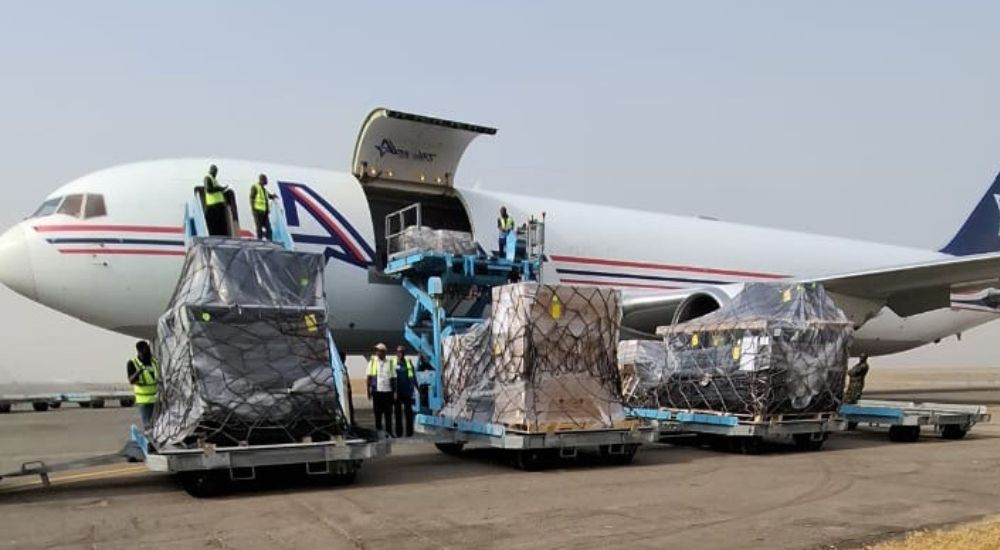
The United States has delivered military supplies to Nigerian security agencies to bolster operations in several parts of the country.

This was disclosed in a post via X on Tuesday by the United States Africa Command (AFRICOM).

“The US forces delivered critical military supplies to our Nigerian partners in Abuja. This delivery supports Nigeria’s ongoing operations and emphasizes our shared security partnership,” the post read.

The development shows cooperation between both nations after US President Donald Trump previously threatened to invade the country over the killing of Christians.

Last November, the federal government dispatched a delegation to Washington, the US capital, aimed at strengthening security partnerships between the two countries and opening new avenues for cooperation.

Leading the delegation then was the National Security Adviser, Mr Nuhu Ribadu, who met with senior officials across the US Congress, the White House Faith Office, the State Department, the National Security Council, and the Department of War.

During the meeting, the Nigerian delegation refuted allegations of genocide in Nigeria, emphasising that violent attacks affect families and communities across religious and ethnic lines.

It also rejected the wrongful framing of the situation, saying such a portrayal would only divide Nigerians and distort the realities on the ground.

According to the presidency at the time, both countries agreed to implement a non-binding cooperation framework and to establish a Joint Working Group to ensure a unified and coordinated approach to the agreed areas of cooperation.

The Nigerian delegation also reaffirmed the government’s commitment to strengthening civilian protection measures.

On Christmas Day 2025, the US has launched strikes against militants linked to the Islamic State group (IS) in north-western Nigeria, where militants have sought to establish a foothold.

According to the Nigerian government, the operation was a joint operation and had nothing to do with a particular religion, adding that the strikes had been planned for quite some time using intelligence provided by the country.

The Nigerian government has long been fighting an array of jihadist groups, including Boko Haram and IS-linked factions, but largely in the North-East. However, some new groups are gaining footholds and the new supplies could help the Nigerian military continue its fight against terrorism.


Adedapo Adesanya is a journalist, polymath, and connoisseur of everything art. When he is not writing, he has his nose buried in one of the many books or articles he has bookmarked or simply listening to good music with a bottle of beer or wine. He supports the greatest club in the world, Manchester United F.C.

Advertisement
Click to comment

Leave a Reply

Your email address will not be published. Required fields are marked *

General

Nigeria, Turkey to Fix Bilateral Relations for Better Visa Facilitation

Published

on

nigeria turkey bilateral

By Adedapo Adesanya

The governments of Nigeria and Turkey have agreed to collaborate on enhancing bilateral relations, with a focus on visa facilitation, business mobility, and consular matters.

The agreement followed a meeting in Abuja between the Minister of Interior, Mr Olubunmi Tunji-Ojo, and the Turkish Ambassador to Nigeria, Mr Mehmet Poroy, during a courtesy visit.

Mr Tunji-Ojo highlighted the strong historical and cultural ties between the two countries and Nigeria’s commitment to a “smart, structured, and practical approach to international cooperation” that promotes people-to-people contact and legitimate business engagement.

“These ties provide a solid foundation for deeper collaboration,” he said.

Ambassador Poroy provided updates on improved visa facilitation for Nigerian businessmen traveling to Turkey, noting that “under the new arrangement, applications are processed locally, allowing verified businesspersons to benefit from faster processing timelines of about three to four days.”

He also raised concerns about Turkish businesspeople facing challenges when visiting Nigeria for trade fairs and investments, citing conflicting information about Nigerian visa arrangements. “We request written clarification to guide applicants accurately,” Poroy said.

A key proposal during the meeting was the inclusion of Turkey in Nigeria’s electronic visa (e-visa) system.

“The absence of a Nigerian visa office in Istanbul creates logistical challenges,” the Ambassador explained, adding that, “Including Turkey in the e-visa regime would significantly enhance business mobility for Turkish nationals.”

In response, Mr Tunji-Ojo assured that “denying visas to genuine Nigerian or Turkish businesspeople is not in the interest of either country.”

He emphasized the Ministry’s commitment to “transparency, dialogue, and continuous improvement in visa administration,” stressing Nigeria’s openness to legitimate investors and international business partners.

The discussion also addressed recognition of Nigerian marriage certificates by foreign missions. The Minister clarified that “all marriage certificates issued under Nigerian law are constitutionally valid and should not require additional verification.”

The Turkish Ambassador acknowledged the concern and committed to reviewing embassy procedures, as both parties agreed on the importance of continued engagement to strengthen bilateral cooperation.

Continue Reading

General

Waterway Accidents: FG Urges States to Ban Wooden Boats, Night Travel

Published

on

boat accidents

By Modupe Gbadeyanka

State governments have been advised to ban the use of wooden boats for commercial water transportation to reduce waterway accidents.

This call was made by the federal government through the Minister of Marine and Blue Economy, Mr Adegboyega Oyetola.

The Minister argued that wooden boats are unstable and are highly prone to capsizing because they deteriorate quickly, unlike fibre and aluminium vessels which are more durable and safer.

His call followed incessant boat accidents in some parts of the country.

He charged the sub-nationals to adopt safer fibre-reinforced plastic and aluminium vessels to tackle the recurring and avoidable waterway accidents.

Mr Oyetola urged strict adherence to water safety regulations, warning against night travel, overloading, and the use of rickety vessels, while stressing the importance of wearing life jackets.

He disclosed that 35,000 life jackets were distributed to riverine states in 2025 and called for stronger collaboration with state governments to improve safety, noting that water transport remains critical to Nigeria’s blue economy.

Continue Reading

General

Nigeria Records 57 Electricity-Related Accidents in Three Months

Published

on

Electricity-Related Accidents

By Adedapo Adesanya

Nigeria recorded 57 recorded cases of  electricity-related mishaps, according to the latest electricity sector data released by the Nigerian Electricity Regulatory Commission (NERC).

The data, which covers the third quarter of 2025 (Q3 2025), spotlighted how 33 people lost their lives and another 33 sustained various degrees of injuries in power-related accidents across the country.

According to the Q3 2025 report, a total of 57 power-related accidents were reported across the country during the period under review.

The accidents were spread across several distribution zones, with Ikeja and Kano electricity distribution areas recording the highest number of incidents during the quarter.

Both zones reported 10 accidents each. Ikeja also recorded six injuries and four deaths, while Kano posted six deaths and four injuries.

While Abuja, Jos, Aba, Port Harcourt, Enugu, and Yola recorded varying but still troubling levels of incidents, Eko, Kaduna, and the Transmission Company of Nigeria (TCN) also featured prominently. In many of these cases, accidents resulted in either severe injuries or fatalities, or both.

Unsafe acts and hazardous conditions accounted for the highest number of injuries and tied for the highest number of fatalities, while wire snaps emerged as one of the deadliest hazards, accounting for 10 fatalities and seven injuries during the quarter.

The report noted that 10 deaths and 18 injuries were attributed to unsafe practices or conditions, pointing to a mix of human error, poor safety culture, and inadequate enforcement of operational standards by licensees.

Illegal or unauthorised access to electricity installations also contributed to the casualty figures, leading to two fatalities and three injuries during the period under review.

Vandalism, while responsible for fewer casualties in the quarter, still resulted in two deaths.

The report also noted that the TCN recorded four cases of damage to property and infrastructure arising from explosions, fire outbreaks, or acts of vandalism during the quarter.

However, NERC said it initiated investigations into all reported accidents and signalled its intention to enforce appropriate actions where necessary.

The regulator said it organised periodic health and safety managers’ meetings aimed at improving safety performance across the industry, where it brings together health and safety officers from electricity companies to review incident reports, share lessons learned, and identify areas requiring urgent improvement.

During the period under consideration, the regulator disclosed that it supervised the successful conclusion of two compensation negotiations between electricity companies and families of victims, an indication of ongoing efforts to address the aftermath of such incidents.

However, the report showed that in the previous quarter (Q2), 38 fatalities were recorded, 19 persons were injured, and 60 accidents were reported.

“Relative to 2025/Q2, the number of accidents decreased from 60 to 57, the number of fatalities decreased from 38 to 33, but the number of injuries increased from 19 to 33,” the NERC report stressed.

“During the quarter, all the accidents occurred at the distribution level, i.e., neither TCN nor any of the Gencos recorded safety accidents. Although all Discos recorded casualties, the licensees with the highest number of casualties out of the total 66 recorded during the quarter are Ikeja and Kano (10), Eko and Kaduna (8), representing 15.15 per cent and 12.12 per cent of the total, respectively.

“This quarter continues the trend of the distribution sub-segment being the biggest driver of safety accidents in the sector. Discos accounted for 93.33 per cent, 100 per cent, and 100 per cent in 2024/Q4, 2025/Q1, and 2025/Q2, respectively,” the NERC report pointed out.

Continue Reading

Trending