Economy
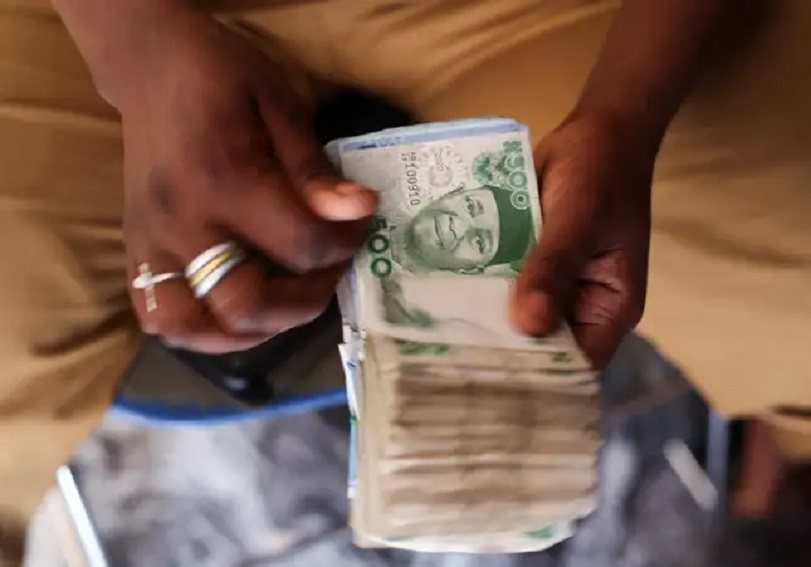
Naira Trades N1,390/$1 at Parallel Market, N1,335/$1 at Official Market
By Adedapo Adesanya
It was another wonderful day for the Nigerian Naira in the different segments of the foreign market (FX) market on Tuesday, February 17, as it appreciated against the United States Dollar at the close of business.
In the parallel market, it improved its value on the greenback by N30 to sell for N1,390/$1 compared with the previous day’s rate of N1,420/$1, and at the GTBank forex desk, it gained N4 to trade at N1,363/$1 versus the preceding session’s N1,367/$1.
As for the official market, which is known as the Nigerian Autonomous Foreign Exchange Market (NAFEX), the local currency gained N11.82 or 0.88 per cent to close at N1,335.96/$1 versus Monday’s price of N1,347.78/$1.
In the same segment of the market, the domestic currency chalked up N32.43 against the Pound Sterling to finish at N1,806.75/£1 compared with the previous day’s N1,839.18/£1, and gained N18.82 on the Euro to close at N1,579.24/€1 compared with the N1,598.06/€1 it was traded a day earlier.
Improved foreign exchange supply levels following recent high demand pressures helped to sustain the currency’s advance. A portion of the delayed demand was eliminated with licensed Bureau De Change (BDC) businesses fully helping to alleviate any development.
While other supply sources, including exporters, non-bank corporations, and other market actors, pause stoked pressures on the exchange rate, their presence is anticipated to increase liquidity and flow.
Foreign reserves were last reported at $47.80 billion after appreciating by $135.75 million. The build-up in reserves has been supported by favourable external conditions, including stronger oil-related inflows and improved FX market stability.
The market is looking forward to a rate cut when the Monetary Policy Committee (MPC) meets next week after inflation decelerated further to 15.10 per cent.
Meanwhile, the cryptocurrency market was down as software stocks continued to plunge, creating a ripple effect on the digital assets.
Market analysts noted that consolidation is expected as crypto searches for a new narrative strong enough to pull capital back from AI stocks and commodities.
Litecoin (LTC) declined by 1.8 per cent to $53.99, Bitcoin decreased by 1.7 per cent to $67,446.46, Cardano (ADA) dropped 1.5 per cent to trade at $0.2810, Binance Coin (BNB) slumped 1.4 per cent to $617.60, Solana (SOL) depreciated by 0.9 per cent to $84.97, Ripple (XRP) shrank by 0.7 per cent to $1.47, and Dogecoin (DOGE) went down by 0.04 per cent to $0.1005.
On the flip side, Ethereum (ETH) appreciated by 0.2 per cent to $1,992.22, while the US Dollar Tether (USDT) and the US Dollar Coin (USDC) remained unchanged at $1.00 apiece.
Economy
N40bn Bond: Relief as Geregu Power Pays N6bn to Bond Investors After Default
By Aduragbemi Omiyale
Those who purchased the N40 billion bond issued by Geregu Power Plc in 2022 but did not receive payments last month as expected have reportedly now been paid by the energy company.
Geregu Power, listed on the Nigerian Exchange (NGX) Limited, was in the news recently over the repayment default on July 28, 2026, triggering panic in the capital market.
Last week, the organisation admitted the issues caused by this default, but said, “Discussions and engagements are ongoing, and the company will continue to act in good faith in fulfilling its responsibilities.”
It further disclosed that “relevant stakeholders and advisers [are being actively engaged] regarding the resolution of the various challenges and is committed to achieving an orderly and mutually beneficial outcome.”
The latest information indicated that N6.03 billion owed investors under the firm’s N40.09 billion Series 1 Senior Unsecured Bond has been cleared.
This is expected to bring relief to investors, who may have feared the worst after the entity failed to meet its debt obligations when due.
However, on the FMDQ Securities Exchange, the status of the debt instrument remains as “credit default in the 8th coupon payment and 4th bullet principal repayment.”
As of the time of filing this report, Geregu Power has yet to confirm the clearing of the N6 billion debt.
Economy
Energy Stocks Sink NGX Index by 0.36% to 240,750.47 points
By Dipo Olowookere
The Nigerian Exchange (NGX) Limited extended its losing streak to seven consecutive sessions on Wednesday after it closed lower by 0.36 per cent.
The loss suffered yesterday was inflicted by the energy space, which significantly shed 4.63 per cent at the close of business. This was because of profit-taking in Aradel Holdings.
Further, the insurance segment went down by 0.88 per cent due to sell-offs, especially after news of the revocation of the operating licence of Universal Insurance Plc by the National Insurance Commission (NAICOM) after it missed the new recapitalisation requirements.
The consumer goods index depreciated at midweek by 0.31 per cent, while the banking space recovered 0.54 per cent, with the industrial goods segment closing flat.
When market activities ended for the session, the All-Share Index (ASI) was down by 860.76 points to 240,750.47 points from 241,611.23 points, and the market capitalisation gave up N556 billion to settle at N155.417 trillion compared with the previous day’s N155.973 trillion.
International Energy Insurance shed 10.00 per cent to quote at N4.77, Aradel lost 9.99 per cent to trade at N1,374.20, Universal Insurance slumped by 9.41 per cent to 77 Kobo, Red Star Express depreciated by 9.26 per cent to N14.70, and Royal Express crashed by 8.62 per cent to N1.06.
On the flip side, Haldane McCall gained 10.00 per cent to end at N3.52, Coronation Insurance improved by 8.44 per cent to N2.44, UAC Nigeria jumped by 6.56 per cent to N177.85, AVA Capital grew by 6.29 per cent to N7.60, and Caverton rose by 5.32 per cent to N4.95.
The most active equity during the session was Fortis Global Insurance, with a turnover of 610.7 million units worth N1.2 billion. FCMB traded 60.9 million units worth N722.9 million, Fidelity Bank transacted 57.0 million units valued at N1.2 billion, Consolidated Hallmark sold 46.3 million units worth N312.7 million, and Royal Exchange exchanged 43.5 million units valued at N45.8 million.
In all, a total of 1.2 billion shares valued at N37.8 billion exchanged hands in 34,546 deals on Wednesday compared with the 429.8 million shares worth N27.5 billion traded in 35,683 deals on Tuesday. This indicated a spike in the trading volume and value by 179.20 per cent and 37.46 per cent, respectively, while the number of deals declined by 3.19 per cent.
Economy
NAICOM Withdraws Universal Insurance Operating Licence
By Aduragbemi Omiyale
The operating licence of Universal Insurance Plc has been withdrawn by the National Insurance Commission (NAICOM).
This action was taken by the regulator over the failure of the underwriting firm, which is listed on the Nigerian Exchange (NGX) Limited, to meet the new recapitalisation requirements on or before July 31, 2026.
NAICOM said it revoked the company’s licence based on its powers stipulated in the Nigerian Insurance Industry Reform Act (NIIRA) 2025.
The regulator has appointed a Receiver/Provisional Liquidator for the insurance company, and he is Mr Ogbonna Chukwumerije, a partner at Pinheiro LP.
He will immediately trace, recover, secure and take possession of Universal Insurance’s assets, collate its liabilities and facilitate their settlement in accordance with the provisions of NIIRA 2025.
He is also required to liaise with NAICOM and submit periodic reports on the progress of the receivership and liquidation process.
Already, Mr Chukwumerije has informed banks, financial institutions, policyholders, creditors, debtors, customers and members of the public that Universal Insurance had entered receivership, advising parties dealing with the company’s funds, assets, records, policies, claims and liabilities to verify the authority of anyone claiming to act on its behalf.
Banks and other financial institutions were specifically warned against honouring withdrawals, transfers, payment mandates or other instructions issued on behalf of Universal Insurance unless authorised by the receiver.
However, Universal Insurance has taken steps to appeal NAICOM’s decision. The organisation was among six insurers that failed to meet the recapitalisation deadline.