Economy
Heritage Bank Backs Triton Group Reforestation Project in Oyo

By Dipo Olowookere
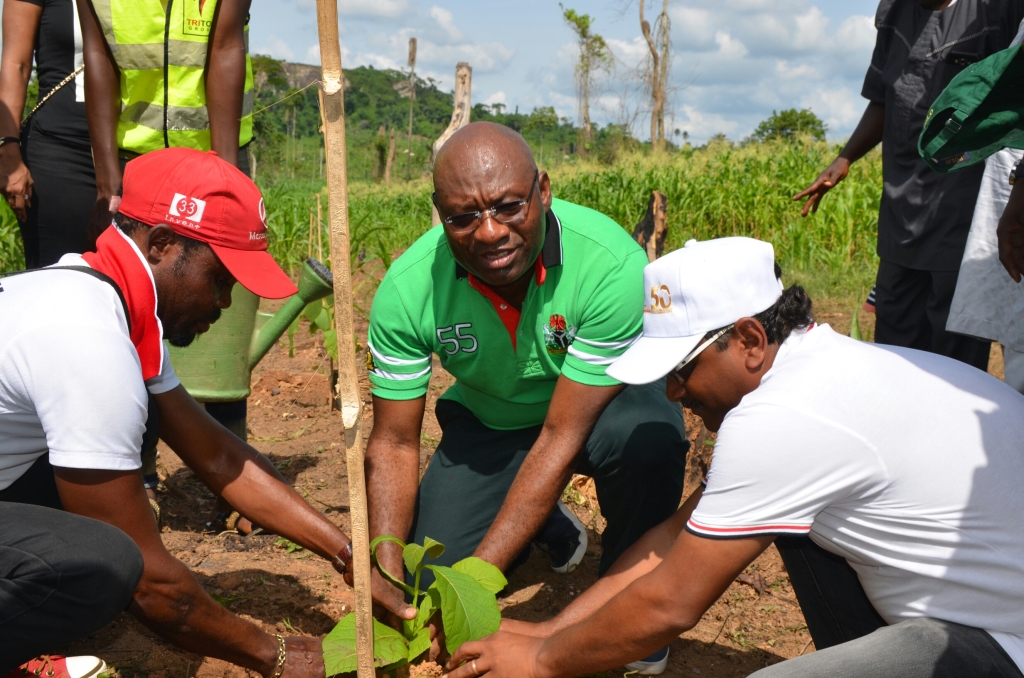
The second phase of afforestation programme of Globus Resources Limited, a subsidiary of Triton Group, in Oyo State has received the backing of Heritage Bank Plc, one of Nigeria’s most innovative banking services providers.
The bank as the first financier had earlier financed the first phase of the project and offered N2 billion long-term facility to enable Triton Aqua Africa Limited (TAAL) expand its aquaculture businesses- nursery/hatchery for the production of fingerlings and brood stock in Ikeja; and earthen ponds for catfish and tilapia in Asejire, Iwo and Gambari towns in Oyo.
Under the programme, Globus Resources is expected to plant about 350,000 seedlings of teak, Gmelina arborea and Cidrella trees yearly over a period nine years in a bid to reforest about nine thousand hectares of land in Gambari village in Oyo state which had been exploited by tree fellers for timbers among others.
Speaking at the event, Managing Director/CEO of Heritage Bank, Mr Ifie Sekibo, commended the state Governor, Mr Abiola Ajimobi and the Triton Group for the initiative between the state and Globus Resources to reforest the area again.
He remarked that if every governor could put a little of bit of backing into agriculture as a way of life, it would go a long way to better the lives of the people.
He added that, “we seemed to forget that our lives as Nigerians/Africans started with the land. If we don’t take care of the land, the land will take care of us, the land does not need us, and we need the land to take care of us. Afforestation is one of the ways to take care of the land and we need to talk about carbon credit because we need to find a way to make money.”
Mr Sekibo said “we consistently cut down trees to make boats, plywood and all kind of things for comfort and don’t think about replenishing them, remarking that they are actually exhaustive, they are not inelastic and there is need for deliberate steps to be taken to replenish them.”
Meanwhile, Mr Sekibo expressed satisfaction with the pace at which the project was going; as he assured the company’s team that Heritage Bank would continue to support the genuine cause by Triton Group to boost the agricultural base of the nation as long as the business relationship between the bank and Triton Aqua is mutually beneficial.
The bank boss thanked Triton Group for taking the initiative to replenish the trees, noting that although it will take a while for the trees to become usable, they will regenerate and as they nurture them to grow, in the next five to ten years, the whole place will be covered with trees.
Chairman/MD of Triton Group, Mr Ashvin Samtani, said the group has been operating in Nigeria for about 40 years, remarking that they are Nigerians, not expatriates, adding that beyond the tree planting initiative, the group intends to employ about 5,000 people.
The chairman of the occasion, Mr Akinwale Moradayo, Deputy Director of Forestry in the Ministry of Agriculture, Natural Resources and Rural Development, Oyo State who stood in for the Commissioner, Mr Oyewole Oyewumi also stressed the need to do something to protect the land, so that its inhabitants would not be consumed.
The Triton Group besides afforestation is also engaged in poultry and aquaculture among others.
Economy
Naira Retreats to N1,366.19/$1 After 13 Kobo Loss at Official Market
By Adedapo Adesanya
The value of the Naira contracted against the United States Dollar on Friday by 13 Kobo or 0.01 per cent to N1,366.19/$1 in the Nigerian Autonomous Foreign Exchange Market (NAFEX) from the previous day’s value of N1,366.06/$1.
According to data from the Central Bank of Nigeria (CBN), the Nigerian currency also depreciated against the Pound Sterling in the same market window yesterday by N2.37 to N1,857.75/£1 from the N1,855.38/£1 it was traded on Thursday, and further depleted against the Euro by 57 Kobo to close at N1,612.52/€1 versus the preceding session’s N1,611.95/€1.
In the same vein, the exchange rate for international transactions on the GTBank Naira card showed that the Naira lost N8 on the greenback yesterday to N1,383/$1 from the previous day’s N1,375/$1 and at the black market, the Nigerian currency maintained stability against the Dollar at N1,450/$1.
FX analysts anticipate this trend to persist, primarily influenced by increasing external reserves, renewed inflows of foreign portfolio investments, and a reduction in speculative demand.
In the short term, stability in the FX market is expected to continue, supported by policy interventions and improving market confidence.
Nigeria’s foreign reserves experienced an upward trajectory, increasing by $632.38 million within the week to $46.91 billion from $46.27 billion in the previous week.
The Dollar appreciation this week appears to be largely technical, serving as a correction to the substantial losses experienced from mid- to late January.
Meanwhile, the cryptocurrency market slightly appreciated, with Bitcoin (BTC) climbing near $68,000, up nearly 5 per cent since hitting $60,000 late on Thursday after investor confidence in crypto’s utility as a store of value, inflation hedge, and digital currency faltered.
The sell-off extended beyond crypto, with silver plunging 15 per cent and gold sliding more than 2 per cent. US stocks also fell.
The latest recoup saw the price of BTC up by 4.7 per cent to $67,978.96, as Ethereum (ETH) appreciated by 6.3 per cent to $2,021.10, and Ripple (XRP) surged by 9.5 per cent to $1.42.
In addition, Solana (SOL) grew by 7.3 per cent to $85.22, Cardano (ADA) added 6.1 per cent to trade at $0.2683, Dogecoin (DOGE) expanded by 5.4 per cent to $0.0958, Litecoin (LTC) rose by 5.2 per cent to $53.50, and Binance Coin (BNB) jumped by 2.3 per cent to $637.79, while the US Dollar Tether (USDT) and the US Dollar Coin (USDC) traded flat at $1.00 each.
Economy
Oil Prices Climb on Worries of Possible Iran-US Conflict
By Adedapo Adesanya
Oil prices settled higher on Friday as traders worried that this week’s talks between the US and Iran had failed to reduce the risk of a military conflict between the two countries.
Brent crude futures traded at $68.05 a barrel after going up by 50 cents or 0.74 per cent, and the US West Texas Intermediate (WTI) crude futures finished at $63.55 a barrel due to the addition of 26 cents or 0.41 per cent.
Iran and the US held negotiations in Muscat, the capital of Oman, on Friday to overcome sharp differences over Iran’s nuclear programme.
It was reported that the talks had ended with Iran’s foreign minister saying negotiators will return to their capitals for consultations and the talks will continue.
Regardless, the meeting kept investors anxious about geopolitical risk, as Iran wanted to stick to nuclear issues while the US wanted to discuss Iran’s ballistic missiles and support for armed groups in the region.
Any escalation of tension between the two nations could disrupt oil flows, since about a fifth of the world’s total consumption passes through the Strait of Hormuz between Oman and Iran.
Saudi Arabia, the United Arab Emirates, Kuwait and Iraq export most of their crude via the strait, as does Iran, which is a member of the Organisation of the Petroleum Exporting Countries (OPEC).
According to Reuters, Iran objected to the presence of any US Central Command (CENTCOM) or other regional military officials, saying that would jeopardise the process.
The current confrontation was sparked by more than two weeks of unrest in Iran that saw authorities launch a deadly crackdown that killed thousands of civilians and shocked the world. As reports of the deaths trickled out of Iran, US President Donald Trump threatened to strike Iran if any of the tens of thousands of protesters arrested were executed.
Meanwhile, Kazakhstan’s planned oil exports could fall by as much as 35 per cent this month via its main route through Russia, as the country’s top oil company, Tengiz oilfield, slowly recovers from fires at power facilities in January.
ING analysts have pointed out Iran’s neighbour, Iraq, and a disagreement with the US as another bullish factor for oil prices. It seems Iraqi politicians favour Mr Nouri al-Maliki as the country’s next Prime Minister, but the US thinks Mr al-Maliki is too close to Iran. President Trump has already threatened the oil producer with consequences if he emerges as PM.
Economy
Adedeji Urges Nigeria to Add More Products to Export Basket
By Adedapo Adesanya
The chairman of the Nigeria Revenue Service (NRS), Mr Zacch Adedeji, has urged the country to broaden its export basket beyond raw materials by embracing ideas, innovation and the production of more value-added and complex products
Mr Adedeji said this during the maiden distinguished personality lecture of the Faculty of Administration, Obafemi Awolowo University (OAU), Ile-Ife, Osun State, on Thursday.
The NRS chairman, in the lecture entitled From Potential to Prosperity: Export-led Economy, revealed that Nigeria experienced stagnation in its export drive over three decades, from 1998 to 2023, and added only six new products to its export basket during that period.
He stressed the need to rethink growth through the lens of complexity by not just producing more of the same stuff, lamenting that Nigeria possesses a high-tech oil sector and a low-productivity informal sector, as well as lacking “the vibrant, labour-absorbing industrial base that serves as a bridge to higher complexity,” he said in a statement by his special adviser on Media, Dare Adekanmbi.
Mr Adedeji urged Nigeria to learn from the world by comparative studies of success and failure, such as Vietnam, Bangladesh, Indonesia, South Africa, and Brazil.
“We are not just looking at numbers in a vacuum; we are looking at the strategic choices made by nations like Vietnam, Indonesia, Bangladesh, Brazil, and South Africa over the same twenty-five-year period. While there are many ways to underperform, the path to success is remarkably consistent: it is defined by a clear strategy to build economic complexity.
“When we put these stories together, the divergence is clear. Vietnam used global trade to build a resilient, complex economy, while the others remained dependent on natural resources or a single low-tech niche.
“There are three big lessons here for us in Nigeria as we think about our roadmap. First, avoiding the resource curse is necessary, but it is not enough. You need a proactive strategy to build productive capabilities,” he stated, adding that for Nigeria, which is at an even earlier stage of development and even less diversified than these nations, the warning is stark.
“Relying solely on our natural endowments isn’t just a path to stagnation; it’s a path to regression. The global economy increasingly rewards knowledge and complexity, not just what you can dig out of the ground. If we want to move from potential to prosperity, we must stop being just a source of raw materials and start being a source of ideas, innovation, and complex products,” the taxman stated.
He added that President Bola Tinubu has already begun the difficult work of rebuilding the economy, building collective knowledge to innovate, produce, and build a resilient economy.
-
Feature/OPED6 years agoDavos was Different this year
-
Travel/Tourism9 years ago
Lagos Seals Western Lodge Hotel In Ikorodu
-
Showbiz3 years agoEstranged Lover Releases Videos of Empress Njamah Bathing
-
Banking8 years agoSort Codes of GTBank Branches in Nigeria
-
Economy3 years agoSubsidy Removal: CNG at N130 Per Litre Cheaper Than Petrol—IPMAN
-
Banking3 years agoSort Codes of UBA Branches in Nigeria
-
Banking3 years agoFirst Bank Announces Planned Downtime
-
Sports3 years agoHighest Paid Nigerian Footballer – How Much Do Nigerian Footballers Earn