Connect with us

Economy

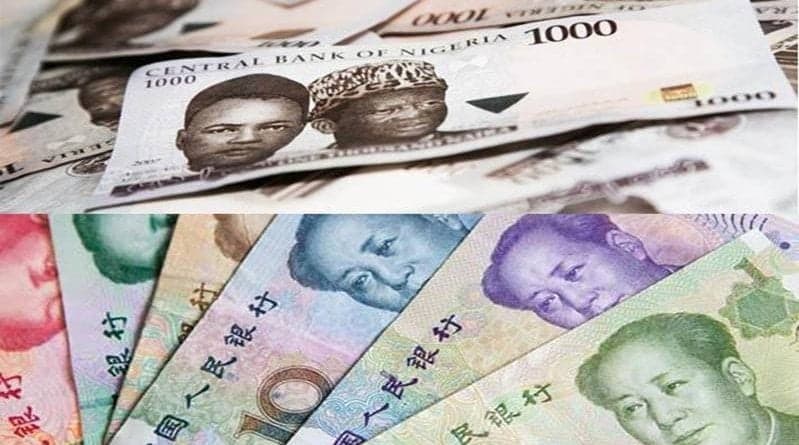
Naira Down Again at NAFEX, Trades N1,359/$1

Published

on

Naira-Yuan Currency Swap Deal

By Adedapo Adesanya

The Naira further weakened against the Dollar in the Nigerian Autonomous Foreign Exchange Market (NAFEX) for the fourth straight session this week on Thursday, February 26.

At the official market yesterday, the Nigerian Naira lost N3.71 or 0.27 per cent to trade at N1,359.82/$1 compared with the previous session’s N1,356.11/$1.

In the same vein, the local currency depreciated against the Pound Sterling in the same market window on Thursday by N8.27 to close at N1,843.23/£1 versus Wednesday’s closing price of N1,834.96/£1, and against the Euro, it crashed by N8.30 to quote at N1,606.89/€1, in contrast to the midweek’s closing price of N1,598.59/€1.

But at the GTBank forex desk, the exchange rate of the Naira to the Dollar remained unchanged at N1,367/$1, and also at the parallel market, it maintained stability at N1,365/$1.

The continuation of the decline of the Nigerian currency is attributed to a surge in foreign payments that have outpaced the available Dollars in the FX market.

In a move to address the ongoing shortfall at the official window, the Central Bank of Nigeria (CBN) intervened by selling $100 million to banks and dealers on Tuesday.

However, the FX support failed to reverse the trend, though analysts see no cause for alarm, given that the authority recently mopped up foreign currency to achieve balance and it is still within the expected trading range of N1,350 and N1,450/$1.

As for the cryptocurrency market, major tokens posted losses over the last 24 hours as traders continued to de-risk alongside equities following Nvidia’s earnings-driven pullback, with Ripple (XRP) down by 2.7 per cent to $1.40, and Dogecoin (DOGE) down by 1.6 per cent to $0.0098.

Further, Litecoin (LTC) declined by 1.3 per cent to $55.87, Ethereum (ETH) slipped by 0.9 per cent to $2,036.89, Bitcoin (BTC) tumbled by 0.7 per cent to $67,708.21, Cardano (ADA) slumped by 0.6 per cent to $0.2924, and Solana (SOL) depreciated by 0.4 per cent to $87.22, while Binance Coin (BNB) gained 0.4 per cent to sell for $629.95, with the US Dollar Tether (USDT) and the US Dollar Coin (USDC) closing flat at $1.00 each.


Adedapo Adesanya is a journalist, polymath, and connoisseur of everything art. When he is not writing, he has his nose buried in one of the many books or articles he has bookmarked or simply listening to good music with a bottle of beer or wine. He supports the greatest club in the world, Manchester United F.C.

Economy

Meristem Projects Nigeria’s March 2026 Inflation at 13.59%

Published

on

inflation in Nigeria

By Aduragbemi Omiyale

Analysts at Meristem Research have projected that the inflation rate in Nigeria for March 2026 should further moderate to 13.59 per cent on a year-on-year basis from the 15.06 per cent recorded in February 2026.

The company, in a note sighted by Business Post, explained that easing in the average prices of goods and services for last month would be impacted by a high base from the same period of 2025, but noted that on a month-on-month basis, the rate will spike.

Last month, energy prices soared after the price of crude oil on the global market soared as a result of the war in Iran, with prices of items growing in Nigeria.

“However, month-on-month pressures are likely to pick up, driven by the renewed increases in energy prices, which should nudge headline inflation higher.

“Core inflation is also likely to edge higher, reflecting second-round effects from higher transportation and production costs, although the relative stability of the Naira should help moderate the pace of increase.

“Food inflation is also expected to rise on a month-on-month basis, driven by higher logistics and distribution costs, as well as recent increases in staple food prices,” a part of the report noted.

The National Bureau of Statistics (NBS) is expected to release the inflation numbers later today.

Nigeria’s headline inflation rate moderated marginally by 0.04 per cent to 15.06 per cent in February 2026 from 15.10 per cent in January 2026, though on a month-on-month basis, inflationary pressures accelerated.

Continue Reading

Economy

Nigeria’s Public Debt Nears N160trn

Published

on

total debt stock

By Adedapo Adesanya

Nigeria’s total public debt rose from N153.29 trillion at the end of September 2025 to N159.28 trillion in December 2025, according to the latest data released by the Debt Management Office (DMO) on Tuesday.

The increase indicates a quarter-on-quarter increase of N5.98 trillion or 3.9 per cent.

The debt office noted that the December 2025 figures are provisional and were converted using the Central Bank of Nigeria’s official exchange rate of N1,435.25/$, while the September 2025 figures were converted using N1,474.85/$.

On a year-on-year basis, the debt profile marked an increase of N14.61 trillion or 10.1 per cent, from N144.67 trillion in December 2024 to N159.28 trillion in December 2025, representing a rise from $94.23 billion to $110.97 billion, an increase of $16.75 billion, in Dollar terms.

Domestic debt remained the largest, rising from N81.82 trillion in September 2025 to N84.85 trillion in December 2025.

This represents a quarter-on-quarter increase of N3.03 trillion or 3.7 per cent compared to December 2024, when domestic debt stood at N74.38 trillion – the figure increased by N10.47 trillion or 14.1 per cent year-on-year.

In Dollar terms, domestic debt rose from $55.47 billion in September 2025 to $59.12 billion in December 2025, and from $48.44 billion in December 2024. This highlights a sustained reliance on the domestic market for financing.

The federal government accounted for the bulk of domestic debt at N80.49 trillion, representing 50.53 per cent of total public debt, while states and the Federal Capital Territory (FCT) accounted for N4.36 trillion.

Nigeria’s external debt stood at N74.43 trillion as of December 2025, representing 46.73 per cent of total public debt.

This reflects a quarter-on-quarter increase of N2.95 trillion from N71.48 trillion in September 2025, and a year-on-year increase of N4.14 trillion from N70.29 trillion recorded in December 2024.

In Dollar terms, external debt rose from $48.46 billion in September 2025 to $51.86 billion in December 2025, and from $45.78 billion in December 2024.

The federal government continued to dominate external borrowing, accounting for N66.27 trillion of the total external debt, while states and the FCT accounted for N8.16 trillion.

However, the structure of Nigeria’s debt portfolio remained broadly stable despite the increase in overall debt.

While domestic debt accounted for 53.27 per cent of total debt in December 2025, compared to 53.37 per cent in September 2025 and 51.41 per cent in December 2024, external debt stood at 46.73 per cent in December 2025, compared to 46.63 per cent in September 2025 and 48.59 per cent a year earlier.

Continue Reading

Economy

Daily Petrol Consumption in Nigeria Slips to 47.3 million Litres Amid Price Hike

Published

on

daily petrol consumption

By Dipo Olowookere

The volume of premium motor spirit (PMS), commonly known as petrol, consumed daily in Nigeria stood at 47.3 million litres in March 2026 compared with the 56.9 million litres recorded in February 2026.

This information was revealed by the Nigerian Midstream and Downstream Petroleum Regulatory Authority (NMDPRA) in its latest factsheet.

The decline in daily petrol consumption in Nigeria coincided with a hike in the price of the product, triggered by a rise in global crude oil prices as a result of the Middle East crisis.

The United States and Israel launched airstrikes in Iran in late February, with crude oil rising above $100 per barrel and even above $110 per barrel at one point.

The price is currently below $100 per barrel on the global market after the President of the United States, Mr Donald Trump, signalled his intention to negotiate with Iran amid the blockage of the Strait of Hormuz.

Data by NMDPRA also showed that diesel consumption eased to 14.5 million litres per day from the previous month’s 20.3 million litres per day, while aviation fuel stood at 2.1 million litres per day versus 2.9 million litres per day in February 2026.

It was also disclosed that PMS daily supply for the month under review increased to 40.1 million litres per day from the preceding month’s 39.5 million litres per day.

From this, domestic supply came down by 6.30 per cent to 34.2 million litres per day from 36.5 million litres per day, while imported petrol stood at 5.9 million litres per day versus 3.0 million litres per day a month earlier.

Business Post observed that Dangote Refinery supplied about 34.2 million litres per day of PMS into the Nigerian market from the 48.2 million litres per day it produced. The private refiner produced 16.5 million litres of diesel per day in March 2026, supplying 2.2 million litres per day into the domestic market.

In the period, the Warri and Kaduna refineries were totally shut down, while the Port Harcourt refinery, according to the report, though it was shut down, witnessed the evacuation of about 0.048 million litres of diesel per day while it was operational.

Continue Reading

Trending