

Connect with us

Media OutReach

PolyU research unveils mechanoelectrical perception in sea urchin spines, empowering next-generation biomimetic sensors

Published

on

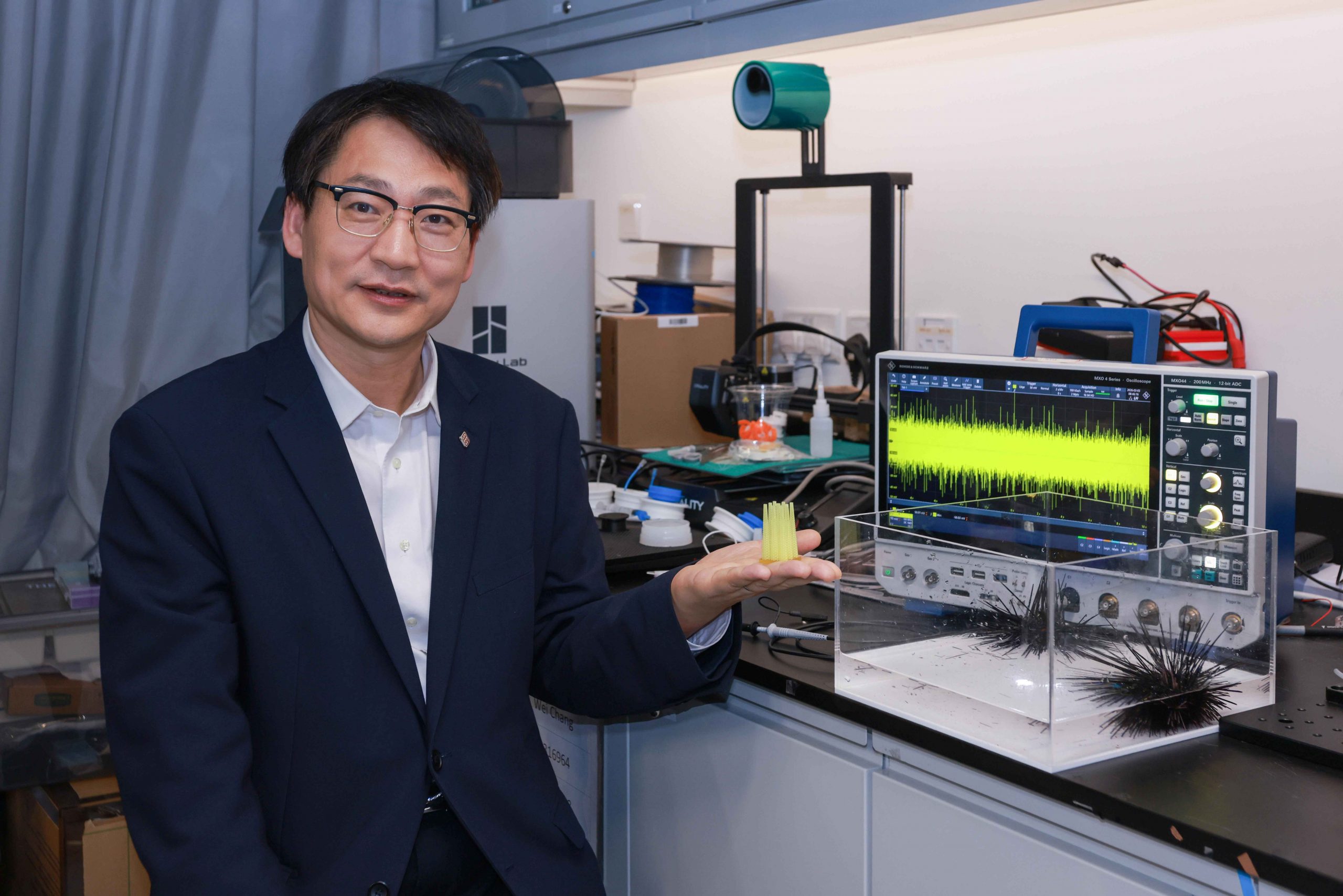
HONG KONG SAR – Media OutReach Newswire – 5 March 2026 – Sea urchin spines are not only for defence—they also act as natural sensors. A research team led by Prof. WANG Zuankai, Associate Vice President (Research and Innovation), Dean of Graduate School, Kuok Group Professor in Nature-Inspired Engineering and Chair Professor of the Department of Mechanical Engineering of The Hong Kong Polytechnic University (PolyU), together with scholars from City University of Hong Kong (CityU) and Huazhong University of Science and Technology (HUST), has discovered the mechanoelectrical perception in sea urchin spines, originating in their gradient porous structure, that allows the spines to instantly detect water flow. Using 3D printing, the team has replicated this structure and developed a bionic metamaterial sensor, which holds promise for breakthroughs in sensing technology. This innovation will drive the advancement of deep-sea technology such as marine monitoring and underwater infrastructure management, and can be extended to other emerging fields like brain-computer interfacing and aerospace.

A research team led by Prof. Wang Zuankai, Associate Vice President (Research and Innovation), Dean of Graduate School, Kuok Group Professor in Nature-Inspired Engineering and Chair Professor of the Department of Mechanical Engineering of PolyU, has discovered the mechanoelectrical perception in sea urchin spines. It originates in the spines’ gradient porous structure that generates electrical signals when water flows through it. The team used 3D printing technology to replicate the structure and develop a novel bionic metamaterial sensor.

The research team found that, in the long-spined sea urchin (Diadema setosum), when a seawater droplet strikes the tip of a spine, the spine rotates rapidly within a second. Electrical measurements revealed that the droplet simulation produced a voltage of about 100 millivolts inside the spine; when the spine is immersed in water, water flow stimulation triggers a voltage of several tens of millivolts. This mechanoelectrical perception was observed even in dead spines, indicating that the mechanism is unrelated to biological cells.

This response originates from the stereom structure of the spine—the porous internal skeleton composed of pores with varying sizes and distributions. These pores exhibit a gradual gradient along the spine from the base to the tip: larger pores and lower solid density at the base, and smaller pores and higher solid density at the tip, forming a bicontinuous gradient porous structure. As water flows through the porous structure, solid-liquid interfacial interaction occurs and the flow exerts shear force on the electric double layer, inducing the separation and redistribution of interfacial charge, which generates a voltage difference. The gradient structure intensifies the interaction between water flow and pore surfaces, resulting in a stronger voltage difference and enhancing the spine’s sensing capabilities.

Inspired by these findings, the researchers used vat photopolymerisation 3D printing to create artificial samples from polymer and ceramic materials that resemble the spine’s stereom. Experiments showed that the spine-mimicking design produce a voltage output about three times higher and an amplitude about eight times greater than non-gradient designs under water flow stimulation, demonstrating that the key to the mechanoelectrical perception lies in the structure rather than the material. They also constructed a bionic 3D metamaterial mechanoreceptor that is designed in a 3 × 3 array with each unit made of gradient porous material. This mechanoreceptor can record electrical signals in real time underwater and precisely locate the position of water flow impact, without the need for additional electricity.

The research team points out that the gradient porous structure in sea urchin spines enhances signal transmission, thereby improving the precision and sensitivity of the mechanoreceptor. By replicating this structure in different materials, it is possible to extend its application beyond water flow sensing to various types of signals, including those measuring pressure, vibration and electromagnetic waves. This will inspire sensing technologies in multiple fields, such as in relation to its use in brain-computer interfaces to enhance the sensing of brainwaves and neural signals, with tremendous application potential.

Prof. Wang Zuankai said, “Compared to traditional mechanoreceptors, our design excels in manufacturability, structural design flexibility, material versatility, geometric and performance control, and real-time underwater self-sensing. Leveraging gradients of porous materials and 3D printing technologies, we aspire to produce more nature-inspired metamaterial sensors with a range of materials, pore sizes and surface features that support potential applications in many fields.”

At the forefront of nature-inspired science and engineering research, Prof. Wang’s team has also invented various new materials, including lotus leaf-inspired self-cleaning surfaces capable of rapid water repellency, Araucaria leaves-inspired surfaces that enable self-propelled liquid transport, and anti-icing structures that achieve spontaneous ejection of freezing droplets by replicating the biological mechanism of spore shooting in fungi. He envisions that their research will open up new avenues for the development of nature-inspired materials.

“For natural porous materials, mechanical properties such as strength may not be the primary function, but rather a by-product of complex biomineralisation. Uncovering previously unknown mechanisms that lie beyond a material’s traditionally recognised function helps us to more comprehensively understand and fully utilise these natural resources. This is crucial for advancing biomimetic research,” he added.

This joint research was co-led by Prof. LU Jian from CityU, and Prof. YAN Chunze and Prof. SU Bin from HUST. The study findings have been published in the international journal Nature.
Hashtag: #PolyU #MarineEnvironment #NatureInspiredEngineering #SensingTechnology #DeepSeaTechnology #Brain-ComputerInterface #Nature #HongKong

The issuer is solely responsible for the content of this announcement.

Media OutReach

VinFast inaugurates 20 e-motorcycle dealerships in Indonesia, expanding its green mobility ecosystem nationwide

Published

on

JAKARTA, INDONESIA – Media OutReach Newswire – 18 July 2026VinFast announced the opening of 20 official e-motorcycle dealerships across Indonesia in July 2026, marking a major milestone in its strategy to expand its distribution network in Southeast Asia’s largest motorcycle market. To celebrate the launch, VinFast hosted a large-scale product experience event featuring the VinFast Evo, VinFast Feliz II, and VinFast Viper, offering consumers the opportunity to experience the Company’s smart e-motorcycles and comprehensive green mobility ecosystem firsthand.

VinFast officially launched 20 electric motorcycle dealerships across Indonesia in July 2026.

The grand opening of VinFast dealers will take place from July 19 to 25, 2026, bringing VinFast’s genuine products and services closer to customers across Indonesia. The 20 new dealerships are located across key regions such as Jakarta, Bandung, Semarang, Yogyakarta, Medan, Palembang, Makassar and many other major provinces and cities nationwide.

VinFast representatives and distinguished guests at the VinFast Electric Motorcycle Experience Day, marking the start of the grand opening series for VinFast's 20 electric motorcycle dealerships in Indonesia.
VinFast representatives and distinguished guests at the VinFast Electric Motorcycle Experience Day, marking the start of the grand opening series for VinFast’s 20 electric motorcycle dealerships in Indonesia.

The expansion follows strong customer response to VinFast’s Early Booking Program, which has attracted thousands of deposits across Indonesia.

Dealerships will provide a full range of services, including vehicle sales, product consultation, after-sales support, and customer care in accordance with VinFast’s global standards. In addition to showcasing and selling VinFast E-motorcycles, the dealerships will offer customers opportunities to test ride the vehicles, experience the battery swapping solution and home charging options, and learn more about VinFast’s attractive ownership policies. Customers can visit VinFast’s official website at: https://vinfastauto.id/ to locate their nearest dealership and register for a test ride.

The VinFast Evo electric motorcycle on display at the event.

The opening campaign kicked off with the VinFast E-Motorcycle Experience Day, taking place on July 18, 2026, at Tribeca, Jakarta. The event welcomed customers, media representatives, KOLs, business partners, and electric mobility enthusiasts to explore VinFast’s e-motorcycle lineup and green mobility ecosystem.

During the event, attendees explored the full range of color options available for the VinFast Evo, VinFast Feliz II, and VinFast Viper, while learning more about each model, VinFast’s battery swapping network, home charging solutions, and the energy infrastructure being developed in partnership with V-Green.

In addition to the product showcase, the event featured dedicated test ride sessions, battery swapping demonstrations, safe riding challenges, interactive games, and opportunities to engage directly with VinFast’s product specialists.

Ms. Vo Thi Cam Tu, Managing Director of VinFast E-scooter Overseas Market, said: “VinFast’s strategy goes beyond introducing high-quality electric vehicles. Our vision is to build a complete ecosystem that makes owning and using electric vehicles more convenient than ever. The launch of 20 dealerships across Indonesia, together with our battery swapping, charging, and after-sales service network, represents another important step toward realizing that vision. We hope more Indonesian consumers will choose E-motorcycles as a smart, economical, and sustainable mobility solution.”

The three e-motorcycle models introduced by VinFast in Indonesia are designed to meet the needs of different customer segments while sharing the company’s advanced technology platform and innovative battery swapping ecosystem.

The VinFast Viper features a sporty design tailored to young, tech-savvy riders. Meanwhile, the VinFast Feliz II and VinFast Evo build upon the proven strengths of their predecessors in Vietnam while incorporating refinements to better suit the needs and preferences of Indonesian consumers.

All three models are equipped with a 5,200W BLDC in-wheel motor. The VinFast Viper and VinFast Feliz II offer a top speed of 90 km/h, while the VinFast Evo reaches 80 km/h. Each motorcycle is designed with dual battery compartments under the seat, allowing the simultaneous use of two 1.5 kWh LFP batteries.

With two fully-charged batteries installed, the VinFast Evo delivers a riding range of up to 150 km, while the VinFast Viper and VinFast Feliz II can travel up to 145 km under standard testing conditions, making them well-suited for both daily commuting and longer urban journeys.

Customers can choose to purchase their motorcycles with batteries included or opt for a battery subscription plan. In addition to battery swapping, the motorcycles can also be conveniently charged at home.

As a special launch benefit, all VinFast E-motorcycle owners will enjoy free battery swapping at V-Green’s public battery swapping stations for one year, with a maximum of 20 battery swaps per motorcycle per month. The motorcycles are also backed by a warranty of up to 4+2 years or 60,000+12,000 kilometers, whichever comes first, helping reduce ownership costs while enhancing convenience and peace of mind.

The simultaneous opening of 20 e-motorcycle dealerships further demonstrates VinFast’s long-term commitment to the Indonesian market. By expanding its retail network, diversifying its product portfolio, and investing in energy infrastructure, VinFast is steadily building a comprehensive green mobility ecosystem that will help accelerate the country’s transition toward sustainable transportation in one of the world’s largest motorcycle markets.

Hashtag: #VinFast

The issuer is solely responsible for the content of this announcement.

Continue Reading

Media OutReach

VinFast partners with Bespoke Logistics to strengthen electric motorcycle logistics capabilities in the Philippines

Published

on

MANILA, PHILIPPINES – Media OutReach Newswire – 18 July 2026 – Global electric vehicle company VinFast has officially signed a strategic cooperation agreement with Bespoke Logistics, a Philippine provider of end-to-end automotive logistics solutions, to establish an integrated mobility processing center and authorized service workshop for the inspection and preparation of VinFast electric motorcycles prior to delivery. The partnership will help ensure vehicle quality, shorten delivery lead times, and lay a solid foundation for VinFast’s expanding electric motorcycle ecosystem in the Philippines.

Mr. Irineo Niño Fabros, CEO of VinFast Electric Motorcycles Philippines (left), and Mr. Allan A. Mina, President and CEO of Bespoke Logistics, at the signing ceremony.

Under the agreement, Bespoke Logistics will operate an integrated mobility processing center and VinFast-authorized service workshop, responsible for warehousing, vehicle inspection, technical preparation of electric motorcycles prior to delivery, vehicle yard management, and transportation. Located in Carmona City, Cavite Province, the 20,000-square-meter facility has a storage capacity of up to 30,000 vehicles, helping streamline vehicle preparation, improve operational efficiency, and ensure product quality before delivery to customers.

As part of the partnership, VinFast will work closely with Bespoke Logistics to implement technician training and certification programs, transfer standardized operating procedures and quality control processes, and establish a parts supply system to support aftersales operations.

Bespoke Logistics specializes in automotive logistics, offering an end-to-end service portfolio that includes pre-delivery inspection (PDI), warehousing, vehicle yard management, transportation, and vehicle delivery. The company also has extensive experience in warehouse-based technical operations and modern vehicle and inventory management systems, serving as a trusted logistics partner for multiple automotive brands in the Philippines.

Partnering with experienced local companies such as Bespoke Logistics will not only strengthen VinFast’s logistics and service capabilities in the Philippines but also provide a strong operational foundation for the delivery of its first electric motorcycles to customers.

The agreement forms part of VinFast’s long-term strategy to develop a comprehensive, international-standard electric motorcycle ecosystem in the Philippines. Alongside the launch of its diverse lineup of battery-swapping electric motorcycles, VinFast is steadily expanding its distribution network, aftersales services, and battery swapping infrastructure to deliver a seamless, convenient, and reliable ownership experience for customers.

Mr. Bui Viet Hung, VinFast Deputy CEO of Global Aftersales Service, said: “At VinFast, world-class products must be supported by robust infrastructure and exceptional aftersales services. Our partnership with Bespoke Logistics is a key milestone in strengthening our distribution and aftersales capabilities in line with global standards, ensuring that customers in the Philippines enjoy high quality products and services from day one of ownership.”

Mr. Allan A. Mina, President and CEO of Bespoke Logistics said: “We are proud to partner with VinFast as it develops its electric motorcycle ecosystem in the Philippines. We are committed to operating the facility in accordance with VinFast’s international standards while continuously enhancing our team’s capabilities and operational processes to support the brand’s long-term growth in the market.”

Over the past few years, VinFast has steadily built a green mobility ecosystem across the Philippines, Indonesia, India, and other international markets through strategic partnerships with local companies and ecosystem partners such as Green GSM and V-Green. In addition to electric motorcycles, VinFast is expanding its product portfolio to include electric cars, electric bicycles, and electric buses, providing consumers with more sustainable mobility options while accelerating the global transition to greener transportation.

Hashtag: #VinFast

The issuer is solely responsible for the content of this announcement.

About About VinFast

VinFast (NASDAQ: VFS), a subsidiary of Vingroup JSC, one of Vietnam’s largest conglomerates, is a pure-play electric vehicle (“EV”) company with the mission of making EVs accessible to everyone. VinFast’s product lineup today includes a wide range of electric SUVs, e-scooters, and e-buses.

VinFast is currently embarking on its next growth phase through rapid expansion of its distribution and dealership network globally while expanding its production footprint with a focus on key markets across North America, Europe, the Middle East and Asia.

Learn more at:

About Bespoke Logistics

Bespoke Logistics is a Philippine-based automotive logistics, warehousing, and mobility solutions company specializing in vehicle processing, stockyard management, electric vehicle support services, transportation, and distribution.

Through its Mobility Processing Center platform, Bespoke Logistics provides integrated solutions for automotive manufacturers, distributors, and emerging mobility brands operating in the Philippines.

Continue Reading

Media OutReach

BRICS Competition Authorities Establish Task Force to Study Global Grain Trade

Published

on

GENEVA, SWITZERLAND – Media OutReach Newswire – 17 July 2026 – Competition authorities from BRICS countries have established a task force to conduct a joint sector inquiry into the global grain trade, marking a new step in cooperation on competition policy across international agricultural markets.

The decision was announced during the discussion “Competition Development in Global Grain Trade: Joint Efforts of BRICS Countries”, organized by the BRICS Competition Law and Policy Centre on the sidelines of the 23rd Session of the UNCTAD Intergovernmental Group of Experts on Competition Law and Policy in Geneva.

The event included a closed meeting of BRICS competition authorities and a public panel featuring researchers, academics and representatives of international organizations.

Discussions focused on competition in global grain markets, the growing influence of financialization and digitalization across agricultural value chains, and policy tools to improve market transparency. Participants also reviewed the findings of a joint report prepared by the BRICS Competition Centre and UNCTAD (link: https://www.bricscompetition.org/ru/grainreport) , first presented at the 9th BRICS International Competition Conference in Cape Town in 2025.

A coordinated market study

The central outcome of the meeting was the establishment of a BRICS task force that will coordinate a joint sector inquiry into global grain trade within the framework of the BRICS Working Group on Food Markets.

The task force will be co-chaired by Diogo Thomson, President of Brazil’s Administrative Council for Economic Defense (CADE), and Mahmoud Momtaz, Chairperson of the Egyptian Competition Authority (ECA).

Thomson welcomed the initiative and proposed making competition in global grain trade a key topic at the next BRICS International Competition Conference, scheduled to take place in Brazil in 2027.

“Brazil is the only jurisdiction that has launched an investigation into digital grain trading platforms such as Covantis. I therefore strongly welcome this sector inquiry, which will help us better understand the impact of digitalization across grain supply chains and the risks it may create for competition. I also support using the BRICS Competition Centre as the coordination platform for this work,” he said.

Momtaz said one of the main conclusions of the BRICS-UNCTAD report was the significant role speculative activity plays in global grain markets.

“One of the key findings of the report presented by the BRICS Competition Centre is the extent to which speculative factors influence global grain trade. The most effective response is greater market transparency. We should not accept a situation where farmers receive only a small share of the value they create while consumers in Egypt pay excessively high prices for bread. Where does this margin accumulate, and who ultimately benefits from it? These are the questions our sector inquiry should answer,” he said.

He also proposed that the task force develop a common AI-powered price monitoring tool covering BRICS grain markets.

“Such a tool would provide the information needed for market analysis and become an important complement to the joint sector inquiry,” Momtaz added.

From analysis to policy recommendations

Hardin Ratshisusu, Deputy Commissioner of the Competition Commission of South Africa, said the study should contribute to the implementation of the BRICS Grain Exchange initiative endorsed by BRICS leaders in the Kazan Declaration (2024) and the Rio de Janeiro Declaration (2025).

“The proposal to establish a BRICS Grain Exchange should become one of the key recommendations of the sector inquiry as an innovative mechanism for restoring competition in global grain trade. Our objective is not merely to identify market problems but to develop practical recommendations that can ultimately be submitted to the leaders of our countries,” he said.

Alexey Ivanov, Director of the BRICS Competition Law and Policy Centre, said competition authorities should play a central role in designing the institutional framework of the future exchange.

“The BRICS Grain Exchange should not become another formal institution. It must serve as a practical mechanism for improving competition and market transparency. Competition authorities are uniquely positioned to identify the institutional features that will allow the exchange to achieve these objectives,” he said.

Growing international role

Frédéric Jenny, Chairmanof the OECD Competition Committee, said the initiative demonstrated the growing international role of BRICS competition authorities.

“This project illustrates how BRICS competition authorities are becoming drivers of the global competition agenda. In the past, they largely followed the lead of developed jurisdictions. That is no longer the case. There are very few examples worldwide of such close cooperation between competition authorities. This applies not only to joint market studies, but also to enforcement cooperation and competition advocacy. Rather than acting individually, you have found both the mechanisms and the political will to work together,” Jenny said.

The task force will now begin developing the methodology and work plan for the joint inquiry. Its findings are expected to provide policy recommendations aimed at strengthening competition, improving transparency in global grain trade, and supporting future BRICS initiatives in agricultural markets.

Hashtag: #BRICSCompetition

The issuer is solely responsible for the content of this announcement.

Continue Reading
