Technology
PIAFo Leads Urgent Push for National Dig-Once Policy
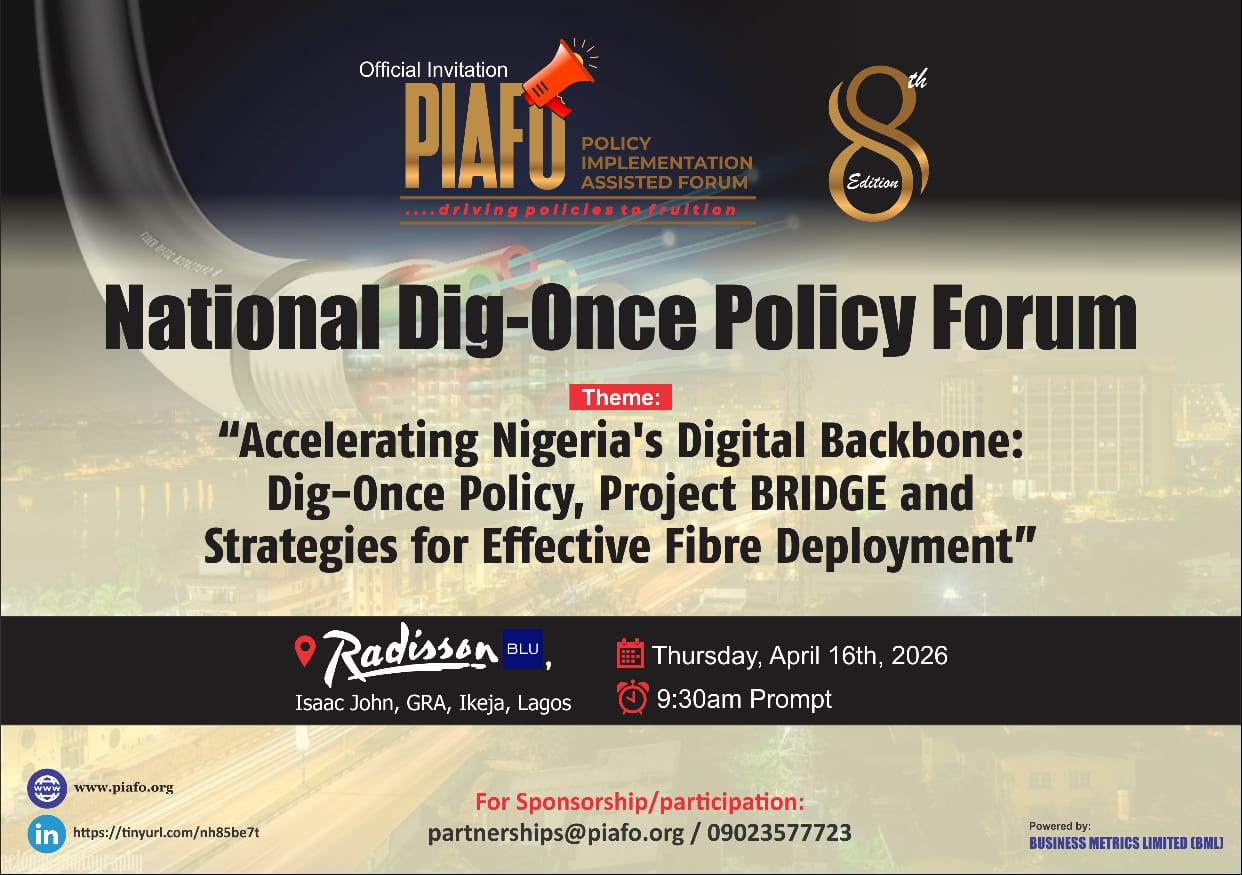
Key players across Nigeria’s digital economy, telecommunications, and infrastructure ecosystem are set for the National Dig-Once Policy Forum to champion a new course towards increasing Nigeria’s digital backbone network to 125,000km of fibre-optic infrastructure.
The event, which marks the 8th edition of Policy Implementation Assisted Forum (PIAFo), is a high-level industry dialogue aimed at accelerating the formulation and adoption of a National Dig-Once Policy as a critical enabler of safe, coordinated and cost-effective fibre infrastructure deployment in the country.
The forum, themed Accelerating Nigeria’s Digital Backbone: Dig Once Policy, Project BRIDGE and Strategies for Effective Fibre Deployment, is slated for Thursday, April 16, 2026, at Radisson Blu Hotel, Ikeja GRA, Lagos.
According to the organisers, Business Metrics Limited (BML), the introduction of the $2 billion Project BRIDGE initiative by the Federal Government to expand fibre infrastructure by an additional 90,000km from 35,000km to 125,000km by 2030 requires some new measures to ensure the successful implementation of the ambitious target and avoid mistakes of the past.
Industry stakeholders have identified that the success of a national connectivity backbone rollout depends largely on institutionalising a Dig Once Policy framework, which encourages the installation of fibre ducts and conduits whenever roads, railways, and other major public infrastructure are being constructed or rehabilitated.
According to industry data shared by the Nigerian Communications Commission, lack of such a framework is taking a toll on the telecoms sector and broadband drive as operators recorded over 50,000 fibre cut incidents across the country in 2024, with more than 60 per cent occurring during road construction and rehabilitation activities. These disruptions have resulted in billions of naira in repair costs, network outages, and service degradation.
Telecom operators in Lagos State alone said they spent over N5 billion in 2024 to repair and replace damaged fibre infrastructure in the state, while lamenting that the development continues to slow down network upgrade and expansion drive.
Beyond infrastructure damage, telecom operators also face challenges such as high Right of Way (RoW) charges, uncoordinated civil works, and repeated excavation of roads for fibre deployment.
PIAFo 8.0 aims to address these challenges by fostering collaboration among stakeholders responsible for planning, financing, constructing, and maintaining Nigeria’s digital infrastructure.
Specifically, the forum seeks to align federal, state, and local infrastructure planning around a unified Dig-Once framework; strengthen collaboration between telecom operators, infrastructure companies, and public works authorities; translate policy intentions into actionable guidelines and implementation timelines; and build stakeholder support for Project BRIDGE and complementary national fibre initiatives.
Speaking about the event, Team Lead at Business Metrics Limited, Omobayo Azeez, said Nigeria is being denied access to the robust connectivity it should derive from up to eight high-capacity undersea cable networks landed on its shores because of difficulties around terrestrial fibre infrastructure expansion.
“The Project BRIDGE initiative should excite everyone because of its ambitious targets. But for those who understand the operating terrain and why it took the industry over 20 years to achieve around 35,000km of fibre network that the country currently operates for broadband connectivity, the project calls for a major shift in execution approach with the adoption of a National Dig-Once Policy as the starting point.
“PIAFo, now in its 8th edition, is again serving as the viable platform for representatives from government ministries and agencies, senior telecom executives, infrastructure companies, data centre operators, equipment manufacturers, state governments, and industry associations to chart the way forward.”
The forum will feature keynote addresses, expert panel discussions, and strategic networking sessions designed to drive pragmatic outcomes that will accelerate Nigeria’s journey toward a resilient and inclusive digital economy.
Technology
Lagos Eyes 250MW Data Centre Capacity by 2030
By Adedapo Adesanya
The Lagos State government plans to expand the city’s data centre capacity to over 250 megawatts (MW) by 2030 as part of efforts to strengthen its digital infrastructure ecosystem.
This was disclosed by the state’s Commissioner for Innovation, Science, and Technology, Mr Olatubosun Alake, at the launch of the Kasi Cloud LOS1 data centre facility in Lekki. Nigeria Sovereign Investment Authority (NSIA) invested in Kasi Cloud through an $8 million convertible loan note in 2021.
Mr Alake said Lagos already hosts nearly three-quarters of Nigeria’s commercial data centre capacity, adding that the government intends to expand its infrastructure footprint significantly over the next five years.
“There are about 146 additional megawatt data centres planned in the pipeline,” he said. “We envisage that by 2030, we would have over 250 megawatts of data centre capacity in Lagos, three times the current capacity growth.”
The expansion comes as demand for cloud services, AI computing power, and local data storage continues to grow across Nigeria’s digital economy, with Lagos at the forefront, housing thousands of businesses and startups.
Mr Alake said the Kasi Cloud facility represents Lagos’ entry into “large-scale hyperscale AI infrastructure,” signalling the state’s ambition to evolve beyond being known primarily as a startup hub into a major centre for digital infrastructure and AI computing.
“Lagos is no longer simply a startup city,” he said. “It is an infrastructure city.”
The Kasi LOS1 facility is designed as a 40MW hyperscale data centre campus, beginning operations with an initial 7.2MW IT load.
According to Mr Alake, the facility includes advanced GPU computing infrastructure powered by Nvidia H100 and H200 chips, alongside liquid cooling systems and cloud infrastructure services designed to support AI workloads.
The Lagos State government believes such infrastructure will become critical as AI adoption accelerates globally.
Mr Alake said the state is investing in fibre optic networks, smart city technologies, university innovation programmes, and digital government systems to prepare for the transition.
“The AI economy is going to require hundreds of megawatts,” he said. “The market has already made its decision about where digital infrastructure belongs.”
On his part, Mr Johnson Agbogun, co-founder and chief executive officer of Kasi Cloud, said the project was built to reduce Nigeria’s dependence on foreign cloud infrastructure and give African businesses more control over how their data and AI systems are developed.
“Nigerian enterprises are currently spending $850 million every year on foreign cloud infrastructure,” he said. “Every naira spent abroad on cloud and AI infrastructure helps build capabilities somewhere else.”
He added that the facility runs GPU-powered AI workloads from local enterprises and described the Lekki campus as “the beginning of Nigeria’s AI factory.”
“As artificial intelligence reshapes economies globally, the nations that control their own compute infrastructure and data will be the ones positioned to lead,” added Mr Kolawole Owodunni, NSIA’s Executive Director and Chief Information Officer.
Technology
Google I/O 2026: 4 Major Updates That Are Changing How Google Search Works
The goal of Google Search has always been simple: to help you ask anything on your mind. Whether it is a quick fact to help with your daily hustle or a complex question about starting a new business, Nigerians rely on Search every single day.
Over the last year, Google has rapidly reimagined what Search can do with AI. The momentum has been incredible—just one year after its debut, AI Mode has surpassed one billion monthly users globally. As people have realised just how much more Search can do for them, they are searching more than ever before, reaching an all-time high in search queries last quarter. Today at Google I/O, Google shared the next step in its journey to bring together the best of a search engine with the best of AI.
To power this next chapter, Google is officially upgrading Search with Gemini 3.5 Flash as the new default model in AI Mode for everyone worldwide. Delivering sustained frontier performance for agents and coding, Gemini 3.5 Flash is the engine driving the new era of AI-powered Search. Because curiosity doesn’t always fit into standard keywords, this powerful AI model is transforming Search from a tool that simply finds information into an intelligent platform capable of reasoning, monitoring the web, and executing complex tasks on your behalf.
Here is a look at the four biggest AI-powered announcements coming to Google Search:
1. A Completely Reimagined Search Box
Google is introducing the biggest upgrade to its Search box in over 25 years. Now completely reimagined with AI, the new intelligent Search box dynamically expands to give you the space to describe exactly what you need. It goes beyond simple autocomplete by anticipating your intent and helping you phrase your questions. You are no longer limited to typing; you can now search using text, images, files, videos, or even Chrome tabs as inputs. Additionally, Google is making it easier to ask follow-up questions directly from an AI Overview, flowing naturally into a conversational back-and-forth where your context stays with you as you explore.
2. New Search Agents That Work in the Background
We are entering the era of Search agents, where you can create and manage multiple AI agents directly in Search. Google is launching “Information agents” that operate in the background 24/7. These agents intelligently scan the web—alongside fresh data on finance, shopping, and sports—to monitor for changes related to your specific questions. For example, if you are house hunting, your agent will continuously scan the market and notify you the moment a listing matches your exact criteria. Furthermore, Search is expanding its agentic booking capabilities; you can soon share specific criteria (like a late-night private karaoke room) and Search will pull the latest pricing and links to finish booking. For certain categories, Google can even call businesses on your behalf.
3. Custom Mini-Apps and Visuals Built Just for You
Search is no longer just returning links; it is now building the ideal response in the perfect format for your query entirely on the fly. By bringing the power of Google Antigravity and the agentic coding capabilities of Gemini 3.5 Flash into Search, users will get a custom “Generative UI.” This means Search can design custom layouts, interactive visuals, tables, graphs, or simulations in real-time. But it goes a step further: if you have an ongoing task, like establishing a new health routine, Search can actually code a custom fitness tracker or mini-app for you. These custom dashboards tap into real-time sources like live maps and weather, giving you a personalised tracker you can return to again and again.
4. Expanded Personal Intelligence Without a Subscription
For AI to be truly helpful, it shouldn’t just know the world’s information—it should understand your personal context, too. To achieve this, Google is expanding Personal Intelligence in AI Mode to more people in nearly 200 countries and territories across 98 languages. Crucially, this is being rolled out with no subscription required. Users can securely connect apps like Gmail, Google Photos, and soon Google Calendar directly to Search. Designed with transparency and choice at its heart, this allows you to safely ask Search to find information buried in your own personal files, always keeping you in complete control of your connected data.
Technology
Fibre Cuts: Expert Blames Road Construction for 60% of Network Outages
By Modupe Gbadeyanka
The chief executive of Dimensions Data Limited, Mr Gbenga Olabiyi, has blamed road construction for 60 per cent of network outages caused by fibre cuts.
Speaking recently at the National Dig-Once Policy Forum, which marked the 8th Policy Implementation Assisted Forum (PIAFo), he drew attention to the gap between the infrastructure Nigeria has and what it can actually deliver if a coordinated framework is adopted.
“Nigeria currently has about 35,000 kilometres of fibre in the ground, yet only 16 per cent of Nigerians are connected to it. Broadband penetration stands at 45 per cent. Lagos alone has a penetration rate of over 70 per cent,” Mr Olabiyi said.
He emphasised that the failure to address the missing fibre link over the years has led to saturation of connectivity in urban centres, while the hinterlands are left either unconnected or poorly served.
At the same programme, convened by Mr Omobayo Azeez, stakeholders in the telecommunications sector called for the adoption of the dig-once policy to lower the costs of fibre deployment, reduce infrastructure damage, improve safety, and shorten rollout timelines.
Quoting the Nigerian Communications Commission (NCC), it was noted that of the 50,000 fibre cut incidents recorded in a year, about 30,000, which represents 60 per cent, occurred during road construction and rehabilitation.
Stakeholders thus called for a review of existing road construction and building codes to accommodate the installation of fibre conduits in the original design standard of the infrastructure planning.
“What Dig-Once offers is an opportunity to correct this,” the president of the Association of Telecommunication Companies of Nigeria, Mr Tony Emoekpere, stated.
He added that even operators frequently damage one another’s cables during repeated digging, thus increasing repair costs and service disruptions.
The Deputy Director of Strategic Business Initiatives at ipNX Nigeria Limited, Mr Segun Okuneye, said under the dig-once policy, road contractors should install ducts during construction.
He said the repeated excavation of the road leads to incessant destruction of existing infrastructure and triggers service blackouts with operators bearing additional costs of repair of replacing the fibre.
Also, the chairman of the Association of Licensed Telecom Operators of Nigeria (ALTON), Mr Gbenga Adebayo, said operators should focus not just on digging once but on eliminating unnecessary digging altogether by sharing existing infrastructure and jointly replacing legacy cables.
“Early fibres laid 15 to 20 years ago are now ageing, and the industry needs a plan to replace them without everyone digging the same routes again,” he said.
-
Feature/OPED6 years agoDavos was Different this year
-
Travel/Tourism10 years ago
Lagos Seals Western Lodge Hotel In Ikorodu
-
Showbiz3 years agoEstranged Lover Releases Videos of Empress Njamah Bathing
-
Banking8 years agoSort Codes of GTBank Branches in Nigeria
-
Economy3 years agoSubsidy Removal: CNG at N130 Per Litre Cheaper Than Petrol—IPMAN
-
Banking3 years agoSort Codes of UBA Branches in Nigeria
-
Banking3 years agoFirst Bank Announces Planned Downtime
-
Sports3 years agoHighest Paid Nigerian Footballer – How Much Do Nigerian Footballers Earn