

Media OutReach
KGI 2026 Mid-Year Global Market Outlook: Beyond the Mist, First Light Appears

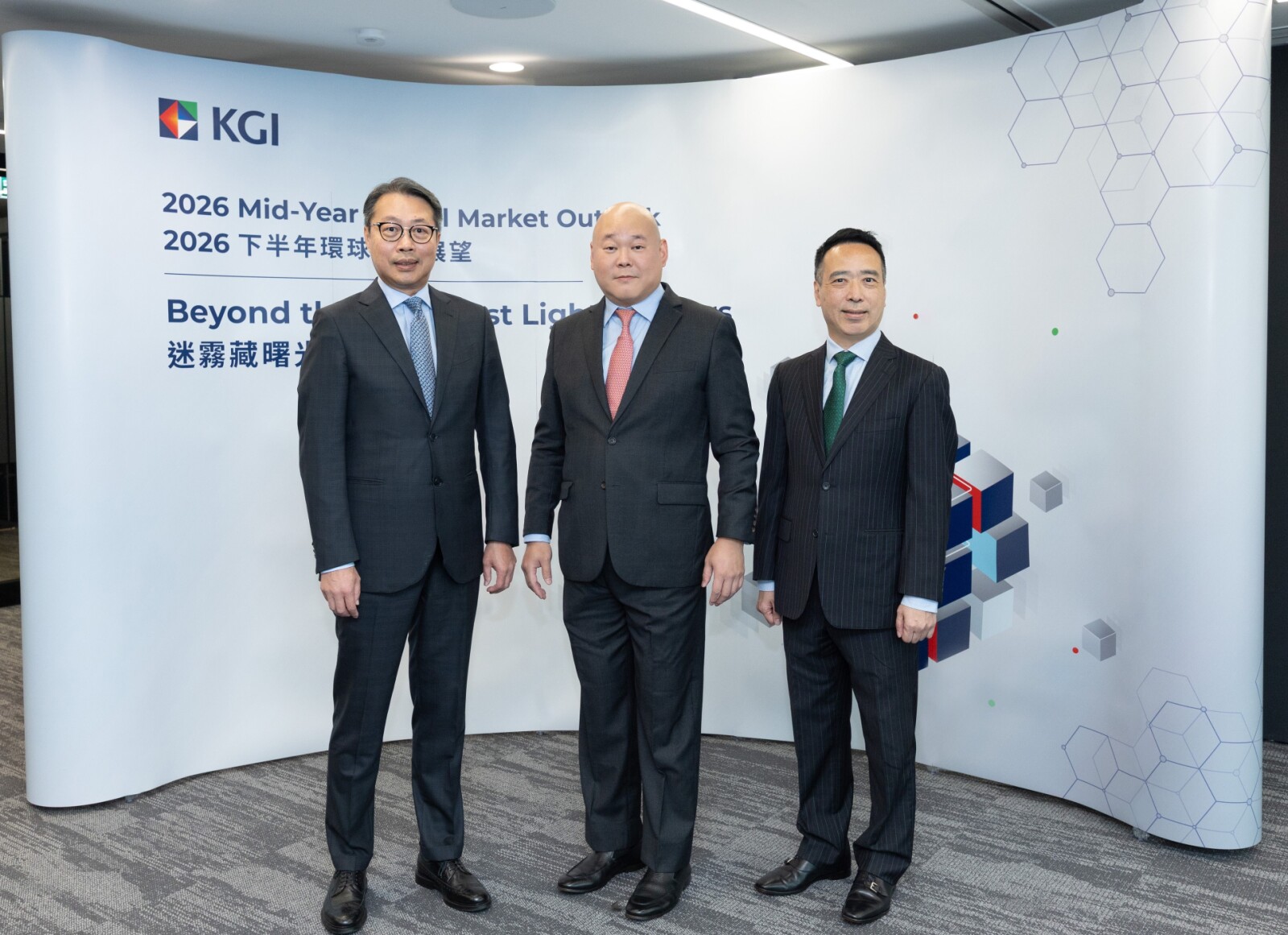
Amid US-Iran geopolitical tensions and persistent inflation, the US economy in 2H 2026 is projected to leverage AI investment to drive growth across sectors, even as the Federal Reserve holds rates steady, potentially pushing Treasury yields above 4.8%. Concurrently, mainland China and Hong Kong markets are undergoing a structural transition, with high-tech exports showing notable resilience. Against a backdrop of shifting macroeconomic policies in both nations, coupled with historically low valuations in China-Hong Kong equities, economic growth targets are expected to catalyze a market realignment.
Under this backdrop, we maintain the “LEAD” strategy for the second half of 2026:
- Liquidity Shift
- Earnings Focused
- Adding Credit
- Diversified Assets
James Wey, Head of International Wealth Management at KGI, says: “In a fragmented macroeconomic environment where interest rates are plateauing and traditional asset correlations are breaking down, investors cannot afford to sit on passive cash. Our ‘LEAD’ framework is an active, high-conviction playbook designed for this exact environment. By transitioning liquidity into the structural growth lifecycle of AI infrastructure and unlocking predictable, institutional-grade yields in highly rated corporate credit, we are helping clients construct resilient, multi-asset portfolios. True wealth management goes beyond vanilla advisory; it requires seamlessly mobilizing resources across our fixed income, asset management, and global markets capabilities to institutionalize how private wealth navigates macro realignments.”
Macro & US Markets
The US economy should remain resilient in 2H26F. Although consumption faces headwinds from elevated oil prices and inflation resulting from the US-Iran war, investment is the current growth driver of the US economy, in particular AI‑driven capex, rather than the consumption seen in the past. As a result, the US economy has not seen the usual effects from a softening of consumer demand. Moreover, both the US and the global economy have become less dependent on crude oil, and with the US being a net oil exporter, its vulnerability to oil‑price shocks is greatly reduced compared to other economies. We therefore maintain our forecast for US GDP growth of 2.2% in 2026F.
In the eurozone, economic growth is soft amid ongoing energy price pressures and tightening credit conditions as a result of cautious policies. In Japan, domestic demand is losing steam, but external demand remains resilient, supported by the semiconductor sector. Inflation in Japan has yet to stabilize near the targeted level, prompting policymakers to maintain a steady and cautious approach toward normalization. In China, domestic demand and the property sector remain anemic. However, global AI investment is supporting external demand and emerging industries, mitigating the risk of a sharp economic slowdown.
With oil prices elevated and contributing to a rising CPI in the US, and as the unemployment rate is stable, the Federal Reserve (Fed) has kept policy rates unchanged over the past three FOMC meetings. We expect the Fed to keep interest rate changes on hold through the end of this year. That said, should medium‑to long‑term inflation expectations get out of control, or should wage growth pick up pace again, the Fed could face renewed pressure to raise interest rates.
As far as US stock markets are concerned, strong AI‑related capex and productivity gains have driven earnings upgrades, which now point to almost 20% YoY growth. As these benefits begin to spread beyond the tech sector, non-tech sectors will also be supported, resulting in extremely solid fundamentals. On the valuation front, although US 10‑year Treasury yields have risen alongside inflation expectations, increased profit margin has helped to keep equity risk premia at low levels. As a result, discount rates have been relatively stable, limiting the negative impact on stock valuations. Overall, with fundamentals being revised upward while valuation headwinds are contained, we raise our 2026F target for the S&P 500 index to 8,000 points.
Sector-wise, in addition to AI‑driven growth stocks, cyclical sectors benefiting from the spillover effects of AI are also likely to perform well, leading to a more diversified market boom. Regarding fixed income assets, as inflationary pressure rise and rate hike expectations intensify, US 10‑year Treasury yields could potentially rise to 4.8% or higher in 2Q-3Q26F. Investors are advised to engage medium‑and long‑term US Treasuries and investment‑grade US corporate bonds with higher credit ratings during periods of yield spikes. At the same time, given the deteriorating fundamentals of poorly-rated US issuers and their vulnerability to elevated oil prices, we advise against US high‑yield corporate bonds rated CCC/Caa or below.
James Chu, Chairman at KGI Investment Advisory, says: “Although the US economy continues to face pressure from higher oil prices and inflation, AI-related capital expenditure has become the primary growth driver, reducing the economy’s reliance on consumer spending and energy demand while supporting resilience in both economic activity and corporate earnings. We maintain our 2026 US GDP growth forecast of 2.2% and raise our S&P 500 target to 8,000, as we expect the benefits of AI investment to continue spreading across a broader range of industries.”
Mainland China and Hong Kong Markets
Market focus has shifted from “growth magnitude” to “policy and earnings visibility.” Despite tepid PMIs, positive signals are emerging: easing deflation, narrowing housing price drops, recovering consumer confidence, and a robust trade surplus supporting the RMB despite U.S. tariffs. Bolstered by monetary easing, accelerating corporate profits, and RMB 1.3 trillion in special government bonds, China’s economy is stabilizing. In this “tepid yet highly visible” environment, we recommend focusing on structural growth across four key themes:
Theme 1: U.S.-China Trade Volatility Offers Accumulation Opportunities
Tariff negotiations will peak between September and November. Initial aggressive tactics will likely yield to partial agreements, as full decoupling remains unfeasible. The resulting market volatility creates excellent long-term accumulation opportunities.
Theme 2: AI Monetization Highlights High-Tech and Robotics
With Q1 high-tech exports up 39.2% and AI token consumption surging, we favor downstream AI applications, cloud computing, and humanoid robotics. LLM-capable tech giants and core robotics manufacturers will be the primary beneficiaries.
Theme 3: Green Supply Chain Thrives Amid Energy Crisis
Geopolitics and elevated oil prices continue to drive global renewable energy demand. Avoid the saturated solar sector; instead, target wind energy for its expanding margins and tier-one lithium battery makers with next-gen technology and overseas growth.
Theme 4: State-Owned Banks Offer Defensive and Dividend Value
Slower rate cuts have eased net interest margin (NIM) pressures. Supported by economic stabilization and falling NPL ratios, large state-owned banks with high CET1 ratios and growing non-interest income are poised for robust earnings recovery.
Cusson Leung, Chief Investment Officer, International Wealth Management at KGI, says: “As China’s economy bottoms out, investors should capitalize on four core opportunities driven by policy support and easing deflation: (1) Accumulate during trade negotiation volatility, (2) Invest in AI-driven tech giants and robotics innovators, (3) Favor wind energy and lithium battery leaders over solar, (4) Leverage large state-owned banks for defensive yield. In summary, investors should utilize “technological innovation” and “green energy” as growth engines, anchored by “stable financials” to navigate volatility and achieve resilient returns.”
Taiwan Market
Benefiting from the continued acceleration of the AI infrastructure race and upward revisions to supply chain earnings momentum, we currently set our peak target for Taiex at 50,000 points this year, implying approximately 25% upside from current levels. This target is derived based on a 21x forward P/E multiple on next year’s earnings.
Taiex has delivered strong performance year-to-date, particularly since April. Despite rising geopolitical risks in the Middle East and potential supply disruptions in the Strait of Hormuz, the market has demonstrated notable resilience. The key driver behind this strength lies in the AI supercycle, which has effectively overshadowed short-term negative factors and supported market sentiment.
The latest global technology earnings season reinforces a critical message: AI is no longer merely a valuation narrative, but has evolved into a tangible driver of corporate earnings growth and capital expenditure expansion. For Taiwan’s supply chain, as AI applications extend from the cloud to edge devices and agentic AI, major cloud service providers (CSPs) are facing increasingly urgent compute demand, leading to broad-based upward revisions in capex guidance during this earnings cycle.
Supported by continued order expansion, earnings expectations for Taiwanese corporates have been revised upward accordingly. We now forecast overall Taiwan market earnings growth of 40% this year, significantly higher than our earlier estimate of 20% at the start of the year and 30% prior to the earnings season. Despite the high base, earnings growth is expected to remain solid at around 25% next year, suggesting the AI-driven earnings cycle remains durable.
Overall, we maintain a positive view on Taiex, with the structural bull trend intact. However, in the near term, two key risks warrant attention: first, escalating geopolitical tensions may push up oil prices and disrupt market confidence; second, any resurgence in inflation could alter the Federal Reserve’s policy trajectory. Given that Taiex are currently trading at elevated levels, a materialization of these risks could lead to increased volatility and potential technical corrections.
James Chu, Chairman at KGI Investment Advisory, says: “Driven by the surge in computing demand from the rise of agentic AI applications, global computing capacity remains in a clear state of undersupply. Major cloud service providers continue to raise capital expenditure, further driving upward revisions to earnings expectations across the AI infrastructure supply chain. At the same time, spillover effects from capacity constraints are broadening the range of beneficiaries. This AI investment cycle-driven bull market in Taiwanese equities represents a structural growth trend, rather than a traditional consumer electronics replacement cycle, and is likely to extend through 2027.”
Hashtag: #KGI #MarketOutlook
 https://www.linkedin.com/company/kgi-hongkong/
 https://x.com/kgiasia?s=11
 https://www.facebook.com/KGI.HongKong?mibextid=wwXIfr&rdid=3xkntTaTec9uUE6C&share_url=https%3A%2F%2Fwww.facebook.com%2Fshare%2F16VbJab3nN%2F%3Fmibextid%3DwwXIfr
 Wechat: KGI 凯基
The issuer is solely responsible for the content of this announcement.
About KGI
KGI* has been a leading financial institution in Asia since 1997. Our scope of business encompasses Wealth Management, Global Markets, Asset Management and Global Sales & Prime Services. We are committed to offering a comprehensive range of financial products and services to corporate, institutional, and individual clients throughout Asia. Backed by KGI Financial Group, we have a robust footprint in Asia, covering Taiwan, Hong Kong, Singapore, Indonesia, and Thailand^.
*KGI refers to KGI Asia Limited and its affiliates
^an investee enterprise of KGI Securities, not a subsidiary
Disclaimer
All the information contained in this document is not intended for use by persons or entities located in or residing in jurisdictions which restrict the distribution of this document by KGI Asia Limited (“KGI”), or any other affiliates of KGI. Such information shall not constitute investment advice, or an offer to sell, or an invitation, solicitation or recommendation to subscribe for or invest in any securities, insurance or other investment products or services nor a distribution of information for any such purpose in any jurisdiction. In particular, the information herein is not for distribution and does not constitute an offer to sell or the solicitation of any offer to buy any securities in the United States of America, or to or for the benefit of United States persons (being residents of the United States of America or partnerships or corporations organised under the laws of the United States of America or any state, territory or possession thereof). All the information contained in this document is for general information and reference purpose only without taking into account of any particular investor’s objectives, financial situation or needs and may not be redistributed, reproduced or published (in whole or in part) by any means or for any purpose without the prior written consent of KGI. Such information is not intended to provide any legal, financial, tax or other professional advice and should not be relied upon in that regard.
All investments involve risks. The prices of securities fluctuate, sometimes dramatically. The price of a security may move up or down, and may become valueless. It is as likely that losses will be incurred rather than profit made as a result of buying and selling securities.
Bond investment is NOT equivalent to a time deposit. It is NOT protected under the Hong Kong Deposit Protection Scheme. Bondholders are exposed to a variety of risks, including but not limited to: (i) Credit risk – The issuer is responsible for payment of interest and repayment of principal of bonds. If the issuer defaults, the holder of bonds may not be able to receive interest and get back the principal. It should also be noted that credit ratings assigned by credit rating agencies do not guarantee the creditworthiness of the issuer; (ii) Liquidity risk – some bonds may not have active secondary markets and it would be difficult or impossible for investors to sell the bond before its maturity; (iii) Interest rate risk – When the interest rate rises, the price of a fixed rate bond will normally drop, and vice versa. If you want to sell your bond before it matures, you may get less than your purchase price. Do not invest in bond unless you fully understand and are willing to assume the risks associated with it. Please seek independent advice if you are unsure.
You are advised to exercise caution and undertake your own independent review, and you should seek independent professional advice before making any investment decision. You should carefully consider whether investment is suitable in light of your own risk tolerance, financial situation, investment experience, investment objectives, investment horizon and investment knowledge.
No representation or warranty is given, whether express or implied, on the accuracy, adequacy or completeness of information provided herein. In all cases, anyone proposing to rely on or use the information contained herein should independently verify and check the accuracy, completeness, reliability and suitability of the information. Simulations, past and projected performance may not necessarily be indicative of future results.
Information including the figures stated herein may not necessarily have been independently verified, and such information should not be relied upon in making investment decisions. None of KGI, its affiliates or their respective directors, officers, employees and representatives will be liable for any loss or damage of any kind (whether direct, indirect or consequential losses or other economic loss of any kind) suffered or incurred by any person or entity due to any omission, error, inaccuracy, incompleteness or otherwise, or any reliance on such information. Furthermore, none of KGI, its affiliates or their respective directors, officers, employees and representatives shall be liable for the content of information provided by or quoted from third parties.
Members of the KGI group and their affiliates may provide services to any companies and affiliates of such companies mentioned herein. Members of the KGI group, their affiliates and their directors, officers, employees and representatives may from time to time have a position in any securities mentioned herein.



