Connect with us

Economy

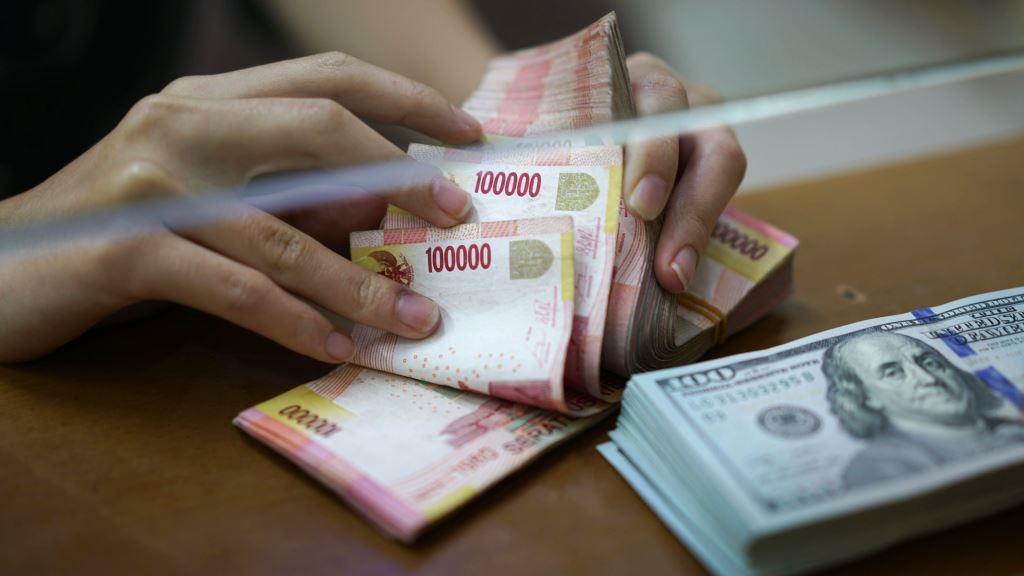
Naira Tumbles to N1,360/$1 at Official Market

Published

on

Official FX Market

By Adedapo Adesanya

The Naira depreciated against the United States Dollar by 0.21 per cent or N2.89 in the Nigerian Autonomous Foreign Exchange Market (NAFEX) on Wednesday, June 17, to N1,360.07/$1 from Tuesday’s closing rate of N1,357.18/$1.

In the same vein, the Nigerian Naira weakened against the Pound Sterling in the official market during the session by N4.42 to trade at N1,824.81/£1 versus the preceding session’s N1,820.39/£1, and lost N4.19 on the Euro to sell at N1,577.96/€1 compared with the previous day’s N1,573.79/€1.

However, at the GTBank segment, the local currency gained N1 against the greenback yesterday to exchange at N1,372/$1 versus N1,373/$1, and at the parallel market, it remained unchanged at N1,385/$1 at midweek.

The Naira’s performance comes amid tight inflows from exporters, non-bank corporates, and foreign investors, evidenced by the slow movement of the country’s gross external reserves level of $50.505 billion, despite muted inflows from oil sales after a recent drop in prices.

There have been reduced FX market interventions by the Central Bank of Nigeria (CBN) as it maintains its stance to keep the local unit stable enough to retain foreign investments.

The Nigerian government also dismissed a report suggesting that it was considering new taxes on telecommunications services and petroleum products, which would have spooked investors.

The federal government said that the reports misrepresented recommendations contained in the International Monetary Fund (IMF) Article IV Consultation Report on Nigeria, explaining that the recommendations were advisory and do not constitute government policy or binding obligations on Nigeria.

In the cryptocurrency market, prices were negative as traders and investors shrugged off a signed Iran peace deal that lifted stocks, after the Federal Reserve held interest rates but made clear it is more worried about inflation than growth.

Under the new Chair, Mr Kevin Warsh, the Federal Reserve left rates unchanged at 3.5 per cent to 3.75 per cent,  in line with expectations, but its updated projections pointed to higher inflation and a slower pace of future rate cuts, and some officials floated the possibility that rates may still need to rise.

Cardano (ADA) slid 4.5 per cent to trade at $0.1731, Ripple (XRP) went down by 4.2 per cent to $1.16, Ethereum (ETH) shrank by 3.5 per cent to $1,727.55, Solana (SOL) lost 3.4 per cent to sell $71.05, Dogecoin (DOGE) also fell by 3.4 per cent to $0.0843, Binance Coin (BNB) slumped by 3.1 per cent to $587.53, and Bitcoin (BTC) crashed by 2.6 per cent to $63,892.28, while TRON (TRX) gained 0.7 per cent to finish at $0.3201, with the US Dollar Tether (USDT) and the US Dollar Coin (USDC) closing flat at $1.00 each.


Adedapo Adesanya is a journalist, polymath, and connoisseur of everything art. When he is not writing, he has his nose buried in one of the many books or articles he has bookmarked or simply listening to good music with a bottle of beer or wine. He supports the greatest club in the world, Manchester United F.C.

Click to comment

Leave a Reply

Your email address will not be published. Required fields are marked *

Economy

FAAC Disburses N3.007trn from July 2026 Earnings to FG, States, Councils

Published

on

FAAC allocation

By Aduragbemi Omiyale

About N3.007 trillion of the N4.359 trillion revenue generated by Nigeria in July 2026 was disbursed in August 2026 to the three tiers of government by the Federation Account Allocation Committee (FAAC) at its meeting held in Owerri, Imo State, on the sidelines of the National Council of the Federation and Economic Development.

A statement issued on Tuesday by the Director of Press and Public Relations in the Office of the Accountant-General of the Federation, Mr Bawa Mokwa, disclosed that the gross statutory revenue jumped 17.8 per cent from N3.700 trillion in June due to improved collections from petroleum and non-oil revenue sources.

The statement noted that Petroleum Profit Tax, Hydrocarbon Tax, Companies Income Tax, Capital Gains Tax, Stamp Duty, petroleum royalties, mineral royalties, excise duty and gas-flaring penalties rose, while earnings from Value Added Tax (VAT), import duty, Common External Tariff levies, gas-flaring fee rentals and miscellaneous oil revenue declined.

“In its regular monthly business, FAAC approved the disbursement of a total of N3.007 trillion to the Federal Government, the 36 State Governments and the 774 Local Government Councils as revenue for July 2026,” a part of the statement disclosed.

Continue Reading

Economy

Oil Prices Edge Higher as Iran Keeps Hormuz Strait Closed

Published

on

oil prices driving up Trump

By Adedapo Adesanya

Oil prices rose marginally as Iran said it would adopt a more offensive stance and the Strait of Hormuz would remain ‌closed, while the United States ruled out extending a ceasefire.

Brent crude futures finished higher by 15 cents or 0.17 per cent at $91.02 a barrel, while the US West Texas Intermediate (WTI) crude futures chalked up 44 cents or 0.52 per cent to trade at $84.94 a barrel.

A top Iranian negotiator, Mr Mohammad Baqer ​Qalibaf, said that Iran will keep the strait closed until the United States meets the conditions of the interim deal signed in June.

Mr Qalibaf’s comments came after a senior Iranian official earlier said that ⁠Iran will shift to a “fully offensive” military posture as efforts have stalled toward a permanent end to the war.

Meanwhile, US President Donald Trump, who previously labelled that deal “over,” said on Tuesday that talks between the US and Iran were ​neither taking place nor scheduled, but the strait was open.

Iran has separately been negotiating with Oman on an agreement on managing the strait and says they are close to a deal. However, the American President threatened ​to bomb Oman, a longstanding ⁠US security partner.

Yemen’s Houthis launched missiles in an attack on vessels they described as a Saudi military ship and four escorts in the Red Sea while the United Kingdom Maritime Trade ​Operations (UKMTO) separately said it received a report on Tuesday that a vessel was struck by an unknown projectile while transiting out of ​the strait, causing engine ⁠room damage and a crew casualty.

Amid these developments, Saudi Aramco has resumed oil loadings from inside the strait, and is offering cargoes for loading via ship-to-ship transfers off ​Fujairah in the United Arab Emirates (UAE) while two Chinese shipping giants also have started collecting oil cargoes outside the Gulf.

Russia is reportedly rerouting Kazakhstan’s crude oil exports from the Baltic port of Ust-Luga to the Black Sea port of Novorossiysk, freeing up capacity ⁠for more ​Russian oil exports from the Baltic amid heightened Black Sea security risks. The move would allow Russia ​to replace Kazakh barrels at Ust-Luga with its own crude exports, while Ukrainian drone attacks make it more difficult for Russian exporters to secure tankers for Black Sea loadings.

Continue Reading

Economy

FCCPC Investigates Dangote, BUA, HBM Over Alleged Cement Price Fixing

Published

on

cement price fixing

By Adedapo Adesanya

The Federal Competition and Consumer Protection Commission (FCCPC) is set to investigate leading cement manufacturers over allegations of price manipulation in the Nigerian cement market.

The anti-trust agency has formally issued a Notice of Commencement of Investigation and Summons to Produce to major manufacturers in Nigeria’s cement industry following preliminary findings from a three-month cross-border study conducted by its Anticompetitive Practices Department. Some of Nigeria’s manufacturers include Dangote Cement, BUA Cement and HBM Nigeria, previously known as Lafarge Africa.

The investigation, according to a statement signed by the Director of Corporate Communications at FCCPC, Mr Ondaje Ijagwu, was initiated in response to persistent public complaints over the rapidly rising cost of cement.

The commission’s preliminary 40-page field report revealed a sharp increase in retail prices during the first half of 2026, where a 50kg bag selling for between N9300 and N9700 in January escalated to between N13,000 and N15,000 in several regions by July.

The FCCPC noted that Nigeria maintains an installed production capacity exceeding 60 to 65 million metric tonnes annually against an estimated domestic demand of roughly 25 to 30 million metric tonnes, creating a situation of significant excess installed capacity where downward price pressure would ordinarily be expected.

It also stated that cross-border comparative metrics across Sub-Saharan and North African markets revealed that retail prices in Nigeria remain significantly higher than in countries such as Kenya, Tanzania and Togo despite Togo lacking natural limestone deposits.

“Of particular concern to the commission is that this level of production capacity has not resulted in the downward pressure on domestic prices that might ordinarily be expected in a competitive market with substantial excess capacity,” the agency said.

While cement manufacturers have pointed to macroeconomic headwinds, including persistent Naira depreciation, rising energy expenses, transport logistics, and the inflated cost of imported industrial machinery spare parts, the FCCPC is actively auditing these claims against verified operational data.

Through the formal summons, the commission is legally requiring the affected entities to present comprehensive documentation detailing their pricing methods, factory capacity utilisation rates, export volumes, and distribution network agreements.

Continue Reading